Saturday, July 22, 2006

Links for the Weekend

Powered by Intern Sharkey

I’m sorry if this weekend’s Links don’t live up to your expectations. I’m still recovering from my night on the town with Mike James.

  • Another day, another dubya. Silva got slapped around, but it didn’t matter, as the Twins pounded out 14 runs on 18 hits.


  • Rondell White had another big night, continuing his sudden resurgence. For The Love of the Game runs down what White means to this team here.


  • The White Sox and Yankees also dropped their games last night. The Twins are now 3 and 1 behind in the loss column, respectively. Are we starting to believe?


  • Nick Punto continues to be a key part of the Twins’ lineup. Will writes on Punto’s new found extra-base power (and overall hot bat) here.


  • If we play our cards right, maybe we won’t have to wait until 2010 for that new stadium.


  • Woody Paige lays out his case for Halladay over Liriano in the Cy Young race. An airtight argument, to be sure.


  • And finally, remember to exercise your right to vote.

Tuesday, July 18, 2006

Where is The Cavalry?

Powered by Twins Geek

For the umpteenth time this season, the Twins called up a player from Rochester, and that player immediately provided a boost to the Twins offense. Jason Tyner had six hits in his first twelve at-bats and drove in five runs, including the game-winning run in the bottom of the tenth inning on Saturday.

It’s a great story, but Tyner isn’t really a prospect, since prospects aren’t 29 years old. That doesn’t mean Tyner can’t be a major league player. His track record suggests that he would be a very capable fourth outfielder on most major league teams, especially if he can recapture some of that speed that produced 31 stolen bases with Tampa Bay in 2001.

A more significant question is whether he can be a major league starting centerfielder. It would behoove the Twins to get an answer to that question when Jason Kubel’s knees quit barking. Moving Tyner to center field would get Kubel back in the lineup, and give them a chance to evaluate whether Tyner can be their center fielder in 2007.

But Jason Tyner isn’t going to provide an extended offensive boost that the Twins will need in Hunter’s absence. That’s going to fall to the other weekend call-up, Rondell White. White was supposed to be a better hitter than Hunter before the season started, and had the history and stats to back that claim up. His season-long struggles were unforeseen, a mystery that may have been solved by the realization that his surgically repaired shoulder was still a concern.

The mystery was solved, but the problem still needed to be fixed. The Twins passed over White several times to give him the full twenty days he could squeeze out of his injury rehabilitation time in Rochester, but finally relented when Stewart was placed on the Disabled List. It isn’t clear from the minor league reports whether White has made the necessary adjustments to allow his shoulder to catch up with fastballs again, but the home run this weekend is an optimistic sign.

The Twins should certainly hope so. Their cupboard at the minor league level is nearly bare, as seen by the recalls of Tyner and 27-year-old Josh Rabe. The Twins tentative position in the playoff race probably limits Terry Ryan’s desire to part with the prospects necessary for a big name at the trade deadline. Bounceback second halves by under-performing veterans, like White and Carlos Silva, will need to fuel any large leap in performance.

On The Hill

Tampa Bay: Jae Seo (2-7, 5.07 ERA)

- 2005: 8-2, 90.1 IP, 59 K, 2.59 ERA
- 2006: 87 IP, 93 H, 57 K, 34 BB, 16 HR
- Just acquired a couple of weeks ago in a trade with the Dodgers. He’s pitched much better in his three starts with the Rays.
- Can struggle with control. Prior to this year, he was with the Mets where he was effective without great stuff. It may take awhile for the AL to catch up with him.

Minnesota: Brad Radke (7-7, 4.97 ERA)

- 2005: 9-12, 201.2 IP, 117 K, 4.04 ERA
- 2006: 112.1 IP, 148 H, 60 K, 26 BB, 18 HR
- Relies primarily on an average fastball and a good changeup; also throws a curve.Why don’t you give up on a struggling veteran pitcher with an ERA over 7 in May? Because there is a reason he’s a veteran pitcher – he knows how to make adjustments. Radke’s adjustment has apparently been made. In June, Radke’s ERA was 2.09

Monday, July 17, 2006

7 Reasons to Care about the Devil Rays.

“Did you know they have a baseball team in Tampa Bay? It’s true.”
- TwinsGeek.com, nearly every time it mentioned the Devil Rays since 2002

It’s been a running gag for years for a franchise that has become a running gag for major league baseball.

The deck was stacked against the Devil Rays from the beginning. They are an expansion team that plays in an indoor monstrosity (always a solid way to hold down revenue). Their fan base consists of retirees (who are always known for their free-spending ways) and they share that fan base with another expansion team. As the finishing touch, they were placed in the American League East, a division with the top two spending teams in major league baseball. Ok, guys - ready, set, compete!

Not too surprisingly, they’ve floundered. They tried building around speed. They tried signing aging sluggers. They bought a coaching legend. They’ve still never had a .500 record. In fact, they’ve never finished within 10 games of .500. They’ve finished last in their division every year of their existence except one.

This year they’re on pace to continue every one of those depressing trends. And yet, there are reasons for Tampa Bay’s fans to start banging their walkers in excitement. There are also at least seven reasons for Twins fans to care about the Devil Rays, starting with…

7. The Sale – With all the success that the Rays’ franchise had had, you’ll be shocked to hear that they were owned by a cheapskate owner named Vince Naimoli. Whoulda thunk? But in May of 2004, a huge stake in the franchise was bought by a new ownership group led by 45-year-old Wall Street investor and “baseball junkie” Stuart Steinberg.

6. They’re trading aggressively – Steinberg inherited a minor league system loaded with prospects, but a front office loaded with stagnation, so he cleaned house. New GM Andrew Friedman has been far more aggressive than his predecessor in trading players while they still have some value for other teams, mostly for young pitching. Within the last month he’s traded Joey Gathright (who was crowded out of TB’s talented outfield) to the Royals and Aubrey Huff (who becomes a free agent this offseason) to the Astros for three talented pitching prospects.

5. They would be an ideal trading partner for the Twins – The Devil Rays wouldn’t make a great trading partner for the kind of deal that is most commonly mentioned on sports radio around here – dumping Kyle Lohse, Shannon Stewart or Torii Hunter - but they’re almost a perfectly complimentary organization. The Twins minor leagues are loaded with young pitching that the Devil Rays need, and the Devil Rays organization is loaded with top-shelf hitting talent that the Twins could use. Could the Twins pry away infielder B.J Upton for Boof Bonser and Kevin Slowey? That’s not the kind of deal that happens at the trading deadline, but the two teams are a great fit for an offseason deal.

4. They’re rebuilding like the Twins – Ok, maybe “re”-building isn’t correct, since it implies there was something built in the first place. But Tampa Bay is no longer following in the footsteps of the Baltimore Orioles and Toronto Blue Jays, who have thrown around money without a plan so they can finish in third place behind two teams spending at least $40 million more. The Devil Rays are trying to build a core of youngsters who will become stars, and then fill in the gaps, much like the Twins did in 1999 and 2000.

3. Their outfield is fun to watch – The Devil Rays outfield has a chance to become special, like when the Royals outfield consisted of a young Johnny Damon, Jermaine Dye and Carlos Beltran. In center field is 24-year-old Rocco Baldelli who has 30 home run/30 stolen base potential. In right field is 24-year-old Carl Crawford, who already has 13 home runs and 32 stolen bases this year. (By the way, the Rays have contracts with both players through at least 2010). They should be joined later this year by baseball’s #1 prospect Delmon Young, who is just 20 years old and will likely end up being better than either of them.

2. Their AAA Club is reminiscent of Animal House – Young and their minor league talent might have a chance to shine if Dean Wormer doesn’t catch him and the rest of the Deltas violating their double-secret probation. So far this year, Upton has been arrested for DUI, Elijah Dukes has been suspended for 15 games for an “unspecified action”, and Young has been suspended for fifty games for throwing his bat at an umpire.

1. They’ve got Don Zimmer – How can you not love 75-year-old Don Zimmer, who is a little like a mascot for Major League Baseball, complete with muppet-like features. “Zim” left the Yankees staff after the 2004 season and became a Senior Baseball Advisor for the Devil Rays. He doesn’t travel with the team, which is a shame, because he has some history with baseball in our state. In 1965, Jim Kaat struck him out to deliver the Twins first American League pennant. Second, it was during his time playing with the St. Paul Saints that he was hit in the head by a pitched ball, which resulted in the celebrated metal plate in his head.

Hmmm. Or maybe he’s not so disappointed that he can’t come back to visit…

On the Hill

Tampa Bay: Scott Kazmir (10-6, 3.27 ERA)
- 2005: 10-9, 186 IP, 174 K, 3.77 ERA
- 2006: 115.2 IP, 108 H, 125 K, 44 BB, 12 HR
- He’s having his breakout season and getting plenty of attention for it. That’s unusual for a player in a small market, but New York Mets fans closely watch Kazmir because the Mets traded him two years ago in one of the few deals where Tampa’s management looked like geniuses. As the Mets search high and low for pitching, Kazmir’s success (which resulted in an All-Star appearance last week) is salt in Mets fans’ wounds.
- Kazmir is 22 years old and is second in the AL in strikeouts. Looks like the Rays have their future ace.

Minnesota: Francisco Liriano (10-2, 2.12 ERA)
- 2005: 1-2, 24.2 IP, 33 K, 5.70 ERA
- 2006: 93.1 IP, 68 H, 108 K, 26 BB, 8 HR
- Everyone thought he’d be good, but this is just silly. He’s the best pitcher in the American League right now, and nobody’s particularly close, not even Johan Santana. If the second half of the year is anything like the first, the only thing that can keep the Cy Young away from him is some quibbles about how many innings he’s pitched.
- His last start was not good. If it points to a second half where he’s human, the Twins are done. No pressure, kid.
- Please, god, keep this kid healthy.

Links of the Day for 7/17/06

Powered by Intern Tom

All those injuries kind of put a damper on the Twins taking three of four from the Indians, didn’t it? While they managed to cut the White Sox lead in the Wild Card to only 6.5 games, it still seems like an insurmountable deficit now that the Twins’ outfield consists of Cuddyer and a lot of players who probably shouldn’t be patrolling the outfield.

Then again, as some have pointed out, so long as Kubel’s knees don’t keep him out of the DH spot, the Twins are still trotting out their 1-5 hitters and with Jason Bartlett in the 9 hole, they still have a lineup better than the one they began the season with. And, it seems, they only have to wait two weeks for Torii to get back. Of course, since that means he can’t play until July 31st, it effectively removes the option of trading him this year.

So what should the Twins do about Torii? Well, Jim Souhan thinks they should definitely pick up his option now. I’m still not sure how he manages to conclude that a stress fracture eliminates all of the other options, but it looks to me that the Twins could still trade Torii in the offseason (after he shows he’s over the fracture in the last two months of the season) or let him walk if they so chose. Then again, there’s a reason that Deadspin spotlighted him in their ongoing “Why Your Hometown Columnist Sucks” feature.

And now some quick links:

  • I have to say that this comparison by the folks over at 10,000 Takes is an apt one. Hopefully Stewart is the only Twin whose plane goes down over the Sea of Japan.


  • Is it just me, or is Bert going to be begging Terry Ryan to sign this pitcher when he comes over from Japan? If the Twins do, we’ll never have to listen to him complain about pitch counts anymore. (And we might get to see a gyroball!)


  • Finally, Peter Gammons was released from the hospital today, and he’s starting his rehab assignment. I, for one, can’t wait for ESPN’s only competent baseball analyst to get back on his feet and back to Baseball Tonight where he belongs.

Sunday, July 16, 2006

Erosion

Powered by Twins Geek

Is this how it ends? Not with a dive into the turf, or with a leap over the baggy, but quietly, from a routine outfield sprint? Or maybe it ended more spectacularly last July in Boston, only we didn’t realize it, or didn’t want to realize it.

When Torii Hunter pulled up lame on Saturday night with what was eventually diagnosed as a stress fracture in his foot, it may have been the last straw the ends his career with the Minnesota Twins. He could get healthy and finish the year with the Twins – they certainly will have trouble trading him prior to the July 31st trade deadline given his questionable health – but it greatly reduced the number of scenarios in which Hunter could return in 2007.

That didn’t appear to be a question prior to the latest injury. There had been a deafening silence concerning trade rumors surrounding Hunter, both locally and nationally. The Twins, needing a solid centerfielder and right-handed power, looked poised to keep Hunter, whether it was by renewing the $2 million contract option they have or working towards a long-term deal. Hunter was having another year where he looked to provide exceptional defense, 25+ home runs and a .270 batting average (while occasionally making Twins fans pull out their hair). And the Twins payroll, assuming Brad Radke really retires, could have accommodated Hunter’s salary.

Instead, there are probably too many questions. The Twins must be wondering if Hunter’s surgically repaired left ankle will ever truly be healthy. Can they nurse it through a 162 game season with some rest (something Hunter and the Twins have not done this season)? And can they gamble $12 million next year on the answer?

But the Twins aren’t the only ones who have questions. Hunter has consistently said his heart is in Minnesota, but he’s always been cautious about playing on that damnable Metrodome turf. It’s certainly possible that the unnatural surface helped cause the stress fracture, and he may not experience the same problems if he plays eighty-one home games on grass. This injury might make his regrettable decision for him. There’s no amount of money a team can offer to replace a half dozen years of a players’ career.

It is a lose/lose situation for everyone. Hunter will face unanswerable questions in his first offseason as a free agent (and probably his last opportunity for a huge contract). The Twins will need to address a position that is thin both inside and outside of their organization. A fracture so small that x-rays were inconclusive could lead to a schism between the team and their most popular player. It’s a situation that nobody wants.

Least of all the fans. For several years, Hunter was able to negate the sterility of the Metrodome with his slugging, catching and smiling. It appears that again, the Metrodome will have the last laugh. Not by producing a spectacular flameout, but by utilizing quiet, debilitating erosion.


On the Hill


Tampa Bay: Tim Corcoran (4-0 1.57 ERA)

- 2005: 0-0, 22.2 IP, 13 K, 5.96 ERA
- 2006 (AAA): 5-1, 37.2 IP, 32 K, 1.91 ERA
- 2006: 23 IP, 19 H, 15 K, 9 BB, 1 HR
- Last year he was a reliever, and this year he was shelled in spring training, starting the year in AAA-Durham. Something good happened there. The 28-year-old had a great start and was called up in June to work in the Rays’ bullpen. A week later he was inserted in the rotation, where he’s continued to thrive.

Minnesota: Scott Baker (2-5, 6.06 ERA)

- 2005: 3-3, 54.2 IP, 32 K, 3.35 ERA
- 2006 (AAA): 3-2, 49.1 IP, 41 K, 2.92 ERA
- 2006: 49 IP, 66 H, 41 K, 8 BB, 10 HR
- Welcome back, Scott.
- “Keep the ball down” is a mantra to pitching coach Rick Anderson, and Baker didn’t do it his first time around, as evidenced by those hit and home run numbers. It looks like he was able to do that at Rochester, or maybe hitters there couldn’t make him pay like they could here. We’ll find out soon.

Links of the Day for 7/17/06

Powered by Intern Sam

Okay, first off, in the interest of full disclosure, we should mention that Intern Sam is putting together this post a full day in advance of its appearance on the GameDay site, due to circumstances beyond his control that will require him to be the hell out of this insane oven of a city on Sunday, attending to family business while sipping sangria in a lounge chair on the shores of beautiful Lake Hubert.

So nowhere in this filing will you find the very latest up-to-the-minute info on Torii Hunter’s ankle, Shannon Stewart’s plantar fascism (whatever – Bert can’t pronounce it either,) Jason Kubel’s exploded knee, Terry Tiffee’s newly arrived offspring, or Ron Gardenhire’s impending coronary. However, because we love you, we have put together a helpful Google News search which we believe should be most effective in locating any pertinent new injury tidbits. You’re welcome.


  • Apparently, Terry Ryan is still looking to acquire a veteran power bat, and he has not been in the least deterred by Exhibits Batista, White, and Sierra. Welcome to the family, Erubiel Durazo…


  • The news this week that the Twins will be cutting ties with WCCO radio this offseason and taking its radio rights in-house (with games to air on KSTP 1500 beginning in 2007) has not apparently sat well with the demographic Intern Sam likes to refer to as “Crazy Old Minnesota Coots.”

    If there’s anything positive to be gained from the changeover from the fan’s perspective, it might be that teams often use flagship changes as an excuse to rejigger their broadcast team. With a little luck, we might finally get a play-by-play man who gives the score occasionally and spends more time describing the game than he does laughing hysterically at nothing and hollering “TOUCH ‘EM AAAAAAAWWWLLL” in reference to quartz countertops.

    As for all the hand-wringing over the once-mighty (and strong signaled) WCCO losing the Twins after lo these many years, everyone should probably relax. It’s not as if KSTP is some nowhere station no one can hear – it’s a 50,000-watt station (admittedly without the long-range nighttime reach of WCCO,) family-owned and with a long history in the area. And while some Twins fans may not be altogether enamored of their team being on a station known primarily for right-wing talk, you’ve gotta love the idea of The Mischke Broadcast serving as a lead-in to the old ballgame…


  • Twins Ballpark 2010 (not affiliated with the Twins) is soliciting fan input as to what the team’s priorities ought to be in designing their new home, and so far, it seems that what worked for the Wild might just work for the Twins as well: embracing the area’s sporting history as a way of tapping into the sometimes subsumed passion for Minnesota sports.


  • The Twins are not a perfect organization, as we all know, but on occasion, it’s nice to be reminded of what a truly pathetic baseball franchise looks like, and how it differs from a basically successful team with a miserly and somewhat disengaged ownership. Intern Sam grew up a Phillies fan, and he is here to tell you that absolutely nothing about this sordid tale came as any kind of surprise to him or anyone else who spent their childhood in the 700 level of old Veterans’ Stadium.


  • Finally, from the boys at The Brushback comes news that the Chicago Cubs actually intend to show some life before the calendar year ends. Punching someone in the head doesn’t actually sound particularly productive in a baseball sense, but at this point, we suspect that the long-suffering Wrigley faithful would take it.

Saturday, July 15, 2006

Links for the Weekend

Powered by Intern Sharkey

This weekend’s links brought to you by Francisco Liriano’s glove

  • You know, it really is a shame that WCCO is losing its Twins flagship status. That means we’re going to be deprived of future brilliance in investigative reporting.


  • A look back at the first half of the season, courtesy of the Phat Phree, home of the internet’s finest preseason predictions.


  • Speaking of the internet, we all know how complicated and confusing this new technology seems to the layperson. Thankfully, we have Senator Ted Stevens to explain to all of us how our internets work.


  • My crack research staff has informed me of the following: this article appeared in Friday morning’s New York Times. The Auburn admissions department received Gary Russell’s application at 12:38 PM.


  • Barry Bonds is back in a spot of trouble. For the best coverage of the ongoing story, I would suggest Only Baseball Matters.


  • For anyone still waiting for the Tigers to fade, history is not on your side.


  • And finally, your Audio Daily Double. The Target Center will be basking in the glory of MJ this winter. No, not that MJ. The Mike James MJ. Chad Hartman had the thrilling announcement live on his show, and you can find the audio here and here. Definitely worth twenty minutes of your time. Among other topics, Mike discusses losing at Golden Tee, betting on black, and cheap prostitutes. Also, anyone that can explain to me why James’ pregnant wife is “sleeping with the enemy” wins a free paragraph in next weekend’s links.


Enjoy the ESPYs, everyone. See you next week.

Thursday, July 13, 2006

The Right Way™

Powered by Twins Geek

This weekend the Twins will begin their quest to recapture the title of American League Central’s resident dynasty of the “oughts”, and will do so against the AL Central’s dynasty of the nineties. Popular perception for Cleveland’s recent domination of the division is that they did it The Right Way™, by developing young players and signing them to long-term contracts. That perception is half right.

It’s true that Cleveland’s talented teams were largely home grown. It’s also true that they further developed the practice of offering long-term, guaranteed contracts to promising young players in return for a hometown discount. On the other hand, some of those contracts, like those for Carlos Baerga, Kenny Lofton or Roberto Alomar, eventually became loadstones around their neck. And the practice of giving away countless prospects, without acquiring the ace starter they seemingly needed, will likely haunt Indian fans until their next chance at a world championship.

Regardless, the front office fielded dominant teams from 1995-2001 and the Indians won six division titles. But guess what else Cleveland did from 1995 – 2001?


Cleveland started spending in 1992, and kept increasing their payroll until 2002. This was almost entirely fueled by their new ballpark, Jacobs Field, which opened in 1994. Previously, they had never spent more than $20 million on payroll. By the end of their run, they had more than quadrupled that number.


Pop quiz, hotshot. What’s the difference between a three-year streak and a seven-year dynasty?

Answer: Revenue.

The Twins are attempting to do now what Cleveland did in the late 90’s – renew a dynasty as one generation of players replaces another. Those departures weren’t due to the player development side. They were driven by limitations surrounding marketing and sales. The Twins have relied on the same revenue sources they relied on in the nineties: namely, attendance in a crappy indoor stadium and TV contract in a market that is monopolized by a single regional sports channel.

The new ballpark is one attempt by the Twins to change that paradigm, and the contract negotiations with WCCO are another. Their failed attempt at Victory Sports was yet one more. Whether you think the Twins are justified or not in these endeavors, whether you think the Twins are competent in their effort in these areas, and whether or not you think some moral high ground exists surrounding these issues, you can't argue with one point:

Winning consistently takes money. It's the gas that fuels continued success.

So understand that you can't have it both ways. You can't complain about the Twins being small market, or never signing a big free agent, and also complain about the passed stadium bill, or wax nostalgic about your history with a particular AM frequency. They're two sides of the same coin.

But Carl is RICH!! He's a billionaire, for Chrissakes! He can't take that money with him - why not spend an extra $20 million??!!??"

Indeed, he is rich. And he probably could shake half that much just out of the cushions of his couch. Of course, he could also give that $20 million to the fine arts. Or to homeless shelters. Or maybe children's cancer research. Hmmm....maybe we should let him decide what to do with his money.

Cleveland did it The Right Way™ all right - they used the success of their team to harvest additional sources of revenue, and used that revenue to continue to fuel the success of their team. It's a cycle that feeds itself until the talent dries up. At which point, you scale back, stock the minor leagues, rinse, lather and repeat.

As for our favorite small market team, the Twins success for this year will rest on the shoulders of Terry Ryan, the coaching staff and the farm system. But the Twins success for this decade and the next is resting on the efforts of the rest of the organization, like President Dave St. Peter. This realization is Cleveland's true lesson for small market teams.

Wednesday, July 12, 2006

Looking for Hope

Powered by Twins Geek

Can the Twins can really make a run at the nine game deficit that they face for a playoff spot? With two weeks left to determine if they’re going to be buyers or sellers at the trade deadline, answering that question isn’t just fun, it’s necessary. So, let’s look at the remaining 76 games and see if the schedule maker is going to help them out…

Good news: 22 games versus the White Sox and Tigers, 13 of which are at home. It’s not often that a team is excited to play nearly a third of their remaining games versus the two best teams in the major leagues. For this team, it’s their best hope.

Bad news: Fourteen games versus Cleveland. They’re a much better team than they appear in the standings, having outscored their opponents by 45 runs this year. They also have a trio of left-handed pitchers that could give the Twins fits.

Good news: Eleven games versus Kansas City, seven of which are at home. The Royals are playing better, but we’ll see how motivated they are as they sniff that upcoming five-month vacation.

Bad news: Six games versus the Yankees and Red Sox on the road. Strangely, they’re not on the same road trip. The Twins face the Yankees Labor Day weekend, and travel to Fenway Sept 19-21.

Good news: Seven games versus the Devil Rays. Did you know Tampa Bay has a baseball team? It’s true. Though it’s worth noting that the Twins have been beat-up by the D-Rays in recent years.

Coin Flip: Seven games versus Baltimore on the road. Four versus Toronto at home. Three versus the Athletics at home. Six games versus Texas.

The schedule has more good news than bad for a team trying to make up ground. The schedule leans towards home games, is heavy on teams below .500, and leaves lots of chances to play the teams the Twins are chasing. In addition, the White Sox and the Tigers still have most of their head-to-head match-ups (12 games) remaining on their schedule. The opportunity is still there for the Twins this year, if they care to seize it.

Trusting Our Eyes

"If he hits .400, I’ll buy him a car."
- Torii Hunter, on what he'll do if Joe Mauer hits .400 (as reported by the Kansas City Star)
"A Hyundai."
- Hunter, when asked what kind of car

We were warned about this “catchers wear down” thing, and we may have seen the first signs of it as the All-Star Break approached. Chairman Mauer went 3-18 on the last road trip, though two of those three hits were home runs. More telling were some plays not made behind the plate, such as some wild pitches that shouldn’t have been, and a clean miss of a one-hop throw that would have assasinated a Royal in Kansas City.

This probably says more about our expectations than Mauer’s performance. He was fighting a stomach ailment, hitting third, playing catcher on the road in July in Kansas City and Texas, and dealing with the attention that comes from his first All-Star selection. Oh, and he’s 23 years old. Given all that, it’s amazing that we can categorize a four game lapse as a “slump”. That’s how other-wordly his performance has been so far this year.
So let people quote the numbers about how few catchers have won batting titles, just like they used to tell us how few 6’ 4” catchers had any kind of baseball career. While they’re at it, they should probably add some trivia demonstrating how difficult it is to hit .400. It’s fine to understand the history, but my eyes tell me I’m watching something different.
Status Report
Cleveland: You might never see another team that’s 16.5 games out of the playoff race and is this good. They’ve actually outscored their opponents by 45 runs this year, and yet they’re 40-47 and in fourth place of the AL Central. They’ve even started to trade players away to contenders, looking towards next year, which still looks bright.
Minnesota: After a memorable, if not historical, hot streak, they stumbled on their last road trip before the All-Star Break. They’re 47-39, 11 games behind the Tigers in the AL Central.
On The Hill
Cleveland: Cliff Lee (8-6 4.76 ERA)
  • 2005: 18-5, 202 IP, 143 K, 3.79 ERA

  • 2006: 109.2 IP, 127 H, 73 K, 31 BB, 17 HR

  • Came in 4th for the Cy Young award last year. He was that good.

  • You never want to see bigger numbers next to “H” than you seen next to “IP”. For the first time in his career, Lee has been really hittable, and too many of those hits have been home runs. After a very tough May, the Tribe thought he was tipping his pitches, and he had a fair amount of success in June.

  • However, in his last two starts versus Cincinnati and the Yankees, he had very mediocre outings, giving up four earned runs in six innings in each start.

  • Gave up five runs in five innings in a 6-5 loss versus Minnesota on 5/23.
    • Minnesota: Francisco Liriano (10-1, 1.83 ERA)
      • 2005: 1-2, 24.2 IP, 33 K, 5.70 ERA

      • 2006: 88.1 IP, 63 H, 102 K, 23 BB, 5 HR

      • Everyone thought he’d be good, but this is just silly. He’s the best pitcher in the American League right now, and nobody’s particularly close, not even Johan. If the second half of the year is anything like the first, the only thing that can keep the Cy Young away from him is some quibbles about how many innings he’s pitched.
      • Please, god, keep this kid healthy.
        • Links of the Day for 7/13/06

          Powered by Intern Snarky

          What do baseball fans do during the all star break? Surely we can't spend our time reading articles like this and this?

          How about some mid-season grades? Jesse at Twinkie Town and Nick N. and Nick and Nick's have assigned grades to the players. It's actually pretty scary how similar their grades are. The largest deviation between them is their assessment of Torrii and Lew's performance to date.

          Are you losing interest in your twinkies? Team Assessments given by the Twins themselves are, not surprisingly, upbeat- we're still in this! If you're not convinced by Kelly Thesier's article, Twins Territory and Sethspeaks have given us some reasons to continue to watch. Mlb.com has also given us an excuse to watch - the shear greatness of Joe.

          I suppose if you're reading this, your the type of fan who'd tune in even if Ron Coomer was our only all-star.

          Oh, and there was a game yesterday. We won. I bet Mark Redman will sleep a lot better knowing that the AL has home field advantage in the World Series this year.

          Monday, July 10, 2006

          Links of the Day for 7/11/06

          Powered by Intern Thomas

          • It’s official—Fransisco Liriano is an All Star! After Jose Contreras bowed out with a bit of “Pedroitis”, Ozzie Guillen named the Cisco Kid, otherwise known as the “biggest All Star snub” to the team. Whether or not that will push him back in the rotation is a question that has yet to be answered. Hopefully, the game falls on the same day that he normally throws between starts, so that the Indians get to enjoy the experience of futile flailing at Fransisco’s filthy fastball (and slider—did you enjoy reading that alliteration as much as I enjoyed writing it?).


          • If you’re free tomorrow around 1pm (CST), make sure you tune in to Bud Selig’s Live chat from the All Star game festivities. Before you do that, make sure you can come up with some quality questions for Budzilla, which you can submit here. If you need some help thinking of something to Stump the Selig, check out Deadspin for some ideas. Personally, I’d like to know what he’d do if the All Star game ended in a tie again this year.


          • Oh Ruben, we hardly knew ye.


          • Finally, if you’re like me, you took in the World Cup Final yesterday. And what a final it was, ending when the Italians defeated the French on penalty kicks. That being said, it was all overshadowed by French star Zinedine Zidane head butting an Italian player in extra time. Surprised? Horrified? Laughing out loud? Well, as the saying goes, don’t judge a man before you’ve walked a mile in his shoes. Or in this case, until you’ve played a flash game starring him. (Move Zidane with your mouse and click to head butt the Italians).

          Sunday, July 09, 2006

          Links of the Day for 7/10/06

          Powered by Intern Sam

          • Halfway through the season, and we’re already running out of ways to describe Joe Mauer’s prowess. But even as we become (unfairly?) accustomed to Mauer’s dominance, there’s still little question that we’re seeing a performance that ranks with the all-time great seasons by a catcher. At the halfway mark, Mauer is on pace for the best batting average by a catcher in major league history; is threatening the all-time on-base mark set by Mickey Cochrane in 1933; and is even on pace to shatter Mike Piazza’s record of 201 hits in a season. And even with all that, there still seem to be Twins fans who would like to see Mauer moved to another position on the flimsy notion that it would extend his career. What that idea misses, of course, is that Mauer is also one of the outstanding defensive catchers of his generation, and he handles his pitching staff as well as any catcher currently in the majors. Even if he never again approaches the offensive level he has achieved in the first half of 2006, his value behind the plate should continue to thrill Twins fans for years to come.


          • Speaking of people named Mauer, those with a sentimental bent will doubtless enjoy this online package put together by the Strib…


          • How good has Francisco Liriano been since joining the starting rotation? So good that people in New York have actually heard of him, and are writing articles about him without even once speculating as to whether he will wind up playing for the Yankees or the Red Sox three years down the line. Since there is considerable evidence to suggest that people in New York are actually unaware that the western border of the U.S. is not on the Pennsylvania-Ohio state line, this is a remarkable measure of Liriano’s accomplishments.


          • One of the more under-covered aspects of the Twins’ new ballpark story has been the role of the “ballpark authority” which will oversee the planning and development of the park, and which will eventually be in charge of the venue. Late last week, Minnesota State Auditor Pat Awada made a surprising announcement that she would (unilaterally, as far as anyone can tell) assume an oversight role with the authority, acting as a “watchdog” for taxpayers.

            Depending on whom you ask, Awada’s insertion of herself into the process was either a stunning overreach by an ambitious politician running for reelection, or a much needed reminder to the Twins that the state intends to insure that its investment is protected. Of course, there’s no state money in the project, so Awada would likely be treading on shaky legal ground if she attempted to intervene in any significant way.

            The upshot of those legal questions is hard to assess: if the cynics are right, Awada has no real intention of making herself a part of the ballpark effort and is merely hoping to garner a few votes from the Taxpayers’ League crowd; but if she really does start making noise over specific aspects of the design and construction of the park, more than a few sparks could fly. Stay tuned...


          • Over at the PiPress, Gordon Wittenmeyer (who, for Intern Sam’s money, has established himself as the best baseball writer in the Twin Cities,) is writing what looks like an excellent series examining the precipitous decline in the number of African-American baseball players. Among the highlights of Sunday’s opening salvo, which follows Torii Hunter’s efforts to spark an inner-city baseball revival, is the controversial assertion that Americans simply don’t have the interest in racial equality that we once did:

            "Through the civil rights movement, I think a lot of critics of American race relations have seen the black experience in that same trajectory,'' [Douglas] Hartmann said. "You have this high point in the '50s and '60s where Americans as a nation realized the faults of slavery and Jim Crow and stood up against that and started creating policies to sort of reverse those trends. The effects are you start to see improvements in employment and income and education status.

            "And starting sometime in the '80s, as people are willing to spend less money on those specific programs, you start to see gains African-Americans have made at least stagnate if not decline.''

            What did Major League Baseball do at this time? Nothing, really. Which might be part of the issue.


          • On a less serious note, LaVelle E. Neal III is getting a wee bit tired of the All-Star Game and all its attendant silliness.


          • In minor league news, the whole bobblehead thing is officially out of control. Way, way, way out of control.

          Links of the Weekend


          • Twins phenom and FreeDarko favorite Francisco Lirano put together another ho-hum start Saturday night: 7 innings, 4 hits, 3 walks, 8 strikeouts. Those seven innings re-qualified Kid K for the league’s ERA lead, giving the leaderboard a Minnesota flavor.


          • Of course, it wasn’t enough to land Liriano in the Tuesday’s All-Star Game. Nick and Nick chime in on the flawed selection process here.


          • frightwig writes an excellent bit here running down some of the Twins’ All-Star history. The immortal Ron Coomer takes home the crown for worst Twins All-Star of all time.


          • Friday night may not have been the most pleasant of games for Twins fans, but it did feature the debut of rookie Pat Neshek. Sporting one of the strangest deliveries in the league and a history of two-inning saves, it will be interesting to see how he’s used. You can get to know him here.


          • Roger’s latest Minor League Report is up. I always make a bee-line for New Britain’s section to check on pitchers Matt Garza and Kevin Slowey, both of whom continue to pitch well.


          • From the Continuing Items Department: minor league teams have the best promotions.


          • And finally, the All Star companion: the MLB “They’re Still Playing? Team”.


          Enjoy the Celebrity Softball Game!

          Wednesday, July 05, 2006

          Arbitration Notes

          Powered by Twins Geek

          One of the blessings of TwinsGeek.com (and now MNGameDay.com) is that it provides the opportunity for the Twins community to educate each other a bit about some of baseball's intricacies. That occurred yesterday, when long-time reader Mark sent an email pointing to a Cleveland Indians blog which contained some details surrounding arbitration that I didn't know.

          Arbitration is not a trivial issue to Twins fans. At a high level, it provides a point of outrage for Twins fans every year as one of their least favorite players is given a ridiculous raise. But for baseball geeks, it's much more. The Twins rely on young players, and they're limited by money, and arbitration is all about young players starting to make the money they're worth. It isn't an exageration to say that if you understand arbitration, you can gain a much clearer idea of the Twins future.

          I encourage you to click over to the article, because it's full of good info and interesting to anyone paying attention to moves an AL Central rival makes. While explaining arbitration, it also illustrates why the Indians traded Coco Crisp this offseason, and why Andy Marte likely won't be called up before the end of the season. Again, read it yourself, but I'll highlight a couple of points that I found interesting:

          How to read a player's service time
          This is going to make me sound stupid, but at wonderful sites like Cot's Baseball Contracts, I've been reading the notes for service time incorrectly for years. When it says that coming into the season Justin Morneau had service time of 1.168, I thought it was truly a decimal, so he was closer to one year's service time instead of two. Wrong. Instead, it means that Morneau has one year plus 168 days of service time (out of 172 days). In other words, Morneau is just a couple days short of two years of service time.

          Super 2 Cutoffs
          One of the more infuriating aspects of arbitration is that it the cutoff isn't clean. Anyone with over three years of service time is arbitration eligible, but "Super 2" players are also eligible, and trying to figure out who Super 2 players are has been mostly guesswork.

          It still is, but at least the guesswork is a little more precise now. The article clarifies that the Super 2 cutoff is usually between 2.130 and 2.140, so that helps tremendously in figuring out who will qualify for Super 2 arbitration in the next couple of years.

          Back to the Twins, this also makes it a bit clearer just exactly when some players will be arbitration eligible:

          Justin Morneau will certainly be arbitration eligible. He came into the year with 1.168 days, and will be on the roster the whole year.

          Lew Ford will be arbitration eligible. He may have just missed being a Super 2 this year. He came into the year with 2.123 service time which is close to the cutoff.

          Jason Kubel will be arbitration eligible after the 2007 season. He gets credit for a lot of that time on the Disabled List, but he's still at just 1.034 coming into the season, and will probably be a little over two years at the end of the season if he's not send down.

          Jesse Crain will also be arbitration eligible after the 2007. He came into the year with 1.064. He'll be quite a bit short of Super 2 status.

          Jason Bartlett conspiracy theorists, unite. Bartlett came into the year with 148 days of service time. If he had been with the Twins the whole year, he likely would have been arbitration eligible after 2007, due to Super 2 status. By waiting two months to call him up, the Twins essentially ruined any chance of that happening. Bartlett will be eligible for arbitration, at best, after 2008. (It's not a very similar case, since Terry Tiffee isn't seen as a long-term starter for the Twins, but Tiffee came into the year with 144 days of service time. He was also called up at the same time.)

          While leaving Bartlett in Rochester undoubtedly hurt the Twins for the first couple of months this season, it may have been a very fiscally prudent thing to do. By having him spend two months in Rochester, they gained an eatra year of affordability.

          Tuesday, July 04, 2006

          HERE’S A SUGGESTION…

          Powered by Peter Schilling Jr.

          Having won the stadium game, the Twins in their giddiness have asked the general public for suggestions to improve the new ballpark. The public has responded with ideas all over the map: from the usual (Puckett Park, great seating) to the unusual (wireless internet, removal of the men’s room trough) to the downright bizarre (robots, midget clowns, knishes). If history is any guide, now is the time for the clearheaded to get as vocal as they can, if only to avoid the garish nightmare that is the new Tiger Stadium, with its massive concrete bengals, Mao-sized photos of Ernie Harwell, and the now-diminished outfield fences.

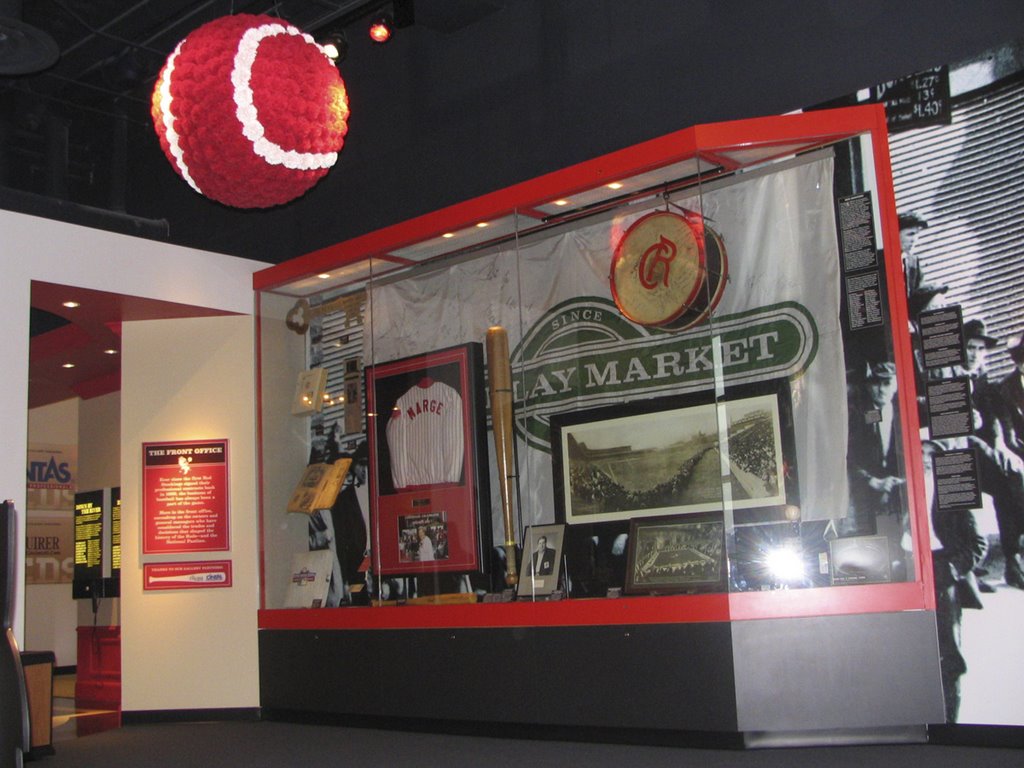
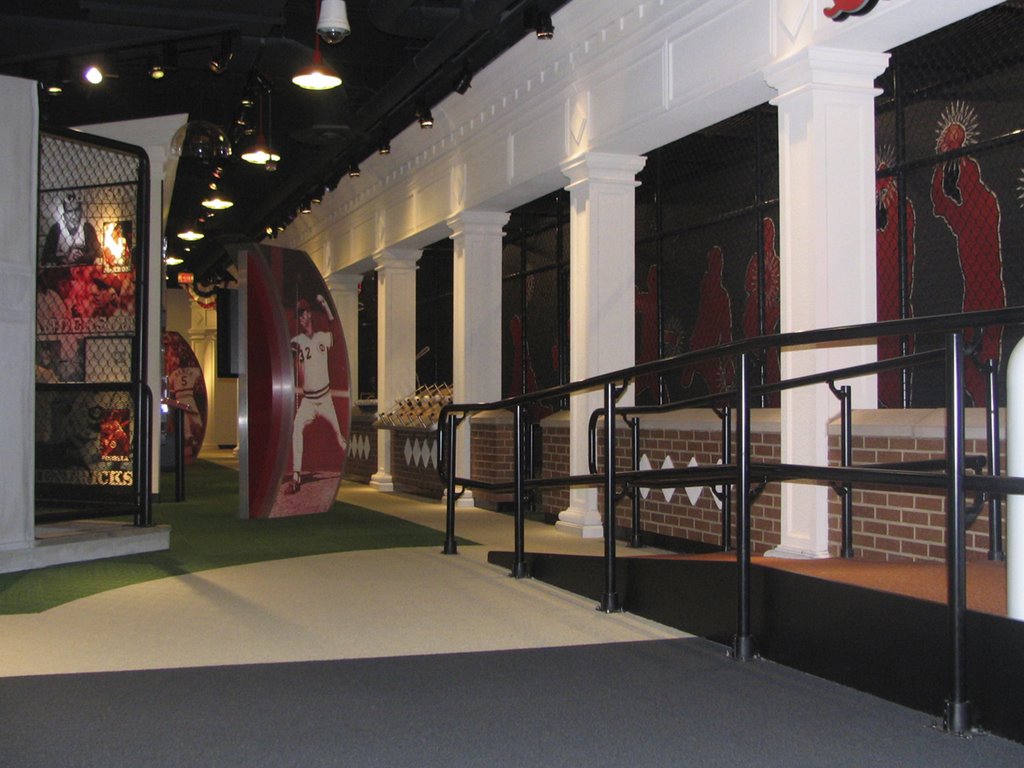
          But I’ll leave the dimensions, comestibles, and restrooms to the experts: my suggestion is a Minnesota Baseball Museum right in the park. For inspiration, one need only look to the south, to the Cincinnati Reds Hall of Fame Museum, perhaps the finest shrine to baseball outside Cooperstown. I had the good fortune to visit this wonderful place this spring.

          “It’s important that a museum is done right, right from the start,” Greg Rhodes, director of the museum, told me. The Hall is located in its own wing of the recently constructed Great American Ballpark. The idea behind the museum has a long history: according to Rhodes, the Reds and their manic fans had been batting about ideas for over thirty years. When their new park was approved, the Reds took an informal survey of their fans, inquiring as to their wants and needs, much like the Twins are doing now. A museum was right at the top.


          The Reds Hall of Fame Museum is an impressive spectacle, part nostalgia trip, history lesson, interactive sporting center, and, at the end, a nice tribute to the players who’ve worn the Redlegs uniforms through the decades. It helps that the Reds have the lengthiest history of any professional team—your first engagement with this storied past is a scale replica of a twenty-five foot wooden bat presented to the 1869 team. As you wind your way through the museum, you climb a set of stairs past a fifty-foot high “wall of balls” (their choice of words) that contains 4,256 baseballs, one for each of Pete Rose’s hits. If you’re lucky, as I was, you’ll be dogged by a friendly volunteer who makes mention of the elephant in the room—no, Pete Rose can’t be inducted into their Hall, either. “But we have just about everything else with his name and likeness on it,” he chuckled. “You can’t evade Pete.”

          My favorite section was dedicated to that grand celebration, Opening Day. The Reds have the distinction of being the only team to always enjoy the start of the season at home. (The Senators could also make this boast, but lost that first game by moving to Minnesota and Texas). The Opening Day exhibit features photos dating back to the turn of the last century, old proclamations, newspaper headlines, and tributes to fan groups like the Rosie Reds—‘Rosie’ being an acronym for Rooters Organized to Stimulate Interest and Enthusiasm. Frankly, I can’t imagine a fan club of such zeal in this town, much less a city holiday, replete with a parade every opening day. As much as the new stadium will increase our team’s fortunes and our hometown pride, something tells me we won’t be marching down 5th Street in April anytime soon.

          The Reds museum has wisely catered to children, giving them a number of interesting interactive exhibits that adults can appreciate—and embarrass themselves at—as well. I was able to impress one of our hosts by actually striking out the simulated ballplayer in a full count. Yes, it was from the usual sixty feet six inches. I kept from him the fact that a forty-mile-an-hour fastball without movement wouldn’t get past today’s little league, and gloated a bit over the K. The museum also gives patrons the opportunity to slam against a padded outfield wall, hit a major league fastball with the push of a button, and call a game in a television booth. All three resulted in a degree of embarrassment for everyone in our group.

          In addition to a number of cool artifacts from the number of Reds champions, the actual Hall of Fame is the showcase of the museum. The room curves, and each plaque is suspended on wires, giving the place an almost heavenly feel. This was a far cry from the vinyl banners that now hang in the Metrodome. And according to Mr. Rhodes, the Hall is a real magnet for former players, who often return to admire their own plaques, or those of former teammates.

          Needless to say, the Twins don’t have as rich a history. But they could still have one heck of a museum. You could counter their relative youth in a number of ways. First, the Twins could connect themselves to their original franchise, The Washington Senators. It seems a shame to me that we ignore this past, for the Senators had a number of Hall of Famers and, in Walter Johnson, perhaps the greatest pitcher in history of baseball. The Senators were the basis for the musical “Damn Yankees!”, were storied as one of the worst teams in the sport, and fan-fave Harmon Killebrew is one of the few notables who played for both. Finding artifacts shouldn’t be a problem: the Reds museum often elicits the goodwill of Cooperstown, and I would guess the Twins could augment their team’s historic displays with help from the Hall.

          Even better, in my mind, would be to embrace the entire history of baseball in Minnesota. The Twins are famously a ‘state-oriented’ team, not from Minneapolis or St. Paul or Duluth, but Minnesota—why not have a reliquary that celebrates its very rich baseball history?

          Consider the Minneapolis Millers, just for a start. Seventeen—count 'em—seventeen Hall-of-Famers wore the flannels of the Millers alone. There was Ted Williams, who was sold in 1938 to the Millers (then an independent team) for a tune-up on his way to the Red Sox. Willie Mays did not see as much of the grainy city, but still managed a respectable .477 in 38 games before the Giants figured they needed to hop on the kid’s back en route to the 1951 World Series. Negro League great Ray Dandridge—considered one of the finest third basemen in history—played the hot corner for three seasons, from 1949 to 1952. Left-handed ace Rube Waddell, who pitched for the Millers as his career (and health) winded down. Personally, I’d love to see a Splendid Splinter display and wonder to myself about a man who was a chronic walker, and try to imagine into which of our neighborhoods he took his long peregrinations.

          At Nicollet Park you could have seen Hoyt Wilhem toss his famous knuckler, stood in awe at Monte Irvin out in center, heckled at “The Beast”, Jimmie Foxx, now coaching, and admired the less-than-colorful Carl Yastrzemski or Orlando Cepeda, to name but a few. A museum isn’t just a place to honor the past—staring at the gewgaws of our sport makes the present a mystery as well. The thought of these players at 31st and Nicollet makes that bleak corner seem so much more thrilling.

          Other colorful characters made their way through town: future ‘atomic spy’ Moe Berg, whose photos of Tokyo during a Japanese barnstorming tour helped Doolittle bomb the place in '42; Pumpsie Green, the first African-American to integrate the Boston Red Sox (and the last team to do so); Satchel Paige’s barnstormers came through; two of the most memorable women ballplayers came through—Toni Stone of the Negro Leagues and Ila Borders of the Saints; and Van Lingle Mungo, a good player whose name I can’t resist adding here.

          This list is woefully inadequate, but if you’re hungry for even more details, grab Stew Thornley’s books (Baseball in Minnesota and On To Nicollet!) or last year’s compilation on our state’s black baseball, Swinging For the Fences, and you’ll see that there’s no lack of history for a museum. Plus, there are probably tons of untapped sources of memorabilia. According to Rhodes, when the Reds were looking to stock the museum, collectors of all stripes loaned all varieties of wonderful curios culled from basements and attics. “They were proud to be a part of the museum,” he said. “For many of these fans, this stuff just sat on a shelf at home… now it’s enjoyed by everyone who visits.”

          The Reds made their museum work because they were dedicated to it from the start. “You have to be realistic about it,” Rhodes said. “Make sure you budget for it, and make it a year-round presence.” Rhodes believes it costs a minimum of $350.00 a square foot for good museum space—there are environmental issues in keeping the artifacts safe from humidity, and aesthetically it’s important to hire the right people to make the displays engaging. Rhodes noted that unless you make your museum an attraction on its own, it won’t generate enough income to remain open year-round, which creates problems with staffing, with generating the memorabilia from collectors, who might not be so keen to share if the place were empty or closed all winter.

          In spite of being just a shade older than myself, The Twins can capitalize on one of the finest histories of the noble sport in all the land. There can be almost no finer nod to the fans than a Minnesota Baseball Hall of Fame and Museum—it would help ease the pain of high ticket prices, the corporate moniker, the truly nosebleeding seats. And it could just be plain fun besides.

          Peter Schilling Jr. can be read regularly at MudvilleMagazine.com and The Rake. As you read this, he will be touring Saudi Arabia in the faint hope of bringing the noble sport to the men and women of the desert.

          Links of the Day for 7/4/06

          As I’m sure you all noticed, the All Star Rosters were announced last night. And while Johan Santana and Joe Mauer were named to the roster, some Twins fans seem to think that Joe Nathan and Fransisco “The Major League ERA Leader” Liriano should join their teammates in Pittsburgh. And they have a pretty compelling argument, in my opinion. Nathan is dominating Bobby Jenks in ERA, K/9, BB/9, OPS against and Batting Average against. The Cisco Kid, obviously, is dominating everyone in ERA and K/9, let alone the Royals lone All Star, Mark Redman. Then again, I’d rather Redman’s pitching routine get thrown out of whack. But there is no question that, based on performance, Liriano should be an All Star.

          The question, of course, is should Twins fans be outraged? Should they spend every waking moment (and use every email address they have) voting to send Liriano to the nicest park I’ve ever been to? (I’ve also been to Fenway, Camden, Safeco and Coamerica—trust me when I say PNC Park is the nicest). Does it really matter? That seems to be the question on everyone’s mind—should fans care about the All Star game? While reasonable people differ, I think that the fans should care. What’s going to be more fun to watch, an All Star Game with the best players or one with random replacement level players?

          Now, I’ve always enjoyed the All Star game. It’s fun seeing all of the best players playing at the same time. That’s why people should hate the “one player from each team” rule. I didn’t care if Ron Coomer made it, and I can’t see Royals fans caring if Mark Redman is on the team. While I know that interleague play ruins the novelty of watching the greats from each league play each other, it’s always cool to see Pujols dig in against Santana or have Mauer come to the plate in a late inning situation against Trevor Hoffman.

          “But it’s an exhibition game” the All Star game’s detractors moan. Which is probably as it should be. And while Bud Selig has actually designated a prize for the victor, home field advantage in the World Series wasn’t awarded to the team with the best record before it became the spoil of the league that won the All Star Game anyway. I’m not saying it’s the best way to do it, or even that they should do it, just that having it alternate wasn’t that much better.

          So to sum things up, Nathan and Liriano got hosed, the All Star Game is fun, and you should vote for the Cisco Kid to fill out the roster. Have a safe and Happy Fourth!

          Sunday, July 02, 2006

          Optons, options, options

          Powered by Twins Geek

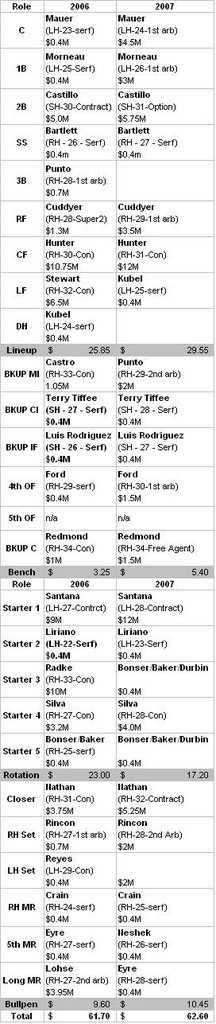
          I don't have the energy to write around this, but I'll publish the data. Below you'll find a rough draft of the Twins payroll situation next year, with an unexpected and unfortunate conclusion. Assuming that
          1. Brad Radke retires,
          2. the Twins let Kyle Lohse, Shannon Stewar and Rondell White and
          3. the Twins pick up the options of Luis Castillo, Carlos Silva and Torii Hunter,

          they're already at $63 million for next year, even without paying for a third baseman or a designated hitter. Data can be seen by clicking on the image below

          Saturday, July 01, 2006

          Weekend Links

          Powered by Intern Sharkey

          Hello all. I’m sorry if this weekend’s links aren’t quite up to par, but I’ve been spending most of my time trying to get my Blockbuster card back from Eddie Griffin.

          • The Twins kept things rolling Friday night with an 8-2 win over the visiting Brewers. Brad Radke continues to pick well, and Justin Morneau cranked his twentieth homer of the season. Hopefully that will help out his All-Star chances.


          • You know things are going well when Bump has kind words, even if they’re of the back-handed variety.


          • We all know defensive statistics are shaky at best, but Baseball Think Factory has their latest rankings up for all players with 200 or more innings in the field. Among the notables: Louis Castillo and Tony Batista ranked as the worst AL fielders at their positions, with Juan Castro posting negative numbers as well. I question the positive numbers for Morneau and Stewart, but then again, what do I know?


          • A follow-up link: hopefully you checked out Thomas’s Tuesday link of the minor league manager (another video here if you missed it). Now, thankfully, all has been explained: it was Calvinball.


          • Speaking of managers, it’s good to see that Ozzie has amended his ways.


          • I’ve always been a fan of Paul DePodesta, and frightwig does a wonderful job of summing up his situation. It also appears that DePo has landed on his feet in San Diego.


          • And finally, a link from the wonderful Fire Joe Morgan. I’m sure Celizic would have wanted the Metrodome crowd to mercilessly boo Koskie, too.


          Enjoy the holidays, everyone.

          Thursday, June 29, 2006

          Out of Left Field

          Powered by Twins Geek

          The Twins (and their fans) don’t need any extra incentive to win a border battle, but it’s there anyway. Beating down Milwaukee wouldn’t just improve the Twins record, it would also improve the chances of the Brewers becoming “sellers” at the trade deadline, which could make Carlos Lee available to the highest bidder.

          Lee’s no stranger to Twins fans from his days as a White Sock(er), but it’s important to note that he hasn’t stopped mashing in Milwaukee. This year he already has 25 home runs (.582 SLG). The Twins might be especially interested because all that power is generated from the right side of the plate. His defense in the outfield can probably best be described as “indifferent”, but he’s a far better option for designated hitter than the Twins have had since David Ortiz left.

          This is the last year of a long-term deal he signed with the White Sox, so he’ll be a free agent next summer. He’ll be an attractive one, too, seeing as he’s just thirty years old. The Brewers have a history of not being afraid to move mammoth right-handed sluggers to build on the future, ala the 2003 trade of Sexson for six players, all of whom had at least some time in the major leagues.


          What’s Not Working. Yet.

          They’ve developed a perennial Cy Young candidate and another starter with a 3.10 ERA. Their rookie first baseman has sixteen home runs. They’ve got two fantastic shortstop prospects, one of whom already has fifteen home runs. They’ve filled gaps with productive veterans, like acquiring one of the premier right-handed hitters in baseball, and a gold glove caliber Canuck who we all miss.

          Yet their record is eminently average, and their playoff hopes are based more on a mediocre division than they are on sustained excellence. What’s wrong with the Brewers?

          Nothing that most rebuilding small market teams don’t face. It’s great to say “play the kids” or to tout the advantages of building from within, but the reality is that teams who go that route have to be very lucky, or supplement their young talented core team with difference makers. For instance, it’s nice to portray the Tigers as a rebuilt team with some fun young players, but their team is also stacked with premier free agents, like Magglio Ordonez, Ivan Rodriguez and Kenny Rogers.

          The Brewers have developed and nabbed about as much talent as any team can hope. They’ve drafted future stars, like Prince Fielder, who they selected in the 2002 draft and who already has sixteen home runs in his first full season in the majors. They’ve traded for minor league talent, like starting pitcher Chris Capuano, who was acquired a couple years back in the Richie Sexson deal, and who has a 3.10 ERA this year. They’ve traded for established difference makers, like Carlos Lee, who has 25 home runs and reasonable contract this year. They’ve found creative ways to plug gaps in their lineup, like trading a minor leaguer for Corey Koskie and $7 million.

          But wait, there’s more. They’ve developed a perennial Cy Young candidate in Ben Sheets (whom they both drafted and developed). Their farm system has spit out productive middle infield prospects like Pez, such as shortstops JJ Hardy and Bill Hall or second baseman Richie Weeks. Their pitching coach has been praised for developing a bullpen out of former castoffs like Derrick Turnbow and Dan Kolb.

          Unfortunately, it turns out that a team needs about fifteen dependable players to compete, and even the most productive farm system can have trouble finding all those pieces. The gaps for the Brewers have been on their pitching staff, which currently ranks last in the National League in runs against. Part of the problem is injuries. Sheets, who had a 2.70 ERA with 264(!) strikeouts in 2004, has had trouble remaining healthy for an extended stretch since. Toma Ohka wasn’t supposed to carry the Brewers staff, but his shoulder injury has meant more starts for guys like Dana Eveland (8.51 ERA), Ben Hendrickson (12.00 ERA) and our old friend Rick Helling (8.64 ERA).

          The bullpen is almost as bad, and because of the bad starters, is also overused. Their closer, Turnbow, has blown four of 25 saves this year – and he’s the bright spot. The rest of them are pretty interchangeable – non-dominant guys with below-average ERAs because they tend to give up home runs.

          That’s a shame, because this team has come a long way, and has a lot of offensive firepower. Their management has done a fantastic job, but their team still had some gaps which were widened by injuries where they could least afford them. The Brewers aren’t a great team yet. With some luck, they may just be a year from being a true contender.


          On The Hill

          Brewers: Carlos Villanueva (0-0, 2.65 ERA)


          • 2006 (AA): 4-5, 3.90 ERA, 62.1 IP, 61 H, 59 K, 14 BB, 6 HR

          • 2006: 17 IP, 12 H, 13 K, 4 BB, 26 HR

          • Desperate times call for desperate measures, which likely explains how a 22-year-old with all of 14 starts above A-ball finds himself in the Brewers rotation.

          • Doesn’t have a lot of velocity. Relies on great command.

          • Was sent to the bullpen about ten days ago, but he’s back in the rotation, replacing Rick Helling.


          Twins: Brad Radke (6-7, 5.40 ERA)


          • 2005: 9-12, 201.2 IP, 117 K, 4.04 ERA

          • 2006: 93.1 IP, 129 H, 49 K, 25 BB, 17 HR

          • Relies primarily on an average fastball and a good changeup; also throws a curve.

          • He’s back. Since a shellacking against Cleveland at the end of May, Radke’s been very good. In June, he has a 2.27 ERA, and has given up just three home runs.

          • In the past, Radke’s shaken slumps by tightening his control, but that isn’t the case this year – he’s walking players at about the league average rate, which is a stratospherically high rate for Radke.

          • The knock on Radke has been his early game struggles. In his last start, the Cubs had several early opportunities, but didn’t capitalize. More promising is that Radke didn’t give up a home run (knock, knock).

          What's Hunter Worth?

          Powered by Twins Geek

          The Twins have a big decision to make within the next month regarding Torii Hunter. Picking up his $12 million option would seem out of the question to a team with the Twins means – even to Torii. “I hope it's with a long-term deal, (because) I can't see it with the option," Torii reportedly said to ESPN.com’s Jayson Stark. "If they felt they had to go with the option, then I would be out of here July 31."

          The reality is that neither option is very palatable to the Twins. Either they pay him $12 million to stay for one more year, or they pay him $2 million to leave as a free agent with no compensation beyond a possible draft pick. The third option – trade him for cheaper players or prospects before the end of July – isn’t going to be considered if the Twins are within shouting distance of the playoffs.

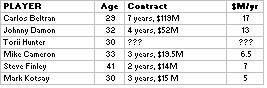
          There’s one more option which Torii has mentioned a number of times – rip up the current contract and sign Hunter to a long-term deal. That’s a tricky proposition, and not just because it would need to happen over the next month, when it’s bound to be a distraction. The bigger problem is that it’s damn hard to figure out exactly what Hunter’s worth based on some of the other contracts that have been handed out lately. Given these deals, what would you pay Hunter?


          I think most people would agree that Hunter slots in below Damon and above Cameron or Finley, but that leaves a range of salary between $7 million and $13 million per year. Would Hunter accept a four-year deal for $32 million plus the $2 million buyout? Would he be willing to do that when large market teams like the Angels or Dodgers might be waiting to offer him $44+ million? Would Terry Ryan be willing to tie up that much money when he has Lew Ford on the roster and Denard Span playing in AA-New Britain?

          Hunter says there hasn't been a hint from the front office that they want to start negotiating a long term deal. Looking at the questions above, and with the possible range in salaries, it wouldn’t be too shocking if the Twins decided the chance of negotiating successfully in the next month was outweighed by the risk of it affecting Hunter’s performance. Or, possibly, Ryan has just delayed his decision until the all-star break so he give the Tigers or White Sox some more time to cool off.

          But the clock is ticking. If the Twins find themselves on August first with Torii Hunter, without a long-term deal, and with no realistic chance of making the playoffs, Ryan will have made a mistake that a payroll-capped team like the Twins can’t afford. Literally.