Friday, January 20, 2012

Hot Stove League Banquet

It ain't fancy. It is fun.

If you're looking to get together for a lot of irreverent and fun Twins talk, I'd invite you to attend the 4th Annual LAST Hot Stove League Banquet and Charity Auction next Friday night. It's not the fourth annual - it's the fourth annual LAST, because this has been going on for decades now and they keep trying to stop doing it.


You'll likely see both The Voice of Reason and I there and we'll probably be taking the party someplace else immediately afterwards. I hope you can make it.

Wednesday, January 18, 2012

Season Insurance

The Twins have invested $99M in their 2012 team.

Whether you think they'll be competitive or not isn't the point. (I do.) Whether you think they should have cut payroll or not isn’t the point. (I don't.) The point is this: the Twins have invested $99M in their 2012 team.

Now they need to spend a tiny fraction of that to insure it.

You would think that would be obvious to the Twins, who have traditionally been a risk-adverse organization, especially under Terry Ryan. They demonstrated that again this offseason. They could've waited to sign their free agents, gambling that the market would go down and they wouldn't be left without competent players. Instead, they reversed course from the last few seasons, aggressively signing almost their entire roster before Christmas.

But they also have a tradition of being extremely tied to a budget, and it appears they've hit it. But to stop now, when the free agent market is so affordable and they still have two enormous risks on the roster would be the definition of pennywise and pound-foolish.

They created the first of these risks earlier this week when they signed Joel Zumaya to a super affordble one-year deal, heavy with incentives. The contract is awesome. Zumaya's health history isn't.

Zumaya has failed to stay healthy for the last five consecutive seasons. The question isn't if he'll stay healthy. The question is when he'll break.

When he does, the Twins are right back where they were a week ago - without a dependable right-handed arm in their bullpen other than Matt Capps. (Let's let the irony of that last sentence settle in for minute.)

Zumaya has the potential to be a great signing or a dubious choice depending entirely on whether the Twins go out and sign someone else. There are a half-dozen competent right-handed relievers on the market, all of whom are likely to cost between one and two million dollars. That's how much it would take to transform the bullpen from “mess” to “average with upside.”

The second risk was made clear last week on the MLB Network in an interview with Justin Morneau.

"Most days, I wake up I feel pretty good. Usually after I get done, really exert myself, really working out hard after a long day, your brain gets tired and everything gets so worn down. It's not functioning the way it's supposed to be, and you kind of get done with the day and you go, 'Something's not right.' And you end up going home and taking a nap for a couple hours or whatever it is, and you wake up and the headache's still there and you kind of grind through it. But it's been a lot better lately.”

“A lot better.” That’s an in interesting phrase. Not “good” or “fine.” Just “better.”

Last year the Twins had a backup plan for Morneau: Jim Thome. He wouldn't play first, but manager Ron Gardenhire could move around the lineup and have Thome play designated hitter. He can do the same this year, except that the bats he is going to turn to are Trevor Plouffe and Luke Hughes.

Meanwhile, one of the stories of the free agent market is how many designated hitter are looking for work. Vladamir Guerrero, Hideki Matsui, Johnny Damon, Raul Ibanez, Magglio Ordonez and even Carlos Guillen are available and several of them are going to be available for about the same amount the Twins paid Thome.

For $2-4 million, the Twins could pick up two key insurance policies on their #5 hitter and their bullpen. To not do so, to instead roll the dice on two critical areas that already look dubious, is foolhardy.

~~~~


If you haven't taken advantage of the special pre-order price for Seth Stoh's Minnesota Twins Prospect Handbook, time is running out. This isn't an e-book, you can throw this on your bookcase, bring it to games, give it to the Twins fan in your life. Grab it quick to help retain your sanity during these cold snaps. You can order it HERE.


Gleeman & The Geek Episode 24: Zumaya & Arbitration


This week, Nick Nelson joined Aaron and I to talk about the wisdom of signing reliever Joel Zumaya, how Victor Martinez's injury could affect the AL Central race, Seth Stohs' 2012 Twins Prospect Handbook, the arbitration process and whatever happened to last year's top prospects. Here are:
Or click on the image below to listen. Thanks!

Wednesday, January 11, 2012

Delmon vs. Revere

Does Revere's Defense Make Up For Delmon's Offense?

Last week in a thought exercise, I wondered if who we could expect more out of this year – Delmon Young or Ben Revere. One offensive, one defensive. One defensively laughable, one offensively infuriating. So let’s look, sabrmetrically, at what each should be worth offensively and defensively next year.

Offense

I like using a very basic sabremetric stat to measure offensive production for players: Bill James’ Runs Created (or RC). Basically James discovered that by looking at the number of walks, hits, doubles, triples, homeruns and at-bat a team had, he could give a pretty good estimate of how many runs they scored that year. Then he used that same formula for players.

(If you’re looking for more on Runs Created, I did a short story on it back in April you might want to check out. That theory is that basis for a huge chunk of the sabremetric work out there. It also started the alphabet statistical soup that people like to mock. If you want to be able to explain the basics of this stuff to people, it’s a good start.)

Runs Created has been through all kinds of formulas and there are all kinds of pet derivations for it. I’m going to just pull mine from ESPN.com for both players.

Delmon Young created 51 runs last year, 89 the year before and 76 &45 in his first two years with the Twins. My gawd, was he really here four years? I guess time flies when you’re flailing at first pitches. He’s probably good for somewhere between 50 and 90 runs, so I’ll go with 70 as a nice round figure.

Revere played in 117 games with 481 plate appearances and created 46 runs. It’s not safe to assume he’ll be playing full time this year, but just so we can compare apples to apples, let’s assume he gets another 90 AB. That would give him about 55 runs of offense, about 15 less than Delmon.

Defense
The most widely used defensive metric, Ultimate Zone Rating (or UZR) also uses runs as its measuring stick, though this time it is runs in comparison to the average defender. We’ll take that number and add it to (or subtract it from) our offensive runs. We’ll get those numbers from FanGraphs.com.

Young has been bad defensively, but did you know that according to UZR he has really improved over the last two years? Last year he only cost the Twins three runs compared to the average left fielder, seven runs better than 2010 and 11 runs better than the year before that. My guess is that Young costs between 0 and -15 runs, and so I’ll got with -5. Overall that leaves him with 65 runs.

Revere is also a little hard to measure. His UZR in left field was also negative, but he only played there for a few games, so it’s hard to count on UZR. However, in center field he saved 10 runs, and that translates to 15 runs if he had played there full time. Generally, you would see that number go up in left field, just because the average left fielder is worse defensively than the average center fielder. So 15 runs seems safe, and it could be as high as 20. Let’s stay with 15.

And the cry goes up: But WHAT ABOUT HIS ARM? Well UZR takes an outfielder's arm into account. So for now, let's go with it.

Parenthentically, it should be a fascinating year for Twins fans as they watch a thought experiment play itself out in reality. Enormous range. No arm. Which is more important to an outfielder? I think it’s going to be “range” in a landslide, but I wonder if I’ll feel the same way after this year.

That gives Revere 70 runs and Delmon 65. I wouldn’t take it as definitive proof that Revere is going to be more valuable than Young, but they’re a lot more comparable than I would have thought.


Picture this: it’s June and you just heard about a Twins AA reliever who was named player of the week. You wonder: could he be the help the Twins bullpen needs? But you know almost nothing about him other than last week’s stats. Is he really a prospect, or some AAAA veteran who is dominating younger competition?

Fortunately, you thought ahead and bought Seth’s Twins Prospect Handbook which lists 160 guys in alphabetical order. So you look him up and get the full scoop. Wouldn’t that add a little enjoyment to your baseball season?

So, start thinking ahead and looking under those couch cushions for loose change. It’ll be out soon, and we’ll have all the details.


Have you checked out the Gleeman and the Geek podcast yet? This week Aaron and I spent the first 20 minutes dissecting the Twins dip in payroll, including why the explanations either don’t work or make us all the madder. Then we go through our listener’s questions about all things Twins. It’s like a warm blanket on this cold offseason day. Curl up and enjoy.

Gleeman & The Geek Episode 23: Mailbag!

In episode 23, Aaron & I turned to our readers for their Twins questions. Here are:
Or click on the image below to listen. Thanks!

Monday, January 09, 2012

Gleeman & The Geek Mailbag

It's time for a mailbag episode of Gleeman and the Geek, so please send in your questions/comments below so we can read them on the podcast and respond.

THANKS!
John

Sunday, January 08, 2012

Who Was 1987’s 25th Man?

I was born in 1967 which means for the first 30 years of my life, there was no internet. Those were my formative years – so how come it almost seems inconceivable to have a world where there isn’t one?

But occasionally, it still surprises me, usually around a topic from my youth. Like a month ago, when I realized I could find the song from the movie Hopscotch that I had been humming to people for a couple of decades. (It’s Rondo in D, K382 by Mozart).

The latest example was generated by the local SABR chapter’s message board. It turns out that in the 1987 World Series, 24 players appeared for the Twins (http://www.baseball-reference.com/postseason/1987_WS.shtml). But the postseason roster (as far as we know) is 25 players. So who didn’t get to play?

I used this question as an excuse to truck around the internet for an hour and become amazed at everything you can find out. Bear with me on the tour.....

Only nine pitchers pitched for the Twins in that series , so I though it would have had to have been a pitcher. The ones who did are starters Frank Viola, Bert Blyleven, Les Straker and relievers Jeff Reardon, Juan Berenguer, Dan Schatzeder, Keith Atherton, Georg Frazier and Joe Niekro.

In the ALCS, only seven pitchers appeared: the nine above minus Frazier and Niekro. That doesn't help.

The Twins who threw the most innings in 1987 (other than those nine) were Mike Smithson (21 G, 109 IP), Mark Portugal (13G, 44 IP), Steve Carleton (9G, 43 IP) and Joe Klink (12G, 23 IP). Nobody else had more than 16.1.

Smithson pitched all year, including a long relief stint on 9/25. Portugal didn't pitch for the Twins past 6/5 in the regular season. Carlton pitched all year, including on 9/30. Plus, he was veteran and left-handed and Schatzeder was the only southpaw in the bullpen (or other than Viola, on the staff.) Klink was also left-handed, but didn't pitch past June 3rd in the regular season.

So my best guess was that it was Carlton, but his wikipedia bio says he was never on the Twins postseason roster along with another interesting tidbit about the team picture at the White House:

"He was traded to the Minnesota Twins, where he was yet again ineffective. He went a combined 6-14 with a 5.74 ERA for both the Indians and Twins. However the Twins, who had been a bad team for most of the 1980s, would go on to a surprising win in the 1987 World Series, albeit without Carlton on the postseason roster, to earn him a third World Series ring and a trip to the White House to meet President Reagan along with his teammates. Interestingly, when Carlton was photographed with his teammates at the White House, newspapers listed each member of the team with the notable exception of Carlton. Instead, Carlton was listed as an "unidentified Secret Service agent."[12] The Twins brought him back in 1988 but he lasted only a month (0-1 16.76 ERA in four games) before the Twins released him."

So I looked into Smithson, but it states on John Swol’s website that Smithson was never on the 1987 playoff roster. That link includes a 31-minute audio interview with Smithson which I didn't listen to, so I can't tell you if he confirms that in the interview or not.

Ok, how about the other guys? There were four other guys who pitched at some point in 1987: Roy Smith, Allan Anderson, Jeff Bittiger & Jeff Niemann. Niemann & Anderson were lefties, and I gotta think Tom Kelly would've have wanted more than one southpaw in that bullpen. Niemann didn't pitch past June (or even again in the majors, so I think he's out.) And Anderson didn't pitch in the regular season for that team past May, so I doubt it's him. (BTW, If you would like to ask Anderson, you might be able to do so through his facebook page.

So maybe it was Bittiger or Smith, but I wondered what other position it might be. Hmm, maybe TK might have had a 3rd catcher on the roster for the World Series? Other than Tim Laudner and Sal Butera, the other catcher that year was Tom Nieto. He was on the roster in September, so he was certainly an option. (Yes, that’s the same Tom Nieto who the Twins recently fired as their AAA head coach.) A search on google for "Tom Nieto 1987 World Series" turned up a 1987 Tom Nieto World Series jersey. That's far from definitive proof, but that's my best bet right now.

But one of the other powers of the internet is that it can bring people together, so let’s try opening this up to TwinsCentric’s esteemed readers. If you remember or have any other thoughts or information, please let me hear it in the comments. Or share your favorite obscure 1987 Twins trivia.

Thursday, January 05, 2012

Expectations Thought Excercise

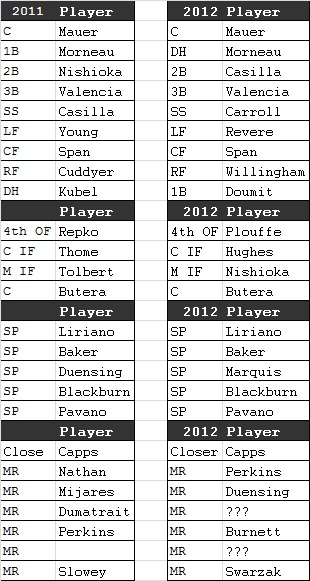
Below is the opening day roster (more or less) of the 2011 Twins versus the probable roster for the 2012 Twins (as things stand right now). I want to do a quick comparison of the two but add a twist – I want to compare the 2012 player with what we hoped the 2011 player was going to do, not what they actually did. Let’s call it the Hope Index. There is a reason I want to go that way, I promise. I’m also not going to do a ton of analysis here - it's late and I'm winging it a bit - so if you want to make your own changes, go ahead. You can put your Hope Index in the comments.

Hitters

EVEN
Cuddyer for Willingham is a wash.

Carroll for Nishioka would be a huge upgrade, except this isn't based on reality, but instead on what we expected from Nishioka. We expected a guy who could get on base from the #2 spot and play average defensively. We’re expecting the same from Carroll. I’m calling those even.

I’ll call Doumit and Kubel about even.

I expect about the same out of Casilla as I did last year. I’m going to say the same about Valencia, but I was pessimistic about him last year. I expect most Twins fans would say they expect less.

Morneau will be a wash – we had a bunch of health concerns and we still do. I’m not sure if they are worse or not than they were.

DOWNGRADE
Ben Revere for Delmon Young is a tough comparison because they’re such different players, but Revere is certainly less than what we expected from Delmon. (Comparing those two in more detail might make a fun entry.)

Mauer and Span, I think we absolutely need to expect less than we did, given their injury concerns.

And the bench as a whole gets a downgrade, too, just because they lose Thome.

Hitters Hope Index: six evens and four downgrades.

Pitching

EVEN
Pavano, Baker and Blackburn are going to be even. They have essentially been the same two years in a row.

As much as I hated the Capps signing this year – and I hated it a lot – I’m not sure the Twins look any worse at closer than they did last year. They might have had a little more depth, but everyone was so unsure of Nathan. I’m calling it even.

I’ll call the back half of the bullpen even, too. I didn’t know who was going to get innings and I’m not sure it mattered a ton. I feel the same way now. I might have a little less confidence in Gardenhire and Anderson’s ability to piece something together but I also have more confidence in Ryan’s ability to dig up some arms.

DOWNGRADE
Liriano is a downgrade – we absolutely expect less of him this year than we did going into last year.

I expect we’ll be happier with Marquis than we were with Duensing last year, but our expectations are probably lower. Duensing entered last year with such solid numbers as a starter, it wasn’t unreasonable to view him as a decent #3 starter. I don’t think many folks expect that from Marquis.

UPGRADE
I would argue that the Twins bullpen setup roles look better this year than they did last year. Nobody knew who was going to be setting up and at least this year Perkins seems like a solid bet.

Hope Index: five evens, two downgrades and one upgrade.

Now, here’s why I wanted to do this: I’m trying to establish reasonable expectations for this team and I wanted to establish a baseline for how much talent this team really has. Usually one starts with how the team did last year. This team lost 99 games, but it really wasn’t this team, was it? With so many injuries, so many rookies, so many meaningless August and September games, I don’t know how to reasonably start to add wins to a 63-win team whose playing time will be so radically altered.

So instead, I’m going back to the beginning. Last year going into the season, this felt like an 85-90 win team, especially after winning 95 games the year before. And what I’ve found is that from that team I have eleven even grades, six downgrades and one upgrade.

Looking at the downgrades, I can see some hope. Liriano could become what we expected, and so could Mauer and Span. The others I’m not so sure about. That feels like a .500 team, though with a lot more downside than upside.

Tuesday, January 03, 2012

Gleeman & the Geek Episode 22: Marquis and Morris


Aaron & I dissect Jason Marquis, pine for some more right-handed relief, argue about Jack Morris' Hall of Fame credentials and celebrate Aaron's birthday. Here are:
Or click on the image below to listen. Thanks!

Wednesday, December 28, 2011

Gleeman & the Geek Episode 21: Minors Moves


The Twins are on their break, so Aaron and John talk about a lot of minor moves, like losing Jose Mijares and lots of ex-prospects joining the Twins. Here are:

Tuesday, December 20, 2011

Gleeman & the Geek Episode 20: Swapping Outfielders


Cuddy's gone. Kubes too, but Josh Willingham arrives. Aaron and I talk about how the changes will affect the Twins lineup and defensive alignment. Also, what "Hot 100" is and why Aaron wants no part of it. Here are:

Wednesday, December 14, 2011

Stuff I Didn't Know About Josh Willingham

He’s Kind Of A Catcher

As a 23-year-old, after a couple of years in the Marlins organization, Willingham began playing catcher. Over the next few years he spent most of his time in the minors behind the plate, playing 60 of 66 games there in AAA. In fact, his first promotion to the majors happened because an ex-Twins catcher was experiencing back stiffness. It was Mike Redmond.

But catching didn’t last. The plan going into 2006 was for Willingham to get extensive catcher-specific coaching from manager Joe Girardi and bench coach Gary Tuck, who is often credited for molding Jorge Posada into a capable catcher. They worked with him all spring, but on Opening Day he was their left fielder. Even then they planned on him catching a couple of days per week, but by the end of April, he was the full time left fielder. He hasn’t caught since.

In the majors, he’s been almost completely a left fielder, laying there 662 in 799 games. While he’s only played first base for four innings in the majors, it’s worth noting that he played all around in the minors, including 119 games at 3B and 68 games at 1B. In fact, in the minors, he was viewed as a possible utility player, though not a middle infield utility player.

Of course, the Twins need a right fielder, since it makes zero sense for Ben Revere’s exceptional range and suspect arm to play in Target Field’s tiny right field. Willingham has only played right field 35 times in his professional career. If the move to right field is a deal breaker, the Twins are going to need to do some roster shuffling – or still go get a right fielder.


He’s Been Injured, But Not THAT Injured

Looking at Willingham’s injury history, one sees lots of indeterminate injuries like a bad back, sore knees and stiff neck. These aren’t exactly injuries that play to the Twins medical (limited) strengths. But the good news is that while his injuries often sideline him for a couple of days, he hasn’t lost too much time to the DL.

Not that there haven’t been some serious issues. He had a brutal September in 2007 due to a herniated disc and it sounds like he needs to lots of maintenance to keep his back strong and healthy. In his first year of catching (2003), he ended up have meniscus surgery on his right knee. Just a couple of years ago his season ended in mid-August because of surgery on his other knee. He’s also been on the DL for an Achilles strain (last year) and a stress fracture in his arm cost him a couple of months back in 2005.

But the reports almost always have him coming back from lesser problems after a couple of days of rest. Given the organization’s frustrations with players sitting out with nagging injuries, it’s easy to speculate that Willingham is viewed a gamer who toughs things out.

Monday, December 12, 2011

Gleeman & the Geek Episode 19: Three Amigos


Seth Stohs (over there on the right) joins us to talk Twins news, straighten us out on the farm system and reflect on a decade of blogging.

Or, you listen by clicking on the image below.


Sunday, December 11, 2011

Cuddyer's Timeline

There has been lots of talk about Michael Cuddyer recently, primarily due to the Twins 3-year/$25 million contract offer. The natural conclusion, given all that chatter and at least one hard offer, was that a decision would be made soon. That hasn't happened.

News broke yesterday that the Twins are considered one of two finalists for Josh Willingham, another right-handed right fielder with 30 HR power. If Willingham were to agree to an offer with the Twins, it would essentially end Cuddyer's Twins career, as the Twins apparently can't afford both. Again, these report suggest a decision will be made soon.

I'm not at all confident that is going to happen.

There is a certain hierarchy to free agent signings and believe it or not, it has nothing to do with "setting the market." That is a myth. Just because some team paid a certain amount for one player doesn't mean that another team needs to pay a similar amount for a similar player. To get that similar player, you just need to have a better offer than the other teams.

Instead, the hierarchy works for logical reasons, by which I mean greed. Given two players, a team wants the better one. Once that player is gone, they want the next best one. And so on.

Want to know why you haven't heard too much about teams pursuing Cuddyer yet? Because they've been pursuing other, better players. There are two right-handed slugging free agents who are much better than Cuddyer (Albert Pujols & Aramis Ramirez), and two more that are comparable (Carlos Beltran & Willingham). Only one of those four players have signed, and it was Pujols on Thursday. Sure enough, reports are that the Cardinals are considering replacing his bat with Beltran. The Marlins and a mystery team also missed out on Pujols. Guess what they're likely shopping for right now?

It's not unusual for free agents to sign before the higher-rated players, but it's unusual for them to do so for a lot less than the market expected. The Twins offer to Cuddyer was considerably less than the market expected. It shouldn't surprise us it wasn't snapped up.
The situation with Willingham is similar. The Rockies, for instance, have already made it clear they might be interested in Willinham IF they don't get Cuddyer. So why would Willingham sign before Cuddyer?

There are other advantages to waiting, too. The Phillies made it clear they valued Cuddyer, but have been trying to work out a deal with shortstop Jimmy Rollins. Depending on how much they spend on him, they might be able to re-enter discussions with Cuddyer. The Red Sox have had interest in Cuddyer, clearly have a need for a corner outfielder, but have limited space before they go over the luxury tax threshold. How much they can spend might depend on whether they can trade away Marco Scutaro's contract, or can work out a multi-year deal with David Ortiz, lowering how much they pay him this year.

All the reports about contract offers and interest make it feel like there should be a speedy resolution. But logic suggests that it is in Cuddyer's and Willingham's best interests to wait this out awhile. If you've been compulsively hitting the refresh button on your favorite baseball website or twitter feed, you may want to recognize that Cuddyer's timeline may not match ours.

Wednesday, December 07, 2011

Rule 5 Draft Previews

The Twins have the second overall pick in this morning’s Rule 5 draft, which is a fun offseason event. Ever heard of Shane Mack or Johan Santana? They were Rule 5 draft picks. Of course, so was last year’s choice, Scott Diamond, or the choice in 2008, Jason Jones. Who? Exactly.

But having the second overall pick is a unique opportunity. The Rule 5 draft is a chance for the Twins to pick over other organization’s players. If a minor leaguer has a certain amount of time in that organization, but isn’t protected by being added to the 40-man roster, the Twins can grab him for $50,000. That might sound like a lot of money, but compared to what it takes to sign a free agent, or even a draft pick, it’s a pittance.

But there is a huge catch. The Twins would need to add their choice to their 25-man roster for the entire season. That means he must be on the team, at the ballpark, being used somewhere by Gardy. If the Twins don’t want to do that, they need to offer him back to his original organization for just $25,000, giving that team a nice return on their rental of the player.

Because of that rule, there are only so many places for a competitive team to “hide” a guy on the roster. Usually, it would be the last guy in the bullpen, a backup infielder or backup outfielder.

Jonathan Mayo
of MLB.com listed some of the top names available here. He has a nice mix of starters and relievers, southpaws and dextrals. With the Twins clearly lacking right-handed relievers, the name that jumped out to me was Johan Yan, a right-handed Rangers side-armer who spend most of the year in AA and is a converted position player.

Yan’s fastball reportedly only tops out around 90, but he’s got a slider that has induced a ton of groundballs (one thing the Twins seem to value) and he’s shown decent control (22BB in 68 IP), missed a lot of bats (61K in 68 IP) and was death to right-handed hitters. You can read more about him here.

Mayo also mentions a few middle infielders, the most intriguing of whom is Drew Cumberland, a second baseman with the Padres. Cumberland was a decent prospect who was sidelined for all of 2011 with inner-ear/concussion problems, but that seems to be licked. Since he only made it to AA, he would need to be used sparingly, but that might work out well, given his recovery. And at just 22 years old, he’s still young enough that if he was stashed for a year, it would just mean he went back to New Britain or Rochester as a 23-year-old. I’m not sure he’s a great fit for the Twins, who want to be competitive, but for a truly rebuilding team, he’s an interesting option. You can read a good story about his comeback here.

Some of our local blogs have done some speculating too. Nate Gilmore at Puckett’s Pond listed middle infielders yesterday and one matched a name on Mayo’s list: Ryan Flaherty, a 25-year-old second baseman with the Cubs. Flaherty is a true utility infielder who played every position except center field and catcher last year. He also raked in AA (.907 OPS, 55K/40 BB) – and then took his lumps in AAA (676 OPS, 44K/10BB). He was drafted as a supplementary pick (41st overall), has been known to struggle against lefties, and probably isn’t good enough defensively to play shortstop except as a backup.

The day before, Gilmore examined some pitchers, drawing attention to right-handed reliever Bryce Stowell in the Indians organization. Stowell fits the mold of other recent Twins bullpen targets – hard thrower, big strikeouts, questionable control. Last year he worked his way through three levels of the minors, topping out in AA with 57K in 38.2 IP – and 21 walks. The year before he spent time in AAA, but had 17 walks in 19.2 innings (but with 28 strikeouts). He could be just another Jim Hoey, but he’s also just 24 years old. There is time for him to find his control.

Those are just four names out of hundreds available, so the chances of the Twins taking any of these guys are slim to none. But this afternoon, check your twitter feed and you’ll find the diamond in the rough that the Twins think they found. Do a google search on the name and see what you find. This time of year, every little bit of hope helps.

Gleeman & the Geek Episode 18: Winter Meetings


It's the middle of the winter meetings and the Twins are making news. Aaron Gleeman and I discuss the Twins re-signing Matt Capps, whether they can do the same with Michael Cuddyer, and how much blame the Twins shoulder for Kevin Slowey's Twins career. Here are:
  • Or you can just click an listen to it below. Let us know what you think!

Wednesday, November 30, 2011

Nathan's Middle Finger

For the last two years, we’ve been worried about Joe Nathan’s arm. Last week he showed the Twins that his middle finger is working just fine.

It took me a couple of days to reach that conclusion because Nathan had always been praised for being such a standup guy. He was known as a leader for younger members of the bullpen. In interviews, he did not shy away from tough questions and gave honest thoughtful replies. He obviously worked hard to prepare, exemplified by how quickly he came back from Tommy John surgery at the advanced age of 36. And he and his wife did lots of charity work for the community.

It isn’t clear the Twins appropriately valued all of that. They certainly didn’t value it enough to pay the extra $10.5M to pick up his option for this season. While they apparently gave Nathan a contract offer early in the free agency process, it was likely a starting point, no more. And when the Twins asked him to sign a waiver 30 minutes prior to the trade deadline this summer, the message wasn’t one of eternal fealty.

Joe Nathan

So, it’s not clear how much the Twins really valued Joe Nathan. But that’s also because they were never given a last chance to show it. When the Rangers came calling and made an offer to Nathan, by all accounts the Twins had no opportunity to match - or exceed - it.

Obviously, Nathan isn’t under any obligation to give the Twins such an opportunity. Of course, there’s no reason to NOT do it either – all it can do is drive up the price. He gets to choose when he signs a deal and with whom.

No, there is no reason to NOT do that – unless the player has what he wants and doesn’t need any more. It sounds like that was where Nathan was: he had just received a fair multi-year offer (almost exactly matching our phttp://www.blogger.com/img/blank.gifrediction in the TwinsCentric Offseason GM Handbook) to be the closer for a team that has played in the World Series the last two years. What team could match that?

Not the Twins, apparently. All the Twins had in their favor was…
1. Promoting Nathan from middle reliever to closer before he threw a single game for them.
2. Having him close 260 games, giving him the franchise record for saves.
3. Five trips to the postseason, where Nathan had one save and two blown saves with a 1.83 WHIP.

There was also the matter of some financial commitments.
4. The Twins signed him to a two-year, seven-figure deal before his first game, even though his salary was still completely under team control.
5. Two years later, when they could have offered arbitration, they instead signed him to an eight-figure deal, largely because it included an affordable $6M option year…
6. But they ripped up that option year when they signed him to a four-year $47M deal.

So, just to review:
1. In the first year of Nathan’s big deal, he saved 39 games, and could have made just $6M, but instead made $11.25M.
2. In the second year he made that same amount while saving 47 games.
3. In the third year he was out the entire year with Tommy John surgery. Another 11.25M.
4. And in the fourth year he was given back the closer job, lost it, came back from injury midyear and regained it. He saved 14 games, blew three saves and made another $11.25M.
5. Oh, and let’s not forget: then the Twins paid him $2M just so they didn’t have to pay him for a fifth year.

In our podcast, Aaron Gleeman pointed out that Nathan made $47M to throw two-and-a-half years or 181 innings, which is certainly bad enough. But it’s even a little worse than that, because the Twins could have had that first year at half the price. The truth is that they paid $41M for one-and-a-half year, just 113.1 innings. In fact, had the Twins NOT offered that four-year deal, the only real impact was that they would have needed a different closer in 2009. Which, of course, is the year that Nathan laid eggs in Games 2 and 3 of the ALDS versus the Yankees, ending the Twins season.

One might think that a guy whose career literally skyrocketed with an organization might be able to put away recent disappointments. Or that the recipient of that kind of enormous contract might feel lucky, maybe even a little grateful, especially considering how it turned out. Or one could postulate that the relationships formed during an eight-year run, most of which was wildly successful, might result in a single phone call.

It didn’t. Nathan didn’t leave the Twins the way Torii Hunter, Johan Santana or Corey Koskie did, overwhelmed by a team with greater financial resources. Nathan left because he was done with the Twins. The history, the money, and the relationships were quickly forgotten.

They say great relievers must have a really short memory. Nathan just proved it.

Episode 17: Mailbag 2

Aaron Gleeman and I are joined by two great kids: Joe The Random Internet Baseball Guy and his Super-Girlfriend Kate. Together we talk about Twins news and listener's questions, including Matt Capps' return, the hiring of Gene Glynn and why the guy below still gives me nightmares. Also, Aaron reveals his top opening lines for meeting the fairer sex.


Rob Wilfong

Wednesday, November 23, 2011

Gleeman and the Geek Episode 16

Aaron Gleeman and I talk about Joe Nathan's departure, how MLB's new Collective Bargaining Agreement could affect the Twins and disagree on the wisdom of signing catcher Ryan Doumit.


If you're looking for yet more audio, I'll also be on Fanatic Jack's podcast around 9:30 tonight (Wednesday). He's coming back from a self-imposed year's hiatus and is sure to have plenty of penned up thoughts.

Friday, November 18, 2011

The Doumit Gamble

When TwinsCentric looked ahead to the Twins offseason this year, it’s fair to say that Ryan Doumit was prominently mentioned. Here is his writeup for the Offseason GM Handbook:

Ryan Doumit
Age: 30 (4/3/81) | 2011 Salary: $5.1M
2011 Stats: .300/.350/.478, 8 HR, 28 RBI
When the Pirates acquired Chris Snyder from Arizona at the 2010 July trade deadline, it signaled the end of regular playing time for Doumit. After playing in 124 games in 2010, Doumit played in less than half of the Pirates games in 2011. However, he posted an OPS over .800, and his career OPS in seven seasons is .776. He has thrown out 25% of would-be base stealers in his career. Not exactly a strong defensive catcher, the Pirates have also tried him out at first base and right field in recent years. Pittsburgh has options for 2012 and 2013 at a combined $15.5 million, a lot for a part-time player, so we expect Doumit to be on the market.

And then he made it into half of our offseason blueprints. First Nick Nelson:

5) Sign free agent catcher Ryan Doumit for two years, $9 million.
With Mauer’s status hanging in the balance, the Twins need to add depth at catcher, preferably in the form of a player who could play somewhat regularly and add offensive punch to the lineup. Doumit has spent his career as a part-time guy with the Pirates, never playing in more than 124 games, but his .271/.334/.442 career hitting line is very solid for a catcher and he’s only 30. He’s not considered a strong defensive backstop, but Drew Butera can be kept around to fill that role and Doumit can also fill in at first base and in right field.

Seth targeted him in his blueprint, too:

#5 – Free Agent Signings
Ryan Doumit – C – After making $5.1 million in 2011 in Pittsburgh, he has a $7.25 million option for 2012 and $8.25 million in 2013. He will likely be non-tendered. Although he is not a great defensive catcher, he can definitely hit which would make him a good #2 catcher, DH and PH option. I’d offer him 2 years and $6 million.

(As usual, I’ll just mention – you can buy that Handbook. It’s really easy. It’ll come immediately. Doumit was mentioned NINE times in it. But best of all, it’ll make the offseason more fun and a lot shorter. Just click the button below.)

Add to Cart

There are several good reasons for signing Doumit (pronounced DOUGH-mit). First, he’s not Drew Butera. Second, he’s flexible in the way that Cuddyer was flexible: he can play several non-defensively challenging positions.Also, as mentioned above, he hit last year. And finally, he’s still not Drew Butera.

But there are reasons he was available – and not just available, but available at 1-year and $3 million. It’s for these reasons that I’m more cautious than my fellow TwinsCentrists. And I’d like to illustrate these with a couple of hard-learned lessons:

Lesson 1: A catcher is only described as “flexible” when he can’t catch.
If he could catch, he would never be moved from catcher. You would never know how flexible he is. The problem with signing Doumit is that while he protects the Twins a bit if Mauer can’t catch, he won’t be a real option for any extended period of time. That is especially true for the Twins and Ron Gardenhire, who aren’t too likely to put up with his brand of defense for too long.

Doumit has caught over 100 games just twice in him MLB career. Those two years he threw out 19.6% of base stealers. Overall, he’s thrown out just 24.6% of basestealers. But there is another reason why you can’t expect him to catch for any extended period of time.

Lesson 2: Rate stats don’t help you if you can’t stay on the field.
Here are excerpts from Doumit’s yearly review from rotowire.com, and invaluable subscription site for MLB fans. These are yearly evaluations as captured in that moment in time. See if you can see a trend….

2004 The switch-hitting Doumit had trouble staying on the field in 2004, but if he can beat the injury bug this season he has a chance to re-assert himself as a candidate to become the Pirates catcher of the future.

2005 - Health has always been a huge concern for Doumit. The 25-year-old switch-hitting catcher stayed healthy enough in 2005 to play 100-plus games (126) for just the second time in seven seasons of professional ball.

2006 - For the sixth time in eight professional seasons, Doumit missed significant time due to injuries in 2006. A balky hamstring caused the switch-hitter to play in just 61 games for the Bucs.

2007 - The oft-injured Doumit missed nearly half of the 2007 season with ankle, hamstring and wrist injuries, appearing in just 83 games while batting .274 with nine homers and 32 RBI.

2008 - He played in only 116 games, but that number was good for the second highest mark of his 10-year professional career.

2009 - It's safe to say the Pirates expected more out of their top backstop in 2009, but injuries, slumps and the trading of numerous veterans combined to sour Doumit's season. Doumit broke a bone in his wrist in April and didn't return until July.

2010 - Concussions ruined much of Doumit's usefulness in 2010 and it remains to be seen whether he can recover from multiple bouts of head injuries.

Honestly, when I got to the part about the concussions, I laughed out loud. Of course he has concussions. In fact, he has a history of them. Last year, while catching on 9/23 he took some foul balls to the face mask. He didn’t start another game after that.

Oh, and he was placed on the 60-day DL this last year, too, with a broken ankle.

Given the Twins medical history lately, I’m seriously worried about Doumit’s future. Playing for the Twins might kill him. And if he does die, the medical staff will wait at least five days before confidently placing him on the 15-day DL.

Lesson 3: Platoon splits can lie.
Doumit is listed as a switch-hitter, and hit career splits aren’t terrible: 798 OPS versus right-handers and 718 versus left-handers. But it’s important to look at the at-bats. Doumit has had 75% of his at-bats versus right-handers, which means he’s often been hidden against left-handers, and usually that means he’s not facing the really good left-handed pitchers.

The truth is that Doumit has never been able to convince the Pirates that he was anything more than a platoon hitter for most of his career. That includes last year, when he had only 54 at-bats against southpaws. For the Twins, a platoon hitter at catcher would be fine – but Mauer also hits left-handed.

So there are warts, to be sure. Personally, I’d have rather seen a right-handed hitting defensive backup catcher signed. Coincidentally, Gerald Laird signed with the Tigers today for $1 million. But for for 1-year and $3 million, Doumit is a decent gamble by the Twins, and it could turn out to pay off big.

But make no mistake – it’s a gamble.