Thursday, January 05, 2012

Expectations Thought Excercise

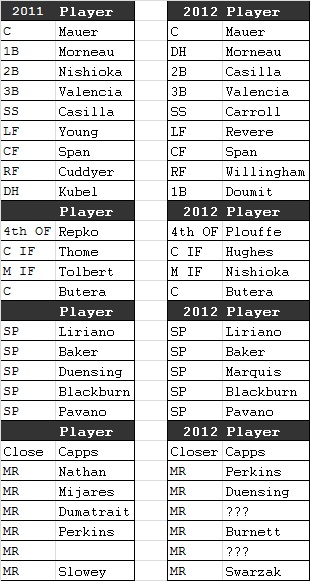
Below is the opening day roster (more or less) of the 2011 Twins versus the probable roster for the 2012 Twins (as things stand right now). I want to do a quick comparison of the two but add a twist – I want to compare the 2012 player with what we hoped the 2011 player was going to do, not what they actually did. Let’s call it the Hope Index. There is a reason I want to go that way, I promise. I’m also not going to do a ton of analysis here - it's late and I'm winging it a bit - so if you want to make your own changes, go ahead. You can put your Hope Index in the comments.

Hitters

EVEN
Cuddyer for Willingham is a wash.

Carroll for Nishioka would be a huge upgrade, except this isn't based on reality, but instead on what we expected from Nishioka. We expected a guy who could get on base from the #2 spot and play average defensively. We’re expecting the same from Carroll. I’m calling those even.

I’ll call Doumit and Kubel about even.

I expect about the same out of Casilla as I did last year. I’m going to say the same about Valencia, but I was pessimistic about him last year. I expect most Twins fans would say they expect less.

Morneau will be a wash – we had a bunch of health concerns and we still do. I’m not sure if they are worse or not than they were.

DOWNGRADE
Ben Revere for Delmon Young is a tough comparison because they’re such different players, but Revere is certainly less than what we expected from Delmon. (Comparing those two in more detail might make a fun entry.)

Mauer and Span, I think we absolutely need to expect less than we did, given their injury concerns.

And the bench as a whole gets a downgrade, too, just because they lose Thome.

Hitters Hope Index: six evens and four downgrades.

Pitching

EVEN
Pavano, Baker and Blackburn are going to be even. They have essentially been the same two years in a row.

As much as I hated the Capps signing this year – and I hated it a lot – I’m not sure the Twins look any worse at closer than they did last year. They might have had a little more depth, but everyone was so unsure of Nathan. I’m calling it even.

I’ll call the back half of the bullpen even, too. I didn’t know who was going to get innings and I’m not sure it mattered a ton. I feel the same way now. I might have a little less confidence in Gardenhire and Anderson’s ability to piece something together but I also have more confidence in Ryan’s ability to dig up some arms.

DOWNGRADE
Liriano is a downgrade – we absolutely expect less of him this year than we did going into last year.

I expect we’ll be happier with Marquis than we were with Duensing last year, but our expectations are probably lower. Duensing entered last year with such solid numbers as a starter, it wasn’t unreasonable to view him as a decent #3 starter. I don’t think many folks expect that from Marquis.

UPGRADE
I would argue that the Twins bullpen setup roles look better this year than they did last year. Nobody knew who was going to be setting up and at least this year Perkins seems like a solid bet.

Hope Index: five evens, two downgrades and one upgrade.

Now, here’s why I wanted to do this: I’m trying to establish reasonable expectations for this team and I wanted to establish a baseline for how much talent this team really has. Usually one starts with how the team did last year. This team lost 99 games, but it really wasn’t this team, was it? With so many injuries, so many rookies, so many meaningless August and September games, I don’t know how to reasonably start to add wins to a 63-win team whose playing time will be so radically altered.

So instead, I’m going back to the beginning. Last year going into the season, this felt like an 85-90 win team, especially after winning 95 games the year before. And what I’ve found is that from that team I have eleven even grades, six downgrades and one upgrade.

Looking at the downgrades, I can see some hope. Liriano could become what we expected, and so could Mauer and Span. The others I’m not so sure about. That feels like a .500 team, though with a lot more downside than upside.

Tuesday, January 03, 2012

Gleeman & the Geek Episode 22: Marquis and Morris


Aaron & I dissect Jason Marquis, pine for some more right-handed relief, argue about Jack Morris' Hall of Fame credentials and celebrate Aaron's birthday. Here are:
Or click on the image below to listen. Thanks!

Wednesday, December 28, 2011

Gleeman & the Geek Episode 21: Minors Moves


The Twins are on their break, so Aaron and John talk about a lot of minor moves, like losing Jose Mijares and lots of ex-prospects joining the Twins. Here are:

Tuesday, December 20, 2011

Gleeman & the Geek Episode 20: Swapping Outfielders


Cuddy's gone. Kubes too, but Josh Willingham arrives. Aaron and I talk about how the changes will affect the Twins lineup and defensive alignment. Also, what "Hot 100" is and why Aaron wants no part of it. Here are:

Wednesday, December 14, 2011

Stuff I Didn't Know About Josh Willingham

He’s Kind Of A Catcher

As a 23-year-old, after a couple of years in the Marlins organization, Willingham began playing catcher. Over the next few years he spent most of his time in the minors behind the plate, playing 60 of 66 games there in AAA. In fact, his first promotion to the majors happened because an ex-Twins catcher was experiencing back stiffness. It was Mike Redmond.

But catching didn’t last. The plan going into 2006 was for Willingham to get extensive catcher-specific coaching from manager Joe Girardi and bench coach Gary Tuck, who is often credited for molding Jorge Posada into a capable catcher. They worked with him all spring, but on Opening Day he was their left fielder. Even then they planned on him catching a couple of days per week, but by the end of April, he was the full time left fielder. He hasn’t caught since.

In the majors, he’s been almost completely a left fielder, laying there 662 in 799 games. While he’s only played first base for four innings in the majors, it’s worth noting that he played all around in the minors, including 119 games at 3B and 68 games at 1B. In fact, in the minors, he was viewed as a possible utility player, though not a middle infield utility player.

Of course, the Twins need a right fielder, since it makes zero sense for Ben Revere’s exceptional range and suspect arm to play in Target Field’s tiny right field. Willingham has only played right field 35 times in his professional career. If the move to right field is a deal breaker, the Twins are going to need to do some roster shuffling – or still go get a right fielder.


He’s Been Injured, But Not THAT Injured

Looking at Willingham’s injury history, one sees lots of indeterminate injuries like a bad back, sore knees and stiff neck. These aren’t exactly injuries that play to the Twins medical (limited) strengths. But the good news is that while his injuries often sideline him for a couple of days, he hasn’t lost too much time to the DL.

Not that there haven’t been some serious issues. He had a brutal September in 2007 due to a herniated disc and it sounds like he needs to lots of maintenance to keep his back strong and healthy. In his first year of catching (2003), he ended up have meniscus surgery on his right knee. Just a couple of years ago his season ended in mid-August because of surgery on his other knee. He’s also been on the DL for an Achilles strain (last year) and a stress fracture in his arm cost him a couple of months back in 2005.

But the reports almost always have him coming back from lesser problems after a couple of days of rest. Given the organization’s frustrations with players sitting out with nagging injuries, it’s easy to speculate that Willingham is viewed a gamer who toughs things out.

Monday, December 12, 2011

Gleeman & the Geek Episode 19: Three Amigos


Seth Stohs (over there on the right) joins us to talk Twins news, straighten us out on the farm system and reflect on a decade of blogging.

Or, you listen by clicking on the image below.


Sunday, December 11, 2011

Cuddyer's Timeline

There has been lots of talk about Michael Cuddyer recently, primarily due to the Twins 3-year/$25 million contract offer. The natural conclusion, given all that chatter and at least one hard offer, was that a decision would be made soon. That hasn't happened.

News broke yesterday that the Twins are considered one of two finalists for Josh Willingham, another right-handed right fielder with 30 HR power. If Willingham were to agree to an offer with the Twins, it would essentially end Cuddyer's Twins career, as the Twins apparently can't afford both. Again, these report suggest a decision will be made soon.

I'm not at all confident that is going to happen.

There is a certain hierarchy to free agent signings and believe it or not, it has nothing to do with "setting the market." That is a myth. Just because some team paid a certain amount for one player doesn't mean that another team needs to pay a similar amount for a similar player. To get that similar player, you just need to have a better offer than the other teams.

Instead, the hierarchy works for logical reasons, by which I mean greed. Given two players, a team wants the better one. Once that player is gone, they want the next best one. And so on.

Want to know why you haven't heard too much about teams pursuing Cuddyer yet? Because they've been pursuing other, better players. There are two right-handed slugging free agents who are much better than Cuddyer (Albert Pujols & Aramis Ramirez), and two more that are comparable (Carlos Beltran & Willingham). Only one of those four players have signed, and it was Pujols on Thursday. Sure enough, reports are that the Cardinals are considering replacing his bat with Beltran. The Marlins and a mystery team also missed out on Pujols. Guess what they're likely shopping for right now?

It's not unusual for free agents to sign before the higher-rated players, but it's unusual for them to do so for a lot less than the market expected. The Twins offer to Cuddyer was considerably less than the market expected. It shouldn't surprise us it wasn't snapped up.
The situation with Willingham is similar. The Rockies, for instance, have already made it clear they might be interested in Willinham IF they don't get Cuddyer. So why would Willingham sign before Cuddyer?

There are other advantages to waiting, too. The Phillies made it clear they valued Cuddyer, but have been trying to work out a deal with shortstop Jimmy Rollins. Depending on how much they spend on him, they might be able to re-enter discussions with Cuddyer. The Red Sox have had interest in Cuddyer, clearly have a need for a corner outfielder, but have limited space before they go over the luxury tax threshold. How much they can spend might depend on whether they can trade away Marco Scutaro's contract, or can work out a multi-year deal with David Ortiz, lowering how much they pay him this year.

All the reports about contract offers and interest make it feel like there should be a speedy resolution. But logic suggests that it is in Cuddyer's and Willingham's best interests to wait this out awhile. If you've been compulsively hitting the refresh button on your favorite baseball website or twitter feed, you may want to recognize that Cuddyer's timeline may not match ours.

Wednesday, December 07, 2011

Rule 5 Draft Previews

The Twins have the second overall pick in this morning’s Rule 5 draft, which is a fun offseason event. Ever heard of Shane Mack or Johan Santana? They were Rule 5 draft picks. Of course, so was last year’s choice, Scott Diamond, or the choice in 2008, Jason Jones. Who? Exactly.

But having the second overall pick is a unique opportunity. The Rule 5 draft is a chance for the Twins to pick over other organization’s players. If a minor leaguer has a certain amount of time in that organization, but isn’t protected by being added to the 40-man roster, the Twins can grab him for $50,000. That might sound like a lot of money, but compared to what it takes to sign a free agent, or even a draft pick, it’s a pittance.

But there is a huge catch. The Twins would need to add their choice to their 25-man roster for the entire season. That means he must be on the team, at the ballpark, being used somewhere by Gardy. If the Twins don’t want to do that, they need to offer him back to his original organization for just $25,000, giving that team a nice return on their rental of the player.

Because of that rule, there are only so many places for a competitive team to “hide” a guy on the roster. Usually, it would be the last guy in the bullpen, a backup infielder or backup outfielder.

Jonathan Mayo
of MLB.com listed some of the top names available here. He has a nice mix of starters and relievers, southpaws and dextrals. With the Twins clearly lacking right-handed relievers, the name that jumped out to me was Johan Yan, a right-handed Rangers side-armer who spend most of the year in AA and is a converted position player.

Yan’s fastball reportedly only tops out around 90, but he’s got a slider that has induced a ton of groundballs (one thing the Twins seem to value) and he’s shown decent control (22BB in 68 IP), missed a lot of bats (61K in 68 IP) and was death to right-handed hitters. You can read more about him here.

Mayo also mentions a few middle infielders, the most intriguing of whom is Drew Cumberland, a second baseman with the Padres. Cumberland was a decent prospect who was sidelined for all of 2011 with inner-ear/concussion problems, but that seems to be licked. Since he only made it to AA, he would need to be used sparingly, but that might work out well, given his recovery. And at just 22 years old, he’s still young enough that if he was stashed for a year, it would just mean he went back to New Britain or Rochester as a 23-year-old. I’m not sure he’s a great fit for the Twins, who want to be competitive, but for a truly rebuilding team, he’s an interesting option. You can read a good story about his comeback here.

Some of our local blogs have done some speculating too. Nate Gilmore at Puckett’s Pond listed middle infielders yesterday and one matched a name on Mayo’s list: Ryan Flaherty, a 25-year-old second baseman with the Cubs. Flaherty is a true utility infielder who played every position except center field and catcher last year. He also raked in AA (.907 OPS, 55K/40 BB) – and then took his lumps in AAA (676 OPS, 44K/10BB). He was drafted as a supplementary pick (41st overall), has been known to struggle against lefties, and probably isn’t good enough defensively to play shortstop except as a backup.

The day before, Gilmore examined some pitchers, drawing attention to right-handed reliever Bryce Stowell in the Indians organization. Stowell fits the mold of other recent Twins bullpen targets – hard thrower, big strikeouts, questionable control. Last year he worked his way through three levels of the minors, topping out in AA with 57K in 38.2 IP – and 21 walks. The year before he spent time in AAA, but had 17 walks in 19.2 innings (but with 28 strikeouts). He could be just another Jim Hoey, but he’s also just 24 years old. There is time for him to find his control.

Those are just four names out of hundreds available, so the chances of the Twins taking any of these guys are slim to none. But this afternoon, check your twitter feed and you’ll find the diamond in the rough that the Twins think they found. Do a google search on the name and see what you find. This time of year, every little bit of hope helps.

Gleeman & the Geek Episode 18: Winter Meetings


It's the middle of the winter meetings and the Twins are making news. Aaron Gleeman and I discuss the Twins re-signing Matt Capps, whether they can do the same with Michael Cuddyer, and how much blame the Twins shoulder for Kevin Slowey's Twins career. Here are:
  • Or you can just click an listen to it below. Let us know what you think!

Wednesday, November 30, 2011

Nathan's Middle Finger

For the last two years, we’ve been worried about Joe Nathan’s arm. Last week he showed the Twins that his middle finger is working just fine.

It took me a couple of days to reach that conclusion because Nathan had always been praised for being such a standup guy. He was known as a leader for younger members of the bullpen. In interviews, he did not shy away from tough questions and gave honest thoughtful replies. He obviously worked hard to prepare, exemplified by how quickly he came back from Tommy John surgery at the advanced age of 36. And he and his wife did lots of charity work for the community.

It isn’t clear the Twins appropriately valued all of that. They certainly didn’t value it enough to pay the extra $10.5M to pick up his option for this season. While they apparently gave Nathan a contract offer early in the free agency process, it was likely a starting point, no more. And when the Twins asked him to sign a waiver 30 minutes prior to the trade deadline this summer, the message wasn’t one of eternal fealty.

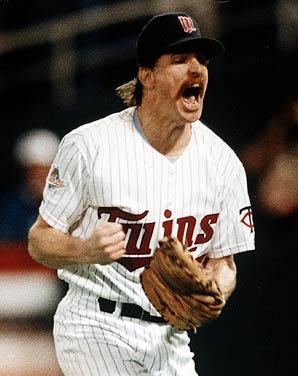
Joe Nathan

So, it’s not clear how much the Twins really valued Joe Nathan. But that’s also because they were never given a last chance to show it. When the Rangers came calling and made an offer to Nathan, by all accounts the Twins had no opportunity to match - or exceed - it.

Obviously, Nathan isn’t under any obligation to give the Twins such an opportunity. Of course, there’s no reason to NOT do it either – all it can do is drive up the price. He gets to choose when he signs a deal and with whom.

No, there is no reason to NOT do that – unless the player has what he wants and doesn’t need any more. It sounds like that was where Nathan was: he had just received a fair multi-year offer (almost exactly matching our phttp://www.blogger.com/img/blank.gifrediction in the TwinsCentric Offseason GM Handbook) to be the closer for a team that has played in the World Series the last two years. What team could match that?

Not the Twins, apparently. All the Twins had in their favor was…
1. Promoting Nathan from middle reliever to closer before he threw a single game for them.
2. Having him close 260 games, giving him the franchise record for saves.
3. Five trips to the postseason, where Nathan had one save and two blown saves with a 1.83 WHIP.

There was also the matter of some financial commitments.
4. The Twins signed him to a two-year, seven-figure deal before his first game, even though his salary was still completely under team control.
5. Two years later, when they could have offered arbitration, they instead signed him to an eight-figure deal, largely because it included an affordable $6M option year…
6. But they ripped up that option year when they signed him to a four-year $47M deal.

So, just to review:
1. In the first year of Nathan’s big deal, he saved 39 games, and could have made just $6M, but instead made $11.25M.
2. In the second year he made that same amount while saving 47 games.
3. In the third year he was out the entire year with Tommy John surgery. Another 11.25M.
4. And in the fourth year he was given back the closer job, lost it, came back from injury midyear and regained it. He saved 14 games, blew three saves and made another $11.25M.
5. Oh, and let’s not forget: then the Twins paid him $2M just so they didn’t have to pay him for a fifth year.

In our podcast, Aaron Gleeman pointed out that Nathan made $47M to throw two-and-a-half years or 181 innings, which is certainly bad enough. But it’s even a little worse than that, because the Twins could have had that first year at half the price. The truth is that they paid $41M for one-and-a-half year, just 113.1 innings. In fact, had the Twins NOT offered that four-year deal, the only real impact was that they would have needed a different closer in 2009. Which, of course, is the year that Nathan laid eggs in Games 2 and 3 of the ALDS versus the Yankees, ending the Twins season.

One might think that a guy whose career literally skyrocketed with an organization might be able to put away recent disappointments. Or that the recipient of that kind of enormous contract might feel lucky, maybe even a little grateful, especially considering how it turned out. Or one could postulate that the relationships formed during an eight-year run, most of which was wildly successful, might result in a single phone call.

It didn’t. Nathan didn’t leave the Twins the way Torii Hunter, Johan Santana or Corey Koskie did, overwhelmed by a team with greater financial resources. Nathan left because he was done with the Twins. The history, the money, and the relationships were quickly forgotten.

They say great relievers must have a really short memory. Nathan just proved it.

Episode 17: Mailbag 2

Aaron Gleeman and I are joined by two great kids: Joe The Random Internet Baseball Guy and his Super-Girlfriend Kate. Together we talk about Twins news and listener's questions, including Matt Capps' return, the hiring of Gene Glynn and why the guy below still gives me nightmares. Also, Aaron reveals his top opening lines for meeting the fairer sex.


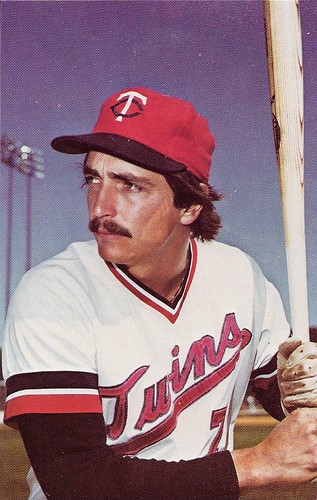
Rob Wilfong

Wednesday, November 23, 2011

Gleeman and the Geek Episode 16

Aaron Gleeman and I talk about Joe Nathan's departure, how MLB's new Collective Bargaining Agreement could affect the Twins and disagree on the wisdom of signing catcher Ryan Doumit.


If you're looking for yet more audio, I'll also be on Fanatic Jack's podcast around 9:30 tonight (Wednesday). He's coming back from a self-imposed year's hiatus and is sure to have plenty of penned up thoughts.

Friday, November 18, 2011

The Doumit Gamble

When TwinsCentric looked ahead to the Twins offseason this year, it’s fair to say that Ryan Doumit was prominently mentioned. Here is his writeup for the Offseason GM Handbook:

Ryan Doumit
Age: 30 (4/3/81) | 2011 Salary: $5.1M
2011 Stats: .300/.350/.478, 8 HR, 28 RBI
When the Pirates acquired Chris Snyder from Arizona at the 2010 July trade deadline, it signaled the end of regular playing time for Doumit. After playing in 124 games in 2010, Doumit played in less than half of the Pirates games in 2011. However, he posted an OPS over .800, and his career OPS in seven seasons is .776. He has thrown out 25% of would-be base stealers in his career. Not exactly a strong defensive catcher, the Pirates have also tried him out at first base and right field in recent years. Pittsburgh has options for 2012 and 2013 at a combined $15.5 million, a lot for a part-time player, so we expect Doumit to be on the market.

And then he made it into half of our offseason blueprints. First Nick Nelson:

5) Sign free agent catcher Ryan Doumit for two years, $9 million.
With Mauer’s status hanging in the balance, the Twins need to add depth at catcher, preferably in the form of a player who could play somewhat regularly and add offensive punch to the lineup. Doumit has spent his career as a part-time guy with the Pirates, never playing in more than 124 games, but his .271/.334/.442 career hitting line is very solid for a catcher and he’s only 30. He’s not considered a strong defensive backstop, but Drew Butera can be kept around to fill that role and Doumit can also fill in at first base and in right field.

Seth targeted him in his blueprint, too:

#5 – Free Agent Signings
Ryan Doumit – C – After making $5.1 million in 2011 in Pittsburgh, he has a $7.25 million option for 2012 and $8.25 million in 2013. He will likely be non-tendered. Although he is not a great defensive catcher, he can definitely hit which would make him a good #2 catcher, DH and PH option. I’d offer him 2 years and $6 million.

(As usual, I’ll just mention – you can buy that Handbook. It’s really easy. It’ll come immediately. Doumit was mentioned NINE times in it. But best of all, it’ll make the offseason more fun and a lot shorter. Just click the button below.)

Add to Cart

There are several good reasons for signing Doumit (pronounced DOUGH-mit). First, he’s not Drew Butera. Second, he’s flexible in the way that Cuddyer was flexible: he can play several non-defensively challenging positions.Also, as mentioned above, he hit last year. And finally, he’s still not Drew Butera.

But there are reasons he was available – and not just available, but available at 1-year and $3 million. It’s for these reasons that I’m more cautious than my fellow TwinsCentrists. And I’d like to illustrate these with a couple of hard-learned lessons:

Lesson 1: A catcher is only described as “flexible” when he can’t catch.
If he could catch, he would never be moved from catcher. You would never know how flexible he is. The problem with signing Doumit is that while he protects the Twins a bit if Mauer can’t catch, he won’t be a real option for any extended period of time. That is especially true for the Twins and Ron Gardenhire, who aren’t too likely to put up with his brand of defense for too long.

Doumit has caught over 100 games just twice in him MLB career. Those two years he threw out 19.6% of base stealers. Overall, he’s thrown out just 24.6% of basestealers. But there is another reason why you can’t expect him to catch for any extended period of time.

Lesson 2: Rate stats don’t help you if you can’t stay on the field.
Here are excerpts from Doumit’s yearly review from rotowire.com, and invaluable subscription site for MLB fans. These are yearly evaluations as captured in that moment in time. See if you can see a trend….

2004 The switch-hitting Doumit had trouble staying on the field in 2004, but if he can beat the injury bug this season he has a chance to re-assert himself as a candidate to become the Pirates catcher of the future.

2005 - Health has always been a huge concern for Doumit. The 25-year-old switch-hitting catcher stayed healthy enough in 2005 to play 100-plus games (126) for just the second time in seven seasons of professional ball.

2006 - For the sixth time in eight professional seasons, Doumit missed significant time due to injuries in 2006. A balky hamstring caused the switch-hitter to play in just 61 games for the Bucs.

2007 - The oft-injured Doumit missed nearly half of the 2007 season with ankle, hamstring and wrist injuries, appearing in just 83 games while batting .274 with nine homers and 32 RBI.

2008 - He played in only 116 games, but that number was good for the second highest mark of his 10-year professional career.

2009 - It's safe to say the Pirates expected more out of their top backstop in 2009, but injuries, slumps and the trading of numerous veterans combined to sour Doumit's season. Doumit broke a bone in his wrist in April and didn't return until July.

2010 - Concussions ruined much of Doumit's usefulness in 2010 and it remains to be seen whether he can recover from multiple bouts of head injuries.

Honestly, when I got to the part about the concussions, I laughed out loud. Of course he has concussions. In fact, he has a history of them. Last year, while catching on 9/23 he took some foul balls to the face mask. He didn’t start another game after that.

Oh, and he was placed on the 60-day DL this last year, too, with a broken ankle.

Given the Twins medical history lately, I’m seriously worried about Doumit’s future. Playing for the Twins might kill him. And if he does die, the medical staff will wait at least five days before confidently placing him on the 15-day DL.

Lesson 3: Platoon splits can lie.
Doumit is listed as a switch-hitter, and hit career splits aren’t terrible: 798 OPS versus right-handers and 718 versus left-handers. But it’s important to look at the at-bats. Doumit has had 75% of his at-bats versus right-handers, which means he’s often been hidden against left-handers, and usually that means he’s not facing the really good left-handed pitchers.

The truth is that Doumit has never been able to convince the Pirates that he was anything more than a platoon hitter for most of his career. That includes last year, when he had only 54 at-bats against southpaws. For the Twins, a platoon hitter at catcher would be fine – but Mauer also hits left-handed.

So there are warts, to be sure. Personally, I’d have rather seen a right-handed hitting defensive backup catcher signed. Coincidentally, Gerald Laird signed with the Tigers today for $1 million. But for for 1-year and $3 million, Doumit is a decent gamble by the Twins, and it could turn out to pay off big.

But make no mistake – it’s a gamble.

Wednesday, November 16, 2011

On Handedness, Pudge & Departures

Just a couple of notes to chew on about the Twins….

Or Left-handed. Or Any-handed.

I’ve trumpeted the acquisition of right-handed hitters for the Twins lineup. But did you know that the Twins actually had a higher OPS last year against left-handed pitchers (670) than they did against right-handed pitchers (665)? I suppose all that shows is that the team was equally dismal on both sides.

Of course, most of the better left-handed bats (Justin Morneau, Joe Mauer & Denard Span) also missed several months last year. Any chance the Twins have competing next year starts with an assumption that at least two of those guys are healthy, and if they are, then the Twins will need some right-handed offense.

And Hopefully That Difference Includes Major League Service Time

Joe Christensen wrote a story about the Twins search for a backup catcher the other day, focusing on veterans Ivan “Pudge” Rodriguez and Jason Veritek. Pudge’s son is also in the Twins farm system, leading to some natural speculation. And Pudge threw out 13 of 25 base stealers last year, showing defensive skills which the Twins value so highly.

His skills from the side of the plate, though, have deteriorated sharply. Over the last three years, he hasn’t cleared a 663 OPS and things got quite a bit worse last year when he hit just .218 with a 604 OPS. He’s enough of an offensive millstone that we didn’t profile him in the TwinsCentric Offseason GM Handbook, lumping him into the “Other Names” section.

But as bad as that 604 OPS is – and it might be bad enough that he can’t find a job this winter – it is still 150 points higher than what Drew Butera posted last year (449 OPS). By way of comparison, 150 points is about the difference between Joe Mauer last year and Joe Mauer in 2010. Or between Joe Mauer in 2010 and Joe Mauer when he won the MVP award in 2009.

Yes, Rodriguez only hit .218 last year – but Butera couldn’t reach that plateau even if you included all of his walks. My point isn’t that the Twins should rush out and get Pudge. The point is that there is a huge difference between an offensively-challenged catcher and Drew Butera.

Ironically, Cuddyer's Departure Wouldn't Be A Departure At All
One other name that has been bandied about hopefully is free agent Josh Willingham, the right-handed outfielder for the A’s who slugged 29 home runs last year. We listed him in the Handbook as the 3rd most desirable free agent outfielder, just behind Michael Cuddyer. Here was the writeup:

Josh Willingham
Age: 32 (2/17/79) | 2011 Salary: $6M
Stats: .246/.332/.477, 29 HR, 98 RBI
Mr. Willingham, the USS Multi-Year has finally pulled into port. After playing a series of one-year contracts, Willingham looks poised for a big deal. He actually had a better year than Cuddyer, but lacks some of the hype. Still, don’t be surprised if the 32-year-old ends up with a longer deal, or one that includes a playable option year.
Estimated Contract: 3 years, $30 million

In the Handbook his name is in red, which means he was projected to be a Type A free agent, and the A’s will almost surely offer arbitration. That means that for the Twins to sign him, they must give up their second round pick to the A’s, which will be somewhere around the 45th overall. I can’t imagine that the Twins would do that, unless…

Unless that’s part of what the “philosophical differences” were. Willingham is clearly, at best, a backup plan if Cuddyer walks. And if Cuddyer (or Jason Kubel) walks, the Twins would end up with extra draft picks in the same vicinity. I suppose it is possible that they could give back one of those picks to sign Willingham.

But it’s worth noting that the Twins – as far as I can remember – have NEVER given up a draft pick for a free agent. Twins officials like to talk about their core philosophy of drafting, developing and giving opportunities to new players. It would be a major departure from that philosophy for them to sign Willingham.

Tuesday, November 15, 2011

Gleeman and the Geek Episode 15


Aaron, the Geek and special guest Howard Sinker talk about Jamey Carroll, the Twins Hall of Fame and new journalism.

Sunday, November 13, 2011

Good Piece, High Price

Middle infielder Jamey Carroll, who the Twins are reportedly very close to signing, is a good fit for the Twins in several ways:

  1. He brings consistent, if average, defense to a team whose infield play was anything but consistent.
  2. He’s been an on-base machine his whole career (.355 career OBP), perfect for a manager that loves the idea of having a middle infielder bat #2 in the lineup.
  3. His right-handed bat plays nicely amidst a Twins lineup that mostly leans left.
  4. He’s been relatively healthy the past few years.

That all sounds great to Twins fans, who had their expectations readjusted last year by eyeball-searing shortstop performances. Which is interesting because they had a guy like that on the roster the year before, who Twins fans sure loved to hate. That player was Nick Punto.

Carroll and Punto aren’t identical. Punto is a better defender, a switch hitter and is three years younger. Carroll has been healthier and has about 25 points of batting average (.278 career) over Punto (.249). But their similarities go beyond their infield flexibility and height (both are listed at 5’ 9”). Both have basically been viewed as very good utility players who have occasionally found themselves in the role of starter, but never for very long.

Because the Twins haven’t officially finished this transaction, it’s hard to say that Carroll will definitely be a starting middle infielder, but he’s sure being paid like it. He’s reportedly going to be making $7M over two years with an option on the 3rd year – which isn’t dissimilar to the 2-year, $8M contract with an optional 3rd year that the Twins gave Nick Punto back in 2008.

What is dissimilar is the age at which those players were given those deals. Punto had just turned 31. On Opening Day this year, Carroll is going to be 38. If Carroll performs both offensively and defensively over the next two years like he did the last two years, it is totally worth it. But for a 37-year-old, that’s far from certain. In fact, it’s probably unlikely.

(And let’s not forget that signing veteran players wasn’t a real strength during Terry Ryan’s first tenure as a general manager. This move feels awfully similar to nabbing Jeff Cirillo and Rondell White. Both were players who looked like great fits, too – right up until their skills tumbled off a cliff. I’m trying to think of counterexamples and having trouble coming up with one. Luis Castillo, I suppose, but he was 30 and came in a trade.)

Make no mistake about it: the Twins overpaid here. It sounds like there was quite a bit of interest in Carroll, so if they really wanted him, they probably needed to. The question is: why him?

It may be that Twins scouts watched Carroll and decided he was worth the considerable risk his age represents. Or it could be that this indicates that Ryan is more concerned about adding offense than defense; there were better defensive middle infielders on the market that would have been cheaper. It also might mean that Ryan wants the flexibility of having another guy who can play third base on the roster, for whatever the reason.

Usually, I’m a big picture guy, and the big picture here is a good one: Carroll is a really good fit for the Twins. If getting that puzzle piece means an extra million dollars and a second guaranteed year, that’s not such a crazy price to pay. And addressing a need like this early in the offseason can set up a team to for even bigger moves this winter.

So it’s a good move - right up until his 38-year-old body gets hurt or Mike Lambs us. At which point this looks as crazy as throwing $8 million at Punto. And then we get the pitchforks out.

Welcome back to the big chair, Terry.

Thursday, November 10, 2011

Offseason Notes

We’ve been awfully insular for the last couple days, gazing at our Twins navels. Meanwhile, the offseason is rolling along. Let’s catch up on some news from around MLB and see how it affects the Twins:

In the “Grass is Greener” Category

San Francisco Giants pitcher Jonathan Sanchez was traded to the Royals for center fielder Melky Cabrera on Monday, hours before the Twins made their change at GM. Sanchez is a guy that we have profiled as a target for the Twins in the TwinsCentric Offseason GM Handbook, though it was last year, not this year. He’s a big arm with little control, exactly the kind of pitcher that the Twins haven’t historically targeted, but to whom they seem to be warming.

Cabrera was one of the names bandied about back when the Twins were talking to the Yankees about Johan Santana. He’s bounced around a bit since then, and was available for peanuts last offseason, when the Royals paid $1.25 million for him. He rebounded nicely with them, becoming a legitimate asset.

The Royals are selling high with Cabrera and the Giants are selling low on Sanchez, which could be praised and criticized. But context is important here: the Royals could afford to take a chance on Cabrera – they weren’t going anywhere anyways. And the Giants are looking for another championship and unwilling to hope that Sanchez turns things around. Both teams are doing what they should do, given their situations.

Cuddy


Michael Cuddyer reportedly visited the Phillies yesterday. I didn’t think he was a good fit for them after they traded for Hunter Pence. He probably wasn’t up until the last at-bat of the NLDS where Ryan Howard hurt his achilles. Now Cuddyer’s flexibility becomes a factor as he can play first base with Howard out and the outfield when Howard returns. I wouldn’t be shocked to see him play around the infield a little this season too, given how banged up the Phillies have been recently.

Cuddyer and the Phillies have been linked pretty closely for a week now, with the only question seemingly being how much and for how many years they’ll sign him. That likely depends on other teams’ interest. The Red Sox reportedly were interested in Cuddyer at the trade deadline, and if they follow through on their attempts to dump Carl Crawford, he would be a great fit there. In fact, he might be anyway, unless they see Josh Reddick taking a big step forward. Those two free-spending teams chasing Cuddy is depressing enough for Twins fans, so, I’ll apologize if the next news feels like piling on.

Remember When WE Had Money? That Was Fun.

The Phillies are also apparently close to re-signing reliever turned closer Ryan Madson. That, by itself, wouldn’t seem to be big news: while the Twins are probably also shopping for a closer, there are still plenty left. ([clear throat.] As you could find out, if you were to purchase the TwinsCentric Offseason GM Handbook. [clear throat.])

But what’s shocking is how much they’re paying for him. The deal was rumored to be for four years and $44 million dollars, significantly higher than we predicted in the Handbook. There are a couple of negative implications here:

1. It means the Phillies are ready to spend, which brings us back to Cuddyer.
2. It may mean that they perceive the closer market to be a lot tighter than we had hoped, bad news if you’re hoping the Twins re-sign Joe Nathan.

The good news? These moves are happening early in the offseason. If Cuddyer (or Nathan) are going to be signed, I’m quite sure the Twins would love to see it happen early, so they can focus on backup plans. For Cuddyer, that might mean taking a longer look at Jason Kubel.

Monday, November 07, 2011

Gleeman & the Geek Ep 14 - Philosophical Differences

You get it all AND the kitchen sink. Bill Smith is fired, Terry Ryan is promoted and Aaron wonders out loud about hitting John in the face.

Thursday, November 03, 2011

Offseason Blueprint + G&G Podcast

Well. That was giant kick to the package.

Check that. That was several giant kicks to the package. Not just this year – next year, too, which hurts even more.

Usually, when a team is decimated by injuries, they have something to show for it. The players who were injured are replaced by minor leaguers who develop some experience and a team reaps those benefits the following year. The Twins got some of that – Ben Revere and Glen Perkins come to mind – but the risks for 2012 outweigh any of those benefits.

Joe Mauer, Justin Morneau and Denard Span are figurative coin flips. So any offseason strategy must take into account some heads and some tails. In each case, you need to leave those players enough room to flourish if they come back strong. But you also need a backup plan for each. So let’s start there.

1) Sign catcher Rod Barajas ($3 milion) and um, “fielder,” Juan Rivera ($2 million).


Barajas is my Mauer insurance, and he adds some right-handed pop (16 HR in 305 appearances with a home park of Dodger Stadium), too. He doesn’t get on base, but he can essentially platoon with Mauer if necessary, or even take a slightly heavier load. He played in 98 games last year, sixteen more than Mauer.

Before we get to Juan Rivera, I’ll point out that his spot could be taken by Chris Parmelee, but I would really like to give Parmelee some time at AAA. Parmelee is the insurance policy if Morneau cannot play at all. I also didn’t address Span, because his replacement is also on the roster: Ben Revere. Moving Revere to center field would require finding a corner outfielder, which brings us to….

Rivera is another right-handed bat with double-digit home run power. He is essentially backing up Span AND Morneau, so I need one of their heads to, ah, come up “heads.” If Morneau is healthy, he can play first base and Rivera hits in the DH spot. I doubt Rivera can really play first base in Morneau’s abscence, but he can play right field. So who plays first base? It could be Mauer. Or it could be….

(Editor's note: since this was published in the
Handbook, Rivera re-signed with the Dodgers. So you'll want to check out the names of the other thirty free agent outfielder profiled in the TwinsCentric Offseason GM Handbook.)

2) Re-sign Michael Cuddyer ($11 million/year) and Joe Nathan ($7/year).


If you want to get all Machiavellian and tell me that money could be spent more wisely, I won’t argue with you. Some will grouse that they’re being retained because they’re two of the more popular Twins in the clubhouse, the organization and the fan base. That’s true, but that’s a very small factor. Another small factor is that they both would love to stay. But the larger argument is that they are both very good fits for this team.

The lineup needs right-handed power. The injury-laden defense need flexibility. And the bullpen needs a good right-handed arm, closer or no. For all those reasons, I’ll roll the dice here. If I end up committing one year longer to Cuddyer than I should have, I’ll worry about that in 2015.

I should mention before we go much further that I’m shooting for a payroll of $115 million, so I had $34.25M to spend (per the payroll story). I’ve spent $23 million. That leaves me with $11.75M, and I want a shortstop, a starting pitcher and another reliever. I’ll take care of the first one on the cheap.

3) Sign shortstop Nick Punto ($750,000).


Punto fields well and gets on base, and those two traits, by themselves, are a huge improvement over anything the Twins trotted out last year. I even think his third trait – getting injured – is nice, because it gives the Twins a chance to insert Trevor Plouffe (who will be on the bench because he’s out of options) or Tsuyoshi Nishioka (who will likely be in AAA, because he’s not).

For the emotionally scarred, there are other names you could insert here, too. If you really like veterans, you can try John McDonald, Cesar Izturis or Jack Wilson. If you want a little more offense, maybe Edgar Renteria. If you want to pay just a little more, upgrade to Ramon Santiago. I won’t blame you. We all have our limits.

Next we get to why I was so cheap at such an important position.

4) Sign Mark Buehrle ($10 million/year).


Most of the Twins rotation leaves after this year. Carl Pavano’s contract ends, Scott Baker’s likely does, and Francisco Liriano will be a free agent. Signing Buehrle hedges against all those defections and gives the team a veteran anchor beyond this year. But there are other reasons, too.

First, he’s left-handed, which plays well at Target Field and often in the playoffs. Second, he’s a successful veteran whose style syncs with the Twins pitching gospel: work fast, throw strikes, and trust your defense (which is upgraded). Third, if the White Sox are willing to let him walk, you just KNOW he would love to stick it to them. And finally, he’s just enough of a cocky son-of-a-bitch to fire up the team a bit. Add all that up and he’s worth the money and the mult-year commitment, even at 33 years old.

That leaves just $1 million, so I’m either trading or non-tendering Kevin Slowey, preferably for a relief arm with some Ks in it. I don’t know if that new arm will help the bullpen this year, and I don’t care. I’d love to add one more arm to the bullpen, but I ran out of money and the organization will need to figure out how to get that seventh inning setup guy.

Instead, the team added some right-handed power, a middle infield glove, a left-handed veteran starter and insured itself against last year’s injuries. It also brought back two of the better (and more popular) players from last year’s debacle. Hopefully this team will be kicking some butts instead of taking kicks on the other side.

~~~~~

Above is one of several offseason blueprints that the Twins could follow and are being pulbished this week in the TwinsCentric Offseason GM Handbook. You can still get yours, if you're fan enough:

Add to Cart

For more on the above blueprint, hear Aaron Gleeman critique it on Episode 12 of the Gleeman and the Geek podcast. Or check out last night’s effort, where we talk about Halloween weekend, the latest Twins news, answered questions from Twitter and dove into middle infield options for the Twins – all while swimming through a pitcher of New Belgium's Snow Day at Tuttle’s in Hopkins. You can find:

Thursday, October 27, 2011

Kubel's Choice and Free Agent Options

There is a possible plot twist to Jason Kubel’s free agency that people aren’t really talking about. With the news yesterday that Kubel is still resting his foot and hasn’t resumed hit offseason routine yet, that twist becomes a little more interesting.

Also, while the free agent market for outfielders is usually described as thin, that’s because it is very thin at the top level. (That “Cha-CHING!” sound you just heard came from Michael Cuddyer’s agent.) But there are some interesting names a little further down the hierarchy, and the Twins may be shopping in that section if they lose Cuddyer and Kubel.

As such, I’m pulling a section about Kubel few free agent profiles from the TwinsCentric Offseason GM Handbook from the “midde” of the free agent outfielders list that talk about Kubel, his interesting option and some of those intriguing names. But first, three things about the handbook:

First, THANK YOU to everyone that has taken advantage of the 40% discounted presale price. We appreciate the support. It's really humbling and exciting that a product this in-depth has hundreds, heading towards thousands, of supporters.

We also appreciate your courage. While the iPad and Kimble have made buying electronic content more commonplace, I still estimate at least 85% of the population wouldn’t consider buying an ebook, just because it’s a little out of their comfort zone. I get that – we all trend to that which we have done before. We appreciate you taking a chance.

Finally, today is possibly the last day to get it at the $5.99 price. It ends when the World Series does. You can do so using this button:

Add to Cart

And again, THANKS.

From the Twins Free Agent Decisions area:

Jason Kubel
Kubel is a Type B free agent, and the Twins will offer him arbitration. I suspect he’ll turn that down, but it wouldn’t be absolutely crazy for him to accept it. After two sub-par years, he’s young enough that he could decide to play for one more year and try the free agent market again next year, after a better season.

If he decides to test the market, he’ll find himself among the top five most desirable outfielder names – and the youngest of them, too. At just 29 years old, he could easily be seen as a steal – a guy just hitting his prime that is overlooked because of some bigger names. A three-year deal for a reasonable number (~$20M) would fill a need for some teams and still allow Kubel another chance at free agency when he’s just 32. Would the Twins be interested in him at that number?

It might depend on the timing, more than the money. The Twins would certainly be more interested in retaining Cuddyer than Kubel, partly because the Twins need more right-handed hitters in their lineup and partly because of Cuddyer’s leadership in the clubhouse. If another team is aggressive and makes Kubel decide before Cuddyer signs, the Twins might not be ready to ante up.

From Free Agent Outfielders section

Coco Crisp
Age: 31 (11/1/79) | 2011 Salary: $5.75M
Stats: .264/.314/.379, 8 HR, 54 RBI
He plays center field, he gets on base at a reasonable clip, he’s got a little power and he stole 43 bases this year. He’s basically everything the Twins would like Denard Span to be. This looks like another mid-level guy that will have some clever GMs licking their chops in anticipation.
Estimated Contract: 3 years, $24 million

Jason Kubel
Age: 29 (5/25/82) | 2011 Salary: $5.25M
Stats: .273/.332/.434, 12 HR, 58 RBI
I guarantee you that there are some savvy GMs sitting in the weeds, targeting a 29-year-old with a career OPS of 833 versus right-handed pitchers, despite an injury-plagued year with a bad foot. The question is whether he’ll take a multi-year deal for ~$6M per year or prefer a one-year deal for more money and try to increase his value. I kind of bet the former.
Estimated Contract: 3 years, $20 million

Cody Ross
Age: 30 (12/23/80) | 2011 Salary: $6.3M
Stats: .240/.325/.405, 14 HR, 52 RBI
He’s young and he’ll always have that 2010 playoffs run. He also put up his substandard OPS in AT&T Park, which should count for something.
Estimated Contract: 2 years, $10 million

David DeJesus
Age: 31 (12/20/79) | 2011 Salary: $6M
Stats: .240/.323/.376, 10 HR, 46 RBI
I’d like to call him yet another sleeper, except for this thumb thing. A torn ligament in his thumb cost him the second half of 2010, after which the Royals traded him. He played out his last year with the A’s, really struggled to the point where he was platooning, and then missed time with soreness in the same thumb. GMs might be wondering if that is a lingering problem. Before last year, he was an on-base machine, so I think he’ll have his choice of some decent one-year “prove it” offers.
Estimated Contract: 1 year, $5.5 million (plus incentives)

Johnny Damon
Age: 37 (11/5/73) | 2011 Salary: $5.25M
Stats: .261/.326/.418, 16 HR, 73 RBI
He played mostly designated hitter for Rays, but 37-year-old beggars can’t be choosers. However, I wouldn’t be shocked if someone would let him play left field, which would lessen the negative impact of his weak arm. His offensive numbers improved over last year, so one way or the other, I think there’s a job out there.
Estimated Contract: 1 year, $5 million

While you’re waiting for the Handbook to arrive, there is still lots of other Twins stuff to check out:
  • Parker asks whether re-signing Joe Nathan is a good idea for the Twins – by looking at his velocity throughout the year and pitch charts that map his control. That’s the kind of analysis that is a level (or three) deeper than most sportswriters will go.
  • If you’re more of a listener, Seth has links to his Weekly Minnesota Twins Podcast, the granddaddy of Twins podcasts. This week the Twins in the Arizona Fall League and about how a Twins prospect led Team Canada to a win in the Pan Am games this week week over (ugh) Team USA.
  • And, The Gleeman and the Geek podcast is twice as good this week because there are two of them. We divided it into two parts and still had to cut it short because we got kicked out (maybe “gently nudged out” is a better term) of the bar we were in.
In Part 1, we talk about the latest Twins news, including how likely Nathan is to return. In Part 2, I unveil my offseason blueprint and Aaron lists other options. We also get sidetracked by topics like our comments section, my weekend and Ron Gardenhire’s aversion for platoons.Thanks again to KFAN.com for helping distribute it. Here are:

- the podcasts

- the rss feed if you want to subscribe and

- the podcast on iTunes (where you can also subscribe).