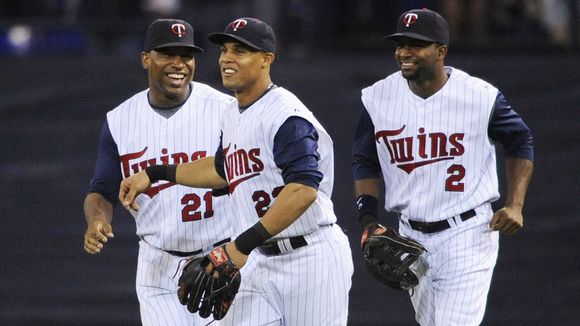
Thursday, June 11, 2009

What the Hell Happened to Delmon Young (Part 4 - The Future)

So what does the future hold for the Twins, their fans and Delmon Young?

Well, for Twins fans, it hopefully includes watching and/or taping the MLB Network (channel 733 in Mpls) today (Friday) at 2PM. That's when "We Are Young" the documentary about Delmon's and Dmitri's family airs. It was on a few months ago, but I completely missed it. I'm looking forward to seeing if it gives any insights. My DVR is set.

You might also want to check out this excellent article in the New York Times by ex-player Doug Glanville about the Young family. He completely relates to older brother Dmitri and gives some further insight on some of the dynamics. He also praises the documentary.

Beyond that? Prepare for a very slow hard road back for Young and the Twins. I listed the traps the Twins and Delmon find themselves in yesterday. And today we find an utter lack of quick solutions.

Solution 1: Send him to the minors
Yesterday we listed why we can't - that stupid contract - and I was asked in the comments just how sure I am that there are no options left. The answer is pretty damn sure. Seth Stohs and I talked about this ad nauseum over the offseason, and he had a source within the Twins confirm that Young had no options left.

That raises the question as to why the Twins had Young sign a 'split' contract during the offseason, which dictates different salaries for time in the majors versus time in the minors. And I still don't know the answer to that.

It was also suggested that the Twins find some way of finagling Young down to the minors, possibly using an DL move. That's a great solution, in a deus ex machina kind of way. But as I mentioned yesterday, it's also a very short term solution, and he needs more than a quick tune-up. There's no evidence he ever mastered Triple-A, and a short trip there isn't going to make much difference. And of course, all of those methods require a player's consent, and there's no indication that Young is open to returning to Triple-A. Especially, I suppose, given that split contract.

Solution 2: Trade him
And get what, exactly?

The Twins apparently went down this road this offseason and couldn't find any value. Since then, Young has performed worse, played less, and grown more expensive. So what exactly do you think you're going to get for him?

Solution 3: Move him to right field
It doesn't necessarily help his offensive development to play right field, but at least you don't need to factor in the atrocious defense when deciding how much he plays. But right now both Michael Cuddyer and Jason Kubel are SIGNIFICANTLY more valuable than Young, though I suppose it would be fine starting Young over Kubel versus southpaws.

Could you trade one of them? Sure, but why the hell would you? We're not talking about a game or two dropoff, like we are when we compare him to the equally overmatched Carlos Gomez. You're giving away 200-300 points of OPS right now substituting Young for Cuddyer or Kubel. That's just nuts.

Solution 4: Play him everyday
This was my solution as little as a couple of weeks ago. The problem is that this too has been tried. He had 600+ plate appearances. None of them are going to do any good if he keeps clutching the "look pa, just arms" approach he has at the plate. If anything all those plate appearances seem to reinforce that his approach is valid. Which makes you want to...

Solution 5: Bench him
By going into the season with a crowded outfield, the Twins left themselves this option. So far the times to play Young are determined on the matchup or whether or not at-bats are being distributed fairly. That's noble, but I'd advocate more Skinnerian method. When Young starts getting serious about modifying his plate approach, you reward him with plate appearances. Until then, we'll play with 24 guys.

(And Nick, before you ask, no, this doesn't mean I'm advocating playing Gomez full time. He NEEDS instruction in Rochester. We are ruining this kid with our short-term fixation. I'm starting to get truly angry as I seem him flop around at the plate like a boated carp. His OBP this month is .259. It's become borderline cruel.

Bring up Morales to DH and move Kubel to LF. Or anything else, really. Talk about something that needs to be a priority. Untracking Gomez from becoming the most talented fourth outfielder in the league needs to be a priority.)


Is that a little harsh? Sure. Maybe even spiteful. But this is what I mean when I say fixing Young needs to be a priority. I don't particularly care if he provides much benefit for the next few months, or even early into next year. The focus needs to be in getting those quick wrists to put up a respectable corner-outfieldish 850 OPS late next year and grow from there.

And I have no problem waiting for that turnaround to happen. If it doesn't, he can spend the next 3.5 years getting a couple of hundred at-bats versus lefties. Gawd knows with fairly pathetic offensive totals arbitration won't make him expensive. And if he does turn things around, we'll figure out where to play him in the field, or whether it then makes sense to move someone else.

That is what I mean when I say we're talking about a very slow hard road back. That's all the more reason to get started now.

-------------------------------

You know what is NOT going to be a very slow hard road? This weekend's trip to Wrigley. On the contrary, it's going to go way too fast.

To all of you Twins fans who are already there, you can rest assured that at 1:20 I will be eating my heart out of pure jealousy. I'm not ruling out tears. A sunny Friday afternoon game at Wrigley watching the Twins - this is what I think of when I think of heaven. Except the players are all dressed in glowing white robes. And nobody is throwing up on my feet.

The Voice of Reason and I will be flying in (way too) early on Saturday and we have tickets with two other friends for the bleachers on Saturday afternoon. We'll be playing in Wrigleyville following the game (and possibly before, depending on whether there is batting practice or not). If you bump in to me, feel free to do two things:
1) Buy TVOR a beer and
2) Promise me you won't talk to me about Delmon Young. I'm done with that subject for awhile.

Finally, if you haven't already, I'd encourage you to sign up for the Twins Geek Twitter. I'll admit I have been very inconsistent in updating it, but I'm really hoping to have a blow-by-blow account of the Chicago trip, and at the very least we'll update the various watering holes we are visiting.

I gotta say, I am really excited about turning Wrigleyville into Twins Territory. Let's do this right, people.

Wednesday, June 10, 2009

What the Hell Happened to Delmon Young (Part 3 - Traps)

When Delmon Young came to the Twins, in many ways, it looked like a match made in heaven. He was right-handed, projected to have power, young and (maybe most importantly) cheap.

Instead he’s been a multi-car crash. On Tuesday we reviewed one of the more popular reasons why – his free-swinging ways. But there are other factors that have led to this trap that he and the Twins are in, some of which are his fault, some of which are the Twins, and one of which can be traced back to a truly awful decision by a man with whom neither party is currently associated.

Trap 1: The Twins moved Young to left field.

Never has it been so apparent to so many the difference between a right fielder and a left fielder as with Delmon Young. Right field would be perfect for Young, or as perfect as any position is going to be. In the Metrodome, right field is small and the attribute most necessary is a strong arm. Young played right field with Tampa Bay for a year and Baseball Prospectus’s fielding metrics listed him as average. With the Metrodome's dimensions, 'average' is a realistic prediction.

But in left field he’s been borderline brutal. Left field in the Metrodome is huge and requires a player with exceptional range. Young's loping run doesn't suffice. Furthermore, Young struggles reading the ball off the bat in left field. His routes are tentative and circuitous. Various defensive metrics indicate his defense gave up about 20 runs more there than the average left-fielder would last year.

It is so painful to watch that it actually makes fans angry. We can’t quite believe he’s that bad out there. But the evidence, both objective and subjective, is overwhelming. He is exactly that bad out there.

Would things be different if he were in right field? Probably. He’s got the range and arm that current incumbent Michael Cuddyer has. And last year’s numbers - .290, 10 HR, 14 SB - would be somewhat acceptable considering they were coming from a 22-year-old with some upside. But because he is such an enormous liability in left field, his defense erases any goodwill his offense (and age) might contribute.

And barring injuries, that’s not gonna change. Michael Cuddyer’s contract goes through this year and next, with a team option for 2011. Ditto Jason Kubel. Assuming they both stick around (and the Twins love to pick up short-term options) Young wouldn’t have a shot at right field until 2012, which is also the last year before he’s officially granted free agency.

If you’re looking for a reason to criticize the acquisition of Young, this is the safest place to start. Twins scouts, prior to pulling the trigger on this deal, needed to communicate just how dismal Young’s defensive range was. Of all the ways that the Twins and Young are trapped, this one is the most unforgivable.

Trap 2: Young’s Attitude/Coachability

I am purposely going to tread carefully here, because so little is concrete about Young’s supposed attitude and stubbornness. We know about the bat-throwing episode. We know about the screaming match at the end of 2007 with the Rays. We know that Ron Gardenhire recently said that Young isn't open to suggestions about his swing. And we know that in a Twins fan poll about Young’s demeanor on the field, it would be a two-horse race between “joyless” and “sullen”.

Last year the Twins, out of necessity mostly, tried the carrot, investing 623 plate appearances in Young. This year, there is decidedly more stick involved, with Young being the odd man out more often than any other outfielder. There isn’t much evidence that either has been effective.

But at some point, fear needs to start being a motivating factor, because if Delmon isn’t afraid, he should be. On this team he is a fourth outfielder who is losing at-bats. Barring an injury, that doesn't look likely to change. Perhaps it is in the back of his (or his father’s, or his agent’s) mind that he could be moved to a less competitive team that can afford to invest at-bats in a future payout.

But there is almost no incentive on the Twins side to make that happen. They'll get pennies on the dollar. And they hold his rights for another 3.5 years. They also control his playing time. And thus, they pretty much control how much he’s going to make in arbitration. Remember how we couldn’t get Luis Rivas to go away because he never good enough to be expensive, and always promising and young enough to gamble on?

That’s Young’s fairly dismal future right now. 3 ½ years of fans booing, teammates avoiding eye contact, and Young's financial advisor wondering where that eight-figure (or maybe nine) guaranteed contract went.

And the REALLY sad part for him is that he's likely past the point where he has any control over it. His playing time is no longer a result of how willing he is to adjust his batting stance. That train has left the station. Now his at-bats are dependent on how effective Carlos Gomez becomes at recognizing pitches, and how healthy everyone else stays. Of all the ways that the Twins and Young are trapped, this one is the most nauseating.

Trap 3: He isn’t one of us.
I went into this a little in yesterday’s sidebar. There have been protests, and it just makes me more belligerent and self-righteous on the subject, which isn't good. So I’ll expand just a little and then leave it alone.

There is no way the Twins ask their first overall pick to switch positions. There is no way Gardy lobbies to trade away his ROY candidate. And Twins fans, who waited for their golden boy for years, are probably far more patient of his struggles, and far more critical of the team for the lack of progress.

In short, there’s more of a spirit of shared responsibility in the mess. And there’s a lot more focus on the enormous long-term benefit of getting Young straightened out, and a lot less focus on whether investing time in him costs the Twins a game or two this year.

Unfortunately, at this point, I don’t think any of that is likely. Both sides are trapped on their side of the fence. This trap is just plain disheartening, because it was certainly the most avoidable.

Trap 4: That stupid major league contract.

Who in gawd’s name gives a 17-year-old kid a major league contract that dictates that he must complete with his minor league career by the time he’s 21 years old?. Hedley – I mean, Chuck - LaMar, the disastrous former GM of the Tampa Bay Devil Rays, that’s who. And both the Twins and Young are paying for that.

Young, as we saw on Monday, never mastered Triple-A. He might very well be stalled because of the habits he developed in Double-A. And the best incentive to modify them – a possible promotion to the majors – wasn’t possible because he had to be in the majors by a certain time anyway.

It also blocks the Twins and Young from their best option at this point. If the Twins want to send Young to AAA, he needs to clear waivers, and that will never happen. (I’ll be completely honest here – I’m not sure if that can be any different if Young somehow agreed to allow it. I don’t think so, but feel free to correct me.)

Are there various machinations that could get him to Triple-A, like a DL stint for some unspecified emotional disorder? Probably, but we’re not talking about someone needing a 4-week refresher. Young’s stats in AAA are completely different than his stats from AA. And they’re remarkably similar to his stats in the majors. That stint is likely only effective if he’s willing to change some things, and frankly that might be the case at the major league level, too. A trip to Rochester needs to be an extended trip, or it’s more of the same.

And it’s all because some ding-a-ling gave a 17-year-old a major league deal. Oh, and he gave it to him with about 3 weeks left in the season of the first year, so the first of four options was essentially comped. And then, in the second season, despite Young dominating the High-A league, they kept him there the full year. Why not call him up to Double-A that year? For that matter, why debut him in the Arizona Fall League? Good lord. I'm rubbing my temples with one hand and typing with the other. This trap is easily the most frustrating.

So that’s where we are. A promising difference-maker is stuck in a fourth outfielder role for the next several years, trapped in at least four different ways. So where do we go? That’s the final piece of the series. And to be honest, I have no idea what it will say.

Tuesday, June 09, 2009

Sidebar: Delmon Young vs. Joe Mauer

GREAT comments the last couple of days. I'm being challenged on lots of stuff, and that's fantastic, because I'm exploring this stuff myself. As I look forward to the next part of this series I really want to explore the idea that Twins fans perception of Young is skewed because he "isn't one of us", meaning we didn't watch the Twins draft him or his meteoric rise through the lower minors.

Which brings me to Ubelmann's impassioned plea to knock off the Mauer-Young comparisons. I had written the first paragraph below, and that got Ubelmann a little riled up.....

"In summary, [Young] was off-the-charts promising, even compared to Twins prospects like Joe Mauer and Justin Morneau. If you asked baseball wonks to project those three players as 21-year-olds, there is no doubt which one they would’ve preferred. Hands down it would’ve been Young. When the Twins traded for him, he was an ideal acquisition."

That's just wrong. Wrong, wrong, wrong. Even if you suppose that Delmon was the better hitter--despite his obvious lack of plate discipline--the difference in defensive value between a GG-caliber catcher and an average-at-best corner outfielder is gigantic. At most, it would have been a toss-up between Mauer and Delmon, and to say that Delmon would have been the "hands-down" favorite is spectacularly ridiculous. And if you'd like a present-day example, you don't have to look farther than comparing the hype for Travis Snider to the hype for Matt Wieters--and Wieters is even a couple of years older than Snider, but is still considered the far more promising prospect. (And using Delmon's RF metrics to defend is defensive abilities is focusing too much on a tiny set of data. Not to mention that if you're average in a corner spot at age 21, you're probably not getting any better--fielding abilities peak much earlier than hitting abilities.)

I know that no one suspected Delmon to be this bad, but I think that people projecting him to be a perennial All-Star as of the 2007-8 offseason were out of their minds. To be a perennial All-Star at a corner outfield spot, you have to be one of the top few hitters in the league--a nearly flawless hitter--and I don't think that Delmon displayed that kind of promise once we saw him against major league pitching. And it's not like this is total hindsight, because at the time of the trade, I wrote about how this was a really risky move, hoping that Delmon's bat would develop, because it seemed like he had no idea what he was doing at the plate, and there was a really long way to go between where he is now and what he might have become, and he had no defensive skills to fall back on.

OK, I'll play. I may be be wrong, and I'm too tired to do any heavy lifting, so rather than write up tonight's next part, I want do the following: I'll look up Mauer and Young's seasons at 20 and 21 on TheBaseballCube.com. I'll compare them, and then I'll also throw out what rotowire.com said about both players, just so we have an objective voice that was writing without hindsight. You know what? Just so we have another credible source, I'll also summarize what Baseball Prospectus said. Let's see what memories this drudges up...

Their Year at 20
Young spent most of the year in AAA, served that suspension, and was promoted to the majors where he posted an 815 OPS in the last month. This is the year he started striking out a lot more and walking a lot less. Rotowire says

"The Devil Rays expect to start the season with Young as their everyday right fielder and No. 3 hitter. With his power, speed and defense, he's a legitimate ROY candidate."


BP said:

"Young doesn't walk a whole lot, but boy howdy can he hit."


Then they praised how he did as a 20-year-old while cautioning that he'll need to learn some plate discipline to become another Vladamir Guerrero.


Mauer spent half of his 20 year in High A and half in Double A. Like Young, he had about an OPS in the lower 800s, a high average, little power - but he had a great eye.

Rotowire wrote:

"Mauer will be given every chance to win the starting job at catcher after the trade of A.J. Pierzynski. The 2002 No. 1 overall draft pick has lived up the hype so far in his minor league career and was named by several organizations as the 2003 minor league player of the year. After hitting .335 at high Single-A Ft. Myers, he hit .341 at Double-A with a .431 OBA. The Twins feel he's ready to make the jump to a starting job in the majors at just 21 due to remarkable maturity and astonishing ability to handle a pitching staff for his age. Combine that with strong defensive skills and he should stick in the big leagues even if his bat is slow to come around. The one worry for Mauer has been a lack of power (just five homers all of last year), but that should come as he ages. As a local product, he'll also face extensive media hype and frequent comparisons to Mark Prior (who was the second pick in 2002). Expect a solid batting average in his first season, but low power totals. Still, he's a top Rookie of the Year candidate and a must-have on any keeper list."

Unfortunately, I can't tell you what BP said. Did I not get the 2004 book? I can't find it in my bookcase. Sorry.

What strikes me most about the priase is how similar they are. Top player in the minors and ROY candidates. Mauer's defense is gushed about, but Young isn't viewed as a defensive liability. Both have some concerns (Mauer - power, Young - discipline and attitude). Mauer is viewed as a decent bet to stay in the majors because of his defense, it's not even a question that Young will stay. Mauer is also not viewed as an impact player offensively because of the lack of power, at least not necessarily right away. I'd call it a push.

Their Year at 21
This was the year Young played full time in Tampa Bay basically did what we've seen him do every year - hit for a decent average, little power and a lot of strikouts. I think it's worth noting that Baseball Prospectus listed his defense in right field as being just one run worse than average there, though he was worse than that when he (shudder) played center field. Rotowire talked about how he didn't have a great year, finished second in ROY voting, but had the talent to make that vote look silly in a couple of years. BP talked mostly about the trade, and brought up his issues, but compared him to Vladamir Guerrero for the second time in two years:


"Yes Young's moody, yes he's overly aggressive at the plate, yes his power hasn't come as expected, but he's also still just 22 and regarded by scouts as one of the best young hitters around. Rays officials are hoping against hope that he fails to live up to PECOTA's Vladimir Guerrero comp (a comparison scouts have made as well) as he heads north to the land of 10,000 lakes."

Mauer missed almost the whole year because of that damn knee injury. He did very well in the 100 or so at-bats he had. Rotowire said:

"Mauer was regarded as the top prospect in baseball before the 2004 season began and won the starting job at catcher. In just his second major league game the 2002 No. 1 overall draft pick tore cartilage in his left knee. After surgery he returned in June but problems with the knee landed him on the DL again six weeks later and he wasn't able to play the rest of the season. ...While the Twins say they expect Mauer to be able to catch again there is some doubt since he had soreness in the knee even into last fall. The Twins would like to keep him behind the plate because he's got strong defensive skills and an uncanny ability to handle a pitching staff at a young age. No matter where he plays, Mauer has strong plate discipline which should lead to a .300 batting average with modest power. If his knee is healthy, he should quickly become one of the AL's top catchers."

BP was more worried. Here's a good chunk of their review of his year:


"The Twins are telling everyone that there's no problem, and if you smoke enough oregano, you might completely believe it. Don't listen, because their actions tell you they're worried. Why else pick up both Mike Redmond and Corky Miller this winter? Even if or when Mauer is healed up, there's still the issue of his size, since he's probably the biggest catcher in the league behind the perpetually fragile Sandy Alomar. It's time to accept that Bunyanesque catchers aren't meant for long and healthy careers."


Geez, I'd forgotten all about the 6' 5" nonsense that BP spewed for years. And how it scared the hell out of us when he hurt that knee.

That, to me, favors Delmon Young. Yes, Mauer's defense added value to him, but there were questions throughout his minor league career whether he would stay behind the plate because of his size. There were questions about his power, even up through this last offseason where BP was comparing his career path to that of Jason Kendall.


So back to the "Wrong. Wrong. Wrong." paragraph I wrote:


"In summary, he was off-the-charts promising, even compared to Twins prospects like Joe Mauer and Justin Morneau. If you asked baseball wonks to project those three players as 21-year-olds, there is no doubt which one they would’ve preferred. Hands down it would’ve been Young. When the Twins traded for him, he was an ideal acquisition."


Was Young "hands-down" a pick over Mauer? Probably not hands down. There were probably plenty of scouts that would've liked the catcher.


But Young would've initiated his equal share of drooling and was off-the-charts promising. He was also right-handed and projected to be another Vladamir Guererro. He truly was an ideal acquisition. So I'd go with "Right. Wrong. Right."


And I'll tell you another thing this little exercise has convinced me of. That we as a community, even incredibly analytical, fairly objective, sharp guys like Ubelmann, are completely undervaluing the talent that Young has demonstrated because it was with another organization. In this weekend's GameDay Chatter on the Twins Extra Innings show (On KSTP 1500 following Sunday's game) there will be a paragraph that says:


I can’t help but wonder, if Young had come up through the Twins minor leagues whether he might have been treated differently by the organization and fans. Would the Twins have asked their #1 overall pick to switch defensive positions? Would fans have been more patient with his lack of power if they had heard about him dominating Double-A as a 19-year-old? Would Gardy have hinted about trading Young if Delmon finished second in Rookie of the Year voting while he was on Gardy's team?


We waited for Mauer and Morneau despite all the concerns because we had been weened on their minor league exploits for years. And Young hasn't received that same consideration, either from the bloggers, the fans, or the organization, because we didn't get those weekly updates over several years.


And I'll go a step further. Developing this talent should be a priority. The Twins risk making another Big-Papi-sized mistake here. And this time, we'll have nobody to blame but ourselves, because the evidence of abundant talent is literally smacking us upside the head if we only care to open our eyes.

Monday, June 08, 2009

What the Hell Happened to Delmon Young? (Part 2 - The Big Problem?)

Yesterday we reviewed Delmon Young’s professional career, of which Twins fans are mostly ignorant or dismissive. In summary, he was off-the-charts promising, even compared to Twins prospects like Joe Mauer and Justin Morneau. If you asked baseball wonks to project those three players as 21-year-olds, there is no doubt which one they would’ve preferred. Hands down it would’ve been Young. When the Twins traded for him, he was an ideal acquisition.

Now, that acquisition looks like a disaster. Forget what the Twins gave up. Young has sunk from future (and practically imminent) all-star to a fourth outfielder, and a bad fourth outfielder at that. He sports a high batting average but mediocre on-base skills and almost no power. He’s Jason Tyner – except without the defensive value.

What happened? The conceptual wisdom is that Young’s primary problem is that he will swing at almost anything. Well, maybe not everything. But if the ball is inside, low or (most especially) high, Young is likely swinging. Young is a swinger.

Inside-Edge.com (sorry, it’s a subscription site, but well worth the money) shows that if pitchers are silly enough to throw the ball in the strike zone, Young can hit it. InsideEdge paints virtually his entire strike zone as ‘hot', and most of it falls within his ‘power zone’. You find similar layouts for Joe Mauer and Justin Morneau. You do NOT find similar layouts for players like Michael Cuddyer or Joe Crede. Their zone is a mixture of hot and cold. Again, Young profiles like a superstar.

But Young chases a lot of pitches. He swings at more than 50% of pitches that are either low or inside. And he swings at over 70% of pitches that are high. InsideEdge tracks how often he chases pitches early in the count, with two strikes, or pitches that aren’t even close, and in all cases he’s about 50-70% more likely to swing than your average major league player. He’s got a swinging problem.

Unfortunately, it’s not totally clear that is his problem this year. Again, according to InsideEdge’s tracking, Young has improved this year in most of their ‘chasing’ metrics, but he is striking out more than ever and walking less than ever. Note that he’s still not good, or even close to average, but their metrics indicate that where Young is struggling this year is more about producing solid contact. This current slump might just that: a slump.

Interestingly, it’s also not clear that Young does any better those months where he is pickier at the plate. You might expect that his batting average improves in those months where he takes more walks and strikes out less. But if you crunch the numbers, the opposite is true – the less he walks, and the more he strikes out, it is slightly more likely that his batting average improves.*

And finally, it’s worth noting that there is another Twin who, according to InsideEdge, is every bit the free swinger that Delmon Young is, and it's not who you think. It’s Justin Morneau, who is actually more likely to chase high or inside pitches than Young. The difference is that when Morneau hits those pitches, they stay hit. (I was personally so shocked by this that it made me wonder about the accuracy of their data. I’ve reviewed it multiple ways over a couple of years. It’s consistent.) If you’re looking for what a free swinger can do when they learn to hit the ball, Morneau is a heck of an example.

It is clear that Young is a free swinger, but it isn't as clear that is the main problem he faces offensively. What is clear is that several other significant factors have contributed to his fall from grace. We'll get into that in the next post.

----------------------------

*This result surprised me, as did a lot of what I found in researching this story. Here's the comparison of Young's BB/K ratio compared to the batting average and OPS every month since the beginning of 2007:

Month BB/SO AVG OPS
2007-4 15.0% 0.257 0.672
2007-5 40.9% 0.247 0.707
2007-6 10.5% 0.310 0.762
2007-7 30.0% 0.343 0.806
2007-8 16.7% 0.298 0.715
2007-9 9.1% 0.268 0.674
2008-4 31.6% 0.255 0.604
2008-5 68.8% 0.264 0.697
2008-6 18.8% 0.321 0.817
2008-7 11.1% 0.330 0.813
2008-8 47.1% 0.245 0.707
2008-9 26.3% 0.330 0.823
2009-4 13.3% 0.241 0.591
2009-5 13.6% 0.236 0.524

The correlation between BB/SO and AVG is -.22, which is obviously negative. The correlation between BB/SO and OPS is .040, which is close to random.

Sunday, June 07, 2009

What the Hell Happened to Delmon Young? (Part 1 - The Promise)

Do you want to believe in Delmon Young? It's not hard if you look backwards a little.

Young appeared on most Twins fans' radars in November of 2007, when he was acquired as part of a six-player trade with the Tampa Bay Rays. But he had a history filled with promise with which we might not be acquainted, or now find easy to overlook. There are all kinds of sites that track players with daily updates for their careers. On of my favorites is rotowire.com, which gave yearly overviews of his progress. So let's review his record and use rotowire as another objective source.

2003 – Young was the first overall draft choice by the Devil Rays and signed a major league contract (which becomes very important) in September. The Rays debuted him in the fairly advanced Arizona Fall League, and Rotowire summarized the excitement about this kid:

“It's tough to make your pro debut in the Arizona Fall League, but that's what Young did, and he pulled off the near-impossible -- making [Rays GM] Chuck LaMar look like a genius. The No. 1 overall pick in the 2003 draft hit .417/.451/.625 in his first 15 games against pro pitching and had scouts drooling, comparing him to a young Albert Belle minus the attitude.”

Yeah, I'm gonna bold some stuff. And how much do you love the Albert Belle comparison given some of Young's later anger-management issues?

2004 – As an 18-year-old, Young played a whole season in High A-ball and dominated the league, batting .320, hitting 25 home runs, stealing 21 bases, and knocking in 115 runs. He struck out quite a bit (120 K) but he also walked 53 times and sported an impressive .386 OBP. Rotowire and the rest of the league were suitably impressed:

“Young will be the best prospect in all of the minors when the 2005 season opens—unless Tampa Bay decides to start him as their right fielder. That sounds ludicrous, but in this organization it could happen.”

2005 – Rotowire was right about that “best in all of the minors” thing. As a 19-year-old Young made Double-A look easier than High-A. He was promoted to Triple-A while he was still just nineteen years old, because in 330 at-bats he had hit .336 with 20 home runs and 25 stolen bases. He still had some problems with the strikeouts (66 K) but also drew some walks (25) and got on base regardless (again, a .386 OBP).

In Triple-A, things didn’t go as well. The power disappeared with just 6 home runs in 228 at-bats. The average (.285) and stolen bases (7) declined too. Maybe most alarming was that he was no longer walking enough (just 4) to counteract all the strikeouts (33). On the other hand, you’re talking about a nineteen-year-old promoted midseason to Triple-A. It would’ve been surprising if he didn’t struggle. Rotowire summarized the season:

“The Minor League Player of the Year put up great numbers at Double-A, but wasn't dominant in his brief stint at Triple-A -- not that he stunk, either, but the stat line shows Young very likely could use some additional seasoning at Triple-A. That's where Young will start the 2006 season; how quickly he comes up will depend both on his bat and on who's doing what at the big league level. The new Rays management team won't mind not calling up Young until after Opening Day of 2007 in order to put off his arbitration payday as long as possible; it'll be up to Young to show them that patience isn't a virtue in his case.”

Note that most of the summary talks about when he'll be called up. That would be overshadowed by an incident in his last minor league season.

2006 - Young started the year in Triple-A and drew national attention when he was suspended for 50 games for flipping a bat at an umpire after a called third strike. That may have delayed his arrival in the majors, but he was still called up and handed a full time role on the Rays in late August. He would not find himself in the minors again.

And, in fact, he couldn’t. Because Rotowire was wrong about the Rays management team not wanting to call up Young until after Opening Day of 2007. Since Young had signed a major league contract, his three ‘option years’ had already been used. (That's unlike most ballplayers, who don’t start using them until they are added to the 40-man roster.) They had been used in 2004, 2005 and now 2006. Young was going to be on a major league roster one way or the other in 2007.

Which, in retrospect, was a pretty big problem, because Young was pretty clearly not ready for that promotion. The hubbub over the suspension and the emphasis on Young’s arrival to the majors overlooked that his performance in AAA hadn’t really improved. Here are Young’s final Triple-A stats from the two years:

570 AB, .303 BA, 14 HR, 29 SB, 98 K, 19 BB.

Just viewing those stats, without all the history and publicity, the analysis would be that Young is a speedy, light-hitting, high-average guy who might struggle in the majors because he has trouble telling a ball from a strike. Instead, mostly the concern about him was the suspension:

“Young lost two months of last season when he was suspended for flipping his bat at an umpire in a Triple-A game. With that, he still put up great numbers at Durham and decent stats in his September stint with the Rays. More importantly, he showed tiny signs that he knew he'd crossed the line and had to reel in his temper. The Devil Rays expect to start the season with Young as their everyday right fielder and No. 3 hitter. With his power, speed and defense, he's a legitimate ROY candidate.”

2007 – Young didn’t win the Rookie of the Year, but he finished in second. He put up stats that are almost duplicates of those he put up with the Twins a year later, meaning he hit for a decent average (.288), not much power (13 HR), stole some bases (10 SB), but had no idea what a strike zone was (127K vs 26BB). For a 21-year-old, those aren’t bad numbers, provided he builds on them, as rotowire noted:

“Young came close to a .300/100-RBI season, a rare achievement for a rookie, especially for one who did not turn 22 until September. He'll certainly start the spring as the Twins' everyday right fielder. However, Young does need to work on plate discipline. … He did not win Rookie of the Year honors in 2007, but Young has the upside to make the resulting vote look like an utter embarrassment in a few years.”

Which brings us back to what looked like an astute trade. The Twins were searching for a young high-upside right-handed bat to plug between Joe Mauer and Justin Morneau. They were able to acquire a 22-year-old who:
1. Was the first overall draft pick in 2003 as a 17-year-old
2. The best prospect in the minors in 2004 as an 18-year-old
3. The Minor League Player of the Year in 2005 as a 19-year-old
4. Made his major league debut in 2006 as a 20-year-old and
5. Finished second in the Rookie of the Year voting in 2007 as a 21-year-old.

Let’s make some blunt comparisons. Mauer was the first overall pick, but he didn’t hit like Young did in the minors. Morneau never had the minor league acclaim that Young did, nor did he put up anything close to ROY numbers in his first two years. There is nobody else on the Twins roster with Young’s pedigree. He was a thoroughbred like no other, and had just been traded to a contending team to fill the lineup void between a batting champion and an MVP.

It was easy to believe.

Next we'll look at the fall of Young and what contributed to it before we look at what the future holds for Young and the Twins.

Tuesday, May 26, 2009

Comebacker

Sorry I've been gone. I honestly don't have a good reason. I just stopped writing, and I didn't start again. Kinda scary. Let's try and get back on the horse by throwing some various thoughts out there while watching this Twins/Red Sox game.

Mauer as DH
Mauer, Mauer, Mauer. If I'm in the Twins clubhouse, I might be getting a little tired of the Mauer talk, except that I expect they're too busy being in awe of this little streak he's on right now. Dan Barreiro described the feeling when he said today that every Mauer at-bat is "An Event". That's how it feels.

I'm surprised more isn't being made of Mauer playing designated hitter when he's not catching. Twins fans have griped about Mauer not playing DH on 'off days' for years, and it's something that the manager has defended for years, usually by talking about game situations where Redmond gets hurt. If that were to happen, if Mauer had to move to catcher from DH, the pitcher would need to bat for the rest of the game.

So what's the difference this year? Why is Gardy batting Mauer at DH on those days, even though he hasn't had a 3rd catcher for most of the month. It might be because Mauer is hitting crazy good, but Mauer was always a key offensive asset, better than whoever else was playing DH. So what's the difference?

One thing that Gardenhire seems to be aware of his his players personal goals. He often manages the length of a starting pitcher's outing based on whether he can get the pitcher a 'W'. Even last Saturday night, with a 6-1 lead, he used two of his top relievers to pitch the eighth and ninth inning. Why? Because he wanted to get Swarzak his first win.

That's why Mauer is DHing. It's to get him the plate appearances to get another batting championship. To qualify for a batting championship, a player needs 3.1 plate appearances for every team game played. Mauer came back after missing 22 of the Twins games, which means he needs to make up 68 plate apperances to 'catch up' to the requirement.

Playing every game, he can make up 1 or 2 of those every game with 4 or 5 at-bats. That's a month or two. If he only plays five of every seven games, he'll only make up about 4 at-bats per week. That's comes out to about four or five months.

So how's it going? Entering tonight's game, Mauer has 100 plate appearances. He needs 142.6. We're still about a month away from seeing his name on the leaderboard. Assuming he continues to DH.

Is Gomez Getting Better?
I watched Saturday's game with several bloggers and Phil Mackey told me during the game that Carlos Gomez has been showing improvement lately. Then, afterwards, Nick Nelson and John Meyer both said the same thing. I admited I hadn't been paying that much attention, so I'd try to look at his performance with an open mind. So let's look at his numbers since he started playing full time back on May 17th.

9 Games, 31 AB, 8H, 2BB, 4K, 1SB, 0CS, .258 BA, .303 OBP, .355 SLG

There is one very encouraging sign there. Prior to this stretch, Gomez had 16 strikeouts in 58 at-bats. That's stunningly bad. So it's very encouraging that he's only struck out four times in his last 31 at-bats. To some extent, that's damning with faint praise, but progress is progress.

As for the rest? Well, he's not hitting much. He's not drawing walks or getting on-base at a level where he's an asset. He's not even using his speed on the basepaths, or at least not stealing bases. Across the board, the numbers are better than they were earlier this year, but even during this "hot stretch" they aren't much different than what we saw last year (.258/.296/.360).

Sorry guys. He's not as putrid offensively as he was earlier this year, but other than the Ks, there hasn't been a lot of improvement either. Apropos of nothing, he now has 853 plate appearances in the majors, but I'm sure that step forward is right around the corner. I'll try and keep an open mind while he's here, but I'd rather keep that open mind while he develops his considerable talent in Rochester.

Tuesday, May 12, 2009

Short Stories: Twins 6, Tigers 2

Some games read like a novel, but this one felt more like a collection of short stories. And since we literary types relish that symbolism thing, it's gotta be nine short stories, with morals like....

Inning 1 - Delmon Young has NOT improved enough in left field.

When your defense makes John Gordon gasp for your safety, it's safe to say things haven't improved. How can Young be so completely helpless out there, and could it somehow be related to his offensive struggles? Remember, before he came here, NOBODY complained about his defense. He even played center field a little in Tampa Bay.

At this point, absolutely everything is on the table regarding Young. Is there something wrong with his eyesight? Is the move from right field to left field so traumatic that it affects his batting? Or, is there something wrong with his legs or back that affects his play in the field and at that plate? Gawd knows he doesn't look that comfortable running. Or, um, might he have had "a little help from his friends" in Tampa Bay? I'm not ruling anything out.

We have a new Cristian Guzman on our hands here - someone who was on a trajectory for greatness but has jumped the track, and we're going to be dissecting the hell out of him for the next three years. And he WILL be around for three years, by the way. Right now he's not good enough to become expensive. Remember Luis Rivas? Just bad enough to remain affordable throughout his arbitration years, but promising enough to remain desirable.

Inning 2 - Nick is right. This is a more patient team. And tonight it paid off.

The first run of the game scores tonight because Michael Cuddyer worked a walk before Joe Crede hit his home run. The Twins drew four of those walks from Armando Galarraga in the 5.2 innings he pitched.

But the patience wasn't effective because one walk scored. It was effective because that's how you attack Galarraga. In Gardenhire's pregame talk, he spoke of how Galarraga lives around the edge of the strike zone, trying to induce batters to swing at his slider that dives on the outside of the plate. You get to Galarraga by laying off enough pitches so that he needs to throw the ball over the plate. And that paid off all game, most demonstrably on a 2-1 pitch to Crede.

In fact, when Galarraga left the game, he had thrown 57 strikes and 42 balls. That ratio should be closer to 2:1. By showing a higher level of patience, the Twins had Galarraga pitching uphill all night.

Inning 3 - Joe Mauer might be bionic.

How much do we know about this kidney surgery, really? Is it possible that sacroiliac pain was really the result of implanting some kind of spring-loaded gyro-thingy (it's a technical term) into his lower back? His home run this inning was AGAIN to the opposite field (all of his home runs have been) and on an 0-1 pitch.

What's more, it was a near duplicate to the one he almost hit in the first inning. Except this time he had enough sense to hit it at a lower trajectory so Clete Thomas couldn't get to the wall in time to rob him. Who decides to hit the ball exactly the same way, only with a lower trajectory, and then does it?

(A: The bionic man. That's who. Nnna-na-na-na-na-na-na....)

Inning 4 - I think I'm always gonna be more comfortable in the low rent district.

Tonight I was joined in the slums of the press box by Seth Stohs of SethSpeaks.net, next to Phil Mackey, Doogie Wolfson and a few other semi-degenerates. It was fun examining every decision (and non-decision) and I've decided I like sitting in the slums. I'll take that any time over a quiet and reverent room. Hell, I'd be OK moving it to the blue seats, and include a handful of beers in the mix. (Though it would be hard leaving the free hot dogs.)

Inning 5 - Jim Leyland is smarter than me.

I didn't recognize before this series just how dependent the Tigers have become on Carlos Guillen, who is on the DL. During the offseason they jettisoned several hitters to improve their defense, leaving Guillen, Magglio Ordonez, Miguel Cabrera and Curtis Granderson as the primary offensive threats.

The problem is that Ordonez and Cabrera are both right-handed, and Granderson is such an asset as a leadoff hitter that it seems foolish to have him bat between them. Because of this, Leyland batted left-handed hitters Clete Thomas (who was called up less than a week ago) third and Jeff Larish (who is hitting .250 in 128 career at-bats) fifth. Neither is a tremendous prospect.

In the first inning, when Thomas hit into a double-play to end an early threat, I was thrilled with Leyland's unconventional approach. By the sixth inning, when Thomas was 2 for 3 and Larish had slugged a home run to start the Tigers scoring, I was less impressed with my opinion.

Inning 6 - Jim Leyland is still smarter than me.

In the bottom of the sixth, with Galarraga struggling, down 5-1, and with runners on first and second base, Leyland brought in Ryan Perry. Perry is basically the Tigers version of Juan Morillo. He throws almost exclusively fastballs that are in the upper 90s. In 12.1 innings this year he has struck out 10 - and walked 11. And while right-handed batters are hitting .105 against him, left-handers have hit .286.

Oh, and did I mention that the first batter he's going to face is Denard Span? A patient left-handed hitter? Who would then be followed by Tolbert, Mauer, and Morneau? All of whom are patient left-handed hitters? I was already doing a very tiny happy dance before he had thrown his first pitch.

And very short-lived. Because he struck out Span looking. Then he stayed in for the seventh and struck out Tolbert before Bionic Joe™ got a hit. Didn't matter. He got through the seventh, and did fairly well in the eighth before being pulled by Leyland. It was exactly the kind of confidence-building outing that I would have LOVED to see Morillo have.

Inning 7 - Ron Gardenhire is as baffled as we are by his bullpen.

At the midpoint of the sixth inning, Slowey had thrown 97 pitches and had been in and out of trouble all night, but the team held a 4-1 lead. We wondered if anyone would be warming up in the bullpen? Nope. Or at least not until the inning went a little long and the lead was extended to 5-1. At that point we were a little surprised to see that Jesse Crain, who previously had been trusted with protecting smaller leads in the eighth, would be coming in.

It was most surprising because Crain is right-handed, and the next two batters were not. But who is Gardy gonna bring in? Breslow? Can't trust him with a lead right now. Mijares? Might need to trust him with the eighth inning. And so the right-handed Crain faced two lefties, giving up a home run on a high fastball and then walking Granderson.

At which point, Gardenhire (and the booing stands) had seen enough so he went with Mijares to get him out of the jam. Except now the batter was the right-handed #2 hitter Placido Polanco. And waiting at #4 was right-handed hitter Miguel Cabrera. Fortunately, Mijares was back to his old self and retired all three hitters he faced.

But now who would pitch the eighth? Finally, the matchups favored the Twins, because the inning started out with the left-handed Larish (who Mijares retired) and then came a couple of right-handed hitters, so the Twins brought in Matt Guerrier.

This was bullpen shuffling at it's most desperate, and you have to feel for Gardy who needs to play a nearly perfect hand when he's short-suited.

Inning 8 - Disdain makes me think violent thoughts.

I like TC Bear. He's no Phanatic, but few mascots are. I've met TC Bear, he's treated my kids well, and I generally respect anyone who has the guts and stamina to jump around for hours wrapped in a wool carpet. So I don't have a problem with our mascot.

So why would I pay cash money to beat the super-imposed dancing TC Bear to death with a bat on the Jumbotron?

I'm not entirely sure, but I think it's because the whole dancing video reeks of disdain. Let's show people dancing in the stands. And since people don't really get into it, let's super-impose TC Bear dancing, too. Don't feel like you have to really do anything TC - just twist back and forth a little bit.

And the icing on the cake? TC Bear does his little half-hearted dance for just ten seconds, and then they just loop it over and over so he 'skips' about twenty times during the feature. The whole thing is so phoned-in that it just screams "We know it's contrived. You know it's contrived. And gawd knows that TC Bear knows it's contrived. So how about you, us and TC just make the best of this and shake our groove things for a couple minutes to fulfill our obligatory fun quota?"

You know how I want to fulfill the fun quota? I want to see a super-imposed overly-caffeinated Matt Tolbert join TC Bear after his third skip and beat him within an inch of his life. And then turn towards the stunned and suddenly immobile fans and sniff the bloody bat like Gomez after a foul ball. Now that, to me, is a rally starter.

Inning 9 - Gomez isn't going anywhere if Gardenhire has his way.


Gardenhire addressed the elephant in the room during his pregame comments, praising Gomez and talking about how they're working on his swing and how hard he works, etc. And, to be fair, Gomez worked a walk against Perry tonight, and he battled to do it, and he was the only Twins who earned one against Perry unintentionally.

And if you're Gardenhire, why wouldn't you want him here? He's a great defensive replacement. He's a great pinch runner (and it was great to see him steal tonight on the second pitch after he got on base). And he's a constant reminder to Delmon Young that he's replaceable. He's got value on this roster for Gardenhire.

The question is, why isn't Bill Smith insisting he go to Rochester? He needs at-bats. He still has plenty to prove in AAA. It slows down his service time. And it sure seems like it would be the best thing for the kid.

So nine lessons learned, and still plenty of questions left. Awesome. Let's see what happens tomorrow night.

Sunday, May 10, 2009

Quick Note: Attendance Matters

A few months ago (it's prior to the Joe Crede signing) we noticed that the Twins payroll had been shrinking since 2007, and we wondered just how much the recession might hurt the Twins. Then, in March, we did a little breakdown of some of the Twins revenues and found out that of the $140-millionish revenue the Twins bring in, only around $50 million was directly related to their gate.

Yes, I know I need to do a part two of this revenue series. There's a reason I haven't. It's because I'm a slacker. I think we've established that fully over the last few years. Soon, I promise.

Since we're about 25% of the way through the home season, I thought it might make sense to check in on attendance. Especially because I had the impression early that attendance was down.

And it is, but not much. Through 20 games this year, the 496,956 while is was 515,630 through 20 games last year. So it's down just 3.7%. And even that number is debatable, because last year the Twins had already hosted Boston (which is always a strong draw) and had hosted three more weekend games. That could more than make up the difference.

On the other hand, at the same point last year, expectations were still fairly low. Alsom my gut feel is that attendance really picked up as it became apparent that the Twins were going to be more competetive than we thought. How much of that is due to exceeding expactations, and how much is due to just the onslaught of summer is unclear. I just don't have time to crunch the numbers, to be honest.

But it appears that the recession shouldn't hurt the Twins gate revenues much. 3.7% of $50 million is $1.85 million. And if we assume that the Twins payroll reflects about 50% of their overall revenues, that's less than $1 million difference. Any decrease in payroll over the last couple years can't be attributed to the recession.

Wednesday, May 06, 2009

Thoughts on the Casilla Move

Let's get one thing straight - Alexi Casilla was not the Twins biggest problem. He might not have been in the top five. In fact, I'm quite sure he's not in the top five, because the top four are all starting pitchers and the next couple can be found in the bullpen. But I'm not here to talk about those problems.

Though I will justify that statement. The Twins starters' ERA this year is 5.32 which ranks 25th in the majors. They're a little bit better in quality starts, with eleven. That ties them at 17th, along with five other teams, which means they're also tied for 21st. That's as many as Cleveland, whose rotation has been a punchline. It's only one more than Detroit, and it's less than Kansas City or the White Sox.

And I'll also say that I was totally wrong about Casilla this year. I've trumpeted Casilla for years, and I viewed his quiet and workmanlike spring training as a sign of a breakout year, and for the first couple of games, I was right. But he's been terrible, both offensively and defensively, for a few weeks.

Nationally, people are wondering if Casilla is still the second baseman of the future for this team, and I still think he is. Matt Tolbert just turned 27 years old, Brendan Harris is 28, and Casilla is just 24. It's still pretty clear where the upside lies in this equation.

That doesn't mean Casilla will be a factor this year, or even be in a position to control his own destiny. If he tears up AAA for a while, he could displace Harris, because after a year-and-a-half I think we can conclude that Harris is always going to be a defensive liability at second base. But he and Tolbert bring the same skill set to the Twins roster, and if Tolbert hits consistently, Harris and Casilla might end up waiting their turn for some time.

The whole scenario is reminiscent of the Carlos Gomez/Denard Span soap opera from last year. Speaking of which, I wouldn't be shocked if we see a similar swap soon in the outfield. The only thing saving Gomez now is his defensive value, but Dustin Martin or Jason Pridie can replace Delmon Young late in games too. They don't bring Gomez's glove, but it would give him a chance to see some regular plate appearances and become more than a fourth outfielder.

Pop Quiz Hot Shot: Since April 22nd (two weeks ago) how many at-bats has Gomez had?
Answer: Nine. In twelve games. I know he missed two games because he had his first kid, but that's ridiculous.

The Gomez move should be made for the same reason that the Casilla move was made - to help him become a productive major leaguer as soon as possible. Casilla has shown a tremendous amount of potention to be a top-of-the-lineup fixture as a 22-year-old and 23-year-old in AAA. Over two shortened years there, he's sported a .348 OBP, and drew 52 walks versus 68 strikeouts. He's also stolen bases at every level, including his introduction to the majors when he stole 11 bases in 189 at-bats.

His minor league history suggest he can be a capable lead-off guy and a great complimentary #2 batter, and now he'll get to add to it. Meanwhile, Tolbert has sported similar offensive numbers in AAA, except without the speed. He'll get to try and prove that his time with the club last year, his promotion this year, and Ron Gardenhire's apparent man-crush on him, are all justified. There's a decent chance he will.

Sunday, May 03, 2009

There's Only One Thing To Do. ROAD TRIP!

I'm not too interested in recapping a fairly bleak series against the Royals. If you do want to hear more about it, stop by MNGameNight.com and listen to Seth Stohs and I try to talk each other off the ledge in last night's podcast.

Instead, how about we talk about a road trip?

At the end of June, the Twins travel to St. Louis and Kansas City, and at a blogger get-together a few weeks ago, we talked about arranging a Twins blogger road trip to watch the games. I've done quite a bit of research on this, and if we can get twenty-five people, we're in. Here's the details:

How much: $649. That's a little more expensive than I would like, so we're making sure things are done right, with first-class accommodations, great tickets, and a baseball-packed five days.

(The most expensive part of this trip is the damn tour bus. If anyone has a lead on an independent tour bus operator with a nice bus and a baseball addiction, I'd sure like to hear about it! That could bring the price down considerably.)

Overview - During the last weekend in June we take a five-day, four-night bus trip to watch the Twins play in the new Busch Stadium in St. Louis and renovated Kauffman Stadium in KC. It also includes a minor league game watching Beloit and visits to the Negro League Baseball Museum and the Field of Dreams.

What it includes
- Transportation, all hotels (including fantastic hotels in downtown STL and KC), great tickets to all ballgames, beer and snacks and tailgating supplies, admission to Negro League Baseball Museum.

Preliminary Itinerary
Friday, June 26th
10 AM - Get on the tour bus in Mpls, snack, drink and watch Field of Dreams on the way to....
2:00 PM - Stop at Dyersville, Iowa, home of the Field of Dreams Movie Site. Hang out there for an hour or so and get back on the bus.
5:00 PM - Stop in Clinton, Iowa to watch the Twins High-A Beloit Snappers face the Clinton Lumberkings. Before the game there is a picnic in the stadium where we get all we can eat and drink prior to the game.
7:00 - Watch game
9:30 or 10:00 Back on bus
1:30 AM - Arrive in St. Louis at the upscale Millennium Hotel in downtown St. Louis, one block from Busch Stadium.

Saturday, June 27th
12:05 - Watch the Twins play the Cardinals. We'll have lower level tickets down the right or left field line (whichever is better).
The rest of the day is yours. We expect guests to generally act irresponsible.

Sunday, June 28th
Before 12:00 - Check out of the Millennium and load bus with stuff
12:05 - Watch the Twins play the Cardinals. We'll have lower level tickets down the right or left field line (whichever is better).
3:05 or so - Travel to Kansas City with snacks, drinks and baseball DVDs.
8:05 - Arrive in KC at the Westin Crown Center Hotel in downtown Kansas City, right next to some famous historical stuff that I forget right now.
The rest of the night is yours. We expect guests to generally act irresponsible.

Monday, June 29th
Most of the day is yours. We expect guests to generally act irresponsible. The Crown Center is apparently a pretty nice shopping area.
3:00 or so - Get on the bus and go to Kauffman stadium. We'll tailgate in the parking lot before the game.
7:00 - Watch the Twins play the Royals. We'll have lower level tickets.

Tuesday, June 30th
Before 8:30 - Check out of the Westin and load bus with stuff.
9:00 - Visit the Negro League Baseball Museum in KC. We'll get a small tour and time to explore
12:00 - Leave KC to travel back to Mpls with snacks, drinks and baseball DVDs
7:00 or so - Arrive in Mpls

That's it. I already have filled several spots filled with friends and various Twins bloggers and I need to gauge whether we can put this together within the next week or two. If you're interested, contact me at John@Bonnes.com and I'll include you on the mailing list where we'll work out the details.

Thanks,
John

Saturday, May 02, 2009

The Ballad of Bombo Rivera

Does anyone out there have an electronic copy of The Ballad of Bombo Rivera by The Powdermilk Biscuit Band? If so, can you please email it to me?

Thanks,
John

Thursday, April 30, 2009

Seth and Glen Perkins on Tonights Podcast!

Hey gang,

Sorry I've been out of commission for the last couple days, and I likely will be again tonight since it's The Voice of Reason's and my anniversary. 15 years married.....wow.

Since I informed Seth that I couldn't join him for tonight's podcast, he went out slumming and dug up....Glen Perkins?!? You know, the guy who is on pace to be an AL Cy Young candidate this year? (Should I feel threatened by this?)

Tune in and find out. You can listen live at 10:00 PM tonight at MNGameNight.com. Or, even easier, just subscribe to it so you find it on your ipod tomorrow. All you need to do is open up iTunes, click on the menu items "Advanced=>Subscribe to Podcast", and paste in the following URL:

http://www.blogtalkradio.com/MNGameNight.rss

That's it for today, tonight, and geez, maybe this week. Have a good weekend and we'll see you on Monday.

Monday, April 27, 2009

Buck Up Little Campers - Rays 7, Twins 1

Well, that was better.

No, really, it was. It’s not easy to take a bunch of positives form a 7-1 loss, especially when it might be the only game this series in which our team is favored.

Was our team favored? I tried to look it up using my laptop via the Metrodome’s wifi connection, but the gambling site I picked was blocked. It makes complete sense that it would be, and I wondered if that wouldn’t happen. Just an FYI for you incurable gamblers out there. The Metrodome wifi connection will not be facilitating your mortal sin.

But there was at least one encouraging sign and that was Scott Baker. If you watched the first inning, you might think this was the same Scott Baker that lobbed home run derby pitches in his first two starts. I did. I was watching with the GameDay brothers and we were joking about moving to the left field bleachers so we could get some souvenir balls.

But it turns out that upon further examination that first inning was NOT like his previous outings. As documented here last week, those home run balls were almost all fastballs that were up and/or inside the strike zone. this time, all three of the hard hit balls in the first inning were offspeed pitches. Longoria doubled on a 3-2 slider that was left high. Pena tripled on a changeup that was right down the middle. And Burrel’s hard hit single was a cutter high and in the middle of the zone.

So that has an easy solution, right?

Cut to one of my favorite lines from one of my favorite movies, The Razor’s Edge. Bill Murray is a disillusioned young American living in 1920s Paris and is visited by his rich American former fiancée in the winter. She’s looking at the poverty of his apartment with a rather sour look on her face, so he asks “Would you like a chilled glass of Chablis?”
She smirks. “Yeah, right.”
He reaches out the window on the ledge, produces a bottle of white wine, perfectly chilled, and begins to pour.
She laughs, pleased. “And just what do you do in the summer?”
“Drink red,” he replies matter-of-factly.


The easy solution is to quit screwing around with the offspeed pitches. In the second inning, the first 13 pitches he throws are fastballs. All told he throws only one slider the whole inning, and by the end of the inning MLB.com is showing the fastballs are reaching 94 mph. He also sat down the Rays in order, and struck out the last two guys.

Now, both the selection and the success might have had more to do with him facing the bottom of the order than a change in philosophy or mechanics. But let the record show that last night Baker didn’t give up any hard hit balls on fastballs that were in the hitters quadrant of the strike zone.

That’s better. No, really.

Missing Joe
I’m a big proponent of not rushing Joe Mauer back, but boy, it woulda been nice to have him back tonight. Let me count the ways….

1. That first inning triple to Pena that was on a changeup? That was the the second consecutive changeup. It was also right down the middle, which the catcher has nothing to do with, but it did make me raise my eyebrows and wonder if there might be something to all the recent blathering about pitch selection.

2. Both Justin Morneau and Jason Kubel had tough nights because both were in a position several times to score some runs. The box score says 4 LOB each, and I have to think that at least half of those were in scoring position. No offense to either, because you have to love their power, but in several cases a single would’ve brought home some runs, and I’d rather have Mauer up in that position.

3. The fifth inning where Baker gave up two runs was a catching travesty. Baker was charged with a wild pitch on an inside fastball that Jose Morales failed to catch because the batter bluffed a bunt. Then Morales was charged with a passed ball - on a pitchout. Both runs ended up being earned anyway, but that inning might have gone a lot smoother and ended a lot earlier if Joe was behind the dish.

I don’t know if Joe would’ve been the difference tonight. But I am so looking forward to his return.

Twins Takes
  • Believe it or not, Delmon Young really does look better in left field this year. In particular, he looks a lot more comfortable on balls that slice to his right (toward the foul line). He made a tough play tonight at full speed, and just missed another. He’s not Jacque Jones out there, but he’s also not, um, (desperately searching for a name of a futile left fielder other than the obvious and giving up) well, Delmon Young.


  • We hit the trifecta in watching interesting relievers tonight. First, RA Dickey looked very good for 1.2 innings until he gave up a monster shot to Carlos Pena. By the way, that was preceded by yet another passed ball – on what almost looked like a “fastball”, not a knuckler.

  • Then, in the ninth inning, we got to see Nuke Morillo. There was a little more excitement in the press box when he came in, and I don’t think it was solely because we feared for our lives. He officially got credit for 8 strikes on 12 pitches, and every one was a fastball. They’re good enough that he doesn’t need to be too fine with them – he can almost just rock and throw them anywhere in the zone. Almost. He gave up a home run to Jason Bartlett on a 98 mph fastball on the inside edge.

    Finally, there was Joe Nelson, who I begged the Twins to sign in the offseason. You can see why they didn’t. He’s an inside-out pitcher, and it’s hard to believe that a guy whose primary pitch seems to be a 74 mph changeup can be effective in the league. He sure was tonight. Coming into the seventh inning, with runners on 1st and second and no outs, he retired Span, Casilla and Morneau without either runner advancing as much as one base.

Sunday, April 26, 2009

Progress

Do yourself a favor and change the 'Year' value on this page at FanGraphs.com a few times. See if you see anything strange about some of the names that appear at the top of the list of the Twins most valuable pitchers.

They're relievers.

And often not even closers. For instance, last year Jose Mijares was more valuable than Glen Perkins, Nick Blackburn and Kevin Slowey. In 2007, Pat Neshek and Matt Guerrier were more valuable than any starting pitcher. In 2006, see where Juan Rincon is on the list. In 2005, check out Jesse Crain. In 2004, Rincon again. 2003 was LaTroy Hawkins and 2002 was JC Romero.

That list is sorted by a stat called WPA, which is Win Probability Added. It kills me not to go into the details too much, because the details are truly elegant, but you can find them here. You can think of it as a measure of how much each player helped along the probability of their team to win a game.

The beauty of WPA is that it is descriptive. It is NOT that it is predictive or evaluative. It isn't. For instance, using WPA, a slugger who hit three home runs in one game might not be as valuable as a utility player who got a couple of lucky singles in another. Because the home runs might have happened when a game was out of reach, and the lucky singles drove home the winning run in extra innings. You wouldn't claim that the slugger is worse than the utility player. You wouldn't claim he'll be worse than the utility player. But you would claim that in those games, he wasn't as valuable as the utility player. (And if you wouldn't, ask yourself, why not?)

So if reliever throw so few innings, why are they getting such high WPA scores? Why do they appear more valuable?

Because high-impact relievers can be used when games are on the line. They are, essentially, trump cards that managers can play. And looking around the Twins organization, there should be plenty of optimism of the hand that Ron Gardenhire might soon be dealt.

First and foremost, Jose Mijares looked awesome on Friday night. Giddy awesome. Twins-Geek-giggling-in-Maxwells awesome. Protecting a 3-1 lead in the eighth inning against top of the Indians lineup, he overpowered Grady Sizemore, Mark DeRosa and Victor Martinez.

We could also talk about the weekend that Luis Ayala had. Or Craig Breslow and Matt Guerrier's appearance. Or the promise of Juan Morillo. Or even the other-wordly numbers that Anthony Slama and Rob Delaney are putting up in New Britain.

But it's late, and they all say the same thing: the bullpen is a work in progress. But the key word is "progress".

More Stuff
We tried something new for the MNGameNight.com podcast, and I'm really happy how it turned out. We - gasp - actually got together and talked face-to-face. Seth and I were also joined by Kyle Eliason, who in addition to being a master sound engineer, is all about harshing on Rays. I hope you like it. And finally, if you really want to get ready for the upcoming series against the Rays, check out our Pitching Probables on DugoutSplinters.com.

Thursday, April 23, 2009

MNGameNight Podcast

Pop quiz, hot shot: John isn't writing tonight because

a) He had some painting and repairs that had to get done
b) The Voice of Reason enticed him into some time on the front steps in 80 degree weather
c) He was hosting a MNGameNight.com podcast until 11:00 PM
d) All of the above

It's "d", but that still means there is plenty to check out. Tonight's podcast at MNGameNight.com was with Cory Caouette and Doug Hennessee, both of whom were very early contributors to this site (way back in 2002-2003). Topics included:

- Scott Baker
- The Return of Joe Mauer
- The Overcrowded Outfield
- What Beer Should Be Served at Target Field

And then, since these are the two biggest and most knowledgeable Timberwolves fans I know (Cory wrote WolvesGeek.com for some time) we talked about the Wolves after the regular half-hour podcast was finished. I thought it was really fun and I encourage you to check it out. If you can't listen on your computers at work, just cut and paste the following RSS feed into iTunes under the menu items "Advanced=>Subscribe to Podcast".

http://www.blogtalkradio.com/MNGameNight.rss

See you on Monday!

Twins Geek and Dark Star - Late Night

Hey gang,
Besides writing up last night's entry (below) I was also on WCCO Radio late last night with Dark Star. We talked about the upcoming Cleveland series, the lineup decision and the return of Joe Mauer. Oh, and Toni Braxton sitting on a dryer. (blink. blink.)

The download is currently featured on WCCO Radio's home page. I think you can also listen to it here.

Thanks,
John

Wednesday, April 22, 2009

Glimmer of Hope on Baker

Scott Baker's second game of the year went about as well as his first. Slightly fewer home runs, many more hits, and the same number of runs in about the same number of innings. Last week I insinuated that I was still worried about Baker's shoulder, and that his shoulder problems may have begun early in spring training.

But how are you going to tell? I suppose we could breakdown his problems a bit, now that we have two starts to work with. Since the big problem has been home runs, using MLB.com, let's take a look at the pitches he's made that have turned into souvenirs and see what we find.

Yesterday vs. Red Sox
Here are the three pitches that led to home runs yesterday:

- Kevin Youkilis, 1-2 count, 92 mph fastball, high, center
- Nick Green, 0-1 count, 90 mph fastball, middle, in
- Mike Lowell, 0-0 count, 92 mph fastball, middle, center

Well, it doesn't look like it's happening because Baker is falling behind in the count. But it does look like control is part of the issue. None of these pitches were low in the zone or on the outside half of the plate. These were pitches ripe to be pounded.

Of course, they were all fastballs, too. Were they just not fast enough? If Baker's shoulder was hurting, one might expect that his velocity would be down, and so I compared the fastball speeds in this start to those from his start in Fenway July of last year. (Why choose the Fenway start? Because I wanted to compare the same radar guns.) This year most of the fastballs were 89-91 mph. Last year most of his fastballs were 92-94 mph.

April 15th vs. Toronto
Here are the four pitches that ended up in the bleachers last week:

- Scott Rolen, 0-2 count, 89 mph fastball, middle, inside
- Aaron Hill, 0-1 count, 89 mph fastball, high, center
- Vernon Wells, 0-1, 81 mph slider, high, center
- Michael Barrett, 0-1, 91 mph fastball, high, center

OK, again it wasn't because Baker was falling behind in the count. In fact, in each case, he hadn't thrown a ball.

Also again, location was critical. The home run by Wells looks like a slider that didn't. The rest are all fastballs that were either high in the zone or middle-in.
They were also low 90s/high 80s fastballs, and so I compared those speeds to an 2008 start by Baker on April 20th.

Turns out, I didn't find the same decrease in velocity I found in Boston. Last April, in his dome start, Baker was throwing fastballs at about the same velocity. He also, by the way, had two starts in the middle of April where he gave up three home runs in each of them.

If you're looking for some hope, and I am, that's not a bad place to start. It appears that Baker's velocity last year increased as spring turned to summer. It also appears that he had some problems with home runs last April, too. This might just be the sort of thing that Baker has had to work his way through, too.

Monday, April 20, 2009

Squirming Thought

Crain DLed
I honestly don't know what to add to this news that likely hasn't been written somewhere else. The key facts, in my mind are:
  • Crain's shoulder hurts
  • That's an especially bad part of Crain to have hurting, seeing as he missed most of the 2007 season with a shoulder problem and rehabbed it extensively.
  • It started hurting after a four-day span where he threw 28, 0, 11 and 30 pitches. He also threw those last 30 pitches while getting the snot kicked out of him.
Someone is going to raise that last point with an arched eyebrow looking towards the coaching staff. That's unfair. It's not a totally unreasonable workload. Or one might suggest that Crain should've been pulled earlier in that last appearance, but I could just as easily suggest given the results that he was having some problems before that outing and didn't tell anyone. Either way, it's all complete speculation, and mostly void of meaning. The bottom line is that Crain threw pitches because that's what he's paid to do. And now his shoulder hurts and needs some rest. That happens.

But I've been squirming over a notion for a couple of years now, and I'd sure like to investigate it a bit more. If Crain's injury turns out to be more serious than just the 15-day DL, or if Crain has trouble being effective after his return, does it continue a trend we've seen this decade with the bullpen? Has the extra careful attitude this organization has with starting pitchers led to overuse of their relievers?

I'm just going off the top of my head here. Besides Crain now (and in 2007) we have Guerrier's decline last year after significant use. Neshek's decline in 2007 after frequent use. Juan Rincon faded significantly. Guardado became injury prone shortly after leaving. JC Romero declined considerably after carrying the team in 2002.

The Twins, and especially Ron Gardenhire, have been extra careful with their starting pitchers, so it's not like there is an uncaring attitude for these young arms. Furthermore, Gardenhire often talks about protecting arms in the bullpen, putting some relievers off limits for games. And while there have been studies examining the effect of high pitch counts on starting pitchers, I've seen no groundbreaking studies on relievers.

But I'm starting to wonder if there shouldn't be. Something like BP's Pitching Abuse Points system that tallies the number of pitches in an outing for relievers and tallies additional points given how recent and extensive their last outing (or two) was.

The recent talk this weekend about extending Glen Perkins and Kevin Slowey made me reach back to my BP2002 book and look up the original study by Ran Jazayerli and Keith Woolner. If I get some time this week we'll go back and take a look at it for starting pitchers, because the more I read it, the more I realize it doesn't match the conventional wisdom regarding overextending young starting pitchers.

And maybe it'll provide a roadmap of what might be a path for evaluating usage patterns and injuries in relievers.

Thursday, April 16, 2009

GameDay Chatter: On Alarms and Angels

During the 2009 season, the Twins Radio Network is going extend their broadcasting after each Sunday game to include a couple of hours or Twins sports talk with Jack Morris and Kris Atteberry. And yes, this means your Sunday's are completely shot to hell.

This show is going to include a weekly 'rant' by a GameDay writer/blogger called 'GameDay Chatter'. You'll find this week's below. If you're interested in hearing the audio, or talking with Morris or Atteberry about it, be sure to tune in on Sunday.


It was just eleven words by Dan Gladden, almost a throwaway comment in Tuesday’s game. They were: “Redmond’s on second. It will take a double to score him.”

But I heard alarm bells. Followed by a choir of angels.

The first reaction, and alarm, has been drilled into me by decades of my favorite team’s coverage. Was Gladden ripping Redmond’s speed? Well, yes. And no. Yes, he called Redmond slow, but that’s not a rip. Redmond is slow. He brings a lot of valuable assets to the Twins 25 man roster – and none of them are speed. Calling Redmond slow is like calling an orange – orange.

So why the alarms? Because it’s the sort of candid analysis that, in the past, has been shied away from in our market. Coverage has been geared towards the casual fan, which too often means dumbing down story lines, blind homerism, or even outrageous attacks. But that’s changed lately. Minnesota fans aren’t satisfied with fuzzy stories about how confident Jason Kubel is this year. We want to know if he’s able to hit lefties yet.

And the media is responding. This spring we had stories in the Strib evaluating the Twins fielding using advanced statistics. This year the Twins are partnering with GameDay (the independent program & scorecard that wasn’t allowed on the Metrodome grounds for the previous eight years) to provide objective analysis in each of the Twins $1 scorecards. And on the radio you have ex-ballplayers like Gladden or Jack Morris reacting as honest teammates to both the good - and the bad.

As the old coverage is replaced, we’re seeing other changes, too. Like ratings that don’t fall off a cliff when the team isn’t a front-runner. Or fans paying more attention to Twins prospects than big name free agents. Or even baseball crowds rising in unison when they recognize their team needs to be elevated to a higher place, rather than grudgingly clapping when the “Noise-o-meter’ prompts them to.

That’s what happens when you trust the public with truths. You get choirs of angels singing. Maybe loud enough to drown out the alarm bells.

Thanks for stopping by. If you would like to read more from the Twins Geek, check out the preview of the pitchers for this weekend's tilt against the Angels at DugoutSplinters.com.

Wednesday, April 15, 2009

Half-Baked

There was a carnival feel at the Metrodome tonight, as if the crowd was ready to erupt. That probably had something to do with it being student night and dollar dog day. But there was also a level of anticipation driven by the return of Scott Baker, the Twins' #1 pitcher.

That was the primary appeal of today's game. Baker has shown the ability dominate on occasion, including a couple of near no-hitters, as well as provide consistency to a young rotation. He also signed a long-term deal at the beginning of spring training. The only reason he wasn't the Opening Day starter is because of a short bout of "shoulder stiffness".

And that was the primary concern of today's game. After one week of rest and one minor league start, he had been declared ready. (Whether that was by himself of by the team, it isn't clear.) But there were additional red flags during spring training.

A week before his surprise trip to the disable list I asked "What was wrong with Baker?" based solely on the number of hits and home runs he had given up this spring. Then you had to wonder why his last start of the spring was against minor leaguers instead of during a regular spring training game. The skeptic might suggest because if he was put on the 15-day DL after a regular spring training game, he would have needed to be out for even more time. Which would mean that the Twins were aware of, or at least suspected, the shoulder stiffness before that last spring training start.

And then, finally, you have that long-term deal. I'm not suggesting that anyone is being less than honest for an ignoble reason. But you can understand that Baker might feel additional self-applied pressure to live up to his end of the bargain, labrum or no.

Which is why I started to make live blogging notes as the game started. The one's concerning Baker show a fan's journey into denial and then madness. And then just mad.

1st inning, 0 outs - Baker's first pitch is tagged to the opposite field warning track - by Marco Scutaro. Who is now hitless in his last 12 at-bats. Uh-oh.

1st inning, 1 out - After a single by Aaron Hill, and after shaking Mike Redmond off a number of times, Redmond and Baker and Nick Punto(?) have a conference on the mound before they throw a single pitch to the third batter of the game. What's going on? Whatever it is, it works. Punto starts a 6-4-3 double play to end the inning.


2nd inning, 1 out - Scott Rolen hits a two run home run to left field. It was pulled directly down the line and made it about five rows up. He got just enough of it, and put it in the right place.

3rd inning, 1 out - Aaron Hill hits a two run home run to left field. Denard Span mistimed his leap a little, but it looks like it would have still been just out of reach. Again, he just got enough of it.


3rd inning, 2 outs - Vernon Wells hits the third Blue Jays homer of the night. This one was NOT close. Um, mabye the wind is blowing out?


3rd inning, 3 outs - The last out of the inning is the hardest hit ball of the night. Hit to the deepest part of center field Carlos Gomez tracks it down at the wall. Must refrain fist of death....


4th inning, 2 outs - #42 hits his fourth home run of the night off of Baker. He’s really having a hell of a game. Sometimes you just have to tip your cap to the batter. So, uh, how's the FREAKING SHOULDER SCOTT?!?


I may or may not have been in the midst of a full blown anxiety attack by that last. The fact that the notes degenerate into ramblings about tasty jello would probably suggest as much to a professional. But I'm obviously not a professional.

My press pass doesn't extend into the locker room for postgame questions. That's unfortunately because I spend the last hour of the game steeling myself to ask some uncomfortably questions. Like:

- What was the diagnosis for the shoulder stiffness?
- How sure are we that it's better?
- How does Gardenhire handle a player that might be hiding an injury?

Or mabye it's not so unfortunate. Because if those questions are asked, tonight's carnival feel might very well extend into the locker room and postgame press conference.

Twins Takes
It seems like such a waste to trash the rest of the notes just because the Baker story was so blatantly obvious, so let's see what else we had.....

While You're At It, Why Not Make Both Team Where Identical Dodgers Jersies Too?
Since Major League Baseball was honoring Jackie Robinson today, the had a pregame video with inspirational music that gave me goosebumps. I admit it. I’m a sucker for this sort of thing. It's really kind of pathetic.

And, as is tradition, all of the players were wearing number #42. Which was a great way to honor Jackie Robinson – provided you weren't Stew Thornley, whose job is to provide realtime updates on the game for MLB.com. He was screwed, and knew it.

And the game degenerating into garbage time made it all the worse. I was amazed that Stew noticed that Jose Morales replaced Mike Redmond in the ninth inning last night. We're about 30 rows up, and a right-handed catcher (in full gear) comes out to catch Luis Ayala and he picks up that it's Morales. Nice job Stew.

And It Didn't Cost Anyone a Timeout
The Twins second run of the game scored when a ball got away from catcher Michael Barrett, but it wasn't clear whether it was a wild pitch or a passed ball. The official scorer watched the replay, and still couldn't really tell, so he called it a wild pitch.

But the next inning he used the DVR in the pressbox to replay it over and over. Unfortunately, FSN hadn't broadcast a view that could give a definitive answer, and sicne that's all he had to work with, he and several others kept looking and looking. This went on whenever they had a break for the next two innings.

Finally, some guys in the box were able to find a slow-motion and much more definitive look at it (on a camera that hadn't been shown on FSN). They were able to broadcast it on the Metrodome TVs, which made it clear that it had actually been a passed ball. So the call was reversed and the Twins second run ended up being unearned.

Starting at Catcher - Inspector Clouseau (#42)
Speaking of Barrett, early in the game it was apparent that both the Twins and the Blue Jays were very aware of the Twins speed. When Casilla reached base in the first inning, the threw back to first three times before the first pitch. And then the first pitch was a high fastball which the catcher immediately rifled back to first base. And STILL Casilla kept inching out to the point where his foot was on the carpet.

A quick look at the Michael Barrett’s fielding stats shows why. He threw out just six of forty-nine base-stealers last year. Casilla didn't steal, and neither did Span a couple of innings later. By the middle of the game, the game was out of reach, and so the Twins didn't have a single stolen base despite the obvious intention of running wild.

Finally
I think the quality of the podcasts that Seth Stohs and I have tried have varied in quality, but I gotta say, I thought last night's was really fun. That might be because I called in halfway during the show out of the blue and neither Seth or Parker from Over The Baggy were prepared for that. But if you have a chance, check it out today at MNGameNight.com and let us know what you think.