
Talk about dark.
Yesterday, Francisco Liriano had his worst start of the young season statistically. In just five innings (actually, 5-plus), he gave up seven runs, all earned, and watched his ERA climb to 9.42. And yet, I think we watched a possible turning point.
In each his two previous starts, Liriano only gave up four hits – and yet he gave up four runs in each, too. He gave up that many runs because he also put eight additional guys on base with walks. Yesterday he only gave up one walk, but gave up eight hits in five innings.
Er, make that one inning. The eight hits became seven runs because so many were strung together. The Royals produced a six-run fourth inning that included six straight hits. Actually, let’s put “hits” in quotes…
1st AB – Melky Cabrera gets a ground ball through the left side of the infield.
2nd AB – Alex Gordon gets a ground ball over second base, just out of the reach of shortstop Matt Tolbert and second baseman Michael Cuddyer.
3rd AB – Billy Butler grounds a hit between third baseman Danny Valencia and Tolbert.
4th AB – Another ground ball up the middle that neither Cuddyer nor Tolbert can reach.
By now, the 1-0 lead has turned into a 2-1 deficit, we’ve seen four grounders become hits, and there still aren’t any outs. Nor will there be any time soon.
5th AB – Wilson Betemit – Hey, an actual line drive! A soft line drive, but a line drive.
6th AB – Mike Aviles doubles when (you guessed it) a ground ball goes past Danny Valencia down the third base line. Two more runs in.
7th AB – Matt Treanor grounds out to third baseman Danny Valencia.
At this point, a Bronx Cheer rose from the Target Field faithful. A fielder … FIELDING?!? That’s awesome!
8th AB – Alcides Escobar is sawed off - and ends up floating a soft blooper in front of right fielder Jason Kubel. At least it was in the air. Another run scores.
9th AB – Chris Getz hits a….well, you know. Cuddyer ranges and dives to field it, throws to first base, but pulls Justin Morneau off the bag. It is scored as a hit, driving in the sixth run. Getz is eventually picked off of first by Liriano.
10th AB – Liriano strikes out Melky Cabrera.
In case you didn’t have an abacus handy, that was eight hits and six runs, or just about all the damage that Liriano gave up. Liriano’s seventh “earned” run came after he had left, when reliever Glen Perkins gave up a double which scored the only batter Liriano had walked.
So while the box score was ugly (and watching it live was even uglier), it was a positive step forward in a lot of ways. This was the first outing where Liriano didn’t hurt himself.
It’s also worth noting that even with all those balls in play, Liriano still struck out four in five innings.
(One side note: It’s tempting to put the blame on the range of the infielders, but sitting down the first base line, I have trouble judging that. I’ll say this – there weren’t any obviously missed plays. But there were several times during the game that both the infielders and outfielders looked a step slow to me.)
But this felt like a bad luck game with an inordinate amount of bad luck. Change that to an exponentially inordinate amount of bad luck. I’m choosing to believe that the dawn has just about arrived.
Wednesday, April 13, 2011


Sunday, April 10, 2011
True Thome Tater
The second that Jim Thome's home run hit somewhere in the center field concourse, the media corps' ears pricked, fingers poised and eyes gathered atop their sockets. They all waited for the same thing - the measurement.
 The ears were waiting for the "official" announcement, which happens within a minute or so of a home run. The fingers were poised for the tweets, a new learned behavior. And the eyes waited to roll, a planned journey designed to convey disbelief.
It came as scheduled: 444 ft. The tweets went out, and we all turned to each other, eyeballs askance, sure we had witnessed an injustice. We wanted it to be greater than that. We wanted to be part of "greater than that."
This time, unlike so many others, I think we were. Home runs in ballparks should be a science, but are usually more of an art - and art is not immune to hyperbole. The 444 foot home run was announced to be the 5th longest home run at Target Field, all of which are hit by Jim Thome. The longest - the infamous "Labor Day flagpole" home run, was estimated at 480 feet (though I had trouble confirming if that was the "official" length.)
An important clarification is that nobody says that Labor Day blast traveled 480 feet. Home run distances are always estimated by how long the ball would have traveled if there had been no obstacle. That's where the "art" comes in.
But the site HitTracker.com attempts to use science to determine the ultimate length of those hits. Thome's blast from today isn't loaded yet, but that Labor Day blast came in at only 440 feet.
 I'm here to tell you, yesterday's blast was longer than that. After the game, I went out to center field with Joel Anthony from Twins Guest Services. He saw where the ball landed. It found the gap between the decks out there and bounced off of the TV in the picture to the right.
That TV is just above the "State Fare" concessions in center field, the place The Boy insists on going for cheese curds (and where I apparently need to try their new ribs.) It is in the deepest part of the ballpark, above the batting eye.
The dimensions to that part of the ballpark are 403 feet. Then the ball needed to clear a small garden (which is where the pine trees used to reside). Joel and I estimated that garden to be 15-20 feet wide. Then we paced off the width of the concourse, from the batting eye to the TV. It was about 8 paces, or 24 feet. So the ball traveled about 443 feet horizontally.
But that still isn't the story - because it still hit a TV on the second deck.
How high is that above the playing field? The TV is approximately 5 feet higher than the batting eye. The batting eye extends down to the center field wall. It consists of panels that are about four feet wide, and there are 6 and a half of them. And the wall itself in center field is at least eight feet tall. Add that all up, and the ball was still about 40 feet above the ground when it hit the TV.
Major league estimators are supposed to multiply that vertical difference by a factor depending on whether it was a line drive, a normal fly, or a high fly. (Here's the formula.) Assuming this was a high fly, that factor is .6, which means the ball would have traveled an additional 24 feet. Which puts the length of that home run at 467 feet.
We'll see what HitTracker.com says, but it looks like the "eyes" had it. We saw something greater: a true Thome tater.
The ears were waiting for the "official" announcement, which happens within a minute or so of a home run. The fingers were poised for the tweets, a new learned behavior. And the eyes waited to roll, a planned journey designed to convey disbelief.It came as scheduled: 444 ft. The tweets went out, and we all turned to each other, eyeballs askance, sure we had witnessed an injustice. We wanted it to be greater than that. We wanted to be part of "greater than that."
This time, unlike so many others, I think we were. Home runs in ballparks should be a science, but are usually more of an art - and art is not immune to hyperbole. The 444 foot home run was announced to be the 5th longest home run at Target Field, all of which are hit by Jim Thome. The longest - the infamous "Labor Day flagpole" home run, was estimated at 480 feet (though I had trouble confirming if that was the "official" length.)
An important clarification is that nobody says that Labor Day blast traveled 480 feet. Home run distances are always estimated by how long the ball would have traveled if there had been no obstacle. That's where the "art" comes in.
But the site HitTracker.com attempts to use science to determine the ultimate length of those hits. Thome's blast from today isn't loaded yet, but that Labor Day blast came in at only 440 feet.
 I'm here to tell you, yesterday's blast was longer than that. After the game, I went out to center field with Joel Anthony from Twins Guest Services. He saw where the ball landed. It found the gap between the decks out there and bounced off of the TV in the picture to the right.
That TV is just above the "State Fare" concessions in center field, the place The Boy insists on going for cheese curds (and where I apparently need to try their new ribs.) It is in the deepest part of the ballpark, above the batting eye.
The dimensions to that part of the ballpark are 403 feet. Then the ball needed to clear a small garden (which is where the pine trees used to reside). Joel and I estimated that garden to be 15-20 feet wide. Then we paced off the width of the concourse, from the batting eye to the TV. It was about 8 paces, or 24 feet. So the ball traveled about 443 feet horizontally.
But that still isn't the story - because it still hit a TV on the second deck.
How high is that above the playing field? The TV is approximately 5 feet higher than the batting eye. The batting eye extends down to the center field wall. It consists of panels that are about four feet wide, and there are 6 and a half of them. And the wall itself in center field is at least eight feet tall. Add that all up, and the ball was still about 40 feet above the ground when it hit the TV.
Major league estimators are supposed to multiply that vertical difference by a factor depending on whether it was a line drive, a normal fly, or a high fly. (Here's the formula.) Assuming this was a high fly, that factor is .6, which means the ball would have traveled an additional 24 feet. Which puts the length of that home run at 467 feet.
We'll see what HitTracker.com says, but it looks like the "eyes" had it. We saw something greater: a true Thome tater.
Wednesday, April 06, 2011
SABRMetrics 101: Predicting Wins
First, let’s show the magic trick. People love magic tricks.
The Twins scored 781 runs last year and gave up 671 runs. How many wins did they have?
 OK, you probably know that they had 94 wins. Bad example. Let’s use Cleveland, instead. (Everyone else does.) The Indians scored 646 runs and gave up 752 runs. What was their record?
What Bill James showed in the 80s is that if you have a calculator, I’ve given you enough information for you to predict how many games a team won. He called his little trick the Pythagorean Formula, which is an incredibly unfortunate name, because Pythagoras has already coined that, but it stuck. We’ll walk through it using Cleveland’s numbers above.
1. Square the runs scored. (646 * 646 = 417,316)
2. Square the runs against (752 * 752 = 565,504)
3. Add those two numbers together. (417,316 + 565,504 = 982,820)
4. Divide the 1st number by the 3rd number (417,316/982,820 = .4246)
5. That is the team’s winning percentage. So just multiply that number by 162, or however many game the team played (.4246 * 162 = 68.7)
So the formula says the Tribe won 69 games, which is exactly as many as they won. If you do the same thing with the Twins number, you’ll see it predicts they won 93 games, one less than they won. And if you do it for all major league teams, you’ll see that it predicted sixteen teams records within two games. All but three teams are within 5 games of its prediction. It also accurately predicted all eight of the teams that made the playoffs.
Ta-DA! (Deep bow)
The basis of this formula is simple enough for anyone to understand: the more runs you score, and the less runs you give up, the more games you’re going to win. Nobody argues with that idea. But what was revolutionary was how precise it seemed. And how FUN is was. With a calculator (remember, this was the 80s) and an imagination, you could come up with all kinds of insights.
For instance, Nick Blackburn gave up 101 runs last year in 161 innings. What if we had a more average pitcher, who gave up just 75 runs? Just subtract those 25 runs from the Twins runs against, rerun the numbers and see how many more games the Twins might have won.
(I’ll let you go ahead and crunch that one yourself. It’s good practice. Have fun.)
It became a favorite plaything of anyone doing analysis on their favorite team. It became a powerful tool for insight. It became widely misunderstood. But most importantly…(hold it, this requires caps.)
MOST IMPORTANTLY, IT IMPLIED THAT IF YOU CAN STUDY RUNS, THEY CAN BE CONVERTED TO WINS.
Runs, it turns out, are a lot easier to study with baseball stats than wins. And that was especially true when James dropped his next bombshell. We’ll get to that next time.
If you’re going to any of the games this weekend, I’d highly recommend plunking down $1 for the Twins Official Scorecard. TwinsCentric writers and other independent bloggers will be providing the content for the Dugout Splinters, which is a preview of both teams within the Scorecard. For the A’s series, I’m writing the Twins side while Kyle Eliason (who has been a key contributor for years) looks at what the A’s are up to.
It’s easily the best bargain at Target Field, and you can buy it at any souvenir or program stand. You’ll love it.
Over at Seth Speaks, Seth reviews the prospect hounds’ choices for the minor league pitchers most likely to break out this upcoming season.
The Twins scored 781 runs last year and gave up 671 runs. How many wins did they have?
OK, you probably know that they had 94 wins. Bad example. Let’s use Cleveland, instead. (Everyone else does.) The Indians scored 646 runs and gave up 752 runs. What was their record?What Bill James showed in the 80s is that if you have a calculator, I’ve given you enough information for you to predict how many games a team won. He called his little trick the Pythagorean Formula, which is an incredibly unfortunate name, because Pythagoras has already coined that, but it stuck. We’ll walk through it using Cleveland’s numbers above.
1. Square the runs scored. (646 * 646 = 417,316)
2. Square the runs against (752 * 752 = 565,504)
3. Add those two numbers together. (417,316 + 565,504 = 982,820)
4. Divide the 1st number by the 3rd number (417,316/982,820 = .4246)
5. That is the team’s winning percentage. So just multiply that number by 162, or however many game the team played (.4246 * 162 = 68.7)
So the formula says the Tribe won 69 games, which is exactly as many as they won. If you do the same thing with the Twins number, you’ll see it predicts they won 93 games, one less than they won. And if you do it for all major league teams, you’ll see that it predicted sixteen teams records within two games. All but three teams are within 5 games of its prediction. It also accurately predicted all eight of the teams that made the playoffs.
Ta-DA! (Deep bow)
The basis of this formula is simple enough for anyone to understand: the more runs you score, and the less runs you give up, the more games you’re going to win. Nobody argues with that idea. But what was revolutionary was how precise it seemed. And how FUN is was. With a calculator (remember, this was the 80s) and an imagination, you could come up with all kinds of insights.
For instance, Nick Blackburn gave up 101 runs last year in 161 innings. What if we had a more average pitcher, who gave up just 75 runs? Just subtract those 25 runs from the Twins runs against, rerun the numbers and see how many more games the Twins might have won.
(I’ll let you go ahead and crunch that one yourself. It’s good practice. Have fun.)
It became a favorite plaything of anyone doing analysis on their favorite team. It became a powerful tool for insight. It became widely misunderstood. But most importantly…(hold it, this requires caps.)
MOST IMPORTANTLY, IT IMPLIED THAT IF YOU CAN STUDY RUNS, THEY CAN BE CONVERTED TO WINS.
Runs, it turns out, are a lot easier to study with baseball stats than wins. And that was especially true when James dropped his next bombshell. We’ll get to that next time.
If you’re going to any of the games this weekend, I’d highly recommend plunking down $1 for the Twins Official Scorecard. TwinsCentric writers and other independent bloggers will be providing the content for the Dugout Splinters, which is a preview of both teams within the Scorecard. For the A’s series, I’m writing the Twins side while Kyle Eliason (who has been a key contributor for years) looks at what the A’s are up to.
It’s easily the best bargain at Target Field, and you can buy it at any souvenir or program stand. You’ll love it.
Over at Seth Speaks, Seth reviews the prospect hounds’ choices for the minor league pitchers most likely to break out this upcoming season.
Sunday, April 03, 2011
Tennis with Gardy
A tennis match broke out in the eighth inning of the Twins 4-3 win yesterday. Or at least I expect it did. It wasn’t one I could see, because it was in Ron Gardenhire’s head. Let’s see if we can get an instant replay….
 The Twins were in a game that they wanted badly, leading by just one run in the eighth inning. It’s apparent how important this game was when the Twins brought in one of their closers in the seventh inning to protect the one-run lead.
The Twins half of the eighth inning started out well with a sawed-off infield single by Justin Morneau. Morneau, the designated hitter, was replaced with pinch runner Alexi Casilla. It was a logical move for a manager who wanted to get his big fella some rest and was working to coax a run around the bags, but it didn’t work out in two different ways.
The first way was that Michael Cuddyer immediately grounded into a double-play, so it didn’t matter who was on first base. The right-handed Cuddyer, by the way, was facing left-handed reliever Marc Rzepczynski, which was exactly the matchup the Twins wanted. But this is baseball, so Rzpeczynski gave up a hit (albeit incredibly weak) to the left-handed hitter he was supposed to get out (Morneau) and then got a double-play against the hitter who was supposed to have the advantage.
And just so the baseball gods got their trifecta, Rzepczynski then defied conventional logic for a third time by plunking left-handed Jason Kubel, putting him on base. (Kubel was then replaced for another pinch runner: Jason Repko.) The next two batters for the Twins were right-handed, so Rzepcynski was pulled for right-handed reliever Shawn Camp.
Once again, the matchup didn’t work the way it was supposed to. Danny Valenica lined a hit off of third baseman Edwin Encarnacion’s glove, and by the time it was chased down, Valencia was on second and Repko was on third.
Now the tennis match begins. Let’s watch the volleys.
Serve - If you were keeping score at home, Ron Gardenhire has an obvious move. On the mound is a right-handed pitcher. Coming up to bat is a right-handed hitter (Drew Butera) who is one of the weakest hitters in the American League. On the bench is a left-handed hitter (Joe Mauer) who is one of the best. Simple – make the move, right?
Volley - Ah, except that first base is open. So if Gardenhire brings in Mauer, Toronto will just walk him. And then the right-handed reliever will face the switch-hitting Matt Tolbert. So Gardenhire will have to play Mauer on his rest day and burn Mauer for a later pinch-hitting opportunity just to have a nearly equally anemic batter up. Obviously, you don’t make that move.
Return volley – But, hold it. Gardenhire has another card to play. Jim Thome, who happens to hit left-handed, is still on the bench, too. Why not have him hit for Tolbert? This is what he’s on the team for, right? And you can’t get a much more critical situation than a one-run lead with the bases loaded and two outs. It makes perfect sense to pinch-hit Mauer for Butera after all, while telling Jim Thome to get warmed up.
Volley – Ooh, except that now there is nobody on the bench to replace Thome after he pinch-hits. Remember I said that using Casilla for a pinch-runner didn’t work in two ways? This is the second. If Casilla was still on the bench, he could take the field at shortstop. Obviously, Thome can’t play shortstop. Never mind, maybe we don’t make that move.
Return volley – Hmmm, but Casilla IS available. It’s just that he’s now the designated hitter. The Twins could move him from DH to shortstop, and all it would mean is that the pitcher would need to then be in the lineup. The pitcher would replace Thome, which means he would be a full nine spots from hitting. Odds are, the game is going to be long over before we get to that spot. So Gardy actually can make the move, empty his bench, and get Mauer and Thome into exactly the spots he wants.
Volley Winner – Well, maybe not EXACTLY the spot. The Blue Jays still had a left-handed reliever, David Purcey, available. (I don’t know if he was warming up in the bullpen or not.) If he was available, then when Gardenhire played his last cards, Mauer would be walked and Thome would end up facing Purcey. Thome hit just .241 against lefties last year. In his career, Tolbert has hit .237 against right-handed pitchers. I doubt Gardy would quote you those numbers, but he knows the gyst of it – all those moves haven’t necessarily done his team much good.
How far into that logic did Gardy go? We don’t know. It might have stopped at Step 1, just because he really wanted to rest Mauer before the Yankees series. What we do know is that he didn’t make a move, Butera struck out, and the inning ended. It didn’t end up mattering. While the battle might have been lost, the war was won.
I just wish I knew how the tennis match ended.
The Twins were in a game that they wanted badly, leading by just one run in the eighth inning. It’s apparent how important this game was when the Twins brought in one of their closers in the seventh inning to protect the one-run lead.The Twins half of the eighth inning started out well with a sawed-off infield single by Justin Morneau. Morneau, the designated hitter, was replaced with pinch runner Alexi Casilla. It was a logical move for a manager who wanted to get his big fella some rest and was working to coax a run around the bags, but it didn’t work out in two different ways.
The first way was that Michael Cuddyer immediately grounded into a double-play, so it didn’t matter who was on first base. The right-handed Cuddyer, by the way, was facing left-handed reliever Marc Rzepczynski, which was exactly the matchup the Twins wanted. But this is baseball, so Rzpeczynski gave up a hit (albeit incredibly weak) to the left-handed hitter he was supposed to get out (Morneau) and then got a double-play against the hitter who was supposed to have the advantage.
And just so the baseball gods got their trifecta, Rzepczynski then defied conventional logic for a third time by plunking left-handed Jason Kubel, putting him on base. (Kubel was then replaced for another pinch runner: Jason Repko.) The next two batters for the Twins were right-handed, so Rzepcynski was pulled for right-handed reliever Shawn Camp.
Once again, the matchup didn’t work the way it was supposed to. Danny Valenica lined a hit off of third baseman Edwin Encarnacion’s glove, and by the time it was chased down, Valencia was on second and Repko was on third.
Now the tennis match begins. Let’s watch the volleys.
Serve - If you were keeping score at home, Ron Gardenhire has an obvious move. On the mound is a right-handed pitcher. Coming up to bat is a right-handed hitter (Drew Butera) who is one of the weakest hitters in the American League. On the bench is a left-handed hitter (Joe Mauer) who is one of the best. Simple – make the move, right?
Volley - Ah, except that first base is open. So if Gardenhire brings in Mauer, Toronto will just walk him. And then the right-handed reliever will face the switch-hitting Matt Tolbert. So Gardenhire will have to play Mauer on his rest day and burn Mauer for a later pinch-hitting opportunity just to have a nearly equally anemic batter up. Obviously, you don’t make that move.
Return volley – But, hold it. Gardenhire has another card to play. Jim Thome, who happens to hit left-handed, is still on the bench, too. Why not have him hit for Tolbert? This is what he’s on the team for, right? And you can’t get a much more critical situation than a one-run lead with the bases loaded and two outs. It makes perfect sense to pinch-hit Mauer for Butera after all, while telling Jim Thome to get warmed up.
Volley – Ooh, except that now there is nobody on the bench to replace Thome after he pinch-hits. Remember I said that using Casilla for a pinch-runner didn’t work in two ways? This is the second. If Casilla was still on the bench, he could take the field at shortstop. Obviously, Thome can’t play shortstop. Never mind, maybe we don’t make that move.
Return volley – Hmmm, but Casilla IS available. It’s just that he’s now the designated hitter. The Twins could move him from DH to shortstop, and all it would mean is that the pitcher would need to then be in the lineup. The pitcher would replace Thome, which means he would be a full nine spots from hitting. Odds are, the game is going to be long over before we get to that spot. So Gardy actually can make the move, empty his bench, and get Mauer and Thome into exactly the spots he wants.
Volley Winner – Well, maybe not EXACTLY the spot. The Blue Jays still had a left-handed reliever, David Purcey, available. (I don’t know if he was warming up in the bullpen or not.) If he was available, then when Gardenhire played his last cards, Mauer would be walked and Thome would end up facing Purcey. Thome hit just .241 against lefties last year. In his career, Tolbert has hit .237 against right-handed pitchers. I doubt Gardy would quote you those numbers, but he knows the gyst of it – all those moves haven’t necessarily done his team much good.
How far into that logic did Gardy go? We don’t know. It might have stopped at Step 1, just because he really wanted to rest Mauer before the Yankees series. What we do know is that he didn’t make a move, Butera struck out, and the inning ended. It didn’t end up mattering. While the battle might have been lost, the war was won.
I just wish I knew how the tennis match ended.
Wednesday, March 30, 2011
Five Twins Predictions
Five random predictions for the 2010-2011 season, just cause I REALLY want to go to bed. I suspect you have your own – throw them in the comment section below.
1. A lot of outfielders are going to have really big years.
Delmon is turning 27. Span gets past last year’s sophomore slump. Cuddyer’s contract year adds a little “F U” to his attitude. And Kubel progresses to the “mean”, as in “not Mr. Nice Guy anymore.” There might be some problems with this offense, but it ain’t coming from those guys.
2. Neither Joe Nathan or Matt Capps is the closer for this team in September.
This will be the major source of rending of garments and gnashing of teeth. I don’t know who will be the closer in September, and he may not even be in the organization yet. But I think this is going to be THE topic of the summer. And I’m really, really, REALLY not looking forward to that.
3. Alexi Casilla is fine.
By fine, I mean he grades out slightly above average defensively and puts up an OPS around 700. Which will earn him lavish praise given how low our expectations are about shortstops.
4. Someone who is not in the starting rotation right now wins 10 games this year.
There are just too many arms – Kevin Slowey, Kyle Gibson, Glen Perkins and even Scott Diamond - waiting their turn. And, to be brutally honest, there aren’t any sure things in the starting rotation.
5. Twins win the AL Central.
I’m not sure how they win 90 games given prediction #2, but this still looks like a good team. The biggest question marks in my mind are:
a) Can they stay healthy? I think so. Health has been such a focal point this offseason, I think everyone is paying special attention to it. My biggest concern on that front is Joe Mauer.
b) Can the bullpen do the job? I think so. I like a lot of the guys that are going to be given middle inning jobs. And I trust the coaching staff to eventually solve the gaps that might develop at the end of games.
c) Can Tsuyoshi Nishioka replace Orlando Hudson? I think so. I’m mostly concerned about whether or not he can get on base batting from the second spot in the order. From what he’s shown this spring, I’m optimistic.
If those questions are answered correctly, this team isn’t much different than last year’s division winner. It may be a rocky start to the year, but Gardenhire’s teams seem to thrive once they have shed expectations. The Twins make another strong second-half charge and edge out the Tigers and White Sox.
1. A lot of outfielders are going to have really big years.
Delmon is turning 27. Span gets past last year’s sophomore slump. Cuddyer’s contract year adds a little “F U” to his attitude. And Kubel progresses to the “mean”, as in “not Mr. Nice Guy anymore.” There might be some problems with this offense, but it ain’t coming from those guys.
2. Neither Joe Nathan or Matt Capps is the closer for this team in September.
This will be the major source of rending of garments and gnashing of teeth. I don’t know who will be the closer in September, and he may not even be in the organization yet. But I think this is going to be THE topic of the summer. And I’m really, really, REALLY not looking forward to that.
3. Alexi Casilla is fine.
By fine, I mean he grades out slightly above average defensively and puts up an OPS around 700. Which will earn him lavish praise given how low our expectations are about shortstops.
4. Someone who is not in the starting rotation right now wins 10 games this year.
There are just too many arms – Kevin Slowey, Kyle Gibson, Glen Perkins and even Scott Diamond - waiting their turn. And, to be brutally honest, there aren’t any sure things in the starting rotation.
5. Twins win the AL Central.
I’m not sure how they win 90 games given prediction #2, but this still looks like a good team. The biggest question marks in my mind are:
a) Can they stay healthy? I think so. Health has been such a focal point this offseason, I think everyone is paying special attention to it. My biggest concern on that front is Joe Mauer.
b) Can the bullpen do the job? I think so. I like a lot of the guys that are going to be given middle inning jobs. And I trust the coaching staff to eventually solve the gaps that might develop at the end of games.
c) Can Tsuyoshi Nishioka replace Orlando Hudson? I think so. I’m mostly concerned about whether or not he can get on base batting from the second spot in the order. From what he’s shown this spring, I’m optimistic.
If those questions are answered correctly, this team isn’t much different than last year’s division winner. It may be a rocky start to the year, but Gardenhire’s teams seem to thrive once they have shed expectations. The Twins make another strong second-half charge and edge out the Tigers and White Sox.
Sunday, March 20, 2011
Prepaid Price
Minnesota Twins announce RHP-Pat Neshek was placed on irrevocable waivers and claimed by the San Diego Padres.
Let's start with the big picture.
The Twins biggest concern this year is their bullpen. This was the case entering spring training and spring training has done little to alleviate that concern. While roster battles are being waged, and the Twins may be able to identify seven guys to take north, certainly no shut-down option has emerged.
And yesterday, the Twins lost Pat Neshek for nothing. Supporters will point out at Neshek hasn't been a shut-down option for three years. The truth is sadder than that. Neshek hadn't shown enough this spring to Twins brass to even be one of the seven guys to come north. So what is the harm in this move?
The harm is that Neshek isn't unique in his status. There are a lot of relievers in the Twins systems who aren't going to make the Opening Day roster, and the Twins didnt waive any of them. What's more, Neshek, unlike some other relievers, had "an option" left, meaning he could be sent to Rochester this year and recalled later in the year. So why give up an organizational asset (in an area where we KNOW there are so many question marks) for nothing? What was gained?
The glib answer is "40-man roster flexibility," which sounds great until you start to unpack it a bit. Yes, the Twins gained a spot on the 40-man roster - but Bill Smith admitted yesterday they don't know if they'll need it in two weeks or six months. What's more, that kind of move can be made at any time - like when a team actually NEEDS the spot. There isn't any advantage to having it early.
Its also been suggested that the Twins did this as a favor to Neshek. Sorry, no. If Neshek or the Twins or Neshek's agent found a team that wanted Neshek, and the Twins wanted to do him a favor, a trade for a player to be named later or cash would have been worked out. Leaving is to the whims of the waiver wire process isn't doing anyone a favor.
No, this move fits a different modus operandi of major league teams. Teams make moves like this earlier in spring training because they think it is less likely a player will be claimed now. Most teams are struggling with 25 and 40 man roster decisions at this time. The Twins gambled.
It almost paid off. If my understanding of the waiver claim order is correct, Neshek made it through 25 of 29 teams before he was claimed. But he WAS claimed. The Twins lost that bet.
Presumably, they made it because they anticipate needing that spot. Is that because they foresee adding Kyle Waldrop? Is a trade in the works? Do they expect another team to run out of room as Opening Day approaches?
I expect we'll find out sooner, rather than later. But we shouldn't pretend that future opportunity didn't come at a prepaid price.
Let's start with the big picture.
The Twins biggest concern this year is their bullpen. This was the case entering spring training and spring training has done little to alleviate that concern. While roster battles are being waged, and the Twins may be able to identify seven guys to take north, certainly no shut-down option has emerged.
And yesterday, the Twins lost Pat Neshek for nothing. Supporters will point out at Neshek hasn't been a shut-down option for three years. The truth is sadder than that. Neshek hadn't shown enough this spring to Twins brass to even be one of the seven guys to come north. So what is the harm in this move?
The harm is that Neshek isn't unique in his status. There are a lot of relievers in the Twins systems who aren't going to make the Opening Day roster, and the Twins didnt waive any of them. What's more, Neshek, unlike some other relievers, had "an option" left, meaning he could be sent to Rochester this year and recalled later in the year. So why give up an organizational asset (in an area where we KNOW there are so many question marks) for nothing? What was gained?
The glib answer is "40-man roster flexibility," which sounds great until you start to unpack it a bit. Yes, the Twins gained a spot on the 40-man roster - but Bill Smith admitted yesterday they don't know if they'll need it in two weeks or six months. What's more, that kind of move can be made at any time - like when a team actually NEEDS the spot. There isn't any advantage to having it early.
Its also been suggested that the Twins did this as a favor to Neshek. Sorry, no. If Neshek or the Twins or Neshek's agent found a team that wanted Neshek, and the Twins wanted to do him a favor, a trade for a player to be named later or cash would have been worked out. Leaving is to the whims of the waiver wire process isn't doing anyone a favor.
No, this move fits a different modus operandi of major league teams. Teams make moves like this earlier in spring training because they think it is less likely a player will be claimed now. Most teams are struggling with 25 and 40 man roster decisions at this time. The Twins gambled.
It almost paid off. If my understanding of the waiver claim order is correct, Neshek made it through 25 of 29 teams before he was claimed. But he WAS claimed. The Twins lost that bet.
Presumably, they made it because they anticipate needing that spot. Is that because they foresee adding Kyle Waldrop? Is a trade in the works? Do they expect another team to run out of room as Opening Day approaches?
I expect we'll find out sooner, rather than later. But we shouldn't pretend that future opportunity didn't come at a prepaid price.
Wednesday, March 16, 2011
Holy Communion
If you’ve looking for some baseball talk today – tough luck. Even the players don’t care about baseball today. They care about their brackets, their alma maters, and maybe some old friends that happen to be on national TV. But mostly they care, like us, about the drama and opportunity for magic that The Big Dance provides. Just like it did eight years ago, when this was initially penned…
For me, it started in Philly, where the Big Five can be close to religion. Philadelphians are a passionate lot (as Kobe well knows), and the five (now six) division 1A college teams inside the city limits can draw a fanatic following, whether they're playing each other in the old Palestra or the new MegaBank-of-the-Moment Center.
The first round of the NCAA has turned into a religious holiday for many, and this year my wife (The Voice of Reason), my friends and I are choosing to worship. We've arranged care for the kids with my parents for the day, who don't really understand our fascination with this event, so it means even more to us that they agree to help. The congregation is gathering at America's Original Sports Bar and the service lasts approximately 11 hours. What makes it communal is the nonsense that we spew at each other between the nail-biting finishes. What makes it holy are the miracles that we invariably witness.
Holy Communion
(from 3/21/2003)
For me, it started in Philly, where the Big Five can be close to religion. Philadelphians are a passionate lot (as Kobe well knows), and the five (now six) division 1A college teams inside the city limits can draw a fanatic following, whether they're playing each other in the old Palestra or the new MegaBank-of-the-Moment Center.
The first round of the NCAA has turned into a religious holiday for many, and this year my wife (The Voice of Reason), my friends and I are choosing to worship. We've arranged care for the kids with my parents for the day, who don't really understand our fascination with this event, so it means even more to us that they agree to help. The congregation is gathering at America's Original Sports Bar and the service lasts approximately 11 hours. What makes it communal is the nonsense that we spew at each other between the nail-biting finishes. What makes it holy are the miracles that we invariably witness.
- "HOOOoolyyyyy CROSS!", Bob exclaims as we walk in at 11:45. #14 Holy Cross is only 2 points behind #3 Marquette, 14-12. It's too soon to be a big deal, so Bob uses the joke while he can. I wonder how long he's been saving it.
- The first beer arrives at 11:55 AM. It's part of the tradition of the tournament - the first beer has to arrive before noon. There's something liberating about snubbing social norms. We feel free and a little giddy.
- Matt walks in the bar and pulls up a seat. He has a 7-day-old baby at home. He's our new hero.
- There are three early games and they're all on big screens - with a small TV in the corner alternating between Fox News and CNN. It's there to ease our guilt about ignoring the real world for 11 hours. We can glance over occasionally, and feel like we're still good citizens for reading the news ticker.
- It turns out that Bob's joke didn't need to be used that early. Holy Cross is playing their hearts out - well enough to be a Cinderella-Sweet-Sixteen-kinda team. Except that Marquette came to play, too.
We watch two talented, focused teams play good solid basketball for the entire second half. Aggressive defense. Hard fouls. Precise, quick ball movement. And gutsy shooting. In the end, it's Marquette's Travis Diener who makes the biggest shots, and we're robbed of a big ending by a stumble and a steal that puts the game out of reach for Holy Cross.
When the game ends, the bar breaks into applause. It may be the best basketball game we'll see played all day. - Al and Bob are doing their best Norm and Cliff impression. They just don't know it.
Bob: We concluded with Andy the other day that you might be able to induce diabetes if you ate 30 Krispy Kreme doughnuts.
The Voice of Reason: Why 30? Why not an even 3 dozen?
Al: I spotted him six.
Bob: Yeah. Eating 30 Krispy Kremes is one thing. But 36 is just crazy. - The highlight you're probably seeing replayed today is from the Cal-NC State game, made even more spectacular because is was announced by Kevin Harlan. With 12 second left in overtime, NC State hits a three to take the lead, but Cal answers by racing down the court and draining a three with 5 seconds left (by a freshman, no less). And then NC State races down to the other end and just misses answering themselves.
The game itself was competitive, but sloppy on both sides, and marred by officiating blunders at the end of regulation. The consensus opinion is that we wanted that to be the ending of the Holy Cross/Marquette game. - The Voice of Reason: If I give you this credit card, can we start a tab?
Hot Waitress [taking card and walking away]: Sure, sweetheart.
The Voice of Reason [stunned, to Matt]: I'm sorry - did she just call me "Sweetheart"?
Long Pause
Matt [meekly]: Can I watch? - The Southern Illinois (#11) vs Missouri (#6) game had something like 20+ lead changes and we were apparently wrong about Holy Cross/Marquette being the best game of the day. Missouri's center, Arthur Johnson, carried his team to a five point lead, but somehow the Salukis came back and tied the score at 71 with Missouri still having the ball for a last shot.
But the Missouri player accidentally charges into Saluki Jermaine Dearman with five seconds left - and the official blows the call. He rewards Missouri with a foul on Dearman, who fouls out. Irate, he walks back to the bench to find the rest of his team on the edge of their seats, with their arms linked. He slides into place, another link in the chain.
Missouri only drains the second free throw, so Southern Illinois is down by just one point with 1.5 seconds left. They get a decent look, but the shot doesn't go in. Before the shooter can walk off the court, a Missouri opponent is shaking hands with him. Good game, indeed. - On the corner TV, Fox News is talking about French President Jacque Shirac. We can tell this because they have a graphic behind the announcer with the word "Shirac" and a picture of Shirac which only a rival campaign manager would love. Honestly, he looks like he's yelling at someone for mispronouncing a wine.
Leave it to Fox News to pull something like that. Why not go the full nine yards and just put up a picture of Pepe LePugh? Or Napolean? - The biggest "almost" upset comes from (#15) Utah State, who battled (#2) Kansas for the entire game. They pull within 3 points with 46 seconds left, but Kansas outlasts their charge.
- A commercial for the movie "Anger Management" comes on.
Al (dryly): That'll be funny.
John(increduously): Adam Sandler and Jack Nicholson?
Andy (dryer still): Finally, they're together. Finally. - University of Wisconsin-Milwaukee (#12) has traded punches with Notre Dame (#5) for 47 minutes. More accurately, they've traded punches with Notre Dame's guard, Chris Thomas, who is literally willing his team to compete. He is scoring, rebounding, and dishing the ball. This would be a 20 point blowout if not for him.
UM-W wasn't even supposed to be here. They made the tournament when they upset Butler in their league championship game. They are lead by senior guard Clay Tucker, who leads the team in scoring, assists and is second in rebounds. And they find themselves up by a point, with under a minute to go, and they have the ball.
Their shot balances on the rim, but falls out and the Irish get the ball back and score on a loose ball putback by Torris Francis with 35 seconds to go. The Irish lead 70-69, but UM-W doesn't call a timeout. Instead, Clay Tucker calmly dribbles the ball across half court and waits for the clock to run down. If they make it, the Irish (and Thomas) won't get another turn. And if they miss....
With 8 seconds left, Tucker starts his drive to the lane, looking for the shot to ice it. Notre Dame's defense comes in waves; one too many waves it seems. Because rather than shoot, Tucker finds 6' 8" UW-M forward Dylan Page, by himself, under the basket. The pass is made and Page goes up above the rim and lays it in the cylinder.
And it rolls around the back of the rim.
And out.
And the game is over. Irish win, 70-69.
We watch Page walk numbly to his bench with his team and start shaking hands.
We all know the feeling. It's an emptiness. A throbbing too intense to be fully realized. A failing that hurts oneself most because it hurts others more.
We look at each other. We exhale and shake our heads. We give our hearts to a 21-year-old kid that we just noticed. We want it to be different. We want to heal it. We want to heal him.
But we're reminded that religions don't provide miracles, they provide communion. This wasn't the miracle we wanted to see, but it's the communion we wanted to feel.
Tuesday, March 08, 2011
Box Score Surfing
What can you learn from spring training stories? Not much. A center fielder going 3 for 3 is likely as critical as the report about the relief pitcher who showed up “in the best shape of his life.” Or the story about the veteran showing the rookie “the ropes.” They’re nice stories that fulfill their primary purpose – convert blank white paper (or pixels) to something with ink on it. But most of us are beyond the point that we believe they provide any insight.
But there is a report that I do pay attention to, especially when the primary position battle is in the bullpen. It’s the box score, and particularly the pitching portion. I’m not so concerned about the results – it’s the order that is often telling.
Coaches want to see the guys they’re considering facing the best players on the other team so they can get a better idea how the player is really doing. For pitchers, this means that the order in which players enter a game often represents a ranking. It’s a vast oversimplification to say it’s quite that cut and dry, but generally, the sooner they get in, the better. So let’s take a quick look at the last six games of spring training and see if anything strikes me:
3/2 vs Pirates:
Duensing, Capps, Neshek, Dumatrait, D Hughes, Diamond, J Manship, A Burnett
And right away we have a question – who it Phil Dumatrait, and why was he getting the 1st spot after Capps and Neshek? Dumatrait is a left-hander who pitched in AAA for the Tigers and then ended up playing in Korea starting in May. He pitched again on Saturday, this time pitching the seventh inning, after Manship and before Waldrop.
I haven’t heard much about him as one of the left-handed options, and there isn’t much in last year’s AAA performance to single him out. But once upon a time, before Tommy John and a shoulder surgery, he was a first round pick with some velocity from the left side. Might be a name to remember.
3/3 vs Orioles
Pavano, Perkins, C James, Hoey, Swarzak
The one exception to the general rule about ranking is the ninth inning. Ron Gardenhire and Rick Anderson seem to like to play around with that a bit. I don’t know what it means that Anthony Swarzak got to finish this game. I find it interesting that southpaw Glen Perkins got an opportunity over lefty Chuck James. And I find it interesting that Hoey was relegated to the 8th inning.
3/4 vs Rays
Slowey, Mijares, Nathan, Hacker, Gibson, Bazardo, C Gutierrez
Here’s another name I didn’t expect to see. Eric Hacker is not a left-handed pitcher, but is on the 40-man roster, so by definition he has a leg up on a lot of pitchers in camp. He started last year in AAA for the Giants, and darn near earned a promotion. I had him tagged for AAA-Rochester as a starting pitcher, but maybe the coaching staff wanted to see what they had there for future reference. It didn’t go well, by the way – he gave up four hits in the inning and three earned runs.
3/5 vs Rays
Blackburn, Capps, Neshek, Manship, Dumatrait, Waldrop, Burnett
Huh. Manship lept over Dumatrait. Kyle Waldrop shows up for the first time, but way back in the 8th inning. And Alex Burnett closes out his second game. I wonder if Burnett, Swarzak and Carlos Gutierrez are being considered as Rochester’s closer.
3/6 vs Pirates
Duensing, Diamond, D Hughes, Hoey, C James, Swarzak
There’s Swarzak at the end again. Diamond made a significant leap over lefties Hughes and James. Diamond pitched in the 4th and 5th, so there is no doubt he was facing major leaguers. It sounds like the coaching staff wasn’t too pleased with his pace on the mound, and he gave up two hits and two walks in two innings, but he sure looks like he was considered the top lefty going into the game. Hoey moved up an inning, for what it’s worth.
3/7 vs Cardinals
Baker, Mijares, Nathan, Perkins, Hacker, C Gutierrez
Hacker got crushed again in this game, so that sucks for him. Perkins also struggled and that was after pitching significantly later in the game than his first time out. That’s not good. And like clockwork, Gutierrez came in and pitched the last two innings. He struck out four. It’ll be interesting to see if that three-man closing rotation carries through to tomorrow.
So what did I learn?
- Phil Dumatrait might be a name for left-handed specialist that I totally overlooked.
- Scott Diamond is also meriting some serious consideration, or at least was.
- I over looked Eric Hacker too, but he is likely slated for Rochester.
- James Hoey isn’t a serious candidate yet.
- I wonder if Jeff Manship might be a serious candidate.
- Something is going on with Burnett, Swarzak and Gutierrez.
Or at least that’s what I’m going with for now. Take a look at the box scores as they come in over the next week or so and see what you foresee.
But there is a report that I do pay attention to, especially when the primary position battle is in the bullpen. It’s the box score, and particularly the pitching portion. I’m not so concerned about the results – it’s the order that is often telling.
Coaches want to see the guys they’re considering facing the best players on the other team so they can get a better idea how the player is really doing. For pitchers, this means that the order in which players enter a game often represents a ranking. It’s a vast oversimplification to say it’s quite that cut and dry, but generally, the sooner they get in, the better. So let’s take a quick look at the last six games of spring training and see if anything strikes me:
3/2 vs Pirates:
Duensing, Capps, Neshek, Dumatrait, D Hughes, Diamond, J Manship, A Burnett
And right away we have a question – who it Phil Dumatrait, and why was he getting the 1st spot after Capps and Neshek? Dumatrait is a left-hander who pitched in AAA for the Tigers and then ended up playing in Korea starting in May. He pitched again on Saturday, this time pitching the seventh inning, after Manship and before Waldrop.
I haven’t heard much about him as one of the left-handed options, and there isn’t much in last year’s AAA performance to single him out. But once upon a time, before Tommy John and a shoulder surgery, he was a first round pick with some velocity from the left side. Might be a name to remember.
3/3 vs Orioles
Pavano, Perkins, C James, Hoey, Swarzak
The one exception to the general rule about ranking is the ninth inning. Ron Gardenhire and Rick Anderson seem to like to play around with that a bit. I don’t know what it means that Anthony Swarzak got to finish this game. I find it interesting that southpaw Glen Perkins got an opportunity over lefty Chuck James. And I find it interesting that Hoey was relegated to the 8th inning.
3/4 vs Rays
Slowey, Mijares, Nathan, Hacker, Gibson, Bazardo, C Gutierrez
Here’s another name I didn’t expect to see. Eric Hacker is not a left-handed pitcher, but is on the 40-man roster, so by definition he has a leg up on a lot of pitchers in camp. He started last year in AAA for the Giants, and darn near earned a promotion. I had him tagged for AAA-Rochester as a starting pitcher, but maybe the coaching staff wanted to see what they had there for future reference. It didn’t go well, by the way – he gave up four hits in the inning and three earned runs.
3/5 vs Rays
Blackburn, Capps, Neshek, Manship, Dumatrait, Waldrop, Burnett
Huh. Manship lept over Dumatrait. Kyle Waldrop shows up for the first time, but way back in the 8th inning. And Alex Burnett closes out his second game. I wonder if Burnett, Swarzak and Carlos Gutierrez are being considered as Rochester’s closer.
3/6 vs Pirates
Duensing, Diamond, D Hughes, Hoey, C James, Swarzak
There’s Swarzak at the end again. Diamond made a significant leap over lefties Hughes and James. Diamond pitched in the 4th and 5th, so there is no doubt he was facing major leaguers. It sounds like the coaching staff wasn’t too pleased with his pace on the mound, and he gave up two hits and two walks in two innings, but he sure looks like he was considered the top lefty going into the game. Hoey moved up an inning, for what it’s worth.
3/7 vs Cardinals
Baker, Mijares, Nathan, Perkins, Hacker, C Gutierrez
Hacker got crushed again in this game, so that sucks for him. Perkins also struggled and that was after pitching significantly later in the game than his first time out. That’s not good. And like clockwork, Gutierrez came in and pitched the last two innings. He struck out four. It’ll be interesting to see if that three-man closing rotation carries through to tomorrow.
So what did I learn?
- Phil Dumatrait might be a name for left-handed specialist that I totally overlooked.
- Scott Diamond is also meriting some serious consideration, or at least was.
- I over looked Eric Hacker too, but he is likely slated for Rochester.
- James Hoey isn’t a serious candidate yet.
- I wonder if Jeff Manship might be a serious candidate.
- Something is going on with Burnett, Swarzak and Gutierrez.
Or at least that’s what I’m going with for now. Take a look at the box scores as they come in over the next week or so and see what you foresee.
Sunday, March 06, 2011
Wrestling With Vegas
Here Is How You Define Expectations
 Every year, millions, if not billions of dollars are bet by fans and analysts on their baseball teams. And while most of it is done on daily bets or World Series champions, there is another bet that I find infinitely more fascinating: the season over/under.
It’s fascinating in the same way that the price of a stock is fascinating. The number demonstrates an equilibrium determined by people who are risking their own money. The result truly represents what the expectations for that team really are. You want to know who is overrated or underrated? You want to claim someone over performed or under performed? Here is your baseline.
So let’s take a look at what gamblers say will happen in the American League this year, and throw out some gut reactions.
The AL East
 Boston has become the clear favorite, and is supposed to be 6.5 games better than they were last year. Supporters will quickly point out how they acquired Adrian Gonzalez and signed Carl Crawford this offseason, but people forget that they lost Victor Martinez and Adrian Beltre this winter, too. But Boston’s struggles last year were largely a result of just how banged up that team was. That number seems about right. Pass.
I'm supposed to believe the Yankees are going to fade 3.5 games just because they're a little older and Andy Pettitte retired? That's reasonable, except that
a) they scored enough runs to be a 98 win team and
b) some of their best hitters - Mark Teixeira, Alex Rodrigurez and Derek Jeter - all had pretty crummy years.
I don't think that happens again. I find it morally reprehensible to bet on the Yankees, but if I didn’t have a soul, I’d take the over.
Tampa Bay won 96 games last year and was good enough to win 98. And yet both Vegas and PECOTA (a statistically-based projection that BaseballProspectus.com uses) have them winning just 84 this year? They lost a lot this offseason, but they didn't lose that much. Over.
Baltimore only won 66 games last year, and they were actually worse than that. Vegas anticipates a 10 game jump, and PECOTA goes even higher than that, predicting a .500 record. I'd usually be all over that, especially in that division, except that I refuse to bet against Buck Showalter. Pass.
And that leaves Toronto at 76.5 games according to Vegas. Someone is going to get the snot knocked out of them in this division. I think it's going to be the Blue Jays. Under.
The AL West
 Texas won 90 games last year and Vegas thinks they're going to be close but fall short of that this year. That seems conservative. They're still the class of this division, and that's worth more than 87 games. Over.
Oakland at 83.5. I'll be totally honest - I have no idea what Oakland has done this offseason. But I trust Billy Beane to tear apart this team if he thinks they'll fall short again, and there is no reason to think they won't fall short again. Under.
The fall from grace by the Angels last year really didn't get enough attention. They lost seventeen more games than the year before. They spent the offseason signing a couple of relievers and trading for Vernon Wells. This feels like an organization experiencing a death rattle. I don't see the 83 games that Vegas predicts, and neither does PECOTA, who predicts just 78 wins. Under.
Seattle, a 61-win team, was even worse than that last year. And this offseason, they....what did they do, exactly? They're supposed to win 70 games? Criminy. I don't see how they do it, but I'm not betting the under on three teams in the same division. Pass.
The AL Central
 I've got bad news for all those who feel the Twins aren't getting enough respect - Vegas is still picking them to win the division, nosing past a three-horse race. I see it the same way, and while I like the Twins and White Sox a bit better than the gamblers, I wouldn't touch the totals of the Twins, White Sox or Tigers.
As for the others, I'm going to predict that they finally swap places in the standings. That means picking the over on KC and the under on CLE. My scientifically deduced reason: it just feels like the Tribe is a little rudderless right now.
I want to thank Alex Halsted for mentioning me in his book 100 Things Twins Fans Should Know & Do Before They Die. #98 is “Venture Online,” which you’ve already done if you’re reading this, but I hope you aren’t stopping with this blog. There are dozens of talented Twins bloggers that aren’t getting nearly enough attention and are worth your time. If you’re looking for a good launching point, I’d suggest stopping by MNGameDay.com, where there is a feed of the latest posts from across the Twins blogosphere.
Every year, millions, if not billions of dollars are bet by fans and analysts on their baseball teams. And while most of it is done on daily bets or World Series champions, there is another bet that I find infinitely more fascinating: the season over/under.It’s fascinating in the same way that the price of a stock is fascinating. The number demonstrates an equilibrium determined by people who are risking their own money. The result truly represents what the expectations for that team really are. You want to know who is overrated or underrated? You want to claim someone over performed or under performed? Here is your baseline.
So let’s take a look at what gamblers say will happen in the American League this year, and throw out some gut reactions.
The AL East
 Boston has become the clear favorite, and is supposed to be 6.5 games better than they were last year. Supporters will quickly point out how they acquired Adrian Gonzalez and signed Carl Crawford this offseason, but people forget that they lost Victor Martinez and Adrian Beltre this winter, too. But Boston’s struggles last year were largely a result of just how banged up that team was. That number seems about right. Pass.
I'm supposed to believe the Yankees are going to fade 3.5 games just because they're a little older and Andy Pettitte retired? That's reasonable, except that
a) they scored enough runs to be a 98 win team and
b) some of their best hitters - Mark Teixeira, Alex Rodrigurez and Derek Jeter - all had pretty crummy years.
I don't think that happens again. I find it morally reprehensible to bet on the Yankees, but if I didn’t have a soul, I’d take the over.
Tampa Bay won 96 games last year and was good enough to win 98. And yet both Vegas and PECOTA (a statistically-based projection that BaseballProspectus.com uses) have them winning just 84 this year? They lost a lot this offseason, but they didn't lose that much. Over.
Baltimore only won 66 games last year, and they were actually worse than that. Vegas anticipates a 10 game jump, and PECOTA goes even higher than that, predicting a .500 record. I'd usually be all over that, especially in that division, except that I refuse to bet against Buck Showalter. Pass.
And that leaves Toronto at 76.5 games according to Vegas. Someone is going to get the snot knocked out of them in this division. I think it's going to be the Blue Jays. Under.
The AL West
 Texas won 90 games last year and Vegas thinks they're going to be close but fall short of that this year. That seems conservative. They're still the class of this division, and that's worth more than 87 games. Over.
Oakland at 83.5. I'll be totally honest - I have no idea what Oakland has done this offseason. But I trust Billy Beane to tear apart this team if he thinks they'll fall short again, and there is no reason to think they won't fall short again. Under.
The fall from grace by the Angels last year really didn't get enough attention. They lost seventeen more games than the year before. They spent the offseason signing a couple of relievers and trading for Vernon Wells. This feels like an organization experiencing a death rattle. I don't see the 83 games that Vegas predicts, and neither does PECOTA, who predicts just 78 wins. Under.
Seattle, a 61-win team, was even worse than that last year. And this offseason, they....what did they do, exactly? They're supposed to win 70 games? Criminy. I don't see how they do it, but I'm not betting the under on three teams in the same division. Pass.
The AL Central
 I've got bad news for all those who feel the Twins aren't getting enough respect - Vegas is still picking them to win the division, nosing past a three-horse race. I see it the same way, and while I like the Twins and White Sox a bit better than the gamblers, I wouldn't touch the totals of the Twins, White Sox or Tigers.
As for the others, I'm going to predict that they finally swap places in the standings. That means picking the over on KC and the under on CLE. My scientifically deduced reason: it just feels like the Tribe is a little rudderless right now.
--------------------------------------
I want to thank Alex Halsted for mentioning me in his book 100 Things Twins Fans Should Know & Do Before They Die. #98 is “Venture Online,” which you’ve already done if you’re reading this, but I hope you aren’t stopping with this blog. There are dozens of talented Twins bloggers that aren’t getting nearly enough attention and are worth your time. If you’re looking for a good launching point, I’d suggest stopping by MNGameDay.com, where there is a feed of the latest posts from across the Twins blogosphere.
Wednesday, March 02, 2011
Duensing's Just Deserts
A few weeks ago, I peeked back at Twins pitching stats. One name kept coming up, over and over:
But this analysis has really opened my eyes on the year [Brian] Duensing had. He was among the leaders in ERA, quality starts, eating innings and WHIP. For two years now we've seen what he can do for a half year in the rotation. I think it might be time to see what he can do for a full year.
Over those two years, Duensing has started 22 games and tallied 138.1 innings, which is about four months of work. The statistic that hopeful Twins fans will latch onto is his miniscule 2.93 ERA. Some of his other stats are more mediocre – 136 hits, 84 strikeouts, 37 walks and 12 home runs. Those are all about in the range of what you would expect for a slightly above-average starting pitcher, not an outstanding pitcher.
There is a statistic that can explain some of that paradox. It’s called BABIP, as in Batting Average on Balls In Play. Duensing’s was .284 as a starter, which is also above average, but suggests he was a little lucky – but did you really need me to tell you that? You’re talking about a guy without great stuff, who has a career ERA in the minors of 3.61. Do you think he’s a 2.93 ERA pitcher? We just overlooked a Pedro Martinez in our farm system?
Of course not. The question is – is he close to that?
To that we’ll go to yet one more statistic called FIP (for Fielding Independent Pitching). FIP is calculated ignoring those pesky batted ball, instead using several of those “slightly above average” stats to determine a number that looks like an ERA. According to the excellent site FanGraphs.com, Duensing’s was 3.91 last year as a starter. This is significant because FIP is a little bit better predictor of a future ERA than ERA is.
So no, he’s not Pedro Martinez, or even particularly close. But if Ron Gardenhire, who announced yesterday that Duensing already has secured a spot in the rotation, gets a 3.91 ERA for a full year out of the southpaw, he’ll need to up his dosage of cherry extract to handle the backflips he’ll be doing.
Not only do the statistics support Gardy’s decision, so does common sense. Gardenhire needs to manage this team and manage this pitching staff, and one thing that managers universally want to drive home to their team is that performance matters. For two years, Duensing has performed, posting quality start after quality start, as well as accepting whatever role the team needed. It’s entirely reasonable that he get his just deserts a little early this spring.
But this analysis has really opened my eyes on the year [Brian] Duensing had. He was among the leaders in ERA, quality starts, eating innings and WHIP. For two years now we've seen what he can do for a half year in the rotation. I think it might be time to see what he can do for a full year.
Over those two years, Duensing has started 22 games and tallied 138.1 innings, which is about four months of work. The statistic that hopeful Twins fans will latch onto is his miniscule 2.93 ERA. Some of his other stats are more mediocre – 136 hits, 84 strikeouts, 37 walks and 12 home runs. Those are all about in the range of what you would expect for a slightly above-average starting pitcher, not an outstanding pitcher.
There is a statistic that can explain some of that paradox. It’s called BABIP, as in Batting Average on Balls In Play. Duensing’s was .284 as a starter, which is also above average, but suggests he was a little lucky – but did you really need me to tell you that? You’re talking about a guy without great stuff, who has a career ERA in the minors of 3.61. Do you think he’s a 2.93 ERA pitcher? We just overlooked a Pedro Martinez in our farm system?
Of course not. The question is – is he close to that?
To that we’ll go to yet one more statistic called FIP (for Fielding Independent Pitching). FIP is calculated ignoring those pesky batted ball, instead using several of those “slightly above average” stats to determine a number that looks like an ERA. According to the excellent site FanGraphs.com, Duensing’s was 3.91 last year as a starter. This is significant because FIP is a little bit better predictor of a future ERA than ERA is.
So no, he’s not Pedro Martinez, or even particularly close. But if Ron Gardenhire, who announced yesterday that Duensing already has secured a spot in the rotation, gets a 3.91 ERA for a full year out of the southpaw, he’ll need to up his dosage of cherry extract to handle the backflips he’ll be doing.
Not only do the statistics support Gardy’s decision, so does common sense. Gardenhire needs to manage this team and manage this pitching staff, and one thing that managers universally want to drive home to their team is that performance matters. For two years, Duensing has performed, posting quality start after quality start, as well as accepting whatever role the team needed. It’s entirely reasonable that he get his just deserts a little early this spring.
-----------------
Late addition: A friend pointed out to me that the initial version of this entry was incorrectly spelling the term "just deserts" as "just desserts." According to this wiktionary entry, "deserts" is the plural of "desert," which is "that which one deserves." Just a late note for you future writers out there....
Wednesday, February 23, 2011
The Prescription: Rest, Dammit
Let’s try and diffuse this Mauertov cocktail a bit. This mix of a beloved icon, incredibly high expectations and a demanding and underachieving position can become highly explosive when you add the catalyst of questionable health.
That’s because there is no shortage of opinions. There are those who want him to move to a different position, which they guarantee will resolve any health issues. There are those to whom the thought of moving him out from behind the plate is ridiculous, negating a substantial amount of his vaue. There is also the faction who questions his toughness, because they expect their superstars to play every day. And, of course, there are those who just love him and sideburns, and want to stuff a gallon of Kemps whole milk into all the Negative Nellys’ pie hole.
These are all fun, and make for great column fodder. But I’m not feeling especially rhetorical tonight, and besides, I’ve wanted to study something for a while. Last year, I kept noticing that Mauer seemed to hit his home runs after a day of rest. It also seemed that Mauer’s offensive surge in the second half of last year coincided with a lot more rest. And of course his 2009 MVP season started with a month or rest.
So let’s try and take the rhetoric out of this. I’m not going to try and judge his perceived toughness or softness, or whether he should want to play more, or should play a different position. What I want to know is: does Mauer hit better when he’s been recently rested?
First, let’s see if I was right about those home runs last year. Mauer hit just nine home runs last year, so let’s take a look at each one and see how close they came to a day where he wasn’t playing catcher:
#1. at LAA– It was only two days into the season, so just two days from an off day for the whole team.
#2. at NYY – Three days earlier he had a day off. He had actually had quite a bit of time off, because he had been hurt, but didn’t go on the DL, and then seemingly rushed back from injury for the Yankees series.
#3. at PHL – The big ninth inning home run versus the Phillies. The whole team had the day off two days earlier.
#4 at TOR – The Twins had an off day the day before.
#5 at BLT – The day before Mauer had been the designated hitter.
#6 at KC – The day before, Mauer had a day off.
#7 at CLE – The day before, the Twins had the day off.
#8 vs CWS – Mauer’s first home run in Target Field came two days after the team had a day off.
#9 at CWS – Two days before this, Mauer had been given the day off.
First, let’s state the obvious: Mauer struggled to get home runs at Target Field, which isn’t too surprising since many of his dingers in 2009 cleared the right field fence. That’s a considerable challenge at the new ballpark.
But it also suggests that maybe there is something to this rest thing. Four of his home runs came the day after he was rested. Four more came two days after a break. One came three days later and none came four days after a break. Incidentally, Mauer played 22 games last year where he had played catcher four days in a row or more.
That’s a fun anecdotal analysis, but let’s take it a step further. If we look at his overall batting line, did he hit considerably better after a little rest? Let’s see:

Oh, right – you don’t like numbers. Let’s turn it into something a bit simpler:
 Last year, Mauer’s batting average went down the more days in a row he caught, and it REALLY affected his power. If we want to get into some treacherous small sample size territory, we can carry it further:
 Apparently Mauer is REALLY good after catching seven days in a row! Actually, Mauer only started four games where he had been catching seven or eight games, and in one of those he went 4 of 7, thus the spike at the end. But the rest of the line seems to further support the thesis: Mauer is quite a bit better when he is frequently rested.
This isn’t proof. Anyone who wanted to poke holes in this analysis would start with the fact that these are fairly small sample sizes, none greater than 40 games. They’ll get no argument from me that this is a long way from proving that Mauer needs his rest.
Instead, let’s take is as directional evidence. Last year, Joe Mauer hit quite a bit better and for a lot more power when he was frequently given a break from playing catcher. Whatever your blustery opinion on how he should be used in the future, it might pay to try that strategy going forward.
That’s because there is no shortage of opinions. There are those who want him to move to a different position, which they guarantee will resolve any health issues. There are those to whom the thought of moving him out from behind the plate is ridiculous, negating a substantial amount of his vaue. There is also the faction who questions his toughness, because they expect their superstars to play every day. And, of course, there are those who just love him and sideburns, and want to stuff a gallon of Kemps whole milk into all the Negative Nellys’ pie hole.
These are all fun, and make for great column fodder. But I’m not feeling especially rhetorical tonight, and besides, I’ve wanted to study something for a while. Last year, I kept noticing that Mauer seemed to hit his home runs after a day of rest. It also seemed that Mauer’s offensive surge in the second half of last year coincided with a lot more rest. And of course his 2009 MVP season started with a month or rest.
So let’s try and take the rhetoric out of this. I’m not going to try and judge his perceived toughness or softness, or whether he should want to play more, or should play a different position. What I want to know is: does Mauer hit better when he’s been recently rested?
First, let’s see if I was right about those home runs last year. Mauer hit just nine home runs last year, so let’s take a look at each one and see how close they came to a day where he wasn’t playing catcher:
#1. at LAA– It was only two days into the season, so just two days from an off day for the whole team.
#2. at NYY – Three days earlier he had a day off. He had actually had quite a bit of time off, because he had been hurt, but didn’t go on the DL, and then seemingly rushed back from injury for the Yankees series.
#3. at PHL – The big ninth inning home run versus the Phillies. The whole team had the day off two days earlier.
#4 at TOR – The Twins had an off day the day before.
#5 at BLT – The day before Mauer had been the designated hitter.
#6 at KC – The day before, Mauer had a day off.
#7 at CLE – The day before, the Twins had the day off.
#8 vs CWS – Mauer’s first home run in Target Field came two days after the team had a day off.
#9 at CWS – Two days before this, Mauer had been given the day off.
First, let’s state the obvious: Mauer struggled to get home runs at Target Field, which isn’t too surprising since many of his dingers in 2009 cleared the right field fence. That’s a considerable challenge at the new ballpark.
But it also suggests that maybe there is something to this rest thing. Four of his home runs came the day after he was rested. Four more came two days after a break. One came three days later and none came four days after a break. Incidentally, Mauer played 22 games last year where he had played catcher four days in a row or more.
That’s a fun anecdotal analysis, but let’s take it a step further. If we look at his overall batting line, did he hit considerably better after a little rest? Let’s see:

Oh, right – you don’t like numbers. Let’s turn it into something a bit simpler:
 Last year, Mauer’s batting average went down the more days in a row he caught, and it REALLY affected his power. If we want to get into some treacherous small sample size territory, we can carry it further:
 Apparently Mauer is REALLY good after catching seven days in a row! Actually, Mauer only started four games where he had been catching seven or eight games, and in one of those he went 4 of 7, thus the spike at the end. But the rest of the line seems to further support the thesis: Mauer is quite a bit better when he is frequently rested.
This isn’t proof. Anyone who wanted to poke holes in this analysis would start with the fact that these are fairly small sample sizes, none greater than 40 games. They’ll get no argument from me that this is a long way from proving that Mauer needs his rest.
Instead, let’s take is as directional evidence. Last year, Joe Mauer hit quite a bit better and for a lot more power when he was frequently given a break from playing catcher. Whatever your blustery opinion on how he should be used in the future, it might pay to try that strategy going forward.
Wednesday, February 16, 2011
The Afterthoughts
The box scores for these early spring training games can be longer than the story of the game itself. That’s because this is a chance for the coaching staff to get to know some of the “other” players in camp – the guys who have almost zero chance of seeing Opening Day in The Show. They’re the names that you squeezed in at the edge of your scorecard. The guys that confuse the announcers, with uniform numbers that approach triple digits. To most of us, they’re afterthoughts.
 For now, that is. Because two years from now, the scribbles on your scorecard have a chance to be that key September call-up, or the crucial July injury replacement. (Heck, some will find themselves thrust into a rebuilding bullpen THIS year.) That’s the thing about following the Twins – these guys have a chance to matter.
That’s one reason why the Maple Street Press Twins Annual consistently has a section on the Twins farm system, including a minor league system overview. This year, Seth Stohs compiled the top five prospects in each of five areas: starting pitchers, relievers, catchers, infielders and outfielders. I'm going to rip him off, and take a look at the top prospects in four of those areas, so you’re primed for those later innings of these spring games.
Starting Pitchers
#1 – Kyle Gibson – Gibson is not only the top starting pitching prospect, he’s arguably the top prospect in the system AND the most likely to significantly impact the Twins major league club this year. He’s only been in the organization for one full year after being the Twins #1 draft pick in 2009. But he shot up through three minor league levels last year, ending up in AAA-Rochester. He fits the Twins starting pitching mold: he doesn’t have dominant stuff, but has very good control and induces a lot of ground balls. If members of the rotation struggle, he could take that last step and play a significant role after the All-Star break, ala Danny Valencia last year.
The Next Four: Liam Hendricks, Alex Wimmers, David Bromberg, Adrian Salcedo
Relievers
#1 – Carlos Gutierrez – In the Twins minors, he’s been a starter, but he could end up a dominant reliever. He’s got a 97 mph fastball that sinks, along with a slider and improving changeup. He spent most of the year in AA-New Britain, but the Twins haven’t been afraid to reach down that low for relievers in the past, as Jose Mijares and Alex Burnett attest. With the Twins bullpen in flux this year, don’t be surprised if he finds his way up to help out this year’s team.
The Next Four: Billy Bullock, Anthony Slama, Dakota Watts, Kyle Waldrop
Infielders
#1 – Miguel Sano – Unlike the other guys mentioned, he definitely WON’T play a roll this year, seeing as he’s just 17 years old. Sano was a highly sought after international signee that chose the Twins in 2009, and showed what he can do in 2010 when he hit .307/.379/.491 at lower levels. That likely means you won’t see him in spring training this year, but you’ll want to remember that name a few years from now.
The Next Four: Chris Parmalee, Trevor Plouffe, Steve Singleton, Brian Dozier
Outfielders
#1 – Aaron Hicks – Another possibility as the top prospect overall in the Twins system is Hicks, but he also won’t be making his acquaintance with The Show this year. He was a #1 pick by the Twins in 2008 and has speed, power, plate discipline and a great glove. The center fielder did well in low A-ball last year despite a tough start and will likely make it to High A ball this year. He’s one of two players (Ben Revere is the other) that Denard Span has identified as the next in line Twins centerfielder.
The Next Four: Joe Benson, Ben Revere, Oswaldo Arcia, Angel Morales
So check out some of the indented names on the box scores this spring. Yankees fans can ignore them, content to wait for hundreds of millions to be thrown at the gap in their roster. But Twins fans get to grow with their team. See what these guys have picked up while toiling for six years in minor league obscurity. And decide for yourself which ones might be your next favorite big league player.
You can pick up the Maple Street Press Twins Annual 2011 at newsstands in MN or order it early (or if you're out of town) at TCAnnual.com. And if you REALLy want to O.D. on the Twins minor leagues, check out Seth's Minnesota Twins Prospect Handbook for 2011.
 For now, that is. Because two years from now, the scribbles on your scorecard have a chance to be that key September call-up, or the crucial July injury replacement. (Heck, some will find themselves thrust into a rebuilding bullpen THIS year.) That’s the thing about following the Twins – these guys have a chance to matter.
That’s one reason why the Maple Street Press Twins Annual consistently has a section on the Twins farm system, including a minor league system overview. This year, Seth Stohs compiled the top five prospects in each of five areas: starting pitchers, relievers, catchers, infielders and outfielders. I'm going to rip him off, and take a look at the top prospects in four of those areas, so you’re primed for those later innings of these spring games.
Starting Pitchers
#1 – Kyle Gibson – Gibson is not only the top starting pitching prospect, he’s arguably the top prospect in the system AND the most likely to significantly impact the Twins major league club this year. He’s only been in the organization for one full year after being the Twins #1 draft pick in 2009. But he shot up through three minor league levels last year, ending up in AAA-Rochester. He fits the Twins starting pitching mold: he doesn’t have dominant stuff, but has very good control and induces a lot of ground balls. If members of the rotation struggle, he could take that last step and play a significant role after the All-Star break, ala Danny Valencia last year.
The Next Four: Liam Hendricks, Alex Wimmers, David Bromberg, Adrian Salcedo
Relievers
#1 – Carlos Gutierrez – In the Twins minors, he’s been a starter, but he could end up a dominant reliever. He’s got a 97 mph fastball that sinks, along with a slider and improving changeup. He spent most of the year in AA-New Britain, but the Twins haven’t been afraid to reach down that low for relievers in the past, as Jose Mijares and Alex Burnett attest. With the Twins bullpen in flux this year, don’t be surprised if he finds his way up to help out this year’s team.
The Next Four: Billy Bullock, Anthony Slama, Dakota Watts, Kyle Waldrop
Infielders
#1 – Miguel Sano – Unlike the other guys mentioned, he definitely WON’T play a roll this year, seeing as he’s just 17 years old. Sano was a highly sought after international signee that chose the Twins in 2009, and showed what he can do in 2010 when he hit .307/.379/.491 at lower levels. That likely means you won’t see him in spring training this year, but you’ll want to remember that name a few years from now.
The Next Four: Chris Parmalee, Trevor Plouffe, Steve Singleton, Brian Dozier
Outfielders
#1 – Aaron Hicks – Another possibility as the top prospect overall in the Twins system is Hicks, but he also won’t be making his acquaintance with The Show this year. He was a #1 pick by the Twins in 2008 and has speed, power, plate discipline and a great glove. The center fielder did well in low A-ball last year despite a tough start and will likely make it to High A ball this year. He’s one of two players (Ben Revere is the other) that Denard Span has identified as the next in line Twins centerfielder.
The Next Four: Joe Benson, Ben Revere, Oswaldo Arcia, Angel Morales
So check out some of the indented names on the box scores this spring. Yankees fans can ignore them, content to wait for hundreds of millions to be thrown at the gap in their roster. But Twins fans get to grow with their team. See what these guys have picked up while toiling for six years in minor league obscurity. And decide for yourself which ones might be your next favorite big league player.
You can pick up the Maple Street Press Twins Annual 2011 at newsstands in MN or order it early (or if you're out of town) at TCAnnual.com. And if you REALLy want to O.D. on the Twins minor leagues, check out Seth's Minnesota Twins Prospect Handbook for 2011.
Friday, February 11, 2011
Liriano Furor
So. Apparently, when I saw Joe C's story about "trading Francisco Liriano," I should have thought to myself "Maybe tomorrow isn't the best time to talk about veteran middle infielders."
In case you missed it, Joe Christensen posted a story Wednesday night saying basically two things:
1) The Twins are not interested in signing Liriano to a long-term deal and
2) similarly, the Twins don't consider him untouchable, so we all have his permission to talk about trading him.
And so we did.
But we missed the bombshell here. It isn't that Liriano is on his way out the door. There is nothing in the story that implies anything is at all close, or that the Twins have even attempted to have trade talks with teams. The bombshell is that the Twins, right now, don't value Liriano nearly as high we thought they did (and probably should).
One area that is being misreported is that the Twins turned down a 3-year/$39 million offer from Liriano's agent. That isn't what Christensen reported. What he said was: "From what I've heard, their long-term talks went nowhere, with Liriano's camp hinting it wanted a three-year, $39 million contract."
What's significant about this is that a 3-year/$39M extension is exactly the range where negotiations should have started from Liriano's side. Seth Stohs did a fantastic job of breaking down what a long-term extension for Liriano might look like in this year's GM's Handbook. He noted that two similar deals, by two similar pitchers with similar service time were recently signed. That provides a hell of a template:
 If you add up the 8/14/14 for 2012-14 for Liriano, you get $36M, or about $1M less per year than Liriano's camp hinted at. If that figure was a non-starter for the Twins, then they just don't have any interest in signing Liriano long-term, because it's awfully close to his market value.
Now, maybe that changes. Maybe they just want to see more than one full-year out of Frankie, and I wouldn't blame them too much for that. But Christensen's primary point is very clear - right now Liriano is not considered an integral part of the Twins long-term future.
In case you missed it, Joe Christensen posted a story Wednesday night saying basically two things:
1) The Twins are not interested in signing Liriano to a long-term deal and
2) similarly, the Twins don't consider him untouchable, so we all have his permission to talk about trading him.
And so we did.
But we missed the bombshell here. It isn't that Liriano is on his way out the door. There is nothing in the story that implies anything is at all close, or that the Twins have even attempted to have trade talks with teams. The bombshell is that the Twins, right now, don't value Liriano nearly as high we thought they did (and probably should).
One area that is being misreported is that the Twins turned down a 3-year/$39 million offer from Liriano's agent. That isn't what Christensen reported. What he said was: "From what I've heard, their long-term talks went nowhere, with Liriano's camp hinting it wanted a three-year, $39 million contract."
What's significant about this is that a 3-year/$39M extension is exactly the range where negotiations should have started from Liriano's side. Seth Stohs did a fantastic job of breaking down what a long-term extension for Liriano might look like in this year's GM's Handbook. He noted that two similar deals, by two similar pitchers with similar service time were recently signed. That provides a hell of a template:
 If you add up the 8/14/14 for 2012-14 for Liriano, you get $36M, or about $1M less per year than Liriano's camp hinted at. If that figure was a non-starter for the Twins, then they just don't have any interest in signing Liriano long-term, because it's awfully close to his market value.
Now, maybe that changes. Maybe they just want to see more than one full-year out of Frankie, and I wouldn't blame them too much for that. But Christensen's primary point is very clear - right now Liriano is not considered an integral part of the Twins long-term future.
Thursday, February 10, 2011
Finding The Right Puzzle Piece
There isn’t much doubt that the 2011 Twins team is still missing some pieces. The trick is finding pieces that fit.
Take middle infield. Nick wrote yesterday about how the Twins could use some additional depth, and that’s undoubtedly true. I’m excited to see if Alexi Casilla and Tsuyoshi Nishioka can become as good as we hope, and like Seth, I’m not anxious to block either of them so I can overpay Michael Young. But a safety net is in order, and there are some good ones – including one I can’t believe we haven’t heard more about.
The most mentioned name, both locally and nationally, seems to be Orlando Cabrera. In many ways, he’s a perfect fit – veteran, winning track record, and he had a very positive impact while here less than two years ago. The problem? He wants to start. Unless he changes his mind, that’s a deal-breaker for either side.
And even if Cabrera says it’s OK to not start, it isn’t clear the Twins would really trust him to maintain that stance. Let’s not forget that the year before he was with the Twins, Cabrera was criticized for being a negative clubhouse presence by the White Sox. Even if he says otherwise, it’s not clear that he’s ready to go gently into that good night.
Another popular name is David Eckstein. Eckstein is 36 years old, hit .267 last year, got on-base at a below-average .321 clip, and has zero power. However, he’s decent defensively (though he played exclusively at second base the last two years) and known for his scrappy, veteran hustle. He’s basically an older Nick Punto – including his fun-sized height. He’s exactly the kind of player that Ron Gardenhire is likely lobbying to add to the team.
Which is EXACTLY why I can’t believe the Twins would sign him. You don’t give a coke addict a vial of crack to store in the closet, and you don’t give Ron Gardenhire a veteran, scrappy, defensive-oriented shortstop to sit on the bench. Gardy will be able to add this to the list of non-moves he can be bitter about.
How about Julio Lugo? The 35-year-old has always been a defensive specialist, which is the kindest term for a guy who can’t hit. That’s a tad overly harsh, considering he hit quite well with both Boston and the Cardinals in 2009. But last year with the Orioles he was dismal, hitting .249 with a sub-.300 OBP while filling various injuries.
But so what if he didn’t hit much? He’s a decent fielder, and he’s not exactly ancient. If he’s not a clubhouse problem, he could be a good overall fit whose hitting will just make him more affordable.
And finally, we get to the name I can’t believe is still out there. He’s played both shortstop and second base recently. He’s only 32 years old. He made $8M last year. He was traded at the deadline, at which point he had a .282/.327/.361 line. And most of all – he’s an ex-Twin All-Star.
I’m talking, of course, about Cristian Guzman, who still hasn’t signed with anyone. He’s absolutely going to need to sign with someone as a utility player if he wants any chance to regain his starter status. The biggest problem might be that his defense has slipped from his time with the Twins, but it’s still not awful. I’m shocked that we aren’t hearing more about him considering the limited options the Twins have in-house.
By most accounts, the Twins have stretched themselves pretty thin with payroll this year, so they might not have much to spend. And let’s not forget that Delmon Young’s arbitration case has not been decided yet, and there’s a $1.6M range between what he’s asking and the Twins are offering. But if the Twins do find some money underneath some couch cushions, there is no doubt the middle infield should be the priority. We’ll see which of these guys they think will be the best fitting puzzle piece.
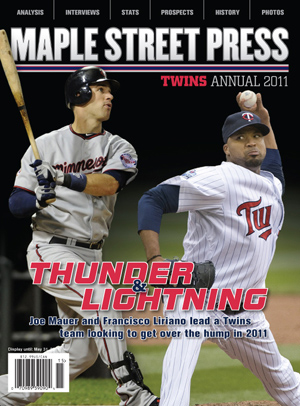
At first, it looks like a 128-page magazine previewing the baseball season. But unlike anything else you’re buying, it isn’t half ads. In fact, it doesn’t have any ads. It also isn’t a preview of every team in the league. It’s JUST the Twins. It is like nothing else you have ever read in its breadth and depth of coverage of your favorite team.
That’s one reason I’m so proud of it. Nobody else dares risk something like this. This is our chance to show that a product like this, created for Twins fanatics, can work. Needless to say, if you’ve been stopping by this blog all offseason, this magazine is your payoff.
And like this blog, it’s a product of TwinsCentric. Nick, Parker, Seth and I helped arrange and edit its 19 feature-length stories and player profiles. But unlike our other products, this is old-school: a collectible with paper and great pictures, available on your magazine rack in March.
But who wants to wait until March? Not you. All offseason you’ve been talking about how winter can’t end soon enough. Here’s a chance to put your money where your mouth is. Enjoy your early spring.
You can find out a LOT more about it here.
Get To Know: The Third Basemen
"[Corey] Koskie is a middle-of-the-order presence whose experience and discipline is especially valuable in October. Losing Koskie will be the biggest free agent loss of a Twins player since Jack Morris. It isn't something this organization is going to just shake off.”
- from “Losing Koskie” at TwinsGeek.com, 12/10/2004
It took six years for the Twins to “shake off” losing Corey Koskie. They may have, finally, last year when Danny Valencia was promoted from Rochester and provided Koskie-esque production from the other side of the plate. If he can do it again this year – not a small “if” – and next year, and next year, the Twins will have finally found their replacement.
And it took six years for a very good reason – because good third basemen are hard to come by. I was reminded of that as I was researching the third basemen in the American League. There is a huge range, so the good ones become very, very expensive in what is always a seller’s market. Let’s take a look at them and see where Danny Valencia fits in.
NO QUESTIONS
Kevin Youkilis - Red Sox
31 years old, 975 OPS in 2010
This is the guy fans want. Power, patience, and epic facial hair. Remember when there were concerns about him taking too many walks in the minors? Good lord, how stupid was that?
Evan Longoria - Rays
25 years old, 879 OPS in 2010
This is the guy the GM wants. He doesn’t have the stats of several other guys on this list, but he’s also just 25 and signed to an extremely team-friendly contract that might run all the way through the 21st century. I wish I was kidding.
FANTASTIC! (BUT….)
Alex Rodriguez - Yankees
35 years old, 847 OPS in 2010
Why isn’t he in the above group? Partly because he’s the oldest guy on this list. (Which is saying something. This is an elderly group.) Partly because he had a bad year that could be a sign of things to come. But mostly because I’m a bitter, petty man, and I love to tear down Yankees.
Adrian Beltre - Rangers
31 years old, 919 OPS in 2010
If you include defense, Beltre might be the best guy on this list. He was certainly paid like that this winter when he landed a 5-year contract for $80 million – and that was after seemingly everyone thought he had overplayed his hand. See what I mean about how it’s a seller’s market?
The question about him? The last time he signed a deal like this, his OPS fell 300 points.
Jose Bautista - Blue Jays
0 years old, 995 OPS in 2010
Here’s the king of this group: 54 home runs, but it came out of nowhere. Forget the question about whether or not he’s discovered some magic elixir for these superhuman feats. The real question is: however he did it, can he do it again? Because THIS time it’s a contract year.
HE IS WHAT HE IS
Chone Figgins - Mariners
33 years old, 646 OPS in 2010
Figgins had the lowest OPS of anyone on this list AND he’s the third oldest on the list, too. That’s not a good combination. What is a good combination is:
a) he was still able to get on base last year (.340 OBP) despite his terrible batting average (.259) and
b) he stole 42 bases for the second year in a row.
Brandon Inge - Tigers
33 years old, 718 OPS in 2010
Good fielder, occasionally very good power, and has never hit for average. Brandon Inge is a switch-hitting Joe Crede, except he stays a lot healthier. He represents the middle of this list, his glove raising his below-average offense. He just signed a two-year deal with the Tigers this offseason that is partly justifiable given what else is available, but he isn’t likely to be better than he has been.
GOOD KIND OF MYSTERY
Mark Reynolds - Orioles
27 years old, 753 OPS in 2010
Reynolds was traded from the Diamondbacks to the Orioles this winter after hitting .195 with 223 K last year. However, he also hit 32 home runs. He’s still young, he was battling injuries, he’s just a year away from his breakthrough 2009 (44 HR, .260 BA) and it looks like he was a little unlucky getting hits to fall last year. He’s no sure thing, but there’s more good than bad.
Mike Aviles - Royals
29 years old, 748 OPS in 2010
Aviles has probably overachieved for the last two years, but he shows a nice combination of power and speed that a lot of teams below would envy. More of a utility infielder type, he will likely start the year as the Royals third baseman, but he likely won’t finish it because of…
Mike Moustakas- Royals
22 years old, 878 OPS (in AAA-Omaha) in 2010
He’s the next big thing for the Royals, and has been since Alex Gordon flamed out. Last year he absolutely torched Double-A (1100 OPS in 259 AB) and didn’t back down in AAA. There is no way the budget-conscious Royals promote him to the majors before June so he doesn’t get a jump on gaining Super-2 arbitration status, but after that they’ll want to see if he can be a cornerstone for the latest rebuilding effort.
Brent Morel - White Sox
23 years old, 851 OPS (in AAA-Charlotte) in 2010
He’ll need to beat out Mark Teahan for the job, but that should happen after the first dozen groundballs. Morel is also a bit of a surprise – a guy who has worked his way into prospect status by exceeding expectations the last couple years. He’s got to do the same thing at this level.
BAD KIND OF MYSTERY
Jayson Nix - Indians
28 years old, 705 OPS in 2010 with Cleveland
Cleveland got him off of waivers last year, which should be damning enough. But he is just 28 years old, and he has 20 home run potential. He goes into this group for now, but I wouldn’t be shocked to see him join his AL Central peers in a higher group next year.
UGH.
Kevin Kouzmanoff - Athletics
29 years old, 679 OPS in 2010
Last year about this time I was being asked over and over if the Twins should try and trade for Kouzmanoff. I sure hope I said “no.”
Maicer Izturis - Angels
30 years old, 684 OPS in 2010
I really respected how the Angels were negotiating with Adrian Beltre this winter – right up to the moment that he signed with their division rival. You can see right here why he would have been such a great fit. Almost the whole AL West was a disaster at the hot corner last year, with the exception of the Rangers Michael Young – and THEY were the team that signed Beltre? Crazy.
OUR GUY
Danny Valencia - Twins
26 years old, 799 OPS in 2010
Valencia has always been a bit old for a prospect, but he’s the fourth youngest on this list. He had a very good year, and his OPS ranked sixth, behind the five studs at the top of this list. I’d definitely put him in the “Good Kind of Mystery” group, along with almost all of the rest of the AL Central.
That said, I don’t think we should overlook the “mystery” for the “good.” Valencia hit very well in the majors – quite a bit better than he did in Rochester. His high rate stats were driven by his .311 batting average, but the last time he hit that well in the minors was High A ball.
Which isn’t to downplay his contribution. The Twins have been looking for their new Koskie for six years before Valencia came. He’s exceedingly valuable for the Twins. And he’s exceedingly valuable for the league, after you look at the other options.
Six For Five
Six starting pitchers are showing up in training camp this year, and five will leave. I'm excited about the possibility of a little competition, partly because I'd like to see what Slowey can do when he needs to find a way to work with his catcher. Or how Baker reacts when he faces the possibility of being dropped from the rotation if he doesn't stay healthy through spring training.
It's been a while since I gave a lot of thought to last year's performance of the members of the starting rotation. So as a way of reintroducing myself to each of them, let's take a quick look at how each of them ranked in terms of some statistics. I'm really focusing on the four guys, Scott Baker, Nick Blackburn, Kevin Slowey and Brian Duensing, who are fighting for three spots.
ERA
Brian Duensing wins this one with a 3.05 ERA as a starter, better than anyone else, including Francisco Liriano(3.62) and Carl Pavano(3.75). Baker(4.49) and Slowey(4.54) are about even, and Blackburn(5.30) was quite a way behind them.
Quality Starts
I don't think I'm going to find a lot of areas where Blackburn isn't in last place, but I find it interesting that he led the "other four" pitchers in quality starts last year with 14. Baker had 12, and Slowey had nine. You could also award this category to Duensing, who had nine quality starts in just 13 starts, the highest percentage of quality starts on the staff.
Strikeouts
Other than Liriano, Baker easily wins this category. He was second on the team in strikeouts(148) overall and in terms of strikeout rate(7.48). Slowey(6.78) is third in rate, Duensing(5.36) was fourth, Pavano(4.76) fifth, and Blackburn(3.76) last.
Eating Innings
Pavano was, by far(221 IP, 32 starts), the leader in this category. Liriano finished second in overall innings, but was actually third in innings per start (6.19 IP per start) behind Duensing(6.54). Blackburn ranked just below Liriano in innings per start (6.08). I'm surprised to find Slowey (5.95) ahead of Baker (5.86).
xFIP
Oh, hell, let's throw one in for the sabrites out there. xFIP is something that looks like ERA but is derived from a pitcher's strikeouts, walks, and fly ball percentage. It is valuable because it is a better predictor of a starting pitcher's ERA than their ERA the previous year.
Liriano (3.06) and Pavano (4.01) led the team last year, but Baker (4.02) was a very close third. Duensing was also very close to those three with 4.10. Slowey (4.48) and Blackburn (4.62) were quite a bit behind the rest.
WHIP (Walks + Hits/Innings Pitched)
How good is each pitcher at keeping players off the base paths? Pavano was by far the best (1.19) but Liriano (1.26) just missed out on second place. That honor belongs to Duensing (1.25) who is putting together a pretty solid argument for being the third strongest pitcher on this staff by this point. Slowey (1.31) and Baker (1.34) are not too far behind. Blackburn (1.44) is again in last place.
Conclusion
Baker's got "the stuff", with Slowey a close second. Blackburn had some terrible stretches last year, but showed that even when he is terrible, he can eat innings and provide quality starts. But this analysis has really opened my eyes on the year Duensing had. He was among the leaders in ERA, quality starts, eating innings and WHIP. For two years now we've seen what he can do for a half year in the rotation. I think it might be time to see what he can do for a full year.
-------------------------------------------
Seth's Minnesota Twins Prospect Handbook 2011 is now available online. To order today, click here.Diamond Awards
The Diamond Awards were held last night, which is a banquet where the Twins present awards from the previous season. It is also a fundraiser for the University of Minnesota Medical Foundation, specifically research surrounding muscular dystrophy, multiple sclerosis, Parkinson’s disease, and ALS. If you would like to see more about last night’s festivities, you can check out their website.
The Voice of Reason™ and I had a great time, but we’re also seriously exhausted. Middle age stinks. So here are just a few quick notes.
- Kyle Gibson seems like about the most humble, coachable guy in the world. When asked by Dick Bremer what he needed to do to go from AAA to the Majors this year, he admitted that he had no idea, but he was really hoping the coaching staff would let him know, and he would work on it. Good plan, that.
- When Joe Benson came on stage, TVOR’s eyes popped out of her sockets like a cartoon character. “Oh, MY. (pause.) HE’S handsome.”
All right. Note to self. Don’t introduce wife to Joe Benson.
- Jesse Crain was on hand to accept an award for outstanding community service. Yes, the same guy who had no real pressure to be there because he has signed with the White Sox. I can’t say enough about how much class he showed, and it was clear just how much he was going to miss the Twins. It was touching, plain and simple.
- Seriously, these are some terrible, terrible diseases. I’ve seen first hand just how devastating they can be to a family. Give a little thought to supporting neuroscience research at the U of M. You can find out more about what they’re doing here.
- The introductions to many of the award recipients were often done by baseball writers. The best? It was Jim Souhan, who was head and shoulders above the rest. Absolutely full of one-liners. If I ever need to have someone host a roast, it’s him (provided it’s not my roast).
- Michael Cuddyer won a couple of awards, which The Voice of Reason was excited about, because he is her favorite Twin. Which prompted this response:
TG: So, is it safe to say that Cuddyer can’t leave the team until Joe Benson arrives?
TVOR: No, it’s not the same thing. It’s “cute & dimples” versus “Oh, my GOD!”
Glad we got that clarified.
- It appears the nickname that Gardy is going to go with for Tsuyoshi Nishioka is “Nishy.” I had thought maybe Yoshi, so I would be disappointed, but this allows me to spell it “Nietzsche.”
(Honestly Bat Girl, it’s like Gardy is baiting you to come back.)
- Gardy really seemed legitimately upset to see so many of his players leave, mostly because he felt so close to them. He went out of his way to make us understand that he feels like they are his kids, and he really missed them.
- If Bill Smith was trying to make Twins Territory even more nervous about a return by Justin Morneau, he did a heck of a job. He went out of his way to point out that their goal was to have Morneau ready to return by April 1st. He even guarded us against expecting him to come back when players report to spring training. So I think it’s pretty safe to say he’s not yet 100%.
- Danny Valencia: “I couldn’t envision my rookie year going any better than it did.”
We feel the same way, Danny. Now get ready for a roller-coaster of a sophomore year.
- Which Twins player had the best one-liners of the night? You won’t guess. Go ahead. List your top five. List your top 10.
Answer: Delmon Young. I might be more encouraged by that than I was about him losing 30 lbs.
- Good lord but Jim Thome is a big ball of positive energy.
- The only award recipient who didn’t attend was Carl Pavano, who instead filmed an incredibly awkward video from Florida. I wonder how that absence would have been received by Twins fans if it was Young. Or how it would have been received by Yankees fans if it was Pavano.
- Pat Borzi of MinnPost.com introduced Joe Mauer by reminding us that he could have been signed by the Yankees this past offseason.
- Michael Cuddyer, in accepting his leadership award, gave a shout out to his wife and all baseball men’s wives for all that they do, their versatility and leadership. At which point TVOR told me that she was counting me as a baseball man and was happy that Cuddy had noticed all she did. And do you know what I said?
“I couldn’t agree more.”
Incidentally, I'm coming up on my 17th anniversary.
- Bert got his lifetime achievement award, and afterwards the Twins announced that they were retiring his number, #28, as a send off to his Hall of Fame induction ceremony.
- And finally, before the ceremony ended, Rod Carew basically walked up to the podium unannounced, and asked that we all think about sending Harmon Killebrew our best wishes. I agree with Sir Rodney. You can leave him your thoughts and comments here.
Wednesday, January 26, 2011
Crystal Ball
What Does Twins 2012 Payroll Look Like?
I’ve been asked several times in the last few weeks what the Twins payroll situation looks like for 2012, a year into the future. Unfortunately, that speculation is a combination of back-of-the-napkin figuring and crystal ball gazing that could be viewed as irresponsible on a major newspaper site.
Good thing I’m a blogger.
So, let’s assume some things:
 If all that is true, the (very approximate) salaries of 2012's team is over there on the right.
Which leads to a couple of observations:
“Juan Berenguer has been added to the line-up for Ballpark Tours 3rd Annual Last Hot Stove League Banquet & Charity Auction scheduled for this Friday Jan 28th at Carpenter’s Hall 710 Olive Street in St. Paul.
Senor Smoke will join Jim Kaat at the podium as our keynoters. In addition, local author Pete Schilling will chat about the art of heckling & a couple of media usual suspects (not sure who yet) will take part in our Q & A.
The focus of the event is to raise money for the Dunning Little League baseball program & this anti-dome crowd will be able to bid on an auction item sure to ‘bring down the roof!!!!’ The Ballpark Tours gang has raised over $50,000 for the fields at Dunning over the years.”
This is easily the best week and weekend of the long offseason. If you’re a Twins fan, make sure you make the most of it.
I’ve been asked several times in the last few weeks what the Twins payroll situation looks like for 2012, a year into the future. Unfortunately, that speculation is a combination of back-of-the-napkin figuring and crystal ball gazing that could be viewed as irresponsible on a major newspaper site.
Good thing I’m a blogger.
So, let’s assume some things:
- Both Franscisco Liriano and Delmon Young continue to perform at a high enough level such that the Twins offer them arbitration.
- Justin Morneau doesn’t need to be replaced (and his contract doesn’t need to be paid by insurance).
- Alexi Casilla and Tsuyoshi Nishioka play well enough that the Twins want them to be the starting infielders next year.
- The Twins don’t add any higher-priced veteran relievers for next year, and find enough arms in their system to stock the bullpen.
- Kevin Slowey starts this year and does well enough that he’s offered arbitration again next year.
 If all that is true, the (very approximate) salaries of 2012's team is over there on the right.
Which leads to a couple of observations:
- My best guess on payroll next year is around $130M. If you want to argue about it, that’s what the comments are for. But the jump this year was from $96M to $113M, and $130M seems about right to me.
- If that’s true, the Twins have 3 big roles to fill (RF, DH, Closer) and $33M to fill them. That’s a much better situation than they had this offseason.
- If one of the starters is traded and Brian Duensing (or Kyle Gibson) takes his place, that’s even more money available.
- You’ll notice I didn’t pen in either Capps or Nathan as a closer. I’m quite sure that if either is successful this year, they’ll cost about $10M. So if you want to put one in there, just do a little adding and subtracting yourself.
- Finally, there’s a lot of big “ifs.” For instance, if Casilla ends up being relegated back to utility infielder, then the Twins might save a couple of million dollars on his salary, but now they have four positions to fill on $33M. That’s not nearly so enticing.
“Juan Berenguer has been added to the line-up for Ballpark Tours 3rd Annual Last Hot Stove League Banquet & Charity Auction scheduled for this Friday Jan 28th at Carpenter’s Hall 710 Olive Street in St. Paul.
Senor Smoke will join Jim Kaat at the podium as our keynoters. In addition, local author Pete Schilling will chat about the art of heckling & a couple of media usual suspects (not sure who yet) will take part in our Q & A.
The focus of the event is to raise money for the Dunning Little League baseball program & this anti-dome crowd will be able to bid on an auction item sure to ‘bring down the roof!!!!’ The Ballpark Tours gang has raised over $50,000 for the fields at Dunning over the years.”
This is easily the best week and weekend of the long offseason. If you’re a Twins fan, make sure you make the most of it.
Wednesday, January 19, 2011
A Contract Worth Waiting For
So how soon after he signed this 2-year/$16.5 million deal did Carl Pavano fire his agent, Tom O'Connell? Was it a full minute? Or did he throw the crumpled contract in his face as soon as it was signed? None of this has been reported yet, but it had to happen, right?
 Don’t get me wrong, I think Pavano is excited to be back. He sure sound genuinely excited, and there have been several reports saying he expressed his desire privately to stay with the Twins from the very beginning. He’s not in a bad place, and clearly likes the situation. I’m happy for him.
But there’s a reason he didn’t sign this same deal back in September or October. It’s because Pavano, who was viewed as possibly the second best free agent starting pitcher on the market, just signed a deal that was worth somewhere between half and three-quarter of his market value.
(That last sentence is not debatable. For instance, Ted Lilly signed for $33M guaranteed over three years. Jorge De La Rosas signed for two years and $21.5M. Hiroki Kuroda gained $12M for one year. Pavano was in their class, if not above.)
Pavano can blame a good chunk of that lost money on the collective bargaining agreement. That’s what allowed the Twins to offer Pavano, a Type A free agent, arbitration. Since he turned it down, it was going to cost every other MLB team a high draft pick to sign him. That severely restricted his potential suitors.
But the Twins had to take a risk to put that loadstone around Pavano’s neck, and his agent didn’t make them pay. By offering Pavano arbitration, they essentially offered him a 1-year/$11 million contract, because that’s how much he would’ve made in arbitration. When Pavano turned that down two months ago, the Twins breathed a sign of relief as it was pulled off the table.
So instead, a month later, he and his agent were without that offer as leverage, and seemingly without any other serious suitors. Thus, the Twins new offer was for twice as long, but at only 1.5 times the price. The Twins essentially got a “buy one year, get the second at 50% off” deal with this signing.
I’m sure Pavano and his agent will put a happy face on the deal, and nobody is going to be unhappy with a guaranteed $16.5M in his pocket. But there is no question – none – that if they had to do it again, they would have accepted that arbitration offer in November. The extra $5.5M now in hand is nowhere near the money that was available in that bush.
(This signing also further strains the credibility of those who might claim that the Twins paid $7M to Capps just so they didn’t need to sign a multi-year deal. By that logic, the Twins would’ve been happier signing Pavano to the same 1-year/$11M contract they essentially offered him in arbitration. We can safely assume that wasn’t on the table.)
The Twins played this exactly right, and deserved the luck that they got. What’s more, the pitching staff suddenly has an abundance of riches - unless this deal leads to some payroll cutting in which they trade away one of their other starting pitchers. It’s not impossible. There have been rumors going back to the winter meetings that the Twins might shop a starter to other teams if they acquire Pavano. Furthermore, the Twins not only have six pitchers for 2011 – they have the same six pitchers under their control for 2012, too. (And don’t forget Kyle Gibson waiting in AAA.)
If the Twins can’t afford it, we’ll likely hear of another trade. But if they can – and the bargain they just got helps - it’s a nice problem to have. Plus, if a move isn’t made this winter, it’ll be a fun topic to talk about as the trade deadline approaches.
Don’t get me wrong, I think Pavano is excited to be back. He sure sound genuinely excited, and there have been several reports saying he expressed his desire privately to stay with the Twins from the very beginning. He’s not in a bad place, and clearly likes the situation. I’m happy for him.But there’s a reason he didn’t sign this same deal back in September or October. It’s because Pavano, who was viewed as possibly the second best free agent starting pitcher on the market, just signed a deal that was worth somewhere between half and three-quarter of his market value.
(That last sentence is not debatable. For instance, Ted Lilly signed for $33M guaranteed over three years. Jorge De La Rosas signed for two years and $21.5M. Hiroki Kuroda gained $12M for one year. Pavano was in their class, if not above.)
Pavano can blame a good chunk of that lost money on the collective bargaining agreement. That’s what allowed the Twins to offer Pavano, a Type A free agent, arbitration. Since he turned it down, it was going to cost every other MLB team a high draft pick to sign him. That severely restricted his potential suitors.
But the Twins had to take a risk to put that loadstone around Pavano’s neck, and his agent didn’t make them pay. By offering Pavano arbitration, they essentially offered him a 1-year/$11 million contract, because that’s how much he would’ve made in arbitration. When Pavano turned that down two months ago, the Twins breathed a sign of relief as it was pulled off the table.
So instead, a month later, he and his agent were without that offer as leverage, and seemingly without any other serious suitors. Thus, the Twins new offer was for twice as long, but at only 1.5 times the price. The Twins essentially got a “buy one year, get the second at 50% off” deal with this signing.
I’m sure Pavano and his agent will put a happy face on the deal, and nobody is going to be unhappy with a guaranteed $16.5M in his pocket. But there is no question – none – that if they had to do it again, they would have accepted that arbitration offer in November. The extra $5.5M now in hand is nowhere near the money that was available in that bush.
(This signing also further strains the credibility of those who might claim that the Twins paid $7M to Capps just so they didn’t need to sign a multi-year deal. By that logic, the Twins would’ve been happier signing Pavano to the same 1-year/$11M contract they essentially offered him in arbitration. We can safely assume that wasn’t on the table.)
The Twins played this exactly right, and deserved the luck that they got. What’s more, the pitching staff suddenly has an abundance of riches - unless this deal leads to some payroll cutting in which they trade away one of their other starting pitchers. It’s not impossible. There have been rumors going back to the winter meetings that the Twins might shop a starter to other teams if they acquire Pavano. Furthermore, the Twins not only have six pitchers for 2011 – they have the same six pitchers under their control for 2012, too. (And don’t forget Kyle Gibson waiting in AAA.)
If the Twins can’t afford it, we’ll likely hear of another trade. But if they can – and the bargain they just got helps - it’s a nice problem to have. Plus, if a move isn’t made this winter, it’ll be a fun topic to talk about as the trade deadline approaches.
Sunday, January 09, 2011
My Favorite Things
Let's Think of Spring and Our Favorite Things
For those of you not in Minnesota, we’re in one of THOSE winters. Since Thanksgiving, I think we’ve reached freezing twice. We’ve been bombarded by record-setting snowfalls. And we’re in the midst of a cold spell (read: not even close to freezing) that is a couple of weeks old with no relief in sight on the 10-day forecast. The word that comes to my mind most often is “oppressive.”

So one starts looking to the future, no matter how far ahead it might be. The only silver lining to this winter is that when spring finally comes (and it’s going to come late, no doubt), there is going to be a shared euphoria that absolutely intoxicating. This state is going to explode like the blooms on the trees.
That’s where my head is tonight – with spring and grass and sun and the marvelous downtown area where I plan to spend a LOT of time this summer. In short, it’s with some of my favorite things that I’m starting to associate with a Twins baseball game.
Food
Let’s start with food, because I’m hungry. And because it’s cold, I’m going to start with…
Comfort Food - Glueks
Check that - let's make that "Comfort Everything." The space is fairly comfortable, seeing as it's practically a Minneapolis institution. The Gluek’s building has been around since 1903 and was completely restored after a fire in 1989. I've also found the crowds pre and post game to be very reasonable considering its prime location.
But what I really get excited about is the food. Their mac n cheese is made with German spaetzle instead of noodles, giving an extra kick of density and satisfaction. The Voice of Reason™ swears by their open-faced turkey sandwich which is also the blue plate special on Wednesdays. Lately, I've been most enamored with The Berliner, an open-faced sandwich of their pot roast. Welcome home.
Burger - Ike’s
I'm sure I'll catch hell about this because burger people each have their favorites, but I'll take Ike's version over everything else around Target Field. It’s the right size, has just the right level of greasiness and comes with a cart of condiments that lets you experiment a bit.
Meat Fest - Fogo de Chao
This brazilian steakhouse is two blocks from Target Field and will serve you enough fresh grilled meat to choke a starving lion. They just keep coming to your table with 14 different types of skewers and give you whatever you're hungry for. It's expensive, but it's a heck of a lot cheaper than heaven.
General - Loon Café
Any list like this needs to obligatorily mention the The Loon's chile - but I'll be honest and say I just don't get it. It is also VERY crowded before and after the game, and any other time that a bar should be crowded. But The Loon does just about everything well - great sandwiches across the board, good service, fun crowd and even the specialty shot - The Grape Ape. I have a good friend to whom this place has basically become a second home. And "second" is in debate.
Sandwich - Murray’s
I've opined about Murray's Steak Sandwich before at length, but it's worth bringing up again, so here's the deal.
Go into the bar - not the restaurant - sit down, order yourself a beer and help yourself to the addictive (and complimentary) garlic toast. Then, order the steak sandwich. Personally, I like it on white bread instead of the panini and also want to make sure it includes the bacon.
This isn't a Philly steak sandwich. It's bite-sized chunks of Murray’s steak, and it is unbelievable. It is like eating one of their steaks, but somehow even better. Is it the cheese? The bacon? The way the steak juice soaks into the bread? Or is it that every bite includes the char-ry texture outside and the tender meat inside? Don't know and don't care. All I know is I miss it like a sibling.
Buffalo Wings - Runyon’s
The buffalo wing craze hit in the late 80s, and Runyon's has been famous for theirs ever since. They don't try to put any fancy twist on the recipe; this is just the ultimate wing, exactly what you want it to be, only better.
Beer
You might be wondering why beer has its own category? But only if you haven’t met me.
Local, Big Beers - Gluek's
They have several taps, but the three you'll want to pay attention to are the three Gluek's brands - a blond, a redhead and a brunette. I like the darkest of them, but it isn't a heavy beer, just a very dark lager style beer called (I think) a dunkel. That's good, because I tend towards the large version of it, served in a liter mug.
Brew Pub - Rock Bottom
It's a national chain of brew pubs, but a good one. They rotate a selection of about a half dozen self-made beers, but risk instead trying one of the couple of casks beers they constantly rotate. Their food is also solid fairly solid, and if you're looking for a fairly light but tasty appetizer, give the soft pretzel a pull.
Beer Selection - MacKenzie's
The further you get from Target Field, the smaller the crowd at the bar, so there is a huge difference between being 2 and 5 blocks away. MacKenzie's is the latter, which is nice because you don't need to fight your way to the couple of dozen taps they have behind the bar. These guys CARE about the beers they serve and aren't afraid to go off the edge of the map to find something they like. As such, you'll find at least a half dozen you've never had before, and when you come back in a month, you'll find another half dozen. That sounds like a pretty good night to me. Two, actually.
Breakfast
Who wants to blow an entire day around the ballpark? Ooh, ooh, me! I do! I DO! So start with a little breakfast before the afternoon game at one of these places.
Cinnamon Roll – Ike’s
The weekend all-you-can-eat brunch at Ike's is fast becoming legendary. The primary feature is the starter - a cinnamon roll to share that is literally the size of Charlie Brown's head. There's plenty more, eggs to order and a family-style plate of everything else you would ever want, but if you're not careful with the "appetizer," it'll all be superfluous.
Ooh, and if you want to shake off last night's festivities, you might want to pony up for the Bloody Mary. I don't drink them, but my wife gets as excited about one as she did about Cliff Lee rejecting the Yankees.
Adventurous - Hell's Kitchen
Hidden about a six-block walk from Target Field is Hell's Kitchen, known for its eclectic food and even more eclectic interior decorating. So when I'm feeling a little less Minnesota Mild, I like to try out the Maple-Glazed Bison Sausage, Huevos Rancheros or the Buttermilk/Cornmeal Pancakes.
Irish Breakfast/Hangover Fixer - The Local
They have a breakfast menu, but who has that kind of patience? Opt for the buffet, and dish yourself an enormous pile of the creamy hash browns. But be careful - they are good enough that you will crave them for months afterwards. You've been warned.
Diner Breakfast - The Band Box
The downside is that this pint-sized diner is way over by the Metrodome, but if you're looking for a true "joint," this is your place. It's been around forever, isn't much more than a counter and some chairs, and is the most affordable place on the list. The breakfast sandwiches are good, but seriously consider the pancakes, which are the size and thickness of a big 'ol diner plate.
Postgame Outside Escapes
The outside game is over, but the last place you want to go is inside. I like to stay outside at one of these options.
Being Fabulous – 7’s Roof
The appeal? Basically, it's that you're on a roof. To be honest, it's not a particularly beautiful view, but it's a roof, it's outside and it's summer in Minnesota. That's enough for bliss.
Not that the bar isn’t beautiful. Lovely people wearing lovelier clothes sitting on plushy couches. Frankly, I'm alway surprised that they'll let me come up there.
Being Young & Stupid – Sneaky Pete’s
Speaking of places that probably shouldn’t let me in, I’m entirely too old to go to Sneaky Pete’s. It is full of very young, very attractive people acting young and attractive. But they will let me in, which is great because it is easily the best people watching place in the Warehouse District. And that’s saying something.
The outside portion is in the back, and it includes both a patio and a deck. Neither overlooks much, but you’ll have trouble turning away from the drama that plays out there at the bar and dance floor anyway.
Ambiance – Smalley’s Alley
I'm not sure why this place calls to me so much. It isn't the beer selection, which is dominated by every kind of light beer imaginable. It isn't the crowd, which is shoulder-to-shoulder substantial before and after a game. And it isn't the food, since they changed the mouth-watering seasoned sour cream.
I'm left with: it's an alley. I just love having a beer in an outside city alley. It feels like you're in a much bigger city, possibly in a different era, next to Wrigley or Fenway or even old Shibe Park. Am I alone in this? I can't be, given just how crazy crowded it is every game night, right? Or do people really just like having five kinds of light beer available that much? (Gawd, I hope not.)
There, I feel better now. Bring on the snow and the cold. I can hold on for another couple of months. But if I missed anything, make sure to let me know in the comments below.
Another baseball tradition is returning after a year hiatus. The Annual Hot Stove Banquet is back and will be Friday January 28th at 6:00 PM at Carpenter’s Hall at 710 Olive St. in St. Paul. It’ll be hosted by Brad Zellar with special guest Jim Kaat.
I’ve been to this event several times and it really is a wonderful, comfortable and casual get-together of hardcore baseball fans. Tickets are $30 in advance (send a check payable to BPT to 1141 Portland Ave, St. Paul, MN 55104) or $35 at the door. The Voice of Reason and I will be there to talk baseball to anyone else willing to brave the elements.
For those of you not in Minnesota, we’re in one of THOSE winters. Since Thanksgiving, I think we’ve reached freezing twice. We’ve been bombarded by record-setting snowfalls. And we’re in the midst of a cold spell (read: not even close to freezing) that is a couple of weeks old with no relief in sight on the 10-day forecast. The word that comes to my mind most often is “oppressive.”
So one starts looking to the future, no matter how far ahead it might be. The only silver lining to this winter is that when spring finally comes (and it’s going to come late, no doubt), there is going to be a shared euphoria that absolutely intoxicating. This state is going to explode like the blooms on the trees.
That’s where my head is tonight – with spring and grass and sun and the marvelous downtown area where I plan to spend a LOT of time this summer. In short, it’s with some of my favorite things that I’m starting to associate with a Twins baseball game.
Food
Let’s start with food, because I’m hungry. And because it’s cold, I’m going to start with…
Comfort Food - Glueks
Check that - let's make that "Comfort Everything." The space is fairly comfortable, seeing as it's practically a Minneapolis institution. The Gluek’s building has been around since 1903 and was completely restored after a fire in 1989. I've also found the crowds pre and post game to be very reasonable considering its prime location.
But what I really get excited about is the food. Their mac n cheese is made with German spaetzle instead of noodles, giving an extra kick of density and satisfaction. The Voice of Reason™ swears by their open-faced turkey sandwich which is also the blue plate special on Wednesdays. Lately, I've been most enamored with The Berliner, an open-faced sandwich of their pot roast. Welcome home.
Burger - Ike’s
I'm sure I'll catch hell about this because burger people each have their favorites, but I'll take Ike's version over everything else around Target Field. It’s the right size, has just the right level of greasiness and comes with a cart of condiments that lets you experiment a bit.
Meat Fest - Fogo de Chao
This brazilian steakhouse is two blocks from Target Field and will serve you enough fresh grilled meat to choke a starving lion. They just keep coming to your table with 14 different types of skewers and give you whatever you're hungry for. It's expensive, but it's a heck of a lot cheaper than heaven.
General - Loon Café
Any list like this needs to obligatorily mention the The Loon's chile - but I'll be honest and say I just don't get it. It is also VERY crowded before and after the game, and any other time that a bar should be crowded. But The Loon does just about everything well - great sandwiches across the board, good service, fun crowd and even the specialty shot - The Grape Ape. I have a good friend to whom this place has basically become a second home. And "second" is in debate.
Sandwich - Murray’s
I've opined about Murray's Steak Sandwich before at length, but it's worth bringing up again, so here's the deal.
Go into the bar - not the restaurant - sit down, order yourself a beer and help yourself to the addictive (and complimentary) garlic toast. Then, order the steak sandwich. Personally, I like it on white bread instead of the panini and also want to make sure it includes the bacon.
This isn't a Philly steak sandwich. It's bite-sized chunks of Murray’s steak, and it is unbelievable. It is like eating one of their steaks, but somehow even better. Is it the cheese? The bacon? The way the steak juice soaks into the bread? Or is it that every bite includes the char-ry texture outside and the tender meat inside? Don't know and don't care. All I know is I miss it like a sibling.
Buffalo Wings - Runyon’s
The buffalo wing craze hit in the late 80s, and Runyon's has been famous for theirs ever since. They don't try to put any fancy twist on the recipe; this is just the ultimate wing, exactly what you want it to be, only better.
Beer
You might be wondering why beer has its own category? But only if you haven’t met me.
Local, Big Beers - Gluek's
They have several taps, but the three you'll want to pay attention to are the three Gluek's brands - a blond, a redhead and a brunette. I like the darkest of them, but it isn't a heavy beer, just a very dark lager style beer called (I think) a dunkel. That's good, because I tend towards the large version of it, served in a liter mug.
Brew Pub - Rock Bottom
It's a national chain of brew pubs, but a good one. They rotate a selection of about a half dozen self-made beers, but risk instead trying one of the couple of casks beers they constantly rotate. Their food is also solid fairly solid, and if you're looking for a fairly light but tasty appetizer, give the soft pretzel a pull.
Beer Selection - MacKenzie's
The further you get from Target Field, the smaller the crowd at the bar, so there is a huge difference between being 2 and 5 blocks away. MacKenzie's is the latter, which is nice because you don't need to fight your way to the couple of dozen taps they have behind the bar. These guys CARE about the beers they serve and aren't afraid to go off the edge of the map to find something they like. As such, you'll find at least a half dozen you've never had before, and when you come back in a month, you'll find another half dozen. That sounds like a pretty good night to me. Two, actually.
Breakfast
Who wants to blow an entire day around the ballpark? Ooh, ooh, me! I do! I DO! So start with a little breakfast before the afternoon game at one of these places.
Cinnamon Roll – Ike’s
The weekend all-you-can-eat brunch at Ike's is fast becoming legendary. The primary feature is the starter - a cinnamon roll to share that is literally the size of Charlie Brown's head. There's plenty more, eggs to order and a family-style plate of everything else you would ever want, but if you're not careful with the "appetizer," it'll all be superfluous.
Ooh, and if you want to shake off last night's festivities, you might want to pony up for the Bloody Mary. I don't drink them, but my wife gets as excited about one as she did about Cliff Lee rejecting the Yankees.
Adventurous - Hell's Kitchen
Hidden about a six-block walk from Target Field is Hell's Kitchen, known for its eclectic food and even more eclectic interior decorating. So when I'm feeling a little less Minnesota Mild, I like to try out the Maple-Glazed Bison Sausage, Huevos Rancheros or the Buttermilk/Cornmeal Pancakes.
Irish Breakfast/Hangover Fixer - The Local
They have a breakfast menu, but who has that kind of patience? Opt for the buffet, and dish yourself an enormous pile of the creamy hash browns. But be careful - they are good enough that you will crave them for months afterwards. You've been warned.
Diner Breakfast - The Band Box
The downside is that this pint-sized diner is way over by the Metrodome, but if you're looking for a true "joint," this is your place. It's been around forever, isn't much more than a counter and some chairs, and is the most affordable place on the list. The breakfast sandwiches are good, but seriously consider the pancakes, which are the size and thickness of a big 'ol diner plate.
Postgame Outside Escapes
The outside game is over, but the last place you want to go is inside. I like to stay outside at one of these options.
Being Fabulous – 7’s Roof
The appeal? Basically, it's that you're on a roof. To be honest, it's not a particularly beautiful view, but it's a roof, it's outside and it's summer in Minnesota. That's enough for bliss.
Not that the bar isn’t beautiful. Lovely people wearing lovelier clothes sitting on plushy couches. Frankly, I'm alway surprised that they'll let me come up there.
Being Young & Stupid – Sneaky Pete’s
Speaking of places that probably shouldn’t let me in, I’m entirely too old to go to Sneaky Pete’s. It is full of very young, very attractive people acting young and attractive. But they will let me in, which is great because it is easily the best people watching place in the Warehouse District. And that’s saying something.
The outside portion is in the back, and it includes both a patio and a deck. Neither overlooks much, but you’ll have trouble turning away from the drama that plays out there at the bar and dance floor anyway.
Ambiance – Smalley’s Alley
I'm not sure why this place calls to me so much. It isn't the beer selection, which is dominated by every kind of light beer imaginable. It isn't the crowd, which is shoulder-to-shoulder substantial before and after a game. And it isn't the food, since they changed the mouth-watering seasoned sour cream.
I'm left with: it's an alley. I just love having a beer in an outside city alley. It feels like you're in a much bigger city, possibly in a different era, next to Wrigley or Fenway or even old Shibe Park. Am I alone in this? I can't be, given just how crazy crowded it is every game night, right? Or do people really just like having five kinds of light beer available that much? (Gawd, I hope not.)
There, I feel better now. Bring on the snow and the cold. I can hold on for another couple of months. But if I missed anything, make sure to let me know in the comments below.
-----------------------------
Another baseball tradition is returning after a year hiatus. The Annual Hot Stove Banquet is back and will be Friday January 28th at 6:00 PM at Carpenter’s Hall at 710 Olive St. in St. Paul. It’ll be hosted by Brad Zellar with special guest Jim Kaat.
I’ve been to this event several times and it really is a wonderful, comfortable and casual get-together of hardcore baseball fans. Tickets are $30 in advance (send a check payable to BPT to 1141 Portland Ave, St. Paul, MN 55104) or $35 at the door. The Voice of Reason and I will be there to talk baseball to anyone else willing to brave the elements.
Subscribe to:
Posts (Atom)

 Posts
Posts

