
Minnesota Twins announce RHP-Pat Neshek was placed on irrevocable waivers and claimed by the San Diego Padres.
Let's start with the big picture.
The Twins biggest concern this year is their bullpen. This was the case entering spring training and spring training has done little to alleviate that concern. While roster battles are being waged, and the Twins may be able to identify seven guys to take north, certainly no shut-down option has emerged.
And yesterday, the Twins lost Pat Neshek for nothing. Supporters will point out at Neshek hasn't been a shut-down option for three years. The truth is sadder than that. Neshek hadn't shown enough this spring to Twins brass to even be one of the seven guys to come north. So what is the harm in this move?
The harm is that Neshek isn't unique in his status. There are a lot of relievers in the Twins systems who aren't going to make the Opening Day roster, and the Twins didnt waive any of them. What's more, Neshek, unlike some other relievers, had "an option" left, meaning he could be sent to Rochester this year and recalled later in the year. So why give up an organizational asset (in an area where we KNOW there are so many question marks) for nothing? What was gained?
The glib answer is "40-man roster flexibility," which sounds great until you start to unpack it a bit. Yes, the Twins gained a spot on the 40-man roster - but Bill Smith admitted yesterday they don't know if they'll need it in two weeks or six months. What's more, that kind of move can be made at any time - like when a team actually NEEDS the spot. There isn't any advantage to having it early.
Its also been suggested that the Twins did this as a favor to Neshek. Sorry, no. If Neshek or the Twins or Neshek's agent found a team that wanted Neshek, and the Twins wanted to do him a favor, a trade for a player to be named later or cash would have been worked out. Leaving is to the whims of the waiver wire process isn't doing anyone a favor.
No, this move fits a different modus operandi of major league teams. Teams make moves like this earlier in spring training because they think it is less likely a player will be claimed now. Most teams are struggling with 25 and 40 man roster decisions at this time. The Twins gambled.
It almost paid off. If my understanding of the waiver claim order is correct, Neshek made it through 25 of 29 teams before he was claimed. But he WAS claimed. The Twins lost that bet.
Presumably, they made it because they anticipate needing that spot. Is that because they foresee adding Kyle Waldrop? Is a trade in the works? Do they expect another team to run out of room as Opening Day approaches?
I expect we'll find out sooner, rather than later. But we shouldn't pretend that future opportunity didn't come at a prepaid price.
Sunday, March 20, 2011


Wednesday, March 16, 2011
Holy Communion
If you’ve looking for some baseball talk today – tough luck. Even the players don’t care about baseball today. They care about their brackets, their alma maters, and maybe some old friends that happen to be on national TV. But mostly they care, like us, about the drama and opportunity for magic that The Big Dance provides. Just like it did eight years ago, when this was initially penned…
For me, it started in Philly, where the Big Five can be close to religion. Philadelphians are a passionate lot (as Kobe well knows), and the five (now six) division 1A college teams inside the city limits can draw a fanatic following, whether they're playing each other in the old Palestra or the new MegaBank-of-the-Moment Center.
The first round of the NCAA has turned into a religious holiday for many, and this year my wife (The Voice of Reason), my friends and I are choosing to worship. We've arranged care for the kids with my parents for the day, who don't really understand our fascination with this event, so it means even more to us that they agree to help. The congregation is gathering at America's Original Sports Bar and the service lasts approximately 11 hours. What makes it communal is the nonsense that we spew at each other between the nail-biting finishes. What makes it holy are the miracles that we invariably witness.
Holy Communion
(from 3/21/2003)
For me, it started in Philly, where the Big Five can be close to religion. Philadelphians are a passionate lot (as Kobe well knows), and the five (now six) division 1A college teams inside the city limits can draw a fanatic following, whether they're playing each other in the old Palestra or the new MegaBank-of-the-Moment Center.
The first round of the NCAA has turned into a religious holiday for many, and this year my wife (The Voice of Reason), my friends and I are choosing to worship. We've arranged care for the kids with my parents for the day, who don't really understand our fascination with this event, so it means even more to us that they agree to help. The congregation is gathering at America's Original Sports Bar and the service lasts approximately 11 hours. What makes it communal is the nonsense that we spew at each other between the nail-biting finishes. What makes it holy are the miracles that we invariably witness.
- "HOOOoolyyyyy CROSS!", Bob exclaims as we walk in at 11:45. #14 Holy Cross is only 2 points behind #3 Marquette, 14-12. It's too soon to be a big deal, so Bob uses the joke while he can. I wonder how long he's been saving it.
- The first beer arrives at 11:55 AM. It's part of the tradition of the tournament - the first beer has to arrive before noon. There's something liberating about snubbing social norms. We feel free and a little giddy.
- Matt walks in the bar and pulls up a seat. He has a 7-day-old baby at home. He's our new hero.
- There are three early games and they're all on big screens - with a small TV in the corner alternating between Fox News and CNN. It's there to ease our guilt about ignoring the real world for 11 hours. We can glance over occasionally, and feel like we're still good citizens for reading the news ticker.
- It turns out that Bob's joke didn't need to be used that early. Holy Cross is playing their hearts out - well enough to be a Cinderella-Sweet-Sixteen-kinda team. Except that Marquette came to play, too.
We watch two talented, focused teams play good solid basketball for the entire second half. Aggressive defense. Hard fouls. Precise, quick ball movement. And gutsy shooting. In the end, it's Marquette's Travis Diener who makes the biggest shots, and we're robbed of a big ending by a stumble and a steal that puts the game out of reach for Holy Cross.
When the game ends, the bar breaks into applause. It may be the best basketball game we'll see played all day. - Al and Bob are doing their best Norm and Cliff impression. They just don't know it.
Bob: We concluded with Andy the other day that you might be able to induce diabetes if you ate 30 Krispy Kreme doughnuts.
The Voice of Reason: Why 30? Why not an even 3 dozen?
Al: I spotted him six.
Bob: Yeah. Eating 30 Krispy Kremes is one thing. But 36 is just crazy. - The highlight you're probably seeing replayed today is from the Cal-NC State game, made even more spectacular because is was announced by Kevin Harlan. With 12 second left in overtime, NC State hits a three to take the lead, but Cal answers by racing down the court and draining a three with 5 seconds left (by a freshman, no less). And then NC State races down to the other end and just misses answering themselves.
The game itself was competitive, but sloppy on both sides, and marred by officiating blunders at the end of regulation. The consensus opinion is that we wanted that to be the ending of the Holy Cross/Marquette game. - The Voice of Reason: If I give you this credit card, can we start a tab?
Hot Waitress [taking card and walking away]: Sure, sweetheart.
The Voice of Reason [stunned, to Matt]: I'm sorry - did she just call me "Sweetheart"?
Long Pause
Matt [meekly]: Can I watch? - The Southern Illinois (#11) vs Missouri (#6) game had something like 20+ lead changes and we were apparently wrong about Holy Cross/Marquette being the best game of the day. Missouri's center, Arthur Johnson, carried his team to a five point lead, but somehow the Salukis came back and tied the score at 71 with Missouri still having the ball for a last shot.
But the Missouri player accidentally charges into Saluki Jermaine Dearman with five seconds left - and the official blows the call. He rewards Missouri with a foul on Dearman, who fouls out. Irate, he walks back to the bench to find the rest of his team on the edge of their seats, with their arms linked. He slides into place, another link in the chain.
Missouri only drains the second free throw, so Southern Illinois is down by just one point with 1.5 seconds left. They get a decent look, but the shot doesn't go in. Before the shooter can walk off the court, a Missouri opponent is shaking hands with him. Good game, indeed. - On the corner TV, Fox News is talking about French President Jacque Shirac. We can tell this because they have a graphic behind the announcer with the word "Shirac" and a picture of Shirac which only a rival campaign manager would love. Honestly, he looks like he's yelling at someone for mispronouncing a wine.
Leave it to Fox News to pull something like that. Why not go the full nine yards and just put up a picture of Pepe LePugh? Or Napolean? - The biggest "almost" upset comes from (#15) Utah State, who battled (#2) Kansas for the entire game. They pull within 3 points with 46 seconds left, but Kansas outlasts their charge.
- A commercial for the movie "Anger Management" comes on.
Al (dryly): That'll be funny.
John(increduously): Adam Sandler and Jack Nicholson?
Andy (dryer still): Finally, they're together. Finally. - University of Wisconsin-Milwaukee (#12) has traded punches with Notre Dame (#5) for 47 minutes. More accurately, they've traded punches with Notre Dame's guard, Chris Thomas, who is literally willing his team to compete. He is scoring, rebounding, and dishing the ball. This would be a 20 point blowout if not for him.
UM-W wasn't even supposed to be here. They made the tournament when they upset Butler in their league championship game. They are lead by senior guard Clay Tucker, who leads the team in scoring, assists and is second in rebounds. And they find themselves up by a point, with under a minute to go, and they have the ball.
Their shot balances on the rim, but falls out and the Irish get the ball back and score on a loose ball putback by Torris Francis with 35 seconds to go. The Irish lead 70-69, but UM-W doesn't call a timeout. Instead, Clay Tucker calmly dribbles the ball across half court and waits for the clock to run down. If they make it, the Irish (and Thomas) won't get another turn. And if they miss....
With 8 seconds left, Tucker starts his drive to the lane, looking for the shot to ice it. Notre Dame's defense comes in waves; one too many waves it seems. Because rather than shoot, Tucker finds 6' 8" UW-M forward Dylan Page, by himself, under the basket. The pass is made and Page goes up above the rim and lays it in the cylinder.
And it rolls around the back of the rim.
And out.
And the game is over. Irish win, 70-69.
We watch Page walk numbly to his bench with his team and start shaking hands.
We all know the feeling. It's an emptiness. A throbbing too intense to be fully realized. A failing that hurts oneself most because it hurts others more.
We look at each other. We exhale and shake our heads. We give our hearts to a 21-year-old kid that we just noticed. We want it to be different. We want to heal it. We want to heal him.
But we're reminded that religions don't provide miracles, they provide communion. This wasn't the miracle we wanted to see, but it's the communion we wanted to feel.
Tuesday, March 08, 2011
Box Score Surfing
What can you learn from spring training stories? Not much. A center fielder going 3 for 3 is likely as critical as the report about the relief pitcher who showed up “in the best shape of his life.” Or the story about the veteran showing the rookie “the ropes.” They’re nice stories that fulfill their primary purpose – convert blank white paper (or pixels) to something with ink on it. But most of us are beyond the point that we believe they provide any insight.
But there is a report that I do pay attention to, especially when the primary position battle is in the bullpen. It’s the box score, and particularly the pitching portion. I’m not so concerned about the results – it’s the order that is often telling.
Coaches want to see the guys they’re considering facing the best players on the other team so they can get a better idea how the player is really doing. For pitchers, this means that the order in which players enter a game often represents a ranking. It’s a vast oversimplification to say it’s quite that cut and dry, but generally, the sooner they get in, the better. So let’s take a quick look at the last six games of spring training and see if anything strikes me:
3/2 vs Pirates:
Duensing, Capps, Neshek, Dumatrait, D Hughes, Diamond, J Manship, A Burnett
And right away we have a question – who it Phil Dumatrait, and why was he getting the 1st spot after Capps and Neshek? Dumatrait is a left-hander who pitched in AAA for the Tigers and then ended up playing in Korea starting in May. He pitched again on Saturday, this time pitching the seventh inning, after Manship and before Waldrop.
I haven’t heard much about him as one of the left-handed options, and there isn’t much in last year’s AAA performance to single him out. But once upon a time, before Tommy John and a shoulder surgery, he was a first round pick with some velocity from the left side. Might be a name to remember.
3/3 vs Orioles
Pavano, Perkins, C James, Hoey, Swarzak
The one exception to the general rule about ranking is the ninth inning. Ron Gardenhire and Rick Anderson seem to like to play around with that a bit. I don’t know what it means that Anthony Swarzak got to finish this game. I find it interesting that southpaw Glen Perkins got an opportunity over lefty Chuck James. And I find it interesting that Hoey was relegated to the 8th inning.
3/4 vs Rays
Slowey, Mijares, Nathan, Hacker, Gibson, Bazardo, C Gutierrez
Here’s another name I didn’t expect to see. Eric Hacker is not a left-handed pitcher, but is on the 40-man roster, so by definition he has a leg up on a lot of pitchers in camp. He started last year in AAA for the Giants, and darn near earned a promotion. I had him tagged for AAA-Rochester as a starting pitcher, but maybe the coaching staff wanted to see what they had there for future reference. It didn’t go well, by the way – he gave up four hits in the inning and three earned runs.
3/5 vs Rays
Blackburn, Capps, Neshek, Manship, Dumatrait, Waldrop, Burnett
Huh. Manship lept over Dumatrait. Kyle Waldrop shows up for the first time, but way back in the 8th inning. And Alex Burnett closes out his second game. I wonder if Burnett, Swarzak and Carlos Gutierrez are being considered as Rochester’s closer.
3/6 vs Pirates
Duensing, Diamond, D Hughes, Hoey, C James, Swarzak
There’s Swarzak at the end again. Diamond made a significant leap over lefties Hughes and James. Diamond pitched in the 4th and 5th, so there is no doubt he was facing major leaguers. It sounds like the coaching staff wasn’t too pleased with his pace on the mound, and he gave up two hits and two walks in two innings, but he sure looks like he was considered the top lefty going into the game. Hoey moved up an inning, for what it’s worth.
3/7 vs Cardinals
Baker, Mijares, Nathan, Perkins, Hacker, C Gutierrez
Hacker got crushed again in this game, so that sucks for him. Perkins also struggled and that was after pitching significantly later in the game than his first time out. That’s not good. And like clockwork, Gutierrez came in and pitched the last two innings. He struck out four. It’ll be interesting to see if that three-man closing rotation carries through to tomorrow.
So what did I learn?
- Phil Dumatrait might be a name for left-handed specialist that I totally overlooked.
- Scott Diamond is also meriting some serious consideration, or at least was.
- I over looked Eric Hacker too, but he is likely slated for Rochester.
- James Hoey isn’t a serious candidate yet.
- I wonder if Jeff Manship might be a serious candidate.
- Something is going on with Burnett, Swarzak and Gutierrez.
Or at least that’s what I’m going with for now. Take a look at the box scores as they come in over the next week or so and see what you foresee.
Sunday, March 06, 2011
Wrestling With Vegas
Here Is How You Define Expectations
 Every year, millions, if not billions of dollars are bet by fans and analysts on their baseball teams. And while most of it is done on daily bets or World Series champions, there is another bet that I find infinitely more fascinating: the season over/under.
It’s fascinating in the same way that the price of a stock is fascinating. The number demonstrates an equilibrium determined by people who are risking their own money. The result truly represents what the expectations for that team really are. You want to know who is overrated or underrated? You want to claim someone over performed or under performed? Here is your baseline.
So let’s take a look at what gamblers say will happen in the American League this year, and throw out some gut reactions.
The AL East
 Boston has become the clear favorite, and is supposed to be 6.5 games better than they were last year. Supporters will quickly point out how they acquired Adrian Gonzalez and signed Carl Crawford this offseason, but people forget that they lost Victor Martinez and Adrian Beltre this winter, too. But Boston’s struggles last year were largely a result of just how banged up that team was. That number seems about right. Pass.
I'm supposed to believe the Yankees are going to fade 3.5 games just because they're a little older and Andy Pettitte retired? That's reasonable, except that
a) they scored enough runs to be a 98 win team and
b) some of their best hitters - Mark Teixeira, Alex Rodrigurez and Derek Jeter - all had pretty crummy years.
I don't think that happens again. I find it morally reprehensible to bet on the Yankees, but if I didn’t have a soul, I’d take the over.
Tampa Bay won 96 games last year and was good enough to win 98. And yet both Vegas and PECOTA (a statistically-based projection that BaseballProspectus.com uses) have them winning just 84 this year? They lost a lot this offseason, but they didn't lose that much. Over.
Baltimore only won 66 games last year, and they were actually worse than that. Vegas anticipates a 10 game jump, and PECOTA goes even higher than that, predicting a .500 record. I'd usually be all over that, especially in that division, except that I refuse to bet against Buck Showalter. Pass.
And that leaves Toronto at 76.5 games according to Vegas. Someone is going to get the snot knocked out of them in this division. I think it's going to be the Blue Jays. Under.
The AL West
 Texas won 90 games last year and Vegas thinks they're going to be close but fall short of that this year. That seems conservative. They're still the class of this division, and that's worth more than 87 games. Over.
Oakland at 83.5. I'll be totally honest - I have no idea what Oakland has done this offseason. But I trust Billy Beane to tear apart this team if he thinks they'll fall short again, and there is no reason to think they won't fall short again. Under.
The fall from grace by the Angels last year really didn't get enough attention. They lost seventeen more games than the year before. They spent the offseason signing a couple of relievers and trading for Vernon Wells. This feels like an organization experiencing a death rattle. I don't see the 83 games that Vegas predicts, and neither does PECOTA, who predicts just 78 wins. Under.
Seattle, a 61-win team, was even worse than that last year. And this offseason, they....what did they do, exactly? They're supposed to win 70 games? Criminy. I don't see how they do it, but I'm not betting the under on three teams in the same division. Pass.
The AL Central
 I've got bad news for all those who feel the Twins aren't getting enough respect - Vegas is still picking them to win the division, nosing past a three-horse race. I see it the same way, and while I like the Twins and White Sox a bit better than the gamblers, I wouldn't touch the totals of the Twins, White Sox or Tigers.
As for the others, I'm going to predict that they finally swap places in the standings. That means picking the over on KC and the under on CLE. My scientifically deduced reason: it just feels like the Tribe is a little rudderless right now.
I want to thank Alex Halsted for mentioning me in his book 100 Things Twins Fans Should Know & Do Before They Die. #98 is “Venture Online,” which you’ve already done if you’re reading this, but I hope you aren’t stopping with this blog. There are dozens of talented Twins bloggers that aren’t getting nearly enough attention and are worth your time. If you’re looking for a good launching point, I’d suggest stopping by MNGameDay.com, where there is a feed of the latest posts from across the Twins blogosphere.
Every year, millions, if not billions of dollars are bet by fans and analysts on their baseball teams. And while most of it is done on daily bets or World Series champions, there is another bet that I find infinitely more fascinating: the season over/under.It’s fascinating in the same way that the price of a stock is fascinating. The number demonstrates an equilibrium determined by people who are risking their own money. The result truly represents what the expectations for that team really are. You want to know who is overrated or underrated? You want to claim someone over performed or under performed? Here is your baseline.
So let’s take a look at what gamblers say will happen in the American League this year, and throw out some gut reactions.
The AL East
 Boston has become the clear favorite, and is supposed to be 6.5 games better than they were last year. Supporters will quickly point out how they acquired Adrian Gonzalez and signed Carl Crawford this offseason, but people forget that they lost Victor Martinez and Adrian Beltre this winter, too. But Boston’s struggles last year were largely a result of just how banged up that team was. That number seems about right. Pass.
I'm supposed to believe the Yankees are going to fade 3.5 games just because they're a little older and Andy Pettitte retired? That's reasonable, except that
a) they scored enough runs to be a 98 win team and
b) some of their best hitters - Mark Teixeira, Alex Rodrigurez and Derek Jeter - all had pretty crummy years.
I don't think that happens again. I find it morally reprehensible to bet on the Yankees, but if I didn’t have a soul, I’d take the over.
Tampa Bay won 96 games last year and was good enough to win 98. And yet both Vegas and PECOTA (a statistically-based projection that BaseballProspectus.com uses) have them winning just 84 this year? They lost a lot this offseason, but they didn't lose that much. Over.
Baltimore only won 66 games last year, and they were actually worse than that. Vegas anticipates a 10 game jump, and PECOTA goes even higher than that, predicting a .500 record. I'd usually be all over that, especially in that division, except that I refuse to bet against Buck Showalter. Pass.
And that leaves Toronto at 76.5 games according to Vegas. Someone is going to get the snot knocked out of them in this division. I think it's going to be the Blue Jays. Under.
The AL West
 Texas won 90 games last year and Vegas thinks they're going to be close but fall short of that this year. That seems conservative. They're still the class of this division, and that's worth more than 87 games. Over.
Oakland at 83.5. I'll be totally honest - I have no idea what Oakland has done this offseason. But I trust Billy Beane to tear apart this team if he thinks they'll fall short again, and there is no reason to think they won't fall short again. Under.
The fall from grace by the Angels last year really didn't get enough attention. They lost seventeen more games than the year before. They spent the offseason signing a couple of relievers and trading for Vernon Wells. This feels like an organization experiencing a death rattle. I don't see the 83 games that Vegas predicts, and neither does PECOTA, who predicts just 78 wins. Under.
Seattle, a 61-win team, was even worse than that last year. And this offseason, they....what did they do, exactly? They're supposed to win 70 games? Criminy. I don't see how they do it, but I'm not betting the under on three teams in the same division. Pass.
The AL Central
 I've got bad news for all those who feel the Twins aren't getting enough respect - Vegas is still picking them to win the division, nosing past a three-horse race. I see it the same way, and while I like the Twins and White Sox a bit better than the gamblers, I wouldn't touch the totals of the Twins, White Sox or Tigers.
As for the others, I'm going to predict that they finally swap places in the standings. That means picking the over on KC and the under on CLE. My scientifically deduced reason: it just feels like the Tribe is a little rudderless right now.
--------------------------------------
I want to thank Alex Halsted for mentioning me in his book 100 Things Twins Fans Should Know & Do Before They Die. #98 is “Venture Online,” which you’ve already done if you’re reading this, but I hope you aren’t stopping with this blog. There are dozens of talented Twins bloggers that aren’t getting nearly enough attention and are worth your time. If you’re looking for a good launching point, I’d suggest stopping by MNGameDay.com, where there is a feed of the latest posts from across the Twins blogosphere.
Wednesday, March 02, 2011
Duensing's Just Deserts
A few weeks ago, I peeked back at Twins pitching stats. One name kept coming up, over and over:
But this analysis has really opened my eyes on the year [Brian] Duensing had. He was among the leaders in ERA, quality starts, eating innings and WHIP. For two years now we've seen what he can do for a half year in the rotation. I think it might be time to see what he can do for a full year.
Over those two years, Duensing has started 22 games and tallied 138.1 innings, which is about four months of work. The statistic that hopeful Twins fans will latch onto is his miniscule 2.93 ERA. Some of his other stats are more mediocre – 136 hits, 84 strikeouts, 37 walks and 12 home runs. Those are all about in the range of what you would expect for a slightly above-average starting pitcher, not an outstanding pitcher.
There is a statistic that can explain some of that paradox. It’s called BABIP, as in Batting Average on Balls In Play. Duensing’s was .284 as a starter, which is also above average, but suggests he was a little lucky – but did you really need me to tell you that? You’re talking about a guy without great stuff, who has a career ERA in the minors of 3.61. Do you think he’s a 2.93 ERA pitcher? We just overlooked a Pedro Martinez in our farm system?
Of course not. The question is – is he close to that?
To that we’ll go to yet one more statistic called FIP (for Fielding Independent Pitching). FIP is calculated ignoring those pesky batted ball, instead using several of those “slightly above average” stats to determine a number that looks like an ERA. According to the excellent site FanGraphs.com, Duensing’s was 3.91 last year as a starter. This is significant because FIP is a little bit better predictor of a future ERA than ERA is.
So no, he’s not Pedro Martinez, or even particularly close. But if Ron Gardenhire, who announced yesterday that Duensing already has secured a spot in the rotation, gets a 3.91 ERA for a full year out of the southpaw, he’ll need to up his dosage of cherry extract to handle the backflips he’ll be doing.
Not only do the statistics support Gardy’s decision, so does common sense. Gardenhire needs to manage this team and manage this pitching staff, and one thing that managers universally want to drive home to their team is that performance matters. For two years, Duensing has performed, posting quality start after quality start, as well as accepting whatever role the team needed. It’s entirely reasonable that he get his just deserts a little early this spring.
-----------------
Late addition: A friend pointed out to me that the initial version of this entry was incorrectly spelling the term "just deserts" as "just desserts." According to this wiktionary entry, "deserts" is the plural of "desert," which is "that which one deserves." Just a late note for you future writers out there....
Wednesday, February 23, 2011
The Prescription: Rest, Dammit
Let’s try and diffuse this Mauertov cocktail a bit. This mix of a beloved icon, incredibly high expectations and a demanding and underachieving position can become highly explosive when you add the catalyst of questionable health.
That’s because there is no shortage of opinions. There are those who want him to move to a different position, which they guarantee will resolve any health issues. There are those to whom the thought of moving him out from behind the plate is ridiculous, negating a substantial amount of his vaue. There is also the faction who questions his toughness, because they expect their superstars to play every day. And, of course, there are those who just love him and sideburns, and want to stuff a gallon of Kemps whole milk into all the Negative Nellys’ pie hole.
These are all fun, and make for great column fodder. But I’m not feeling especially rhetorical tonight, and besides, I’ve wanted to study something for a while. Last year, I kept noticing that Mauer seemed to hit his home runs after a day of rest. It also seemed that Mauer’s offensive surge in the second half of last year coincided with a lot more rest. And of course his 2009 MVP season started with a month or rest.
So let’s try and take the rhetoric out of this. I’m not going to try and judge his perceived toughness or softness, or whether he should want to play more, or should play a different position. What I want to know is: does Mauer hit better when he’s been recently rested?
First, let’s see if I was right about those home runs last year. Mauer hit just nine home runs last year, so let’s take a look at each one and see how close they came to a day where he wasn’t playing catcher:
#1. at LAA– It was only two days into the season, so just two days from an off day for the whole team.
#2. at NYY – Three days earlier he had a day off. He had actually had quite a bit of time off, because he had been hurt, but didn’t go on the DL, and then seemingly rushed back from injury for the Yankees series.
#3. at PHL – The big ninth inning home run versus the Phillies. The whole team had the day off two days earlier.
#4 at TOR – The Twins had an off day the day before.
#5 at BLT – The day before Mauer had been the designated hitter.
#6 at KC – The day before, Mauer had a day off.
#7 at CLE – The day before, the Twins had the day off.
#8 vs CWS – Mauer’s first home run in Target Field came two days after the team had a day off.
#9 at CWS – Two days before this, Mauer had been given the day off.
First, let’s state the obvious: Mauer struggled to get home runs at Target Field, which isn’t too surprising since many of his dingers in 2009 cleared the right field fence. That’s a considerable challenge at the new ballpark.
But it also suggests that maybe there is something to this rest thing. Four of his home runs came the day after he was rested. Four more came two days after a break. One came three days later and none came four days after a break. Incidentally, Mauer played 22 games last year where he had played catcher four days in a row or more.
That’s a fun anecdotal analysis, but let’s take it a step further. If we look at his overall batting line, did he hit considerably better after a little rest? Let’s see:

Oh, right – you don’t like numbers. Let’s turn it into something a bit simpler:
 Last year, Mauer’s batting average went down the more days in a row he caught, and it REALLY affected his power. If we want to get into some treacherous small sample size territory, we can carry it further:
 Apparently Mauer is REALLY good after catching seven days in a row! Actually, Mauer only started four games where he had been catching seven or eight games, and in one of those he went 4 of 7, thus the spike at the end. But the rest of the line seems to further support the thesis: Mauer is quite a bit better when he is frequently rested.
This isn’t proof. Anyone who wanted to poke holes in this analysis would start with the fact that these are fairly small sample sizes, none greater than 40 games. They’ll get no argument from me that this is a long way from proving that Mauer needs his rest.
Instead, let’s take is as directional evidence. Last year, Joe Mauer hit quite a bit better and for a lot more power when he was frequently given a break from playing catcher. Whatever your blustery opinion on how he should be used in the future, it might pay to try that strategy going forward.
Wednesday, February 16, 2011
The Afterthoughts
The box scores for these early spring training games can be longer than the story of the game itself. That’s because this is a chance for the coaching staff to get to know some of the “other” players in camp – the guys who have almost zero chance of seeing Opening Day in The Show. They’re the names that you squeezed in at the edge of your scorecard. The guys that confuse the announcers, with uniform numbers that approach triple digits. To most of us, they’re afterthoughts.
 For now, that is. Because two years from now, the scribbles on your scorecard have a chance to be that key September call-up, or the crucial July injury replacement. (Heck, some will find themselves thrust into a rebuilding bullpen THIS year.) That’s the thing about following the Twins – these guys have a chance to matter.
That’s one reason why the Maple Street Press Twins Annual consistently has a section on the Twins farm system, including a minor league system overview. This year, Seth Stohs compiled the top five prospects in each of five areas: starting pitchers, relievers, catchers, infielders and outfielders. I'm going to rip him off, and take a look at the top prospects in four of those areas, so you’re primed for those later innings of these spring games.
Starting Pitchers
#1 – Kyle Gibson – Gibson is not only the top starting pitching prospect, he’s arguably the top prospect in the system AND the most likely to significantly impact the Twins major league club this year. He’s only been in the organization for one full year after being the Twins #1 draft pick in 2009. But he shot up through three minor league levels last year, ending up in AAA-Rochester. He fits the Twins starting pitching mold: he doesn’t have dominant stuff, but has very good control and induces a lot of ground balls. If members of the rotation struggle, he could take that last step and play a significant role after the All-Star break, ala Danny Valencia last year.
The Next Four: Liam Hendricks, Alex Wimmers, David Bromberg, Adrian Salcedo
Relievers
#1 – Carlos Gutierrez – In the Twins minors, he’s been a starter, but he could end up a dominant reliever. He’s got a 97 mph fastball that sinks, along with a slider and improving changeup. He spent most of the year in AA-New Britain, but the Twins haven’t been afraid to reach down that low for relievers in the past, as Jose Mijares and Alex Burnett attest. With the Twins bullpen in flux this year, don’t be surprised if he finds his way up to help out this year’s team.
The Next Four: Billy Bullock, Anthony Slama, Dakota Watts, Kyle Waldrop
Infielders
#1 – Miguel Sano – Unlike the other guys mentioned, he definitely WON’T play a roll this year, seeing as he’s just 17 years old. Sano was a highly sought after international signee that chose the Twins in 2009, and showed what he can do in 2010 when he hit .307/.379/.491 at lower levels. That likely means you won’t see him in spring training this year, but you’ll want to remember that name a few years from now.
The Next Four: Chris Parmalee, Trevor Plouffe, Steve Singleton, Brian Dozier
Outfielders
#1 – Aaron Hicks – Another possibility as the top prospect overall in the Twins system is Hicks, but he also won’t be making his acquaintance with The Show this year. He was a #1 pick by the Twins in 2008 and has speed, power, plate discipline and a great glove. The center fielder did well in low A-ball last year despite a tough start and will likely make it to High A ball this year. He’s one of two players (Ben Revere is the other) that Denard Span has identified as the next in line Twins centerfielder.
The Next Four: Joe Benson, Ben Revere, Oswaldo Arcia, Angel Morales
So check out some of the indented names on the box scores this spring. Yankees fans can ignore them, content to wait for hundreds of millions to be thrown at the gap in their roster. But Twins fans get to grow with their team. See what these guys have picked up while toiling for six years in minor league obscurity. And decide for yourself which ones might be your next favorite big league player.
You can pick up the Maple Street Press Twins Annual 2011 at newsstands in MN or order it early (or if you're out of town) at TCAnnual.com. And if you REALLy want to O.D. on the Twins minor leagues, check out Seth's Minnesota Twins Prospect Handbook for 2011.
Friday, February 11, 2011
Liriano Furor
So. Apparently, when I saw Joe C's story about "trading Francisco Liriano," I should have thought to myself "Maybe tomorrow isn't the best time to talk about veteran middle infielders."
In case you missed it, Joe Christensen posted a story Wednesday night saying basically two things:
1) The Twins are not interested in signing Liriano to a long-term deal and
2) similarly, the Twins don't consider him untouchable, so we all have his permission to talk about trading him.
And so we did.
But we missed the bombshell here. It isn't that Liriano is on his way out the door. There is nothing in the story that implies anything is at all close, or that the Twins have even attempted to have trade talks with teams. The bombshell is that the Twins, right now, don't value Liriano nearly as high we thought they did (and probably should).
One area that is being misreported is that the Twins turned down a 3-year/$39 million offer from Liriano's agent. That isn't what Christensen reported. What he said was: "From what I've heard, their long-term talks went nowhere, with Liriano's camp hinting it wanted a three-year, $39 million contract."
What's significant about this is that a 3-year/$39M extension is exactly the range where negotiations should have started from Liriano's side. Seth Stohs did a fantastic job of breaking down what a long-term extension for Liriano might look like in this year's GM's Handbook. He noted that two similar deals, by two similar pitchers with similar service time were recently signed. That provides a hell of a template:
 If you add up the 8/14/14 for 2012-14 for Liriano, you get $36M, or about $1M less per year than Liriano's camp hinted at. If that figure was a non-starter for the Twins, then they just don't have any interest in signing Liriano long-term, because it's awfully close to his market value.
Now, maybe that changes. Maybe they just want to see more than one full-year out of Frankie, and I wouldn't blame them too much for that. But Christensen's primary point is very clear - right now Liriano is not considered an integral part of the Twins long-term future.
Thursday, February 10, 2011
Finding The Right Puzzle Piece
There isn’t much doubt that the 2011 Twins team is still missing some pieces. The trick is finding pieces that fit.
Take middle infield. Nick wrote yesterday about how the Twins could use some additional depth, and that’s undoubtedly true. I’m excited to see if Alexi Casilla and Tsuyoshi Nishioka can become as good as we hope, and like Seth, I’m not anxious to block either of them so I can overpay Michael Young. But a safety net is in order, and there are some good ones – including one I can’t believe we haven’t heard more about.
The most mentioned name, both locally and nationally, seems to be Orlando Cabrera. In many ways, he’s a perfect fit – veteran, winning track record, and he had a very positive impact while here less than two years ago. The problem? He wants to start. Unless he changes his mind, that’s a deal-breaker for either side.
And even if Cabrera says it’s OK to not start, it isn’t clear the Twins would really trust him to maintain that stance. Let’s not forget that the year before he was with the Twins, Cabrera was criticized for being a negative clubhouse presence by the White Sox. Even if he says otherwise, it’s not clear that he’s ready to go gently into that good night.
Another popular name is David Eckstein. Eckstein is 36 years old, hit .267 last year, got on-base at a below-average .321 clip, and has zero power. However, he’s decent defensively (though he played exclusively at second base the last two years) and known for his scrappy, veteran hustle. He’s basically an older Nick Punto – including his fun-sized height. He’s exactly the kind of player that Ron Gardenhire is likely lobbying to add to the team.
Which is EXACTLY why I can’t believe the Twins would sign him. You don’t give a coke addict a vial of crack to store in the closet, and you don’t give Ron Gardenhire a veteran, scrappy, defensive-oriented shortstop to sit on the bench. Gardy will be able to add this to the list of non-moves he can be bitter about.
How about Julio Lugo? The 35-year-old has always been a defensive specialist, which is the kindest term for a guy who can’t hit. That’s a tad overly harsh, considering he hit quite well with both Boston and the Cardinals in 2009. But last year with the Orioles he was dismal, hitting .249 with a sub-.300 OBP while filling various injuries.
But so what if he didn’t hit much? He’s a decent fielder, and he’s not exactly ancient. If he’s not a clubhouse problem, he could be a good overall fit whose hitting will just make him more affordable.
And finally, we get to the name I can’t believe is still out there. He’s played both shortstop and second base recently. He’s only 32 years old. He made $8M last year. He was traded at the deadline, at which point he had a .282/.327/.361 line. And most of all – he’s an ex-Twin All-Star.
I’m talking, of course, about Cristian Guzman, who still hasn’t signed with anyone. He’s absolutely going to need to sign with someone as a utility player if he wants any chance to regain his starter status. The biggest problem might be that his defense has slipped from his time with the Twins, but it’s still not awful. I’m shocked that we aren’t hearing more about him considering the limited options the Twins have in-house.
By most accounts, the Twins have stretched themselves pretty thin with payroll this year, so they might not have much to spend. And let’s not forget that Delmon Young’s arbitration case has not been decided yet, and there’s a $1.6M range between what he’s asking and the Twins are offering. But if the Twins do find some money underneath some couch cushions, there is no doubt the middle infield should be the priority. We’ll see which of these guys they think will be the best fitting puzzle piece.
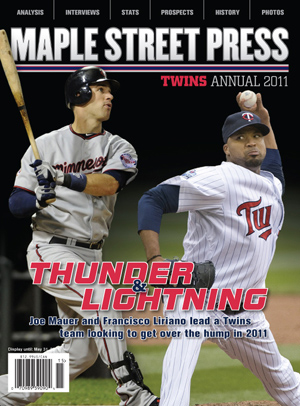
At first, it looks like a 128-page magazine previewing the baseball season. But unlike anything else you’re buying, it isn’t half ads. In fact, it doesn’t have any ads. It also isn’t a preview of every team in the league. It’s JUST the Twins. It is like nothing else you have ever read in its breadth and depth of coverage of your favorite team.
That’s one reason I’m so proud of it. Nobody else dares risk something like this. This is our chance to show that a product like this, created for Twins fanatics, can work. Needless to say, if you’ve been stopping by this blog all offseason, this magazine is your payoff.
And like this blog, it’s a product of TwinsCentric. Nick, Parker, Seth and I helped arrange and edit its 19 feature-length stories and player profiles. But unlike our other products, this is old-school: a collectible with paper and great pictures, available on your magazine rack in March.
But who wants to wait until March? Not you. All offseason you’ve been talking about how winter can’t end soon enough. Here’s a chance to put your money where your mouth is. Enjoy your early spring.
You can find out a LOT more about it here.
Get To Know: The Third Basemen
"[Corey] Koskie is a middle-of-the-order presence whose experience and discipline is especially valuable in October. Losing Koskie will be the biggest free agent loss of a Twins player since Jack Morris. It isn't something this organization is going to just shake off.”
- from “Losing Koskie” at TwinsGeek.com, 12/10/2004
It took six years for the Twins to “shake off” losing Corey Koskie. They may have, finally, last year when Danny Valencia was promoted from Rochester and provided Koskie-esque production from the other side of the plate. If he can do it again this year – not a small “if” – and next year, and next year, the Twins will have finally found their replacement.
And it took six years for a very good reason – because good third basemen are hard to come by. I was reminded of that as I was researching the third basemen in the American League. There is a huge range, so the good ones become very, very expensive in what is always a seller’s market. Let’s take a look at them and see where Danny Valencia fits in.
NO QUESTIONS
Kevin Youkilis - Red Sox
31 years old, 975 OPS in 2010
This is the guy fans want. Power, patience, and epic facial hair. Remember when there were concerns about him taking too many walks in the minors? Good lord, how stupid was that?
Evan Longoria - Rays
25 years old, 879 OPS in 2010
This is the guy the GM wants. He doesn’t have the stats of several other guys on this list, but he’s also just 25 and signed to an extremely team-friendly contract that might run all the way through the 21st century. I wish I was kidding.
FANTASTIC! (BUT….)
Alex Rodriguez - Yankees
35 years old, 847 OPS in 2010
Why isn’t he in the above group? Partly because he’s the oldest guy on this list. (Which is saying something. This is an elderly group.) Partly because he had a bad year that could be a sign of things to come. But mostly because I’m a bitter, petty man, and I love to tear down Yankees.
Adrian Beltre - Rangers
31 years old, 919 OPS in 2010
If you include defense, Beltre might be the best guy on this list. He was certainly paid like that this winter when he landed a 5-year contract for $80 million – and that was after seemingly everyone thought he had overplayed his hand. See what I mean about how it’s a seller’s market?
The question about him? The last time he signed a deal like this, his OPS fell 300 points.
Jose Bautista - Blue Jays
0 years old, 995 OPS in 2010
Here’s the king of this group: 54 home runs, but it came out of nowhere. Forget the question about whether or not he’s discovered some magic elixir for these superhuman feats. The real question is: however he did it, can he do it again? Because THIS time it’s a contract year.
HE IS WHAT HE IS
Chone Figgins - Mariners
33 years old, 646 OPS in 2010
Figgins had the lowest OPS of anyone on this list AND he’s the third oldest on the list, too. That’s not a good combination. What is a good combination is:
a) he was still able to get on base last year (.340 OBP) despite his terrible batting average (.259) and
b) he stole 42 bases for the second year in a row.
Brandon Inge - Tigers
33 years old, 718 OPS in 2010
Good fielder, occasionally very good power, and has never hit for average. Brandon Inge is a switch-hitting Joe Crede, except he stays a lot healthier. He represents the middle of this list, his glove raising his below-average offense. He just signed a two-year deal with the Tigers this offseason that is partly justifiable given what else is available, but he isn’t likely to be better than he has been.
GOOD KIND OF MYSTERY
Mark Reynolds - Orioles
27 years old, 753 OPS in 2010
Reynolds was traded from the Diamondbacks to the Orioles this winter after hitting .195 with 223 K last year. However, he also hit 32 home runs. He’s still young, he was battling injuries, he’s just a year away from his breakthrough 2009 (44 HR, .260 BA) and it looks like he was a little unlucky getting hits to fall last year. He’s no sure thing, but there’s more good than bad.
Mike Aviles - Royals
29 years old, 748 OPS in 2010
Aviles has probably overachieved for the last two years, but he shows a nice combination of power and speed that a lot of teams below would envy. More of a utility infielder type, he will likely start the year as the Royals third baseman, but he likely won’t finish it because of…
Mike Moustakas- Royals
22 years old, 878 OPS (in AAA-Omaha) in 2010
He’s the next big thing for the Royals, and has been since Alex Gordon flamed out. Last year he absolutely torched Double-A (1100 OPS in 259 AB) and didn’t back down in AAA. There is no way the budget-conscious Royals promote him to the majors before June so he doesn’t get a jump on gaining Super-2 arbitration status, but after that they’ll want to see if he can be a cornerstone for the latest rebuilding effort.
Brent Morel - White Sox
23 years old, 851 OPS (in AAA-Charlotte) in 2010
He’ll need to beat out Mark Teahan for the job, but that should happen after the first dozen groundballs. Morel is also a bit of a surprise – a guy who has worked his way into prospect status by exceeding expectations the last couple years. He’s got to do the same thing at this level.
BAD KIND OF MYSTERY
Jayson Nix - Indians
28 years old, 705 OPS in 2010 with Cleveland
Cleveland got him off of waivers last year, which should be damning enough. But he is just 28 years old, and he has 20 home run potential. He goes into this group for now, but I wouldn’t be shocked to see him join his AL Central peers in a higher group next year.
UGH.
Kevin Kouzmanoff - Athletics
29 years old, 679 OPS in 2010
Last year about this time I was being asked over and over if the Twins should try and trade for Kouzmanoff. I sure hope I said “no.”
Maicer Izturis - Angels
30 years old, 684 OPS in 2010
I really respected how the Angels were negotiating with Adrian Beltre this winter – right up to the moment that he signed with their division rival. You can see right here why he would have been such a great fit. Almost the whole AL West was a disaster at the hot corner last year, with the exception of the Rangers Michael Young – and THEY were the team that signed Beltre? Crazy.
OUR GUY
Danny Valencia - Twins
26 years old, 799 OPS in 2010
Valencia has always been a bit old for a prospect, but he’s the fourth youngest on this list. He had a very good year, and his OPS ranked sixth, behind the five studs at the top of this list. I’d definitely put him in the “Good Kind of Mystery” group, along with almost all of the rest of the AL Central.
That said, I don’t think we should overlook the “mystery” for the “good.” Valencia hit very well in the majors – quite a bit better than he did in Rochester. His high rate stats were driven by his .311 batting average, but the last time he hit that well in the minors was High A ball.
Which isn’t to downplay his contribution. The Twins have been looking for their new Koskie for six years before Valencia came. He’s exceedingly valuable for the Twins. And he’s exceedingly valuable for the league, after you look at the other options.
Six For Five
Six starting pitchers are showing up in training camp this year, and five will leave. I'm excited about the possibility of a little competition, partly because I'd like to see what Slowey can do when he needs to find a way to work with his catcher. Or how Baker reacts when he faces the possibility of being dropped from the rotation if he doesn't stay healthy through spring training.
It's been a while since I gave a lot of thought to last year's performance of the members of the starting rotation. So as a way of reintroducing myself to each of them, let's take a quick look at how each of them ranked in terms of some statistics. I'm really focusing on the four guys, Scott Baker, Nick Blackburn, Kevin Slowey and Brian Duensing, who are fighting for three spots.
ERA
Brian Duensing wins this one with a 3.05 ERA as a starter, better than anyone else, including Francisco Liriano(3.62) and Carl Pavano(3.75). Baker(4.49) and Slowey(4.54) are about even, and Blackburn(5.30) was quite a way behind them.
Quality Starts
I don't think I'm going to find a lot of areas where Blackburn isn't in last place, but I find it interesting that he led the "other four" pitchers in quality starts last year with 14. Baker had 12, and Slowey had nine. You could also award this category to Duensing, who had nine quality starts in just 13 starts, the highest percentage of quality starts on the staff.
Strikeouts
Other than Liriano, Baker easily wins this category. He was second on the team in strikeouts(148) overall and in terms of strikeout rate(7.48). Slowey(6.78) is third in rate, Duensing(5.36) was fourth, Pavano(4.76) fifth, and Blackburn(3.76) last.
Eating Innings
Pavano was, by far(221 IP, 32 starts), the leader in this category. Liriano finished second in overall innings, but was actually third in innings per start (6.19 IP per start) behind Duensing(6.54). Blackburn ranked just below Liriano in innings per start (6.08). I'm surprised to find Slowey (5.95) ahead of Baker (5.86).
xFIP
Oh, hell, let's throw one in for the sabrites out there. xFIP is something that looks like ERA but is derived from a pitcher's strikeouts, walks, and fly ball percentage. It is valuable because it is a better predictor of a starting pitcher's ERA than their ERA the previous year.
Liriano (3.06) and Pavano (4.01) led the team last year, but Baker (4.02) was a very close third. Duensing was also very close to those three with 4.10. Slowey (4.48) and Blackburn (4.62) were quite a bit behind the rest.
WHIP (Walks + Hits/Innings Pitched)
How good is each pitcher at keeping players off the base paths? Pavano was by far the best (1.19) but Liriano (1.26) just missed out on second place. That honor belongs to Duensing (1.25) who is putting together a pretty solid argument for being the third strongest pitcher on this staff by this point. Slowey (1.31) and Baker (1.34) are not too far behind. Blackburn (1.44) is again in last place.
Conclusion
Baker's got "the stuff", with Slowey a close second. Blackburn had some terrible stretches last year, but showed that even when he is terrible, he can eat innings and provide quality starts. But this analysis has really opened my eyes on the year Duensing had. He was among the leaders in ERA, quality starts, eating innings and WHIP. For two years now we've seen what he can do for a half year in the rotation. I think it might be time to see what he can do for a full year.
-------------------------------------------
Seth's Minnesota Twins Prospect Handbook 2011 is now available online. To order today, click here.Diamond Awards
The Diamond Awards were held last night, which is a banquet where the Twins present awards from the previous season. It is also a fundraiser for the University of Minnesota Medical Foundation, specifically research surrounding muscular dystrophy, multiple sclerosis, Parkinson’s disease, and ALS. If you would like to see more about last night’s festivities, you can check out their website.
The Voice of Reason™ and I had a great time, but we’re also seriously exhausted. Middle age stinks. So here are just a few quick notes.
- Kyle Gibson seems like about the most humble, coachable guy in the world. When asked by Dick Bremer what he needed to do to go from AAA to the Majors this year, he admitted that he had no idea, but he was really hoping the coaching staff would let him know, and he would work on it. Good plan, that.
- When Joe Benson came on stage, TVOR’s eyes popped out of her sockets like a cartoon character. “Oh, MY. (pause.) HE’S handsome.”
All right. Note to self. Don’t introduce wife to Joe Benson.
- Jesse Crain was on hand to accept an award for outstanding community service. Yes, the same guy who had no real pressure to be there because he has signed with the White Sox. I can’t say enough about how much class he showed, and it was clear just how much he was going to miss the Twins. It was touching, plain and simple.
- Seriously, these are some terrible, terrible diseases. I’ve seen first hand just how devastating they can be to a family. Give a little thought to supporting neuroscience research at the U of M. You can find out more about what they’re doing here.
- The introductions to many of the award recipients were often done by baseball writers. The best? It was Jim Souhan, who was head and shoulders above the rest. Absolutely full of one-liners. If I ever need to have someone host a roast, it’s him (provided it’s not my roast).
- Michael Cuddyer won a couple of awards, which The Voice of Reason was excited about, because he is her favorite Twin. Which prompted this response:
TG: So, is it safe to say that Cuddyer can’t leave the team until Joe Benson arrives?
TVOR: No, it’s not the same thing. It’s “cute & dimples” versus “Oh, my GOD!”
Glad we got that clarified.
- It appears the nickname that Gardy is going to go with for Tsuyoshi Nishioka is “Nishy.” I had thought maybe Yoshi, so I would be disappointed, but this allows me to spell it “Nietzsche.”
(Honestly Bat Girl, it’s like Gardy is baiting you to come back.)
- Gardy really seemed legitimately upset to see so many of his players leave, mostly because he felt so close to them. He went out of his way to make us understand that he feels like they are his kids, and he really missed them.
- If Bill Smith was trying to make Twins Territory even more nervous about a return by Justin Morneau, he did a heck of a job. He went out of his way to point out that their goal was to have Morneau ready to return by April 1st. He even guarded us against expecting him to come back when players report to spring training. So I think it’s pretty safe to say he’s not yet 100%.
- Danny Valencia: “I couldn’t envision my rookie year going any better than it did.”
We feel the same way, Danny. Now get ready for a roller-coaster of a sophomore year.
- Which Twins player had the best one-liners of the night? You won’t guess. Go ahead. List your top five. List your top 10.
Answer: Delmon Young. I might be more encouraged by that than I was about him losing 30 lbs.
- Good lord but Jim Thome is a big ball of positive energy.
- The only award recipient who didn’t attend was Carl Pavano, who instead filmed an incredibly awkward video from Florida. I wonder how that absence would have been received by Twins fans if it was Young. Or how it would have been received by Yankees fans if it was Pavano.
- Pat Borzi of MinnPost.com introduced Joe Mauer by reminding us that he could have been signed by the Yankees this past offseason.
- Michael Cuddyer, in accepting his leadership award, gave a shout out to his wife and all baseball men’s wives for all that they do, their versatility and leadership. At which point TVOR told me that she was counting me as a baseball man and was happy that Cuddy had noticed all she did. And do you know what I said?
“I couldn’t agree more.”
Incidentally, I'm coming up on my 17th anniversary.
- Bert got his lifetime achievement award, and afterwards the Twins announced that they were retiring his number, #28, as a send off to his Hall of Fame induction ceremony.
- And finally, before the ceremony ended, Rod Carew basically walked up to the podium unannounced, and asked that we all think about sending Harmon Killebrew our best wishes. I agree with Sir Rodney. You can leave him your thoughts and comments here.
Wednesday, January 26, 2011
Crystal Ball
What Does Twins 2012 Payroll Look Like?
I’ve been asked several times in the last few weeks what the Twins payroll situation looks like for 2012, a year into the future. Unfortunately, that speculation is a combination of back-of-the-napkin figuring and crystal ball gazing that could be viewed as irresponsible on a major newspaper site.
Good thing I’m a blogger.
So, let’s assume some things:
 If all that is true, the (very approximate) salaries of 2012's team is over there on the right.
Which leads to a couple of observations:
“Juan Berenguer has been added to the line-up for Ballpark Tours 3rd Annual Last Hot Stove League Banquet & Charity Auction scheduled for this Friday Jan 28th at Carpenter’s Hall 710 Olive Street in St. Paul.
Senor Smoke will join Jim Kaat at the podium as our keynoters. In addition, local author Pete Schilling will chat about the art of heckling & a couple of media usual suspects (not sure who yet) will take part in our Q & A.
The focus of the event is to raise money for the Dunning Little League baseball program & this anti-dome crowd will be able to bid on an auction item sure to ‘bring down the roof!!!!’ The Ballpark Tours gang has raised over $50,000 for the fields at Dunning over the years.”
This is easily the best week and weekend of the long offseason. If you’re a Twins fan, make sure you make the most of it.
I’ve been asked several times in the last few weeks what the Twins payroll situation looks like for 2012, a year into the future. Unfortunately, that speculation is a combination of back-of-the-napkin figuring and crystal ball gazing that could be viewed as irresponsible on a major newspaper site.
Good thing I’m a blogger.
So, let’s assume some things:
- Both Franscisco Liriano and Delmon Young continue to perform at a high enough level such that the Twins offer them arbitration.
- Justin Morneau doesn’t need to be replaced (and his contract doesn’t need to be paid by insurance).
- Alexi Casilla and Tsuyoshi Nishioka play well enough that the Twins want them to be the starting infielders next year.
- The Twins don’t add any higher-priced veteran relievers for next year, and find enough arms in their system to stock the bullpen.
- Kevin Slowey starts this year and does well enough that he’s offered arbitration again next year.
 If all that is true, the (very approximate) salaries of 2012's team is over there on the right.
Which leads to a couple of observations:
- My best guess on payroll next year is around $130M. If you want to argue about it, that’s what the comments are for. But the jump this year was from $96M to $113M, and $130M seems about right to me.
- If that’s true, the Twins have 3 big roles to fill (RF, DH, Closer) and $33M to fill them. That’s a much better situation than they had this offseason.
- If one of the starters is traded and Brian Duensing (or Kyle Gibson) takes his place, that’s even more money available.
- You’ll notice I didn’t pen in either Capps or Nathan as a closer. I’m quite sure that if either is successful this year, they’ll cost about $10M. So if you want to put one in there, just do a little adding and subtracting yourself.
- Finally, there’s a lot of big “ifs.” For instance, if Casilla ends up being relegated back to utility infielder, then the Twins might save a couple of million dollars on his salary, but now they have four positions to fill on $33M. That’s not nearly so enticing.
“Juan Berenguer has been added to the line-up for Ballpark Tours 3rd Annual Last Hot Stove League Banquet & Charity Auction scheduled for this Friday Jan 28th at Carpenter’s Hall 710 Olive Street in St. Paul.
Senor Smoke will join Jim Kaat at the podium as our keynoters. In addition, local author Pete Schilling will chat about the art of heckling & a couple of media usual suspects (not sure who yet) will take part in our Q & A.
The focus of the event is to raise money for the Dunning Little League baseball program & this anti-dome crowd will be able to bid on an auction item sure to ‘bring down the roof!!!!’ The Ballpark Tours gang has raised over $50,000 for the fields at Dunning over the years.”
This is easily the best week and weekend of the long offseason. If you’re a Twins fan, make sure you make the most of it.
Wednesday, January 19, 2011
A Contract Worth Waiting For
So how soon after he signed this 2-year/$16.5 million deal did Carl Pavano fire his agent, Tom O'Connell? Was it a full minute? Or did he throw the crumpled contract in his face as soon as it was signed? None of this has been reported yet, but it had to happen, right?
 Don’t get me wrong, I think Pavano is excited to be back. He sure sound genuinely excited, and there have been several reports saying he expressed his desire privately to stay with the Twins from the very beginning. He’s not in a bad place, and clearly likes the situation. I’m happy for him.
But there’s a reason he didn’t sign this same deal back in September or October. It’s because Pavano, who was viewed as possibly the second best free agent starting pitcher on the market, just signed a deal that was worth somewhere between half and three-quarter of his market value.
(That last sentence is not debatable. For instance, Ted Lilly signed for $33M guaranteed over three years. Jorge De La Rosas signed for two years and $21.5M. Hiroki Kuroda gained $12M for one year. Pavano was in their class, if not above.)
Pavano can blame a good chunk of that lost money on the collective bargaining agreement. That’s what allowed the Twins to offer Pavano, a Type A free agent, arbitration. Since he turned it down, it was going to cost every other MLB team a high draft pick to sign him. That severely restricted his potential suitors.
But the Twins had to take a risk to put that loadstone around Pavano’s neck, and his agent didn’t make them pay. By offering Pavano arbitration, they essentially offered him a 1-year/$11 million contract, because that’s how much he would’ve made in arbitration. When Pavano turned that down two months ago, the Twins breathed a sign of relief as it was pulled off the table.
So instead, a month later, he and his agent were without that offer as leverage, and seemingly without any other serious suitors. Thus, the Twins new offer was for twice as long, but at only 1.5 times the price. The Twins essentially got a “buy one year, get the second at 50% off” deal with this signing.
I’m sure Pavano and his agent will put a happy face on the deal, and nobody is going to be unhappy with a guaranteed $16.5M in his pocket. But there is no question – none – that if they had to do it again, they would have accepted that arbitration offer in November. The extra $5.5M now in hand is nowhere near the money that was available in that bush.
(This signing also further strains the credibility of those who might claim that the Twins paid $7M to Capps just so they didn’t need to sign a multi-year deal. By that logic, the Twins would’ve been happier signing Pavano to the same 1-year/$11M contract they essentially offered him in arbitration. We can safely assume that wasn’t on the table.)
The Twins played this exactly right, and deserved the luck that they got. What’s more, the pitching staff suddenly has an abundance of riches - unless this deal leads to some payroll cutting in which they trade away one of their other starting pitchers. It’s not impossible. There have been rumors going back to the winter meetings that the Twins might shop a starter to other teams if they acquire Pavano. Furthermore, the Twins not only have six pitchers for 2011 – they have the same six pitchers under their control for 2012, too. (And don’t forget Kyle Gibson waiting in AAA.)
If the Twins can’t afford it, we’ll likely hear of another trade. But if they can – and the bargain they just got helps - it’s a nice problem to have. Plus, if a move isn’t made this winter, it’ll be a fun topic to talk about as the trade deadline approaches.
Don’t get me wrong, I think Pavano is excited to be back. He sure sound genuinely excited, and there have been several reports saying he expressed his desire privately to stay with the Twins from the very beginning. He’s not in a bad place, and clearly likes the situation. I’m happy for him.But there’s a reason he didn’t sign this same deal back in September or October. It’s because Pavano, who was viewed as possibly the second best free agent starting pitcher on the market, just signed a deal that was worth somewhere between half and three-quarter of his market value.
(That last sentence is not debatable. For instance, Ted Lilly signed for $33M guaranteed over three years. Jorge De La Rosas signed for two years and $21.5M. Hiroki Kuroda gained $12M for one year. Pavano was in their class, if not above.)
Pavano can blame a good chunk of that lost money on the collective bargaining agreement. That’s what allowed the Twins to offer Pavano, a Type A free agent, arbitration. Since he turned it down, it was going to cost every other MLB team a high draft pick to sign him. That severely restricted his potential suitors.
But the Twins had to take a risk to put that loadstone around Pavano’s neck, and his agent didn’t make them pay. By offering Pavano arbitration, they essentially offered him a 1-year/$11 million contract, because that’s how much he would’ve made in arbitration. When Pavano turned that down two months ago, the Twins breathed a sign of relief as it was pulled off the table.
So instead, a month later, he and his agent were without that offer as leverage, and seemingly without any other serious suitors. Thus, the Twins new offer was for twice as long, but at only 1.5 times the price. The Twins essentially got a “buy one year, get the second at 50% off” deal with this signing.
I’m sure Pavano and his agent will put a happy face on the deal, and nobody is going to be unhappy with a guaranteed $16.5M in his pocket. But there is no question – none – that if they had to do it again, they would have accepted that arbitration offer in November. The extra $5.5M now in hand is nowhere near the money that was available in that bush.
(This signing also further strains the credibility of those who might claim that the Twins paid $7M to Capps just so they didn’t need to sign a multi-year deal. By that logic, the Twins would’ve been happier signing Pavano to the same 1-year/$11M contract they essentially offered him in arbitration. We can safely assume that wasn’t on the table.)
The Twins played this exactly right, and deserved the luck that they got. What’s more, the pitching staff suddenly has an abundance of riches - unless this deal leads to some payroll cutting in which they trade away one of their other starting pitchers. It’s not impossible. There have been rumors going back to the winter meetings that the Twins might shop a starter to other teams if they acquire Pavano. Furthermore, the Twins not only have six pitchers for 2011 – they have the same six pitchers under their control for 2012, too. (And don’t forget Kyle Gibson waiting in AAA.)
If the Twins can’t afford it, we’ll likely hear of another trade. But if they can – and the bargain they just got helps - it’s a nice problem to have. Plus, if a move isn’t made this winter, it’ll be a fun topic to talk about as the trade deadline approaches.
Sunday, January 09, 2011
My Favorite Things
Let's Think of Spring and Our Favorite Things
For those of you not in Minnesota, we’re in one of THOSE winters. Since Thanksgiving, I think we’ve reached freezing twice. We’ve been bombarded by record-setting snowfalls. And we’re in the midst of a cold spell (read: not even close to freezing) that is a couple of weeks old with no relief in sight on the 10-day forecast. The word that comes to my mind most often is “oppressive.”

So one starts looking to the future, no matter how far ahead it might be. The only silver lining to this winter is that when spring finally comes (and it’s going to come late, no doubt), there is going to be a shared euphoria that absolutely intoxicating. This state is going to explode like the blooms on the trees.
That’s where my head is tonight – with spring and grass and sun and the marvelous downtown area where I plan to spend a LOT of time this summer. In short, it’s with some of my favorite things that I’m starting to associate with a Twins baseball game.
Food
Let’s start with food, because I’m hungry. And because it’s cold, I’m going to start with…
Comfort Food - Glueks
Check that - let's make that "Comfort Everything." The space is fairly comfortable, seeing as it's practically a Minneapolis institution. The Gluek’s building has been around since 1903 and was completely restored after a fire in 1989. I've also found the crowds pre and post game to be very reasonable considering its prime location.
But what I really get excited about is the food. Their mac n cheese is made with German spaetzle instead of noodles, giving an extra kick of density and satisfaction. The Voice of Reason™ swears by their open-faced turkey sandwich which is also the blue plate special on Wednesdays. Lately, I've been most enamored with The Berliner, an open-faced sandwich of their pot roast. Welcome home.
Burger - Ike’s
I'm sure I'll catch hell about this because burger people each have their favorites, but I'll take Ike's version over everything else around Target Field. It’s the right size, has just the right level of greasiness and comes with a cart of condiments that lets you experiment a bit.
Meat Fest - Fogo de Chao
This brazilian steakhouse is two blocks from Target Field and will serve you enough fresh grilled meat to choke a starving lion. They just keep coming to your table with 14 different types of skewers and give you whatever you're hungry for. It's expensive, but it's a heck of a lot cheaper than heaven.
General - Loon Café
Any list like this needs to obligatorily mention the The Loon's chile - but I'll be honest and say I just don't get it. It is also VERY crowded before and after the game, and any other time that a bar should be crowded. But The Loon does just about everything well - great sandwiches across the board, good service, fun crowd and even the specialty shot - The Grape Ape. I have a good friend to whom this place has basically become a second home. And "second" is in debate.
Sandwich - Murray’s
I've opined about Murray's Steak Sandwich before at length, but it's worth bringing up again, so here's the deal.
Go into the bar - not the restaurant - sit down, order yourself a beer and help yourself to the addictive (and complimentary) garlic toast. Then, order the steak sandwich. Personally, I like it on white bread instead of the panini and also want to make sure it includes the bacon.
This isn't a Philly steak sandwich. It's bite-sized chunks of Murray’s steak, and it is unbelievable. It is like eating one of their steaks, but somehow even better. Is it the cheese? The bacon? The way the steak juice soaks into the bread? Or is it that every bite includes the char-ry texture outside and the tender meat inside? Don't know and don't care. All I know is I miss it like a sibling.
Buffalo Wings - Runyon’s
The buffalo wing craze hit in the late 80s, and Runyon's has been famous for theirs ever since. They don't try to put any fancy twist on the recipe; this is just the ultimate wing, exactly what you want it to be, only better.
Beer
You might be wondering why beer has its own category? But only if you haven’t met me.
Local, Big Beers - Gluek's
They have several taps, but the three you'll want to pay attention to are the three Gluek's brands - a blond, a redhead and a brunette. I like the darkest of them, but it isn't a heavy beer, just a very dark lager style beer called (I think) a dunkel. That's good, because I tend towards the large version of it, served in a liter mug.
Brew Pub - Rock Bottom
It's a national chain of brew pubs, but a good one. They rotate a selection of about a half dozen self-made beers, but risk instead trying one of the couple of casks beers they constantly rotate. Their food is also solid fairly solid, and if you're looking for a fairly light but tasty appetizer, give the soft pretzel a pull.
Beer Selection - MacKenzie's
The further you get from Target Field, the smaller the crowd at the bar, so there is a huge difference between being 2 and 5 blocks away. MacKenzie's is the latter, which is nice because you don't need to fight your way to the couple of dozen taps they have behind the bar. These guys CARE about the beers they serve and aren't afraid to go off the edge of the map to find something they like. As such, you'll find at least a half dozen you've never had before, and when you come back in a month, you'll find another half dozen. That sounds like a pretty good night to me. Two, actually.
Breakfast
Who wants to blow an entire day around the ballpark? Ooh, ooh, me! I do! I DO! So start with a little breakfast before the afternoon game at one of these places.
Cinnamon Roll – Ike’s
The weekend all-you-can-eat brunch at Ike's is fast becoming legendary. The primary feature is the starter - a cinnamon roll to share that is literally the size of Charlie Brown's head. There's plenty more, eggs to order and a family-style plate of everything else you would ever want, but if you're not careful with the "appetizer," it'll all be superfluous.
Ooh, and if you want to shake off last night's festivities, you might want to pony up for the Bloody Mary. I don't drink them, but my wife gets as excited about one as she did about Cliff Lee rejecting the Yankees.
Adventurous - Hell's Kitchen
Hidden about a six-block walk from Target Field is Hell's Kitchen, known for its eclectic food and even more eclectic interior decorating. So when I'm feeling a little less Minnesota Mild, I like to try out the Maple-Glazed Bison Sausage, Huevos Rancheros or the Buttermilk/Cornmeal Pancakes.
Irish Breakfast/Hangover Fixer - The Local
They have a breakfast menu, but who has that kind of patience? Opt for the buffet, and dish yourself an enormous pile of the creamy hash browns. But be careful - they are good enough that you will crave them for months afterwards. You've been warned.
Diner Breakfast - The Band Box
The downside is that this pint-sized diner is way over by the Metrodome, but if you're looking for a true "joint," this is your place. It's been around forever, isn't much more than a counter and some chairs, and is the most affordable place on the list. The breakfast sandwiches are good, but seriously consider the pancakes, which are the size and thickness of a big 'ol diner plate.
Postgame Outside Escapes
The outside game is over, but the last place you want to go is inside. I like to stay outside at one of these options.
Being Fabulous – 7’s Roof
The appeal? Basically, it's that you're on a roof. To be honest, it's not a particularly beautiful view, but it's a roof, it's outside and it's summer in Minnesota. That's enough for bliss.
Not that the bar isn’t beautiful. Lovely people wearing lovelier clothes sitting on plushy couches. Frankly, I'm alway surprised that they'll let me come up there.
Being Young & Stupid – Sneaky Pete’s
Speaking of places that probably shouldn’t let me in, I’m entirely too old to go to Sneaky Pete’s. It is full of very young, very attractive people acting young and attractive. But they will let me in, which is great because it is easily the best people watching place in the Warehouse District. And that’s saying something.
The outside portion is in the back, and it includes both a patio and a deck. Neither overlooks much, but you’ll have trouble turning away from the drama that plays out there at the bar and dance floor anyway.
Ambiance – Smalley’s Alley
I'm not sure why this place calls to me so much. It isn't the beer selection, which is dominated by every kind of light beer imaginable. It isn't the crowd, which is shoulder-to-shoulder substantial before and after a game. And it isn't the food, since they changed the mouth-watering seasoned sour cream.
I'm left with: it's an alley. I just love having a beer in an outside city alley. It feels like you're in a much bigger city, possibly in a different era, next to Wrigley or Fenway or even old Shibe Park. Am I alone in this? I can't be, given just how crazy crowded it is every game night, right? Or do people really just like having five kinds of light beer available that much? (Gawd, I hope not.)
There, I feel better now. Bring on the snow and the cold. I can hold on for another couple of months. But if I missed anything, make sure to let me know in the comments below.
Another baseball tradition is returning after a year hiatus. The Annual Hot Stove Banquet is back and will be Friday January 28th at 6:00 PM at Carpenter’s Hall at 710 Olive St. in St. Paul. It’ll be hosted by Brad Zellar with special guest Jim Kaat.
I’ve been to this event several times and it really is a wonderful, comfortable and casual get-together of hardcore baseball fans. Tickets are $30 in advance (send a check payable to BPT to 1141 Portland Ave, St. Paul, MN 55104) or $35 at the door. The Voice of Reason and I will be there to talk baseball to anyone else willing to brave the elements.
For those of you not in Minnesota, we’re in one of THOSE winters. Since Thanksgiving, I think we’ve reached freezing twice. We’ve been bombarded by record-setting snowfalls. And we’re in the midst of a cold spell (read: not even close to freezing) that is a couple of weeks old with no relief in sight on the 10-day forecast. The word that comes to my mind most often is “oppressive.”
So one starts looking to the future, no matter how far ahead it might be. The only silver lining to this winter is that when spring finally comes (and it’s going to come late, no doubt), there is going to be a shared euphoria that absolutely intoxicating. This state is going to explode like the blooms on the trees.
That’s where my head is tonight – with spring and grass and sun and the marvelous downtown area where I plan to spend a LOT of time this summer. In short, it’s with some of my favorite things that I’m starting to associate with a Twins baseball game.
Food
Let’s start with food, because I’m hungry. And because it’s cold, I’m going to start with…
Comfort Food - Glueks
Check that - let's make that "Comfort Everything." The space is fairly comfortable, seeing as it's practically a Minneapolis institution. The Gluek’s building has been around since 1903 and was completely restored after a fire in 1989. I've also found the crowds pre and post game to be very reasonable considering its prime location.
But what I really get excited about is the food. Their mac n cheese is made with German spaetzle instead of noodles, giving an extra kick of density and satisfaction. The Voice of Reason™ swears by their open-faced turkey sandwich which is also the blue plate special on Wednesdays. Lately, I've been most enamored with The Berliner, an open-faced sandwich of their pot roast. Welcome home.
Burger - Ike’s
I'm sure I'll catch hell about this because burger people each have their favorites, but I'll take Ike's version over everything else around Target Field. It’s the right size, has just the right level of greasiness and comes with a cart of condiments that lets you experiment a bit.
Meat Fest - Fogo de Chao
This brazilian steakhouse is two blocks from Target Field and will serve you enough fresh grilled meat to choke a starving lion. They just keep coming to your table with 14 different types of skewers and give you whatever you're hungry for. It's expensive, but it's a heck of a lot cheaper than heaven.
General - Loon Café
Any list like this needs to obligatorily mention the The Loon's chile - but I'll be honest and say I just don't get it. It is also VERY crowded before and after the game, and any other time that a bar should be crowded. But The Loon does just about everything well - great sandwiches across the board, good service, fun crowd and even the specialty shot - The Grape Ape. I have a good friend to whom this place has basically become a second home. And "second" is in debate.
Sandwich - Murray’s
I've opined about Murray's Steak Sandwich before at length, but it's worth bringing up again, so here's the deal.
Go into the bar - not the restaurant - sit down, order yourself a beer and help yourself to the addictive (and complimentary) garlic toast. Then, order the steak sandwich. Personally, I like it on white bread instead of the panini and also want to make sure it includes the bacon.
This isn't a Philly steak sandwich. It's bite-sized chunks of Murray’s steak, and it is unbelievable. It is like eating one of their steaks, but somehow even better. Is it the cheese? The bacon? The way the steak juice soaks into the bread? Or is it that every bite includes the char-ry texture outside and the tender meat inside? Don't know and don't care. All I know is I miss it like a sibling.
Buffalo Wings - Runyon’s
The buffalo wing craze hit in the late 80s, and Runyon's has been famous for theirs ever since. They don't try to put any fancy twist on the recipe; this is just the ultimate wing, exactly what you want it to be, only better.
Beer
You might be wondering why beer has its own category? But only if you haven’t met me.
Local, Big Beers - Gluek's
They have several taps, but the three you'll want to pay attention to are the three Gluek's brands - a blond, a redhead and a brunette. I like the darkest of them, but it isn't a heavy beer, just a very dark lager style beer called (I think) a dunkel. That's good, because I tend towards the large version of it, served in a liter mug.
Brew Pub - Rock Bottom
It's a national chain of brew pubs, but a good one. They rotate a selection of about a half dozen self-made beers, but risk instead trying one of the couple of casks beers they constantly rotate. Their food is also solid fairly solid, and if you're looking for a fairly light but tasty appetizer, give the soft pretzel a pull.
Beer Selection - MacKenzie's
The further you get from Target Field, the smaller the crowd at the bar, so there is a huge difference between being 2 and 5 blocks away. MacKenzie's is the latter, which is nice because you don't need to fight your way to the couple of dozen taps they have behind the bar. These guys CARE about the beers they serve and aren't afraid to go off the edge of the map to find something they like. As such, you'll find at least a half dozen you've never had before, and when you come back in a month, you'll find another half dozen. That sounds like a pretty good night to me. Two, actually.
Breakfast
Who wants to blow an entire day around the ballpark? Ooh, ooh, me! I do! I DO! So start with a little breakfast before the afternoon game at one of these places.
Cinnamon Roll – Ike’s
The weekend all-you-can-eat brunch at Ike's is fast becoming legendary. The primary feature is the starter - a cinnamon roll to share that is literally the size of Charlie Brown's head. There's plenty more, eggs to order and a family-style plate of everything else you would ever want, but if you're not careful with the "appetizer," it'll all be superfluous.
Ooh, and if you want to shake off last night's festivities, you might want to pony up for the Bloody Mary. I don't drink them, but my wife gets as excited about one as she did about Cliff Lee rejecting the Yankees.
Adventurous - Hell's Kitchen
Hidden about a six-block walk from Target Field is Hell's Kitchen, known for its eclectic food and even more eclectic interior decorating. So when I'm feeling a little less Minnesota Mild, I like to try out the Maple-Glazed Bison Sausage, Huevos Rancheros or the Buttermilk/Cornmeal Pancakes.
Irish Breakfast/Hangover Fixer - The Local
They have a breakfast menu, but who has that kind of patience? Opt for the buffet, and dish yourself an enormous pile of the creamy hash browns. But be careful - they are good enough that you will crave them for months afterwards. You've been warned.
Diner Breakfast - The Band Box
The downside is that this pint-sized diner is way over by the Metrodome, but if you're looking for a true "joint," this is your place. It's been around forever, isn't much more than a counter and some chairs, and is the most affordable place on the list. The breakfast sandwiches are good, but seriously consider the pancakes, which are the size and thickness of a big 'ol diner plate.
Postgame Outside Escapes
The outside game is over, but the last place you want to go is inside. I like to stay outside at one of these options.
Being Fabulous – 7’s Roof
The appeal? Basically, it's that you're on a roof. To be honest, it's not a particularly beautiful view, but it's a roof, it's outside and it's summer in Minnesota. That's enough for bliss.
Not that the bar isn’t beautiful. Lovely people wearing lovelier clothes sitting on plushy couches. Frankly, I'm alway surprised that they'll let me come up there.
Being Young & Stupid – Sneaky Pete’s
Speaking of places that probably shouldn’t let me in, I’m entirely too old to go to Sneaky Pete’s. It is full of very young, very attractive people acting young and attractive. But they will let me in, which is great because it is easily the best people watching place in the Warehouse District. And that’s saying something.
The outside portion is in the back, and it includes both a patio and a deck. Neither overlooks much, but you’ll have trouble turning away from the drama that plays out there at the bar and dance floor anyway.
Ambiance – Smalley’s Alley
I'm not sure why this place calls to me so much. It isn't the beer selection, which is dominated by every kind of light beer imaginable. It isn't the crowd, which is shoulder-to-shoulder substantial before and after a game. And it isn't the food, since they changed the mouth-watering seasoned sour cream.
I'm left with: it's an alley. I just love having a beer in an outside city alley. It feels like you're in a much bigger city, possibly in a different era, next to Wrigley or Fenway or even old Shibe Park. Am I alone in this? I can't be, given just how crazy crowded it is every game night, right? Or do people really just like having five kinds of light beer available that much? (Gawd, I hope not.)
There, I feel better now. Bring on the snow and the cold. I can hold on for another couple of months. But if I missed anything, make sure to let me know in the comments below.
-----------------------------
Another baseball tradition is returning after a year hiatus. The Annual Hot Stove Banquet is back and will be Friday January 28th at 6:00 PM at Carpenter’s Hall at 710 Olive St. in St. Paul. It’ll be hosted by Brad Zellar with special guest Jim Kaat.
I’ve been to this event several times and it really is a wonderful, comfortable and casual get-together of hardcore baseball fans. Tickets are $30 in advance (send a check payable to BPT to 1141 Portland Ave, St. Paul, MN 55104) or $35 at the door. The Voice of Reason and I will be there to talk baseball to anyone else willing to brave the elements.
Thursday, January 06, 2011
On Bert, Zealotry and Jack
Sometimes The Debate Isn't Just About The Player
I don’t get into MVP, Cy Young and Hall of Fame debates too often, and there is a reason for that: too often the debate isn’t really about the player. Instead, it’s a disguised debate between evangelists about their philosophies. And the prize becomes recognition of a paradigm (a view of the world), rather than recognition of a player.
 That was especially true about the election yesterday of Bert Blyleven to the Hall of Fame. When Blyleven was first on the ballot, back in 1998, he only received 17.5% of the vote, and it went DOWN on his second try in 1999, when he received the 15th most votes. That’s not necessarily a death sentence, but consider the names at #10-#14: Jim Kaat, Dale Murphy, Tommy John, Dave Parker, Minnie Minoso. None of those guys are likely to make it to the Hall of Fame very soon.
So what changed? Why was Bert different? The cynics slyly ask how Blyleven became a much more deserving pitcher without throwing another pitch? The upbeat way to view Bert’s turnaround is that the process bought the voters some time. And during that time, voters and the public gradually recognized in Bert’s body of work what they didn’t recognize when he was pitching – that he was very, very good for a very, very, VERY long time.
That’s part of the answer, but there’s a more contentious subtext to this election that drove a lot of the passion over it.
Mostly what has changed over the fourteen years of Bert’s candidacy is our philosophy about baseball and some of its statistics. And in this case, the one that found itself on the front line of the battle was the “Win” statistic for pitchers.
A “Win” is basically awarded to a pitcher who is on the mound when his team takes the lead for good. It was a statistic that was considerably more valuable a long time ago, when relievers weren’t such a big part of the game. (It also compensated when pitchers more regularly faced extreme conditions that could significantly impact the ability of the teams to score. For instance, in a crazy high scoring environment - like the old Athletic Park in Minneapolis - a pitcher might give up a lot of runs, but so would the opposing pitcher. A Win was a way of balancing that out.) Like any statistic, it has its limitations, but it still serves as sort of a shorthand gauge of whether a pitcher is generally effective enough to pitch late into games.
Blyleven was perceived by those who have embraced newer pitching as having been wronged by the Win statistic. He had a career 3.30 ERA and was an absolute work horse on the mound – exactly the kind of guy who should have racked up a ton of Wins. But he didn’t, in part because he was often on teams that didn’t score a lot of runs.
Because he didn’t have many wins, he wasn’t perceived as being particularly valuable. That led to not getting a lot of Cy Young voting attention, finishing in the top 10 just four times (including three times in the top 5). Because he didn’t have those credentials, he was in danger of being overlooked for the Hall of Fame.
But along with enlightenment comes a touch of ugliness. Inherent in that attitude is that the sportswriters of the 80s, the first arbiters of history, got it wrong. First, there is a righteousness to those who believe that the evolving understanding of baseball has reached its zenith, instead of a phase that could be proved just as flawed 15 years from now. And second, for a group that has often been mocked and blocked by the Old Guard of writers, this comeuppance is especially appealing. It’s easy to get lathered up and write a scathing “We’re right, they’re wrong” story using Blyleven as the instrument of destruction.
That’s true on the other side, too. The Old Guard responds saying that “internet zealots” are driving the candidacy, and that isn’t so far from wrong. But it removes the focus from the real question: did we under appreciate Blyleven during his career? The battle becomes much larger than that - and much more personal.
The battle doesn’t end with Blyleven. In fact, the next battle might involve a name equally dear to Twins fans: Jack Morris. But roles may be reversed because in many ways Morris is the exact opposite of Blylelven.
Morris WAS appreciated during his career by the Old Guard, finishing his 18-year career with seven top 10 finishes in Cy Young voting and five finishes in the Top 5. That’s one less in each category than Nolan Ryan, a no-doubt Hall of Fame inductee, and Ryan needed a 27-year career to reach that mark.
However, Morris’ career ERA is 3.90 which is considerably higher than that of Ryan (3.19) and Blyleven (3.31). It’s also likely that much of Morris’ recognition was a result of having so many Wins: from 1979 through 1992 he averaged almost 17 wins per year. And that’s partly because he was on very good and strong offensive teams. Finally, Morris wasn’t particularly good at striking people out, another darling stat.
So now it’s the Old Guard’s turn to attack. In particular the question is whether runs is a flawed way to measure Morris. Morris has always admitted he pitched to the score, and we know that pitchers are coached to do so. That certainly explains why his ERA, innings pitched and win totals were so high but his K rate was so low. Perhaps he was as good as he needed to be. A little thing called “Game 7 of the 1991 World Series” might support that.
That’s the sort of argument that could generate a reaction that dwarves anything we saw with Blyleven. When you start messing with runs allowed and runs scored, you’re messing with the lifeblood of most of the advanced metrics. Runs link to wins and losses via Bill James “Pythagorean” Theorem. Then they link to Runs Created, which is the bridge from team performance to individual players performance. That leads to more stats, like WAR and VORP and umpteen others. When you question whether runs accurately evaluate a player’s performance, you call into question the basis of about 80% of new statistics.
The Old Guard doesn’t need to recognize this. They just need to say “Don’t try to tell us Morris wasn’t great. We were there. He was great. And if your new statistics can’t tell you that, maybe the problem is the new statistics.”
Which, of course, is what the debate was really about all the time.
I don’t get into MVP, Cy Young and Hall of Fame debates too often, and there is a reason for that: too often the debate isn’t really about the player. Instead, it’s a disguised debate between evangelists about their philosophies. And the prize becomes recognition of a paradigm (a view of the world), rather than recognition of a player.
That was especially true about the election yesterday of Bert Blyleven to the Hall of Fame. When Blyleven was first on the ballot, back in 1998, he only received 17.5% of the vote, and it went DOWN on his second try in 1999, when he received the 15th most votes. That’s not necessarily a death sentence, but consider the names at #10-#14: Jim Kaat, Dale Murphy, Tommy John, Dave Parker, Minnie Minoso. None of those guys are likely to make it to the Hall of Fame very soon.So what changed? Why was Bert different? The cynics slyly ask how Blyleven became a much more deserving pitcher without throwing another pitch? The upbeat way to view Bert’s turnaround is that the process bought the voters some time. And during that time, voters and the public gradually recognized in Bert’s body of work what they didn’t recognize when he was pitching – that he was very, very good for a very, very, VERY long time.
That’s part of the answer, but there’s a more contentious subtext to this election that drove a lot of the passion over it.
Mostly what has changed over the fourteen years of Bert’s candidacy is our philosophy about baseball and some of its statistics. And in this case, the one that found itself on the front line of the battle was the “Win” statistic for pitchers.
A “Win” is basically awarded to a pitcher who is on the mound when his team takes the lead for good. It was a statistic that was considerably more valuable a long time ago, when relievers weren’t such a big part of the game. (It also compensated when pitchers more regularly faced extreme conditions that could significantly impact the ability of the teams to score. For instance, in a crazy high scoring environment - like the old Athletic Park in Minneapolis - a pitcher might give up a lot of runs, but so would the opposing pitcher. A Win was a way of balancing that out.) Like any statistic, it has its limitations, but it still serves as sort of a shorthand gauge of whether a pitcher is generally effective enough to pitch late into games.
Blyleven was perceived by those who have embraced newer pitching as having been wronged by the Win statistic. He had a career 3.30 ERA and was an absolute work horse on the mound – exactly the kind of guy who should have racked up a ton of Wins. But he didn’t, in part because he was often on teams that didn’t score a lot of runs.
Because he didn’t have many wins, he wasn’t perceived as being particularly valuable. That led to not getting a lot of Cy Young voting attention, finishing in the top 10 just four times (including three times in the top 5). Because he didn’t have those credentials, he was in danger of being overlooked for the Hall of Fame.
But along with enlightenment comes a touch of ugliness. Inherent in that attitude is that the sportswriters of the 80s, the first arbiters of history, got it wrong. First, there is a righteousness to those who believe that the evolving understanding of baseball has reached its zenith, instead of a phase that could be proved just as flawed 15 years from now. And second, for a group that has often been mocked and blocked by the Old Guard of writers, this comeuppance is especially appealing. It’s easy to get lathered up and write a scathing “We’re right, they’re wrong” story using Blyleven as the instrument of destruction.
That’s true on the other side, too. The Old Guard responds saying that “internet zealots” are driving the candidacy, and that isn’t so far from wrong. But it removes the focus from the real question: did we under appreciate Blyleven during his career? The battle becomes much larger than that - and much more personal.
The battle doesn’t end with Blyleven. In fact, the next battle might involve a name equally dear to Twins fans: Jack Morris. But roles may be reversed because in many ways Morris is the exact opposite of Blylelven.
Morris WAS appreciated during his career by the Old Guard, finishing his 18-year career with seven top 10 finishes in Cy Young voting and five finishes in the Top 5. That’s one less in each category than Nolan Ryan, a no-doubt Hall of Fame inductee, and Ryan needed a 27-year career to reach that mark.
However, Morris’ career ERA is 3.90 which is considerably higher than that of Ryan (3.19) and Blyleven (3.31). It’s also likely that much of Morris’ recognition was a result of having so many Wins: from 1979 through 1992 he averaged almost 17 wins per year. And that’s partly because he was on very good and strong offensive teams. Finally, Morris wasn’t particularly good at striking people out, another darling stat.
So now it’s the Old Guard’s turn to attack. In particular the question is whether runs is a flawed way to measure Morris. Morris has always admitted he pitched to the score, and we know that pitchers are coached to do so. That certainly explains why his ERA, innings pitched and win totals were so high but his K rate was so low. Perhaps he was as good as he needed to be. A little thing called “Game 7 of the 1991 World Series” might support that.
That’s the sort of argument that could generate a reaction that dwarves anything we saw with Blyleven. When you start messing with runs allowed and runs scored, you’re messing with the lifeblood of most of the advanced metrics. Runs link to wins and losses via Bill James “Pythagorean” Theorem. Then they link to Runs Created, which is the bridge from team performance to individual players performance. That leads to more stats, like WAR and VORP and umpteen others. When you question whether runs accurately evaluate a player’s performance, you call into question the basis of about 80% of new statistics.
The Old Guard doesn’t need to recognize this. They just need to say “Don’t try to tell us Morris wasn’t great. We were there. He was great. And if your new statistics can’t tell you that, maybe the problem is the new statistics.”
Which, of course, is what the debate was really about all the time.
Thursday, December 30, 2010
Dangerous Game
Let’s cover a little Major League news, and then we’ll get down to what matters – the Twins. But first, let’s talk about a game show.
The Game Show
Have you seen “Deal or No Deal?” It’s a game show where there are something like 20 locked cases, each containing a dollar amount from $1 to $1,000,000. Those amounts are all listed on a big board. You pick one case, but you can’t open it. Instead you slowly open the other cases to see the amount of money you DIDN’T win.
That’s the "show" part.
The "game" is that a banker is watching you open these other cases and trying to buy away the case you picked. So, say you get down to the last five cases and know that yours holds one of these five remaining amounts: $1, $5, $10, $100,000 and $1,000,000. The banker offers you a deal of $170,000 for your case. Do you take it, or do you open another case? Deal or no deal?
There are always wrong decisions, but it becomes downright painful when they are strung together. For instance, say you turn down the deal above, open a different case – and it’s the $1,000,000 case. Now yours is just one of four cases, and the amounts are either $1, $5, $10 or $100,000. The banker only offers about $20,000 for your case.
Host Howie Mandel tries to put a positive spin on it – “you could still win $100,000” – but that’s a disaster, right? Five minutes ago your case was worth $150,000 more than it is now. You’ll never recoup that money. But it becomes a real car crash if you turn down that deal and the next case you open is $100,000. Now the banker is generously offering you $5 as the camera zooms in on your spouse who is lying on the floor of the studio audience like a wet noodle.
Doesn’t that sound like fun? No? Well, think about that when you gripe about all these MLB free agents and their representatives, because the experience is similar.
Major League News
In the free agency market, sometimes the offer from the banker is generous early. That’s how players like Jayson Werth or Cliff Lee find their deals. But when that doesn’t happen, the agent and Deal contestants often share a trait – they keep rejecting deals, hoping their luck will change.
If you watch “Deal” often, you can see this behavior all the time. As the breaks go against a contestant, they become more and more desperate to turn things around. It’s a natural reaction. They want to get back to where they “were.” They feel like they lost money and make suspect decisions to try and get back there.
There are four free agents who are in similar situations to those contestants. Yesterday it was reported that one of them, third baseman Adrian Beltre, had lost a suitor in the Oakland Athletics. That is one less case with decent money in it. It isn’t the first he lost.
Beltre was reported to have offers from the A’s and Red Sox that he turned down. The A’s are now going to spend money elsewhere. The Red Sox seem to be out of the market now that they have traded for Adrian Gonzalez (moving Kevin Youkilis to third base).
Beltre was also reported to have had an offer from the Angels that they have since withdrawn. The Angels seem like the only really good option for Beltre, but their offer guaranteed about $20 million less than he and agent Scott Boras expected.
Odds are this will play out fine for both Beltre and the Angels. They seem like a natural fit for each other and Beltre’s “no deal” stance is clearly a negotiating ploy. But the Halos have the freedom to look at another option, like trading for an inferior player while they spend their money on something else. Then that case would be gone for Beltre, too.
So then what happens?
Dangerous Game
For what happens next, Beltre just needs to dial up one of Boras’ other clients: Jarrod Washburn.
Washburn said “no deal” last year to the Twins, reportedly turning down a contract offer early in the offseason. He thought he would get a better deal. After all, he had been excellent for most of 2009, posting a 2.73 ERA with Seattle before a knee injury inflated the mark by a run after a trade to Detroit.
But the offers he received never came close enough to his expectations. And eventually, the cases dried up. He didn’t play in the majors or minors in 2010. Last we heard in November, he was interested in a “comeback” in 2011. But his comeback wouldn’t be from injury or poor play, just from turning down deals.
Washburn wasn’t the only cautionary tale. There was also Jermaine Dye, who reportedly received several offers even late into spring training. He also didn’t think they were commensurate with the 27 home runs and 81 RBI he was responsible for in 2009. He also wants to return though he “won’t do a minor league deal.”
There is no guarantee that either player will get another shot, which is remarkable considering the stats they put up in their last years in the majors. Their sin? Waiting too long to make a deal. Trying to get back to where they “were.”
The Twins
That’s an opportunity that a savvy organization might find value. Both players are great fits for the Twins. For pennies on the dollar the Twins could sign their sixth starter - a southpaw whose fly ball tendencies won’t hurt him in Target Field. They could add their power bench bat, who would be right-handed and able hobble around in a tiny right field in a pinch. Combined, the two players would likely cost about what the Twins paid Nick Punto last year.
That isn’t a half bad idea. But it’s not the point of this story. Because that’s not the only way this game show affects the Twins. Before the Twins sign anyone, they seem intent on waiting for Carl Pavano to find his deal.
Pavano is one of the four free agents I mentioned above, and the game has not gone well for him either. Initially expecting to sign a 3-year $30+ million deal, his cases with the big money have been disappearing. First his "Type A" price tag scared away plenty of teams. Then the Brewers pulled out when they signed Zach Greinke. The Rangers have apparently acquired Brandon Webb. The Nationals have less money to spend after their contract for Werth and seem determined to stick with a one-year deal for The ‘Stache.
Suddenly, it isn’t clear that anyone is willing to give Pavano the years or the money that he desires, let alone the draft pick they need to give to the Twins. He seems to have one case left – the Twins.
Or does he? The Twins have spent the last few years trying to infuse talent into their minor leagues with international signings and trades. Do they really want to give up two high draft picks? Not to mention spend $7-10M that could be spent on other needs? How sure are we that what we’re hearing about the Twins interest from the front office instead of the coaching staff? Or Pavano's agent?
And if the Twins do take away their case? Then Pavano really has a problem. Because he’s saddled with something that even Dye and Washburn weren’t – that high draft pick the signing team needs to give up. Is a team that is marginally interested in him – say Pittsburgh is willing to offer 2 years and $14 million – going to be willing to give up their second round pick for the privilege of paying him that? If not, any deal needs to go through the Twins.
Conclusion
There is a lot of concern out there about the Twins inactivity. The concern isn’t about their pace as much as it is a fear that the Twins just won’t do much.
The hard truth is that they probably won't. I can publish the payroll crunching next week, but it looks like the Twins are going to top out around $110-$115 million in payroll. As you’ve seen here several times, that didn’t allow for much offseason maneuvering. And now it would leave them with only $3-$8M left they can spend.
And so they are also pressing the “no deal” button, waiting for the right case full of talent to appear. It’s a strategy that seems to have worked so far. But like Beltre, Pavano, Washburn, Dye and the unemployed plumber from last night’s game show, they need to be careful not to wait too long.
Subscribe to:
Posts (Atom)

 Posts

