Friday, May 23, 2008

Slamming the Door: What's It Worth?

You can also find a version of this article in the June issue of GameDay, sold outside of the Metrodome before Twins games.

I’m old. 41 likely may not sound very old to some of you, but my back, right knee and left ankle would argue otherwise, and they generally win most debates when they get cranky enough. But even when they remain fairly silent, it’s hard to argue otherwise when you’re older than one of baseball’s most often cited statistics. You see, I’m older than The Save.

The Save was defined in 1970, and like most things that came out of the 70s, it’s a little goofy. Some baseball purists would go further than that, considering it the single most evil thing to come out of that decade. That’s no small claim, given that the decade also produced disco and polyester. Oh, and Starland Vocal Band’s Afternoon Delight. That’s where the purists’ argument falls apart – they forget about Afternoon Delight. But I digress.

The Save is incredibly unpopular with the purists because they believe that it fundamentally changed how bullpens started being used. And they’re probably right.

Baseball historians have gone back and tallied the “saves” that players had before 1970, but before that, it wasn’t a formally defined statistic. Once we started counting them and keeping track of them, ballplayers wanted to start getting them. And The Save isn’t something that only occurs naturally in baseball games. It is also created.

For instance, a starter needs to be pulled to get a save, since a pitcher can’t get both a win and The Save. (That’s part of the goofy definition of The Save). Also, nobody gets the Save if a different pitcher is brought into a game to get the last out (because a pitcher must pitch at least a half inning to get The Save). Or if a pitcher is leading by four runs in the eighth inning, but gives up a run, he can’t get The Save if he still finishes the game in the ninth. On the other hand, if the manager brings in a closer for the ninth, he can get The Save. You get the idea.

The change towards gathering The Save was more gradual than you might think. Throughout the 1970s the number of saves didn’t change too much from what it had been in the 1960s. But a corner was turned in the early 80s, and the result was dramatic. Consider this: prior to 1983 the American League never had a season with 500 saves. And since 1983? They’ve never had a complete season where they didn’t exceed 500 saves. It was like a switch was flipped.

And that switch has led to some big changes in the game both on and off the field. On the field, bullpen moves have become more formulaic. If the Twins are leading a game by three runs in the ninth, who is going to be on the mound? Does it matter if the opposing team’s 7-8-9 hitters are up? Does it matter if Pat Neshek struck out the side in the eighth? Does it matter if Nathan just came from the hospital following the birth of his daughter? No, it doesn’t. He’s the closer. He gets The Save.

But what if the Twins are up by four runs? Well, then all bets are off, aren’t they? And there is no particularly good reason for this. Historically, home baseball teams entering the 9th inning with a three run lead have won 98% of their games. And home baseball teams entering the 9th inning with a four run lead have won 98.8% of their games. So is Nathan brought into the game for that last .8%? Or is it because the goofy definition of The Save allows him to get one if there is a three run lead?

It’s also led to some big changes off the field. Saves have become a commodity, one that is worth tens of millions of dollars. The Twins, a team that has recently developed closers from spare parts, joined that movement this spring when they signed Nathan for four years and $47 million dollars. If he averages about 70 innings per year for the next four years, that’s over $167,000 per inning. That’s much more per inning than the Mets will likely pay for Johan Santana.

And that’s what drives some of the stats guys crazy about The Save. They view wins and losses as naturally correlating with how many runs a team creates and prevents. And a closer can only prevent so many runs when he only pitches 5% innings of the 1400-1500 innings that represent a baseball season. It’s a terrible allocation of resources to spend that much money on a fraction of those innings.

But are all innings created equally? Doesn’t it make sense to have your best pitcher in those innings where they can complete a win? And shouldn’t that be worth something? Is there a way to measure that? And can I really justify a paragraph that consists of nothing more than five questions?

The answers are: No, Yes, Yes, Yes and Yes, because it's my blog, dammit. And we're all irresponsible renegades. Ask Buzz Bissinger.

The method for measuring that is called Win Probability Added, or WPA for short. WPA is how much a player improves the probability of their team winning a game based on historical results. It’s best explained using an example.

Say the Twins enter the bottom of the ninth trailing by a run. Historically, MLB teams have only won roughly 19% of those games. If Joe Mauer leads off with a single, he improves the Twins chances of winning. Historically, teams have won 32% of those games, so Mauer earned 13 (32% - 19%) of WPA. If Justin Morneau follows with a home run, the chances of winning the game are now 100%, so Morneau gains 68 (100-32) WPA.

It works on the other side, too. The closer who blows the save is charged negatively for all the WPA. When he came into the game, his team had an 82% chance of winning, and when he left, they had a 0% chance. So he’s charged -82 points.

It’s an elegant little statistic that mirrors how we tend to think about games. There are games that “we were supposed to win” and games won “single-handedly.” WPA’s biggest weaknesses are that it doesn’t take into account defense and you really need computers to do the number crunching. Fortunately, the internet is filled with computers, and they’ve been crunching those WPA for the last several years. Any guess who leads the Twins in WPA over the last four years?

It’s Nathan. In fact, he’s led the Twins in WPA for three of the last four years. (In 2005, it was Santana.) And he’s leading again this year. (For more info on WPA, I highly recommend the site fangraphs.com, which supplied the WPA used for this story.)

And so, maybe The Save is not as overvalued as we might think. I won’t go as far as saying that something positive came out of the 70s, but I will recognize that maybe this is an example of us being able to learn something from a relative youngster.

And I’m looking forward to the next debate of what a closer is really worth. It beats arguing with my right knee.

Monday, May 05, 2008

The Liriano Decision

"[Francisco] Liriano got a chance to see that he wasn't ready to pitch in the Majors quite yet, something that it seemed neither he, nor his agent, was so quick to believe out of Spring Training."

- Kelly Thesier in her mailbag on the Minnesota Twins web site.

Bill Smith: Maybe in [Liriano's] own eyes, he now knows that he's not ready to pitch up here.
Chad Hartman: Did he need to see that? Was he convinced that he could pitch up here right now? And that he would have harbored some negative feelings toward people up here if he was still pitching in Fort Meyers or in Rochester without getting the chance to show everybody....
Bill Smith: I think so. I think there was a chance that that was going to be an issue. Not so much that he's going to harbor feelings, but I think it had a chance for him to really get down that he wasn't being given a chance.
- yesterday in an interview on KFAN
When you study this stuff, you spend more than a little time doing nothing more than reading tea leaves. And I gotta tell you, it's awfull gratifying when you find out you're suspicions were right.
In spring training, the Twins repeatedly talked about Liriano's lack of control. And after his second minor league start, presumably done to have him build arm strenght, it was repeatedly noted that his control was still a major problem. He was called up anyway. This despite walking four batters in four innings in his first start was called up when Kevin Slowey pulled up lame. Hell, his own AAA manager speculated that he wasn't ready yet.
Now, it's fair to say this isn't a protypical move by the Twins. They're absolutely freaks about control. To the point where it's been annoying. In face, they haven't been afraid to use it over an over as a talking point for why a pitcher isn't in the major leagues. So what was different here?
Well, one thought was that the Twins viewed this year as a developmental year. After all, Carlos Gomez clearly doesn't meet the Twins traditional definition of "major-league-ready", but he broke camp with the team. So maybe Liriano fits that mold, too?
Except that in Gomez's case, they felt like he needed to be exposed to major-league pitching, and that is something that can't happen in AAA. Working on control doesn't need to happen in the majors. Learning to put the ball in a certain quadrant of the strike zone can happen at any league. And in Rochester, the Twins weren't burning Liriano's major league service time.
Ah, but that was exacty the point wasn't it? Liriano entered the season with 2 years and 32 days of service time. If he was on the team starting in April, he would end the season with 3+ years of service time which
a) guarantees arbitration
b) guarantees arbitration as a third year player and
c) puts him on track to become a free agent after 2011.
And if you think that little ticking clock wasn't at the top of his and his agent's mind, you're kidding yourself. You can be damn sure there would be plenty of resentment if he "wasn't being given a chance" as Bill Smith so aptly put it.
Three starts later, things were much clearer for the team, the agent, and probably the player. Liriano needed to redevelop his control. His performance wasn't just bad, and might have even gone beyond damaging financially. It was embarassing. And that's the kind of thing that can derail a player's career and is in nobody's self-interest.
The good news, believe it or not, is that Lirano continued to struggle with his control in Rochester. So this isn't just some mental block about the majors. He has some work to do, and he's now probably in the best place to do it, under the less-bright, less-hot lights.
But it also means that there are going to be some artificial deadlines, times when the clock is going to be ticking a little louder in Francisco's and his agent's head. I count about 13 more days on the major league roster, giving him a current total of approximately 2 years and 45 days. So the magic dates are:
  • Mid-May - I suspect he's pressing a bit now, because he'll need to be called up in the middle of this month to get the other 135 days he needs to reach three full years of service time. that would get him more in arbitration and put him on track to become a free agent a full year earlier.
  • End of June - He needs about 90 more days on a major league roster to qualify as Super-2 player and be eligible for arbitration. That likely means a couple of million dollars in salary next year. To reach that, he would need to be called up to the Twins by mid-June.
Calling up Liriano only cost the Twins a couple of starts, and seems to have got everybody on the same page as to what the next steps should be. But these artificial deadlines can either provide further incentive for progress, or get in the way of regaining confidence.
And I'm not just talking about the player. I'm also talking about the team.

Sunday, May 04, 2008

Warranted Optimism

What a glorious day, eh?

It's May 4th, and the Twins lead the Central Division by 1.5 games. Even for someone who was optimistic about the Twins chances to be competitive this year - and I was - that's strange to say. But a modest five-game winning streak and series sweeps of the White Sox and Tigers have put them atop the division. And for today and tomorrow and most of Tuesday, a sense of optimism will be surrounding the Twins.

And there should be. I'm just not sure it's for the right reason.

We may have learned some valuable lessons about the Twins chances of making the postseason, but I'm not sure we learned that much about the Twins. They're still a young team, with plenty of pitching, a decent bullpen, an offensive core that is hit-and-miss, with a lot of youth. They'll need to manufacture runs, just like they have for the last decade.

They manufactured plenty this weekend. With Michael Cuddyer back, Delmon Young batting lower in the order, and Joe Mauer red hot, we finally saw what the middle of the lineup is capable of. Cuddyer had two runs and four RBI this series. Justin Morneau had four hits, three RBI and two runs. And Mauer was 7 for 11(!) with four RBI and three runs.

But the optimism shouldn't come from a mistaken belief that this team is becoming an offensive powerhouse. That's not going to happen until Mike Lamb, Young and Carlos Gomez are shaken out of their early season doldrums or just plain reach another level. After all, this team hit .320 this series, but they're still hitting just .266 this season, and are second to last in the American League in runs scored.

The optimism should come from what we're learning about the rest of the Central Division, which was supposed to be one of the best in the majors. It's not. Not only are the Twins the only team in the division above (or even equal to) .500, but the division as a whole is eight games under .500 against the other divisions. That's the worst showing for any division in the American or National League.

This weekend the Tigers looked like a fundamentally flawed team. They seemed old and one-dimensional, only capable of winning when playing station-to-station baseball. That's overly simplistic, but even Jim Leyland is talking about making drastic changes to their lineup to eek out a bit more production. Their ultra-hyped offense has been outscored by the opposition by 16 runs this year.

But, of course, that really points to the Tigers biggest flaw. Their pitching is nowhere near average, and it doesn't look like there's much that can be done to fix that. The Tigers are sporting a 5.01 ERA as a team right now. Dontrelle Willis should return fairly soon, but all that might do is bump their best starting pitcher out of the rotation. They're calling up guys who have pitched all of seven innings in AAA to help out the bullpen. And their best pitching prospect struggled in his last outing - at High-A ball.

But the Tigers aren't alone in their mediocrity. Looking at the rest of the division, it's hard to find a team that looks like a 90 game winner. The Twins lead the division but have been outscored by their opponents this year. The team with the best run differential in the division is the White Sox, but they did that while having the worst team batting average (.235!) in the American League. Plus, their pitching is a still a work in progress.

The Indians are the only other team in the AL Central who has scored more run than their opponents. They were a victim of very poor starts by pitchers CC Sabathia and Fausto Carmona, but both of them have shown some life lately. However, starting pitcher Jake Westbrook has gone down with an injury and slugger Travis Hafner has been in a slump for, umm, about 14 months now. With all that drama, we probably know the least about the Indians. And strangely enough, that probably makes them the frontrunner to be competitive this year.

Except, of course, for the division-leading Twins. Just a week ago I wrote in GameDay that this team really needed to take two games from the White Sox, so they could buy some more time for their young lineup to develop. So far, so good. I don't know whether some key players will grow enough this year to become an above-average offense. But it seems clear that they'll have they're getting plenty of time to sprout.

And that justifies the optimism we're feeling. Glorious day, eh?

Thursday, May 01, 2008

Phoning In a Friday: The Comments

Hey gang, for about two months I've promised that I would start using Friday's entry to address many of the comments from the previous week's posts. And, of course, I haven't. Until today.

Some of you might wonder why I wouldn't just reply in the comments section. The answer is that way too often I don't check them until late at night, and by then replying seems a little silly because nobody is going to go back and check them out. Plus, this gives me an extra entry with very little required thought. Which is nice.

Before we jump in, I'll recommend to everyone that the come to the Twins game on Sunday and look for GameDay scorecard and programs, sold by the guys in the red vests. We'll be having our first "Customer Appreciation Day" of the year, which means the programs, scorecards, and Dugout Splinters will be absolutely free, instead of the usual price of $2. This will be the last time we'll give out the April issue, which was edited by Nick Nelson of Nick and Nick's blog, and features stories from Jesse Lund and Seth Stohs, so check it out if you're in the neighborhood.

On to the comments....

From What's Not Working - The Offense

ubelmann said:
That the offense is offensive is not only completely believable--it was completely predictable. We lost our most valuable position player from last year and were banking on all of our top hitters to both be productive and healthy, not to mention big steps forward from a pair of 22-year-olds. This is not the stuff that sure-fire improvement plans are made from.

You know how I said I add comments and they're way too late for anyone to read them? I think ubelmann and I were discussing this earlier in the preseason and at the end of the thread I was either tempted (or actually did?) offer to make a bet that the Twins would exceed last year's ineptitude. I would have done it in an email, but I don't think I have your email Mat.

And right now, it looks like it's a good thing I didn't. And since your comments are well documented, and given the several studies you site and the Twins existing performance, I have no choice but to .... well .... to stick my head in the sand and say I know I'm still going to be right about this dammit.

Dam said:
Remember Cuddyer who was batting clean-up before he was hurt missed over half the games. Offense will get better--Cuddyer will be healthy--Delmon will adjust to new team.

Yeah! Cuddyer! Young! How ‘bout you stick that up your PECOTA!?! We are not listening to ubelmann……we are not listening to ubelmann…..la-la-la-la-la

TT said:
I don't know that the current numbers have much meaning except that it is not an auspicious start. And that is hardly limited to their hitting. Only two AL teams have given up more runs per game than the Twins.

TT is right about the Twins pitching and it surprises me, so I’ve been meaning to study that too. Plus, otherwise, I need to be in denial on two fronts. And that takes a lot of effort.

From On Liriano and Important versus Measurable

Sbg said:
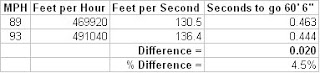
Just another point of reference: in the time that it takes a 93 MPH fastball to travel 60.5 feet, an 89 MPH fastball has traveled 57.9 feet, assuming no loss in velocity (which of course, there is). The slower ball is 2.6 feet behind the faster one! It seems to me that that 4.5% is very significant. But, yes, break and changing speeds, as we all know, is important, too.

I almost added that little computation to the story SBG. Great minds think alike. I didn’t because the more I thought about it, the less I cared. As a batter, swinging seem to be more about timing than distance. But that’s why I included the 4.5% thing. I’m glad someone brought it up.

SL__72 said:
And to follow up my last comment with something that is actually useful: Here is a really good article regarding fastball speeds.

You’re right SL_72, that was a really good article. Thanks for bringing it to my attention.

It is written by John Walsh at the Hardball Times and he studied fastballs ranging from 80-97 mph and the affect that they have on hitters. He came up with some nifty results. I’ll quote his conclusions:


So, what did I turn up with this analysis? Well, keeping in mind the sample size and other caveats previous mentioned, I think I've learned that
1. fastballs outside don't depend much (if at all) on speed for their effectiveness;
2. conversely, inside fastballs are more effective the harder they are thrown (this one I already knew);
3. most of the observed effect appears to come from home runs: outside pitches are rarely hit for homers and when they are, a fast pitch is as likely to be hit out of the park as a soft toss;
4. a pitch thrown hard is more susceptible to the ump's bad call than a soft toss.


I could write a whole entry on this and how it relates to Liriano (though the study was limited to right-handed pitchers). And I wants me that data set badly. Thanks again for pointing it out to me SL__72.

From Stealing a Moment

jesse said...
I don't think the Twins are opposed to the idea of Gomez swiping home...or attempting to...but it just wasn't the right situation. You said it yourself--Morneau at the plate, and he swings from the left side of the plate. Not only is one of your best hitters at the plate, but with no obstruction the catcher could see the entire thing develop in his peripheral vision.

Anonymous said...
It is possible to steal home with a left handed batter. Ideally it would happen with a guy like Ortiz at the plate since the infield shift is on and the third baseman is a long way from the bag, allowing a longer lead.

I wouldn’t be shocked if the White Sox had a small shift on Morneau, because I got to tell you, I was absolutely stunned how far Crede was playing from the third base bag in that at-bat. It was almost as if the White Sox were daring Gomez to try it.

Hell, I would've even supported Morneau to trying a bunt down the third base line. I’m almost sure he could have beat out a throw.

As for whether it matters that Morneaus is left-handed, I don't rightly know. I can't remember ever reading something that broke down the strategies for stealing home. And it's not like there's much opportunity to talk about it anymore. Anyone have a good link for this? SL__72, what's going on? Asleep at the wheel? You used to provide such good links. What have you done for us lately?

BeefMaster said...
I wasn't watching the game, and I didn't notice on the radio - was the pitcher in the stretch? I guess I can see stealing home on a lefty in the stretch, if he's paying little enough attention to the runner that you can get a phenomenal jump (and he doesn't use a slide step every time), but I generally think of a steal of home as coming when the pitcher is throwing out of the windup. Is it more common against a stretch than I'm thinking? I've only seen a steal of home happen once in a major league game, and it was on a first-and-third double steal (Gladden at third, and Jim Dwyer, of all people, at first).

I only included this comment because I love the nickname BeefMaster. I used to know a guy nicknamed Beef in college. If I remember correctly, we met him at a party in Eau Claire where my buddy Matt and I knew just three other people, one of whom was Beef’s girlfriend. Matt and I decided we would meet people by doing vodka shots with strangers, and we talked Beef into joining us, but his girlfriend was having none of it.

But of course, he did. About every 15 minutes he’s sneak away from her, meet us in the kitchen with the rest of the party, and toss back a small shot of something clear and cold and awful. Probably Smirnoff.

And the point is that I think you can trust guys named some derivative of Beef. Even if he tells you he’s seen someone steal home. And with that, I wish you all a happy weekend.

Wednesday, April 30, 2008

Stealing a Moment

"Well, what I like best...'", and then he had to stop and think. Because although Eating Honey was a very good thing to do there was a moment just before you began to eat it which was even better than when you were, but he didn't know what that that was called".
- from Winnie the Pooh

The score was tied, there were two outs, a runnner on third base and Justin Morneau was at-bat. And all I could think was that I almost wished he wasn't. Not because I didn't trust him to get the big hit. (He did.) But because I really wanted to see Carlos Gomez try to steal home.

It sure looked like he could have. Joe Crede, the White Sox third baseman, was playing at least 25-30 feet from the bag. Gomez could have taken a lead one-third of the say towards home and still beaten Crede back to third base. Frankly, it seems like nobody even considers that the opposing team might steal home. Even though it used to be so common that Babe Ruth stole home ten times in his career.

The situation certainly seemed to call for it. The Twins had been struggling to score runs. There were two outs. Morneau had looked terrible in his previous at-bats. And there was a left-handed pitcher on the mound.

And god knows that if any organization should be able to teach a person how to steal home in this modern era, it's the Twins. Rod Carew, who is at spring training every year, stole home 17 times in his career, and still holds the major league record with seven in 1969. But did you know that Paul Molitor also stole home at least ten times?

But today, for whatever reason, it was never really a threat. Gomez never took much of lead, never getting half as far from the base as Crede was. Go-go didn't even play games with the pitcher, as if it never evern occurred to him to consider bluffing, let alone actually doing it.

And, truth is, it probably wasn't a good time. After all, this is Morneau, and he did get the game-winning hit. Plus, I wonder if it's more difficult to steal home with a left-handed batter at the plate. And, it's likely that this is something that the Twins staff is afraid to work with Gomez on, because he does seem to be (as was aptly noted by Patrick Reusse yesterday) the most spontaneous player in baseball.

But count me as someone who is officially looking forward to Eating That Honey. I grew up with Sir Rodney, but to me he was the sweet hitter, not the sneaky thief. Sometime within the next couple years, we're going to see Gomez at least try that play. And the only thing I'm looking forward to more that it is the moment just before it, when the crowd is on their feet, and the whole ballpark, including the opposing team knows it's coming. And then....

Well, I don't know what it's called, but it's even better "than when you were". And I sure want to be there.

Monday, April 28, 2008

On Liriano and Important versus Measurable

The NFL draft and it's post-spin machinations invariably amuses me. Not that I blame teams for trying, especially because the analysis of their moves can be so completely ridiculous. Somehow, a college left tackle is graded "four stars", and some other right tackle is rated "three stars", and god help the team that chooses the second guy first, even if it's the right choice. In the near term, it's a bad choice, because the grading system says it's a bad choice.


But there are several biases inherent in a grading system, and one of the biggest is obvious, when you think about it. It's that each criteria needs to be measurable. Otherwise, it wouldn't be a criteria. It would just be an opinion.


And the reason that can be a problem is because that which is measurable is not necessarily important, and that which is important is not necessarily measurable. For instance, the criteria for a quarterback that is measurable might include arm strength or height or speed, but are those necessarily what you prize most in a quarterback? Or is it the ability to feel pressure, avoid turnovers, or read the tendencies of a free safety? And how the hell do you measure those things?


The answer, too often, is that you can't. And so the temptation is to make the decision based on the more objective criteria, even though you suspect, or even know) they're not as important. Because they are measurable, they become important. And that which is important, but can't be measured, becomes less important.


Of course, the beauty of such grading systems is that they can, through hard work, gradually improve in the long term. For instance, if you suspect that that avoiding turnovers is a prime criteria, perhaps you go through every game film of prospective NFL QBs and measure the times they could have thrown an interception versus how many they did. And then you do that for the prospective NFL QBs for the last five draft classes, and compare your results to how they did in the pros.


But if you've gone through that exercise, you know just how many difficulties that really presents. First, there's the data collection, which can itself be a time-consuming and tedious proposition. But even if you get the data, what are you comparing it to? The number of turnovers they had in the NFL? Over one year? Over their career? As a ratio to their touchdown passes?


And how do you decide which players to include in the study? All QBs that were mentioned in pre-draft literature? What if they're cut before their first season begins? Then what are you comparing them to? And if you only choose QBs that ended up starting, is there some built in criteria that allowed them to start? Like the fact that the matched those same non-important but measurable criteria you started out with?


The answer to all those questions is that you make a decision based on what you really want to know. For instance, switching to baseball, say you're interested in how important K/9 rates really are for a young pitcher. A Twins fan might compare to a pitcher's K/9 rate in AAA to their ERA in the first three years in the majors, because she wants to know what they can expect from that player prior to their arbitration year. But a roto player might compare it to their WHIP the next year, because they want to know what to pay for that player in next year's draft. And a Yankee fan might want to know how long their career lasts, because its not like the Yankees will ever quit paying him if he's successful.


Whichever that person chooses, it's important to know that it means they are answering a very specific question. The general sense might be that "K/9 rate in AAA is important", but the specifics matter, especially when it's "for the long-term outlook of that player" as opposed to "for next year".


All of which is why I grew increasingly uncomfortable as multiple sources evaluated the velocity of Francisco Liriano's pitchers ad nauseum this spring. It isn't that it isn't news. It's certainly news when a player's velocity changes after they have come back from injury. It shows that something is different.


But, of course, something is different almost constantly with pitchers. Maybe they're switching to a slide step when someone is on base. Maybe they're throwing more offspeed pitches earlier in the count, or when they're behind in the count. Or versus left-handers. Maybe they're raising their elbow a little higher, or changing their arm slot, or sliding to the left half of the mound. Or maybe the break on their two-seam fastball is a little greater today than it was last start.


No, we aren't obsessing about it because it shows a difference. We're obsessing about it because we think it's important. And it might be, but I don't know a single study that says velocity has anything to do with how successful a pitcher is in the majors, either short term or long term. I'll admit, it seems like it should be. But as I think about all the pitchers who have had successful careers, only a fraction of them have the ability to throw true gas.


Let's unpack this just a bit more. Reports are that Liriano threw 93 miles per hour before the surgery and 89 miles per hour after the surgery. So how much less time would a 93 mile per hour pitch take to reach the plate over an 89 mile per hour pitch? I'll add my back-of-the-napkin figures below so my fellow geeks can call me on it if I blow the math....


I get two one-hundreths of a second difference. It's certainly possible that is significant. But it seems equally possible that there are factors that matter more, like control or movement or the ability to change speeds.

But we don't obsess about these as much because we can't, and that's because they're not as measurable. But they may be twice as important.


Sunday, April 27, 2008

What's Not Working - The Offense

Last year we watched the Twins struggle all year because of an anemic offense. The bats finished third to last in the American League in runs scored (718), and they might have been lucky to finish that high considering that they were second to last in OPS (On-base Plus Slugging). New General Manager Bill Smith responded by overhauling the offense, replacing five of the nine lineup spots with new players.

The result? Would you believe it's worse? As of today, the offense ranks second to last in the American League in runs scored. And their OPS is actually 57 points worse than it was last year. Five of the positions in the lineup rank among the worst in the league at their position:

Right Field – 628 OPS ranks 11th in the AL
Michael Cuddyer has been hurt, so 1/3 of these at-bats went to Denard Span, and while Span might develop into a decent option in center field, he can’t provide the production of a bopper that typically mans right field. It’s also worth noting that while Jason Kubel (who got another 1/3 of the at-bats here) flashed some power in a hot start, he limps into this homestand with a discouraging .259 batting average and a gut-wrenching .281 On-base Percentage (OBP). The only guy who walks less than him with that many at-bats is….

Center Field – 639 OPS ranks 12th in the AL
The popular wisdom after Carlos Gomez remarkable first week with the Twins was that he would struggle at times this season, but he was just such a weapon that he had to be on the roster. We were mostly right. He’s struggling. And he’s a weapon. We’re just not sure for which team.

In 94 AB this season, Gomez has just 2(!) walks, which is why his OBP is just .271. For some context, the average OBP in the AL is .334. The median team OBP of a lead-off hitter is .351. No team has finished with an OBP lower than .286 from their lead-off hitters in this century. This isn’t just bad. This has a chance to be historically bad.

Shortstop – 523 OPS ranks 12th in the AL
To be fair, the Twins basically punted on this position offensively the minute they signed Adam Everett. He’s never been anywhere close to productive offensively but was supposed to be a defensive whiz. With Everett hurt, the at-bats have basically been split between Matt Tolbert and Nick Punto:

Matt Tolbert - 33 AB - 706 OPS
Adam Everett - 27 AB - 437 OP
Nick Punto - 24 AB - 367 OPS

April is hardly the time to panic. But when it is time to panic, this looks like a pretty good place to consider a change.

Third Base – 618 OPS ranks 14th in the AL
Not much is going according to plan for Mike Lamb so far this year. He was wooed by the Twins with promises of getting a chance to bat more versus left-handed pitchers, but so far only had 13 at-bats against them. And he traditionally feasts on right-handed pitchers, but is hitting just .246 against them with very little power. Lamb has had months like this – last May his OPS was just 598 – but it sure would be nice if it didn’t happen in his first month of a multi-year contract with a new team.

Left Field – 600 OPS ranks 14th in the AL
The Twins biggest offseason acquisition has been their biggest disappointment so far. It looks like Delmon Young is trying to work on driving the ball to all fields and control the strike zone, which would be great if it was working. Instead, he’s striking out just as much, walking just as little, hitting 30 points below his career batting average and slugging 100 points worse. And most of that damage has been inflicted immediately following Joe Mauer and Justin Morneau in the lineup.

The good news is that it sure looks like he’s trying to improve, and at 22 years old, he’s got a good chance of eventually making the adjustment that could lead to stardom. But that sure isn’t happening this month, and recently manager Ron Gardenhire has moved him lower in the lineup.

Sunday, April 13, 2008

On Nick Blackburn and Playing Possum

"For a baseball fan to fail to see that strikeout rates are closely tied to career length, I would argue, is very much like a basketball fan failing to notice that basketball players tend to be tall."

- Bill James in The New Bill James Historical Baseball Abstract

For the first Dugout Splinters of the year, I named ten Twins players I am excited to watch develop this year. And now, two weeks into the season, they almost all rank behind a guy who's pitching tonight. And he wasn't anywhere on the list. And the reason why I'm excited has to do with James' quote above.

The reason Nick Blackburn didn't make that first list was also because of that quote. Blackburn simply didn't show the good in the minors, where "goods" is described as a high strikeout rate. The Twins other young pitchers intrigued me for exactly the opposite reason. But Blackburn wasn't like the others:

A K/9IP (strikeout rate) of 6 is about average in the majors, and it's a little higher in the minors. All the other young studs had some very good strikeout rates - some obscenely good. This is why I was so optimistic about the Twins young rotation developing into something special as the year went along. And, obviously, so far, so good.

But Blackburn seemed likely to be the guy who didn't stick around for long. It was certainly possible that he would have a few good starts, and maybe even stick around for a year or so. Old timers like me will remember Twins starter Allen "Little Franky" Anderson, who won the ERA championship in 1988 in his first full year in the majors. He also struck out just 83 batters in 202.1 innings. He had another good year in 1989, lost 18 games in 1990, and played his last major league game in 1991.

So it isn't surprising that Blackburn, who the coaching staff praises as a polished pitcher, is having early success. That happens even with low strikout pitchers. What's surprising is that so far, Blackburn hasn't been a low strikeout pitcher:

By comparison, Blackurns K/9IP last year in AAA-Rochester was 4.64. It's rare to see a pitcher's strikeout rate go up when they jump from AAA to the majors. It's virtually unheard of for a strikeout rate to jump this much.

Small sample size, you say? Well, obviously. But that's the first reason why this is so compelling to watch. Because if you're looking at a pitcher's early results, and you're going to pull one stat that is a decent indicator on whether that success will last, strikeout rate is usually it. For instance, if your closer is scuffling a bit and you notice that he's only struck out just two guys in his first nine innings, odds are it's because he's hiding an injury. Strikeout rate is a hard thing to fake.

But the second reason I'm compelled to watch is because of what I saw in his last start against the White Sox. Blackburn seemed to be striking out the most dangerous White Sox batters, almost as if he was truly pitching to contact for those hitters that were less likely to hurt him. And saving the Ks for the moments it meant the most.

In the first inning, that also meant striking players out exactly when he needed to. Three batters into that inning, the White Sox had one run in, no outs, and runners on first and second base. Blackburn struck out Paul Konerko and Jermaine Dye consecutively before getting a ground ball to shortstop (from AJ Pierzynski) to end the inning.

The heart of the order was back up in the third inning, when Blackburn struck out Jim Thome and Konerko to start that inning. And in the fourth, he struck out Thome again to end another scoring threat.

What struck me about this was that I'm watching a guy who shouldn't be striking people out, and I'm wondering why his strikeout rate is shooting upward. And then he surprises me even more by recording those punchouts in critical moments against some of the opposing team's best hitters. And I can't help but wonder, can a guy really play possum through a six-year minor league career, and then flash the goods when his team, and his career, needs it the most?

I doubt it. But I damn well am going to watch it.

Sunday, April 06, 2008

On-base Surprises

I don't know what surprises me more: that one week in into the regular season and it looks like we have two lineup changes, or that I don't seem to mind. Granted, neither of them are official or anything. But it looks like two guys are going to get a lot more playing time than anyone anticipated before this weekend's series versus the Royals.

The first is Matt Tolbert, who has played in six games, starting four of them. He received playing time in part because Adam Everett had a family emergency and because Brendan Harris has been fighting some flu, but that still means he was plugging those holes that Nick Punto was supposed to be filling.

But it goes further than that. Those incidents don't explain why he was starting at shortstop yesterday. I'll be surprised if he isn't getting at least one starting the Chicago series, and maybe two considering Mike Lamb (third base) is hitting just .143 so far. It looks like he currently has Ron Gardenhire's confidence. A .462 batting average can do that.

The second surprise is that the Twins plan to start Denard Span most days in right field during Michael Cuddyer's absence. That means that Span has just jump-frogged the capable combination of Jason Kubel and Craig Monroe, who will continue to platoon as designated hitters.

The initial reaction to both developments was a wince. Both smell like knee-jerk reactions. Neither player has been much of a prospect, but they've both been fairly hot, and their more respected competition has been somewhat cold. And that wince turns into a pained grimace when I think of the accolades and hype that are going to be thrown upon these guys by local coverage. It will make the Church of Puntocism that sprang up around here seem restrained.

But if you're watching the games, you can see what Gardenhire is seeing in those players. The Twins like to pontificate about "professional at-bats", and that's an easy thing for them to defend, because like porn, you can claim you know it when you see it. But I see it in their at-bats and both players spring performances show some results to support that assertion.

And frankly, so do both players recent stats. A couple of weeks ago I opined that Denard Span might just have turned a corner late last year, pointing to a large shift in his walk to strikout ratios. And, in his first major league game, he got on base with a walk, and didn't strike out. I'm not claiming he's Ricky Henderson, but he continues to bear watching.

And while Tolbert has never been a particularly high ranking prospect, the one thing he has seemed capable of doing is getting on base. Over the last two years in the minors, he's drawn 81 walks and struck out just 116 times. That's a damn fine ratio and helps explain why his on-base percentage (OBP) over those two years has been .350 over that time.

And this decade, getting on-base has been a real key for this team:
When the Twins have been above the league average in OBP, they've generally done well, and when they haven't, they've generally struggled. I'll admit, that's a pretty simplistic way to break things down, but it makes some sense. This team has always struggled to find power, but has been successful despite that ongoing deficiency. They've done so because they have been a little better at setting the table.
And so, I find myself warming to the surprises this first week has produced. I want to see if these guys are the disciplined hitters that their recent history suggests. And I want to see if the effect that adding to professional hitters might have on this lineup.

Thursday, April 03, 2008

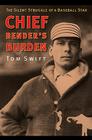
Chief Bender’s Burden

Tom Swift was an editor and writer in GameDay, and some of you may even remember him writing for TwinsGeek.com back in 2003. Or was it 2004? Anyway, for the last few years, he has been working on a biography of Charles Bender, AKA Chief Bender, Minesota's first Hall of Famer.

Tom is going to be at the Twins game tonight, signing copies of his book, which will be available at a 20% discount (I think). He'll also be at Magers and Quinn on Saturday the twelfth talking baseball with some other baseball writers. I encourage you to take advantage of these opportunities to talk with someone who is knowledgable and passionate about baseball.

The following story is in the April issue of GameDay:

Chief Bender’s Burden: The Silent Struggle of a Baseball Star is a new acclaimed biography of Charles Albert Bender, Minnesota’s first representative in the Baseball Hall of Fame and for nearly fifty years its only one. Bender, who was born near Brainerd and spent his early years on the White Earth Reservation, was the greatest American Indian player of all time. A bright, courageous pitcher who thrived in front of lively Deadball Era crowds and was forced to face constant racial prejudice, he helped lead the Philadelphia Athletics to five American League pennants and three World Series championships.

Tom Swift, author of Chief Bender’s Burden, will sign copies of the book in the concourse inside the Metrodome on Friday, April 4, before and during the Twins-Royals game. He sat down with GameDay to discuss Bender and the book.

GameDay: You’ve already gotten some positive reviews — congratulations. Let’s start at the start. Why did you write this book?

Tom Swift: I think what’s behind the generous feedback some have offered the book is what drew me to write it — Bender’s life story is compelling. After his name popped up in newspaper articles, when other Minnesota-born players began receiving Hall of Fame consideration, I became curious. The more I learned the more I wanted to learn. I discovered a man who had a rare ability to throw a baseball. But I was especially fascinated by the reasons why his success was so improbable. It’s funny, but I never would have known about Charles Bender if I wasn’t a baseball fan, but I never would have written the book if he had been just a great baseball player.

GD: It’s written in a different style than most baseball bios. Was that intentional?

TS: For better or worse, I decided early on not to chronicle every game or season of his career. I think baseball fans have plenty to chew on here. But I was after a story that, personally, I found inspiring. I tell people kind enough to show up at readings that they may have many reasons to not read this book. That its subject played baseball is, at least I hope, not one of them.

GD: You write a lot about how bright Bender was. Is it true he invented the slider?

TS: I don’t know. No one knows. That’s the most accurate answer. The most interesting answer — and this comes from historian Bill James, not just me — is that Bender is the first pitcher we know definitely threw the pitch.

GD: This book obviously required a great deal of research. You delve into regular seasons, the World Series, the prejudice, Bender’s surprising number of hobbies. I had no idea, for example, he was one of the best trapshooters in the country or that he was a terrific golfer. What is the most interesting thing you found on the research trail?

TS: One answer that comes to mind, looking at the arc of his life, was just how much he changed over time. Bender arrived in the big leagues as a skinny 19-year-old kid from nowhere and found himself in a racially intolerant business. He was introverted and noticeably shy. Using intelligence and poise, he essentially taught himself to be a great pitcher. He was constantly improving — his ERA dropped for eight seasons in a row — and over time he embraced the spotlight and, eventually, of all things, became a people person.

GD: He was also pretty funny, wasn’t he?

TS: You’re right. He liked to make people laugh. Late in life he was a regular speaker on the rubber chicken circuit. At one banquet, a man who had had too much to drink kept asking him obvious questions, such as what he had done for a living and what country was he born in. Bender replied, deadpan: “I sell blankets at the railroad station in Albuquerque.”

Chief Bender’s Burden, published by the University of Nebraska Press (April 2008), is available where books are sold. For information visit www.chiefbendersburden.com.

Tuesday, April 01, 2008

Opening Day Notes

It's late, I'm bushed and cold and wet, so we'll be doing the lighting round tonight, I think....


The Monroe Decision
I assume this one will be covered extensively by other sites, since I had friends showing me internet articles about it during the game. In case you missed it, Ron Gardenhire trumpeted his intention to bat Jason Kubel and Craig Monroe in the designated hitter spot, and to choose which one to bat day by day.


Some might have thought that would have meant a platoon, since Kubel is bats left-handed and struggled last year versus lefties and Monroe bats right-handed and hit .194 against right-handers. So just to make himself clear, Gardenhire started Monroe against right-handed Jered Weaver. And he stayed with that until the Angels brought in a right-handed reliever, so Gardy responded by batting Kubel.


Apparently it was a hunch, and it was seemingly a hunch that paid off, in that the Twins won, Kubel had early success (he got a gift double in that at-bat) and Monroe can feel like something more than a glorified bench player. This sounds an awful lot like Gardenhire outthinking himself. There are those that say that isn't too hard to do, but if we're going to beat him senseless for that, it's only fair that we give credit where credit is due, too. Like:


Pulling Livan
The top of the seventh ended with the Twins holding a one run lead, and their veteran was on the mound and had only thrown 84 pitches so far. What's more, the eighth inning was going to start with the Angels ninth hitter. There wasn't a doubt in my mind that Livan Hernandez would come out and start the eighth inning until he got into trouble.


And I expected he would have some trouble, too, because he's Livan Hernandez and these are the Angels. I'd expected he would have some trouble in the previous two innings too, and he hadn't. But I'd also expected that he would start those innings instead of turning things over to a lockdown bullpen, and he had. That's generally the way the Twins do things.


I was wrong, because Pat Neshek came out and threw those nasty pitches and made the Angels look pretty silly for the most part. The last battle he had, against Vladamir Guerrero, will be one of the more memorable late inning battles you'll see. Neshek kept throwing nasty pitches, the crowd was on it's feet, and Vlad kept swinging like he was trying to break the baseball like a pinata. On the 2-2 pitch, Neshek uncorked a high and tight fastball as a warning shot. And on the next pitch he blew a fastball past Vlad while Vlad, who had just seen a pitch barely miss his ear, swung as hard and as violently as DeNiro in The Untouchables. Classic.


All of which is a little off topic, because what surprise me was that Neshek was in that game. It's probably because Gardy wanted to get Livan his first American League win. But it could just as easily be explained by Gardy coaching with a sense of urgency, which is franly good to see. And it's also notable that this is a case where Gardy clearly didn't overthink things. Neshek owned that inning, despite it being filled with left-handed batters. It was a smart, strategic and confident move, devoid of a lot of clubhouse politics. I hope we see more of that.


Get to Know 'Em
One of the highlight of the opener is getting to know the new players. And, of course, the snapshots the most regret. My friend Kris practically squealed with glee when she saw Adam Everett's headshot. "Ooooh. Can we call him Baby New Year?"


Yes. Yes we can.

See you on GameDay

If you have some time, we just had a nice story done on GameDay by Finance & Commerce. GameDay has been a lot of work this spring, but I'm very excited about some of the things that are going on with it. Ultimately, I think our goal is to help the Twin Cities become an avid baseball city and I just believe an independent and financially sustainable program/newsleetter that focuses on baseball is a part of that. If you would like to be involved, as a writer, vendor, advertiser or other, please let us know. We would love to have you join the team. Thanks.

Sunday, March 30, 2008

10 Reasons to Watch

If you were a Yankees fan who wanted to win a World Series, you could just sit back and wait for the top free agent to hit the market and demand your team sign him. And, I suppose, if you wanted to be a successful parent, you could just adopt a 17-year-old National Merit Scholar.

But Twins fans are like the rest of us parents. We understand that it is infinitely more rewarding to see success come from someone in whom we’ve invested some time. While it isn’t clear that this team is ready to add to the four division championships they’ve had this decade, the players’ minor and major league histories show that they’re not as far as some might think. So, if you like watching kids grow up, here are the Top 10 reasons to watch the Twins this year:

10. Justin Morneau – He has an MVP award in his back pocket, he’s going to be a Twin for the next six years, and he still hasn’t entered his prime. It’s almost become a cliché that baseball players often have a career year when they turn 27, and Morneau’s 27th birthday is May 15th.

But the critical question about Morneau might be: what happens when this guy doesn’t slump for two months of the year? Last year, he had 28 home runs by the end of July, but slumped the last two months hitting just .222 with 3 home runs in August and September. And in 2006, when he won the MVP, he was hitting just .244 entering June. We still haven’t seen this guy’s ceiling.

9. Scott Baker – As he entered the ninth inning of a perfect game last August, it was pretty clear we were watching Baker make “the leap” that we had been waiting for. In reality, this was the second leap. The first was in 2004 when he motored through three levels of the minors and we got all excited. It’s taken three years, but he’s still just 26 years old.

8. Brendan Harris – He showed last year in Tampa Bay that he could hit in the majors, but he’s going to need to show the Twins that he can field for an organization that cares about details. He’s the starting second baseman for now, but watch to see how many rollers make their way through the right side of the infield. If he even becomes average defensively, he’ll likely hold this job until the new ballpark opens. If not, you’ll see him backing up someone next year.

7. Boof Bonser – Apparently, I’m contractually obligated to talk about Bonser’s weight, or at least that’s what I gather based on the thousands of words penned about the topic this spring. Instead, let’s focus on a minor league career that included a strikeout title in the AAA Eastern League. For all last year’s struggles, he still kept striking out batters (136K/173 IP), which bodes well for continued success in the majors. Fatso or no, he projects to be a legitimate #2 pitcher in the next year or so.

6. Jason Kubel – “Before The Injury”. It seems like those three words have almost become a new first name for Kubel. Like “Before The Injury, Kubel was a more exciting hitter than Mauer or Morneau.” Or “Before The Injury, Kubel was one of the top prospects in the minors.” The sad truth is that Kubel may never be the player he was Before The Injury.

Then again, maybe he will be. Shortly after Twins fans started tuning out last year, Kubel started locking in. He hit .341 over the last two months last year, and showed both patience (.400+ OBP) and power (.500+ SLG). Could that be from the increased plate discipline he showed as the year continued? In April he was striking out four times for every walk. By August, the ratio was 1:1.

(Space is getting short. See what I mean about having a lot to watch? Let’s do a lighting round….)
5. Kevin Slowey – “He needs a strikeout pitch!” Really? He struck out 342 batters in his 354 minor league innings. Maybe he can just use the pitch he used for those. I’m just saying.

4. Joe Mauer – “Where’s the power?” He’s 6’ 5”, 225 pounds, 24 years old and is a career .313 hitter. I’m thinking it will come. Just a hunch.

3. Carlos Gomez - “He’s not ready!” Probably not, but over the last three years, he has averaged 45 stolen bases per year. Only three Twins have ever stolen that many in a season – Chuck Knoblauch, Rod Carew and Cesar Tovar.

2. Delmon Young – “He’ll swing at anything!” True, but if he can learn to recognize pitches that he can’t hit, he may have the highest ceiling in this list. In Tampa Bay, he was striking out four times for every walk. This spring he continued that trend, so he certainly has a ways to go. For now, his power, arm, and lack of plate discipline will remind you of Torii Hunter, both the good and the bad.

1. Francisco Liriano – “What’s his velocity?” Quit obsessing about the radar gun and watch the strikeout totals instead. In his last two spring training starts, he struck out twelve batters in nine innings. Giggle.

--------------------------------------


I'll be at the home opener tonight, and GameDay will be sold across the four corner of the Metrodome as usual. This year, I'm going to be working with the vendors a lot more than in the past, so you might well see me walking around in my red vest (and red stocking cap) tonight. If so, please say "Hi".

And of course, look for GameDay vendors with the red vests and the colorful covers featuring art by Robert Blehert this month. (You can see it at the top of the entry.) This month's guest editor is Nick Nelson and the opposing team's Dugout Splinters is by an Angels blogger from HalosHeaven.com. Plus, there are stories by Jesse Lund and Seth Stohs. It's a virtual bloggers cornucopia.

Tuesday, March 25, 2008

Deal or No Deal

Over at the Bleacher Bums, which is one of the many blogs I should really stop by more, David Zingler wrote up a piece called "Nathan Contract Doesn't Make Sense". His basic argument is that after the Twins didn't pay Johan Santana $137M, they certainly shouldn't pay Joe Nathan $47M.

His basic point is right on, which is that if the Twins can stretch and accept the risks inherent with Nathan, they should have been able to accept the risks inherent with the best left-handed pitcher of this millenium. I made a similar point in the days after he was traded. But there is a key difference for the Twins, and when I started to write it up, I realized I might well crash their comment posting system, so let's go over it here. (Hope you see this David.)

Tuesday night, The Voice of Reason was watching Deal or No Deal, which has become her latest innocent addiction. The contenstant was a young, recently engaged woman who had three cases left - $1,000,000, $500,000 and $25. She could either accept the offer from The Banker for $404,000 or choose to open a case. She would NOT get whatever amount was in that case, and The Banker would then give her another offer.

With two big amounts left on the board, she chose to open a case. In her mind, she had a 2/3 chance of making more money than was being offered. But, in fact, the opposite was true, and that became very apparent within the next five minutes.

Because the case that was opened was the $500,000 case, meaning she was going to end up with either $25 or $1,000,000. Or whatever The Banker offered her. What would you do?

It's obvious, right? You MUST take the banker's offer at that point. And in this case, he made it none too easy, lowballing her with a $340,000 offer. But as she's trying to get up the guts to stick it to The Banker and go for it, her fiance is saying "Be smart. Be Smart." He didn't even need to say what option was the "smart" one. She knew. We all knew. And of course she took the offer.

That's why, when she rejected the $404,000 offer, there was really a 2/3 chance of her leaving with less money than that. Despite 2/3 of the cases being worth more than that. It was going to be impossible for her to swallow that risk. A kid playing with imaginary money can take that risk. A millionaire who already has financial security can take that risk. But with a $25 stink bomb still in play, she was never going to be able to take that risk.

That's the difference between the Nathan deal the Twins signed and the Santana deal they didn't even offer. They can gamble on paying $11.25M four years from now. They couldn't gamble on paying $25 million seven (incuding the option) years from now. The money was too much. The length was too long. The risk was too great. As much as they wanted to, you know someone was whispering to them "Be smart. Be smart."

Which isn't to say that they shouldn't have, because sometimes it pays to take the risk. That's a lesson the contenstant now knows well. The case in her hand, the one she sold for $340,000 (because it was the smart thing to do), held $1,000,000.


----------------------


Speaking of blogs I should stop by more often, Judd Spicer has taken over the role that Pete Schilling Jr. had as the baseball guy at City Pages Balls Blog. Judd has written for GameDay on a number of occasions, usually something offbeat and entertaining, like when he tried to convince Joe Mauer to get a haircut at his girlfriend's salon. As soon as I can figure out how to get just th MLB posts to come over to the MNGameDay.com feed, I'll include it. In the meantime, check it out.

Sunday, March 23, 2008

Weekend Notes

Lotsa little things to talk about, but nothing major. Let's start reporting and see where this goes...

Joe Nathan Signing is Imminent
ESPN, TwinsBaseball.com and Star-Tribune are all reporting that the Twins and Joe Nathan are very close to a deal, and that deal is a four year contract for $11-12M per year. Beyond that we don't know any details.

There is really only one I care about: is there a no-trade clause? I outlined the parameters of a possible deal about a month ago, and this looks like it's going to exceed that by a million or so per year. That's fine - that's what a team should do for a premier player - but the deal cannot include a no-trade clause.

Why? Because if it doesn't have a no-trade clause, it's a movable contract if one assume Nathan stays effective and healthy. That means it's an asset to the organization.

You can argue that the Twins shouldn't be paying much over $42M. Nathan was going to hit the market next year and get either a three-year deal for $14M per year or a four-year deal at slightly less. A three year deal for $14 million is $42 million. If you add the $6M the Twins are paying this year, that's $48 million. So the Twins could have essentially let him walk as a free agent (or traded him at the deadline) and still been suitors for him next year at that kind of money. To give him that guarantee a year early requires a discount.

Contract talks have traditionally not been one of this organiztions strengths. There have been signs lately that has changed, and that there is some more creativity in place under Bill Smith than there had been under Terry Ryan. This contract is the first realy test Smith faces on that front. If there isn't a no-trade clause, it will be interesting to see the details. If there is, it might well be sickening to see the details.

Center Field Decision Today
Speaking of interesting decisions, Monday is the day we'll supposedly see Carlos Gomez or Denard Span win the center field job for Opening Day. On his radio show today, Ron Gardenhire indicated as much, and the Pioneer Press reported the same thing.

I'm not sure I have a dog in this fight, but from a distance of 1500 miles, I'd probaby choose Denard Span. Gomez seems like a potential superstar, but also doesn't seem ripe yet. Span might not be either, but there's more downside if he's mishandled, and he seems to a little more ready than Gomez. If he has the newfound plate discipline he seems to have shown, he also might be a better fit for the leadoff spot, a lineup spot the Twins are struggling to fill.

Note that I'm not saying the Twins will keep Denard Span. Ron Gardenhire tries so hard not to tip his hand today that I wondered if he really knew himself. He gushed about Gomez's game on Saturday, and Sunday Span again went 0 for 4, though he again added to his walk total. And the whole staff seems to go a little gaga when they talk about Gomez, in a way that makes me a little uncomfortable. I'd probably give slightly better odds that Span is the odd man out tomorrow.

Friday, March 21, 2008

Holy Communion

There are pockets of baseball fans who are annoyed as hell by the NCAAs and I hear them that it's all too much. But it's still one of my favorite things about sports. Yesterday didn't provide the magic moment on TV that we wanted (though Belmont was damn close) but I still loved getting together with friends and strangers to watch the games. As a middle-aged father, I can count the times on one hand where I get to hang out with an old friend and do nothing but, well, hang out for way too long.

I still believe, like I wrote five years ago in the post below, that The Big Dance provides an opportunity for magic both on the court and wherever we gather. And I'll be gathering today at Senser's in Bloomington to watch the duration today, starting with (hopefully) the opening tip. I hope you can join us.

Holy Communion
(from 3/21/2003)

For me, it started in Philly, where the Big Five can be close to religion. Philadelphians are a passionate lot (as Kobe well knows), and the five (now six) division 1A college teams inside the city limits can draw a fanatic following, whether they're playing each other in the old Palestra or the new MegaBank-of-the-Moment Center.

The first round of the NCAA has turned into a religious holiday for many, and this year my wife (The Voice of Reason), my friends and I are choosing to worship. We've arranged care for the kids with my parents for the day, who don't really understand our fascination with this event, so it means even more to us that they agree to help. The congregation is gathering at America's Original Sports Bar and the service lasts approximately 11 hours. What makes it communal is the nonsense that we spew at each other between the nail-biting finishes. What makes it holy are the miracles that we invariably witness.
  • "HOOOoolyyyyy CROSS!", Bob exclaims as we walk in at 11:45. #14 Holy Cross is only 2 points behind #3 Marquette, 14-12. It's too soon to be a big deal, so Bob uses the joke while he can. I wonder how long he's been saving it.


  • The first beer arrives at 11:55 AM. It's part of the tradition of the tournament - the first beer has to arrive before noon. There's something liberating about snubbing social norms. We feel free and a little giddy.


  • Matt walks in the bar and pulls up a seat. He has a 7-day-old baby at home. He's our new hero.


  • There are three early games and they're all on big screens - with a small TV in the corner alternating between Fox News and CNN. It's there to ease our guilt about ignoring the real world for 11 hours. We can glance over occasionally, and feel like we're still good citizens for reading the news ticker.


  • It turns out that Bob's joke didn't need to be used that early. Holy Cross is playing their hearts out - well enough to be a Cinderella-Sweet-Sixteen-kinda team. Except that Marquette came to play, too.

    We watch two talented, focused teams play good solid basketball for the entire second half. Aggressive defense. Hard fouls. Precise, quick ball movement. And gutsy shooting. In the end, it's Marquette's Travis Diener who makes the biggest shots, and we're robbed of a big ending by a stumble and a steal that puts the game out of reach for Holy Cross.

    When the game ends, the bar breaks into applause. It may be the best basketball game we'll see played all day.


  • Al and Bob are doing their best Norm and Cliff impression. They just don't know it.
    Bob: We concluded with Andy the other day that you might be able to induce diabetes if you ate 30 Krispy Kreme doughnuts.
    The Voice of Reason: Why 30? Why not an even 3 dozen?
    Al: I spotted him six.
    Bob: Yeah. Eating 30 Krispy Kremes is one thing. But 36 is just crazy.


  • The highlight you're probably seeing replayed today is from the Cal-NC State game, made even more spectacular because is was announced by Kevin Harlan. With 12 second left in overtime, NC State hits a three to take the lead, but Cal answers by racing down the court and draining a three with 5 seconds left (by a freshman, no less). And then NC State races down to the other end and just misses answering themselves.

    The game itself was competitive, but sloppy on both sides, and marred by officiating blunders at the end of regulation. The consensus opinion is that we wanted that to be the ending of the Holy Cross/Marquette game.


  • The Voice of Reason: If I give you this credit card, can we start a tab?
    Hot Waitress [taking card and walking away]: Sure, sweetheart.
    The Voice of Reason [stunned, to Matt]: I'm sorry - did she just call me "Sweetheart"?
    Long Pause
    Matt [meekly]: Can I watch?


  • The Southern Illinois (#11) vs Missouri (#6) game had something like 20+ lead changes and we were apparently wrong about Holy Cross/Marquette being the best game of the day. Missouri's center, Arthur Johnson, carried his team to a five point lead, but somehow the Salukis came back and tied the score at 71 with Missouri still having the ball for a last shot.

    But the Missouri player accidentally charges into Saluki Jermaine Dearman with five seconds left - and the official blows the call. He rewards Missouri with a foul on Dearman, who fouls out. Irate, he walks back to the bench to find the rest of his team on the edge of their seats, with their arms linked. He slides into place, another link in the chain.

    Missouri only drains the second free throw, so Southern Illinois is down by just one point with 1.5 seconds left. They get a decent look, but the shot doesn't go in. Before the shooter can walk off the court, a Missouri opponent is shaking hands with him. Good game, indeed.


  • On the corner TV, Fox News is talking about French President Jacque Shirac. We can tell this because they have a graphic behind the announcer with the word "Shirac" and a picture of Shirac which only a rival campaign manager would love. Honestly, he looks like he's yelling at someone for mispronouncing a wine.

    Leave it to Fox News to pull something like that. Why not go the full nine yards and just put up a picture of Pepe LePugh? Or Napolean?


  • The biggest "almost" upset comes from (#15) Utah State, who battled (#2) Kansas for the entire game. They pull within 3 points with 46 seconds left, but Kansas outlasts their charge.


  • A commercial for the movie "Anger Management" comes on.
    Al (dryly): That'll be funny.
    John(increduously): Adam Sandler and Jack Nicholson?
    Andy (dryer still): Finally, they're together. Finally.


  • University of Wisconsin-Milwaukee (#12) has traded punches with Notre Dame (#5) for 47 minutes. More accurately, they've traded punches with Notre Dame's guard, Chris Thomas, who is literally willing his team to compete. He is scoring, rebounding, and dishing the ball. This would be a 20 point blowout if not for him.

    UM-W wasn't even supposed to be here. They made the tournament when they upset Butler in their league championship game. They are lead by senior guard Clay Tucker, who leads the team in scoring, assists and is second in rebounds. And they find themselves up by a point, with under a minute to go, and they have the ball.

    Their shot balances on the rim, but falls out and the Irish get the ball back and score on a loose ball putback by Torris Francis with 35 seconds to go. The Irish lead 70-69, but UM-W doesn't call a timeout. Instead, Clay Tucker calmly dribbles the ball across half court and waits for the clock to run down. If they make it, the Irish (and Thomas) won't get another turn. And if they miss....

    With 8 seconds left, Tucker starts his drive to the lane, looking for the shot to ice it. Notre Dame's defense comes in waves; one too many waves it seems. Because rather than shoot, Tucker finds 6' 8" UW-M forward Dylan Page, by himself, under the basket. The pass is made and Page goes up above the rim and lays it in the cylinder.

    And it rolls around the back of the rim.

    And out.

    And the game is over. Irish win, 70-69.

    We watch Page walk numbly to his bench with his team and start shaking hands.
    We all know the feeling. It's an emptiness. A throbbing too intense to be fully realized. A failing that hurts oneself most because it hurts others more.
    We look at each other. We exhale and shake our heads. We give our hearts to a 21-year-old kid that we just noticed. We want it to be different. We want to heal it. We want to heal him.

    But we're reminded that religions don't provide miracles, they provide communion. This wasn't the miracle we wanted to see, but it's the communion we wanted to feel.

Wednesday, March 19, 2008

Denard's Patience

School is back in session and you can't help but roam the halls marveling at the changes that took place over the summer. This year, the hot topic is the new girl from New York who nobody can take their eyes off.

I mean, holy cow. Have you see that game-changing speed? Eight steals so far in spring training? And room for power too? She looks like the whole package, except - well, she just doesn't seem to get it, you know? Maybe she's a little too used to being the center of attention and takes things for granted?

And quite suddenly you wonder if all that hubbub hasn't caused you to overlook that girl in American History. You know, the one that you had that thing for in eighth grade, but she was a little too stuck up. And then she started overrating herself, and that turned into a little insecurity, and she just wasn't walking around the same way anymore.

You haven't paid attention to her much, but this year there seems to be something a little more substantial about her. A quiet confidence, or even groundedness, perhaps? Who is she again?

Denard Span has alternated between "overlooked" and "whipping boy" for followers of this organization for several years. Some of that is out of convenience because Span has embodied two of the favorite Twins-critical paradigms. For starters, he's a first round draft pick and a position player, and the Twins have been short on success stories for both recently. Second, he's a light-hitting speedster, and many believe the Twins are too infatuated with "piranhas" like him.

But, to be fair, Span has done his fair share to deserve that criticism. At 24 years old, he's not particularly young, and he hasn't exceeded a 700 OPS since High A ball. With almost no power to speak of, he needs to be an on-base machine that can use his speed, but he's only been average at getting on base in the minors. So Span entered this spring as an aging ex-prospect with career minor league numbers that include a .285 batting average, a .350 on-base percentage and seven home runs over five years.

That's pretty bleak, and would've been a lot bleaker if not for August of last year. You may have read that Span's second half of 2007 was much better than his first half, which gave everyone involved some hope. And you may have read more cynical takes that Span really only had one great month. Both are true, but there might be something more substantial there.


Well, I suppose the optimist could look at that steadily rising batting average and get a little excited, but you can see what has the cynics worried. Span basically had one very good month, and by "very good" I mean he had about a half dozen extra hits fall in. That doesn't erase four years of skepticism.

But this might:

Um, sixteen walks in August, too? That suggests that Span wasn't just finding holes in the field, he was taking substantially different at-bats. That looks a lot like a change in patience, and the skyrocketing OBP looks like a lot like a major league asset.

Now, sometimes with a free-swinging player, they can see a surge like this just because they decide to keep the bat on their shoulder. Pitchers have decided they don't need to throw the player strikes, so the passive batter ends up walking a lot. But the batter also often strikes out a lot as they let quality pitches go past.

But Span's strikeouts in August were also the lowest of any month. Span historically strikes out twice as much as he walks, but in August he walked more than he struck out. That hadn't happend to him in any month for several years.

Now, this doesn't prove he's made an adjustment, but it gave cause for legitimate hope in spring training. Even in the limited at-bats a player has in spring training, you would hope that you would see some similar trends.

And so far, so good. Span has six walks and just three strikeouts. In 31 at-bats, most of which have been as a starter, he's hitting a reasonable .290. But his on-base percentage for the spring is .421. Those numbers look pretty consistent with what happened at the end of last year.

Which isn't to say that you're ready to forget all about that knockout from New York. But it might pay to take a second and third look a that girl you wrote off a couple of years ago. She might be proof that patience really does pay off.

Sunday, March 16, 2008

Weekend Notes

Is there a more frustrating endeavor than to monitor spring training developments from 1200 miles away? I say "no". You can glean a smidgen of info from the stats, and a little more from the lineups, but mostly you need to watch the games.

For Twins fans, this weekend provided two opportunities to do so, and I was able to take advantage of one of them. The Voice of Reason and I had our annual Twins-Phillies bet riding on Saturday's game because it was on TV locally. Since she artfully arranged to have our kids dying Easter Eggs at my parents' house for the same three hours, we got to hunker down at Majors in Bloomington for a baseball date.

AAAAaaandddd.....unwiiiiinnnnnd

It was beautiful. And, because we view you all as our close friends, it seems only fitting we bring you along....

- Over at Stick and Ball Guy's blog, Ubelmann was kind (cruel?) enough to point out to us that the Twins have started Nick Punto at second base most of the time when Adam Everett was playing shorstop. It's a reasonable assumption that Gardenhire is interested in having his keystone combination play together in spring training. Yikes.

Sure enough, Punto played there for our game, too. My impression? It looks like he has rediscovered the plate discipline he lost midway through last season. I did not notice how he handled high pitches, which was part of last year's downfall.

(TVOR's reaction? "OOOH! Look at him move those tiny little legs to get to first base. Isn't he just adorable?".

Umm, OK. I just made that up. That would never happen. She wanted the Phils to win so bad that she would've been more likely to root for him to strain a hammy. She is, after all, from The City of Brotherly Love.)

Then, in yesterday's call-in radio show, Gardenhire was asked point blank whether Brendan Harris would be his starting second baseman. He refused to say that he would be.

And then, in Sunday's game, Harris missed yet another ground ball that should have been playable by 95% of all second baseman. And about 50% of all one-legged second basemen. To be fair, Dick Bremer said it was hit "in the perfect spot", of course. But in the replay, it looked like the perfect spot is about fifteen feet to the right of second base.

Which is a long way of saying that you shouldn't be shocked if Nick Punto is your starting second baseman this year. And even more shocking, I might not have a problem with it.

- Majors was great. I don't think I've been there to watch games more than a handful of times in my life, despite it being very close to may parents house, but it was fantastic. The food was very good, the TVs were everywhere, and the service was fantastic. And you have to love anyplace where a staff member confides that they got a whole one hour and 45 minutes of sleep last night.

- The Twins broke the game open versus JD "The Real Deal" Durbin, who bounced around last year before latching on with the Phils. He's battling for the 5th starter job versus Adam Eaton, who was pretty good versus the Twins. The Phils also re-signed JC Romero during the offseason. Oh, and Kyle Lohse rejected their 3-year, $21 million offer before he snapped up that 1-year, $5 million deal from the Cardinals.

Between Durbin's meltdown on Saturday and Lohse's and Romero's playoff performance last year, I almost have TVOR convinced that their our secret agents.

- It would have been nice to see the offense come alive versus some players who might make the Phils major league staff this season, but beating the hell out of some AAA guys makes for a pretty nice afternoon, too. The most impressive swing of the day came from Jason Kubel, who hit a no doubt home run to deep right field against a horrendous wind.

If you've seen any highlights of the game, you know the same wind played havoc with the gloves, but there was at least one play that drew a some low whistle in the bar. Phillies speedster Jimmy Rollins hit a line drive into the left field corner. Delmon Young chased it down, planted, and threw a strike (directly into the teeth of that wind) to second base. Rollins made it to second, but just barely. Young's arm is real.

That's it for tonight. The whole CF situation deserves more time that I've got. Check back later this week and we'll see if we can't break it down.

Tuesday, March 11, 2008

Tiptoeing through Public Domain Documents

I don't think this is especially ground-breaking, but this is kind of a cool document. Check out pages 12 (for ticket revenues) and page 4 for concessions. I tally about $39.4 M from ticket sales $6 M from concessions.

Anyone remember what deal the Twins made with FSN? Was that $10 M per year?

Sunday, March 09, 2008

On Cuts and Alien Abductions

The Twins made some cuts yesterday, and not all of them were expected. When you break them down, you find some interesting things, like a children's puzzle, a cautionary tale, and evidence of an alien abduction.

Zach Day (P) – Two months ago, Day was a 5 to 3 favorite for the “Kenny Rogers Slot” winner, for the pitcher awarded a spot in Twins staff due to his veteranity rather than any promise of future performance. (And yes, the stress is on the “a” in veteranity. Same as “in-SAN-ity”.) Livan Hernandez changed that, fortunately. Day’s coming back from rotator cuff surgery, and provides all kinds of rhyming options for us literary types, so let’s all pray that he can find a way to pitch another day. Maybe as soon as in May?

Deolis Guerra (P) – He’s the young pitcher that the Twins got back in the Johan Santana trade, and I’m pretty sure that’s why he was in camp. I’ll be little surprised if he’s in camp next year, but pleasantly so, because that’s an invitation he’ll likely need to earn. As opposed to this one.

Oswaldo Sosa (P) – Where’s Oswaldo? New Britain, apparently, where the marketing department can now add that game to their scorecard’s “Kids Corner”. He’s a right-handed pitching prospect who was promoted to AA last year. He doesn’t look like he has an outstanding ceiling, but he might have a chance of seeing The Bigs next year. He was at spring training because the Twins added him to their 40 man roster last year, so they’re using his first option by sending him back down.

Jose Mijares (P) – He’s a left-handed reliever who made it as high as AAA last year. He’s the cut that nobody saw coming, because he wasn’t even really in camp. You see, he broke his arm in a car crash in Venezuela in January. He won’t be healthy until at least May, so this looks like a lost year for him, which is bad, because he’s on the 40 man roster, so I think this is his third option.

Armondo Gabino (P) – He’s a right-handed middle reliever in AA, and not a particularly dominant one at that. He’s also not on the 40 man roster. I honestly wonder why he was in camp to begin with.

Brian Duensing (P) – Duensing might be the most surprising cut of the day. He was considered a dark horse candidate for that fifth spot in the rotation entering camp and should be a candidate to be called up during the year. After all, he’s a lefty that posted a 3.24 ERA in Rochester last year, and his peripheral stats were solid, if not spectacular. But he had a terrible camp, especially struggling with his control. I wonder if he's hiding some injury, and I wonder if the team figured the same thing. Now he can concentrate on getting better.

Jose Morales (C) – Morales was assumed to be first in line if anything happens to Mike Redmond or Joe Mauer. That might not be the case now. The Twins kept Eli Whiteside in the major league camp, and he has plenty of AAA experience and even a cup of coffee with Baltimore. Or maybe the Twins sent Morales down because they want him to focus on recovering from that nasty ankly injury he suffered last year. Hard to say.

Jeff Christy & Allen de San Miguel (C) - Two more catchers that were sent down. Neither of them made it out of AA last year, and neither cleared .225 anyplace where they had significant at-bats. Of course, I could say the same thing about a third catcher that is still in camp. Andrew Butera hit .201 in AA last year, but was part of the “loot” the Twins got back in the Luis Castillo trade. Was that the difference? Did the coaching staff just want to see more of him? Or did he just end up with the long straw?

Felix Molina (2B) – He’s been stuck in New Britain for over two years. This isn’t a strong indication that it won’t be three. (Hooray double negatives!)

Darnell McDonald (OF) – The Twins are silly with outfielders similar to McDonald, none of whom had a sore lower back. And that’s probably because they’re also all significantly younger than the 29-year-old McDonald. It’s nice he was in camp, but he might have been most valuable as cautionary tale to the youngsters. Make sure you seize this opportunity boys, because you can blink and suddenly you’re 28 years old and wondering if you’ll ever make it back.

Alejandro Machado (SS) – So let me get this straight. In the first round of cuts, Ron Gardenhire sent down a veteran pitcher (Day), the presumed favorite as third catcher (Morales), and now he’s sending down a middle infielder who is a defensive specialist (Machado)? Are we sure this is Ron Gardenhire? Is it possible he’s been replace by some alien being? Or maybe he and Toby have switched bodies, like in Freaky Friday? This can’t be good for Nick Punto.