
Huzzah! A summer friday night in Minnesota. I'd like to dedicate today's comments column to the drunk Brewers fan who will accidentally pay me $11 for a $2 GameDay Program and Scorecard tonight because his eyes can't focus. Sir, enjoy that extra three second pause between any crucial stimulus and your response. It's like a little vacation!
And now, on to the comments....
Busch-whacked
Tricia said...
Love the 16 Candles reference. That's one of my favorite movies ever. I am also really starting to like Brian Buscher, small sample size or not.
You like Sixteen Candles references? All right. I knew you'd come around. This blog...this blog is happenin' I'm blowing your mind aren't I? I'm just getting warmed up. Grooowwwwllllll.....
John said...
It's worth noting that Buscher's pro career started at a relatively advanced age; he was already 22 when drafted. Not to say Buscher is his equal, but Corey Koskie's first full season was at age 27. Casey Blake didn't get his first real shot until age 29.
Very nice. I thought about comparing Buscher to Koskie but was under the impression that Koskie started his MLB career much earlier. They aren't dissimilar player in that they are both left-handed, fairly patient hitters. Let's call Buscher a poor man's Koskie, shall we? Because we haven't used that cliche yet.
(BTW, I just looked up Koskie's minor league stats. He had a similar jump in power, but it happened earlier, and he never really had Buscher's plate discipline in the minors.)
And bringing up Blake is partially brilliant and partially just cruel. But it makes me wonder if there's something about third base that allows players to start in the majors a bit later than other positions.
neckrolls said...
I think we sometimes put too much stock in a minor-league track record. A lot of baseball is mental, and it can take some people a while for the light to come on. Nick Blackburn is another one who was middling for awhile, but appeared to figure something out last year. Hopefully, the same sort of thing is also happening for Denard Span, and he'll turn out to be a productive player after all.
Well, I do put a lot of stock in a minor-league track record, but I would argue that Buscher's minor league record does demonstrate growth and some maintainable skills for the majors.
On Waiting and Outrage
Anonymous said...
John, I think it is just a matter of time before Span is brought up again. He will undoubtedly be the first to be called up if an OF lands on the DL. I will also not be surprised if the Twins were to send Gomez down if he goes into a prolonged slump, which appears to be the direction he is heading. Lately, he has not been the catalyst that he was earlier in the season.
I've thought the same thing about Gomez, and the stall pattern he is in makes me wonder if it wouldn't benefit him to spend some time in Rochester. But let's also note that Delmon Young didn't play in the Padres series. I'm not too surprised he was the odd man out in an NL park versus three right-handers, but I am a little surprised that he was the odd man out every night.
twayn said...
I think you have to also consider Bill Smith's mindset in the equation. Span has been in the organization since day one, while Young and Gomez are high-profile Smith acquisitions. As such, they are going to get every chance to prove themselves "at the major league level," as Bert likes to say (way too often). Smith does not have nearly the same vested interest in seeing Span succeed as a major league player as he does in seeing Young and Gomez succeed with the big club.
Well, it's not like Smith wasn't in the organization when they drafted and invested in Span, so there is some interest there. But I can't argue your point. It would be a much larger feather in Smith's cap if one of those guys turned a corner this year. I just wonder if they might not have more success turning that corner in AAA, and I suspect the Twins are debating the same thing, and have been for some time. The longer each one's development stalls, the more it makes sense to try something else.
ThatsRich said...
In addition to the contractual considerations you suggest, I think organization depth makes it clear that the pitcher is the right one to sacrifice.
TT said....
Where is that depth? The only pitcher at AAA that looks remotely read to step into the rotation is Liriano. And he isn't ready. Korecky may be able to step into the bullpen. But the reality is that the Twins vaunted pitching depth appears to be mostly anticipation, rather than anyone really ready for the major leagues.
If Span is going to be on the bench, I agree that the person to cut is the seventh bullpener, and I'd nominate Bass. I don't want Span on the bench, so I'd lean toward Gomez or Young, whichever the coaching staff thinks is more likely to regain confidence in Rochester.
I'll admit that I haven't really researched how the organizational depth is doing in Rochester. I don't think it's overwhelming. But I trust Rick Anderson to find someone else servicable to help out in the bullpen if need be.
Anonymous said...
Part of the problem is that the Twins' left-handed hitters as a group are much better than their right-handed hitters, so adding another lefty bat isn't as appealing as it otherwise would be.
Another fair point. I don't know if it changes anything for me, but it's becoming a little spooky, isn't it? This isn't a new problem this year, or even since Mauer and Morneau arrived. Jacque, Corey, AJ, Ortiz - it seems like we're trying to find someone to plug in between those guys every freaking year. I would love to hear someone from the Twins farm system try to explain this phenomenon.
curveball said....
If Span comes up, will he play? The Twins have to make a decision on him for 2009 especially. He's out of options and has to stay in 2009 or go elsewhere.
I also hadn't thought of that. Like the left-handed thing, I'm not sure it makes any difference right now. At the very least, I suspect they trust him to be a fourth outfielder. The question is whether he can be more than that, and he'll likely get a chance this year or next to show us.
As for next year, this just means the Twins won't re-sign Craig Monroe, and I don't think there are going to be any bitter tears over that. But I'll point out that the Monroe has had his moments, and if I hear one more indignant tirade about the money he's making, my temples might implode. Try out this exact change on the clue bus: before you gripe about the four million that they spent on Monroe (or the three they're spending on Lamb), you might want to gripe a bit about the $8 million dollars that they aren't spending on anyone. Good golly.
Notes from a Late Night Game
Josh's Thoughts said...
Like they did with Brandon Roy, I'm starting to get worried about the Wolves selecting either Mayo or Beasley and then trading him for a player lower on the board (a guy like Kevin Love) and then A) unload some salary and/or B) pick up a veteran role player as well. I hope that whoever they pick (as long as it's one of those two or Rose), I hope they keep them.
It was very quiet and very boring, but I'm excited about seeing what OJ Mayo can do. I just don't understand the argument that the Wolves "don't need" that position. The Wolves definitely need an outside threat to open up the inside game for Jefferson, and neither McCants or Foye showed that they can consistently play that role.
Would I have rather seen an impact center taken? Yep. But there wasn't one. There was a mediocre center. There were impact guys who might be able to occasionally play center (in fact, we have one of those already). But there wasn't an impact center.
Oh, and if you want to get to know Mayo a bit, check out this story by Chad Ford. It will get you excited.
(Late edit: I'm sick about this trade. Sick.)
Nick N said....
This is basically the reason I've been sticking up for Bonser all year long. His peripherals have been SOOO much better than his results. It strikes me that he's just been unbelievably unlucky. I really feel like he'd be fine if he got back into the rotation; the bullpen is not a particularly good fit for him.
He's become the single most puzzling and intriguing guy on the roster for me in the last 24 hours. And I don't believe it's just luck. But I can't figure out what is going on with him. This is just crazy.
Anonymous said...
Personally I would not describe the Marbury trade as the work of inspired, insightful masters of the trade. ... Imagine KG with Allen, and Gugliotta, and high number one pick, instead of a team cancer like Marbury. I'm sorry, but I really, really, really can't stand that guy.
Well, I won't blame the Wolves too much for that one. It's hard to look into someone's heart and determine if they're going to win or lose a battle with themselves. I really, really, really can't stand that guy either, but the difference is that I pity him, in the same way I would pity a fallen Greek hero in a cautionary myth.
The further we get from that break up, the more obvious it becomes that Marbury could have literally had it all. He was absolutely the perfect compliment to KG, and KG was the perfect compliment to him. KG needed someone selfish to play with him, someone who wanted the ball in the most crucial situations, and that was Steph. Steph needed someone who could take require attention and assist the offensive flow so Marbury didn't become a one-dimensional scorer, and that was KG. The fact that they liked each other so much wasn't just coincidence. It was fate gently nudging them to each other.
And ironically, Marbury's need to be "the man" on a team would have fared far better if he had stayed. It likely would have come to fruition during numerous playoff crunch time appearances, just like it did for Paul Pierce and (to a lesser extent) Ray Allen this year. And he would have been on a bigger stage, with more success than he ever actually achieved. And he threw that all away in a pique of jealousy. It honestly breaks my heart.
OK, that's it for this week. See you at the Metrodome this weekend. Hopefully on Monday we'll talking about twelve in a row.....
Thursday, June 26, 2008


Wednesday, June 25, 2008
Notes from a Late Night Game
The Bonnes Bar and Baseball Basement is at least 12 degress cooler than the rest of the house and sports some HD goodness, so let's just watch most of a Twins game and write a bit, shall we?
Brendan Harris
Two home runs in two games makes me wonder if he's starting a streak that could raise his stats back to the level we anticipated. If so, he's got a long way to go.
Last year Harris sported a .286/.343/.434 line. This year, even after the two home runs, he's giving up 30 points in average and on-base percentage and 60 points of power. My perception is that he's struggled a bit all year, but he had a decent April, slid a little in May, and fell off the table for the first couple weeks of June. A week ago his slugging percentage was under .300. that's the kind of "production" that could have lead to him never being heard from again if Punto had just been healthy.
For the record, he never faced that kind of adversity last year. But he does have a history of bunching home runs together. Last year, of his twelve home runs, he hit six in a 3 week span around early June, and another four in 10 days in September.
The Gardy Move
I was a little surprised that Ron Gardenhire pulled Glen Perkins after five innings, but maybe I shouldn't have been. Perkins had thrown 91 pitches, and threw as many balls as strikes in the bottom of the fifth. Gardy removed him for pinch hitter Mike Lamb because it was Perkins turn to bat, and there were runners on first and second base with one out. He was looking to bust the game open.
But the Twins were already ahead 5-3. The move meant that the bullpen would need to hold the lead for four innings instead of just three. And it wasn't that great of a scoring opportunity.
In the short term, the move didn't work, but it did long term. Lamb grounded to first, moving the runners, which is precisely what Perkins probably would have tried to do with a bunt. But the Twins did pick up two more runs that inning (see below) and Brian Bass shut down the Padres in the sixth and seventh inning.
I'm not being critical. I just find it intersesting how Gardy played that situation. At best I would've considered it borderline aggressive, and the truth is that I really expected him to just let Perkins bunt those players over.
The Big Hit
The big hit that inning was by Carlos Gomez, and I must admit I wasn't optimistic about his chances. Here's Gomez, who hasn't improved a lick in his plate discipline since early May, facing Greg Maddux, who can toy with far more disciplined hitters.
Gomez didn't have a particularly good at-bat, but I seem to remember him laying off at least one pitch (I think it was the first one) that was down and away. He earned another ball when he didn't swing at a pitch that was near his elbow (that had already been hit once tonight). I'm pretty sure the two foul balls he hit were borderline balls, so no credit for those.
But Maddux messed up on that 2-2 ball that Gomez pulled on the ground into left field. Frankly, it looks like the control artist missed his spot inside, left the ball out over the plate, and Gomez was aggressive and skilled enough to take advantage. Sometimes that's all hitter needs.
Bonser's Ninth
I'm looking at Bonser's last five relief outings and it just doesn't make sense. He's pitched six innings which means he got eighteeen outs. Seven of them were strikouts, which is good. Another eight were ground outs, which is a really good sign. Only three were fly ball outs. What's more, he's only walked a single batter in those outings. All of those are great signs.
But in those six innings, he's given up eighteen hits?!? Are you kidding me? Eighteen? How do you get 85% or your outs from strikeouts and ground balls and still give up that many hits?
Last nigth he got two strikeouts, one ground ball out, one ground ball that was an error, and one ground ball that was a single. Which means he was a dribbler short of giving up another run. Goofy.
The Wolves Game
They make draft maneuvering sound like chess, but for the Wolves, it's really more of a child's board game.
And it's simpler than that, because the Wolves don't need to make a move. If they do nothing more than stand pat, they're going to either end up with Michael Beasley or OJ Mayo, and both would be outstanding additions to this team. Instead, Wolves fans are having the snot scared out of them amid speculation the Wolves are actively looking to move down in the draft.
There used to be a time that the Wolves looked like masters of the game with their early draft picks. They picked KG up as the fifth pick, and people still don't recognize just how inspipred that was. They also maneuvered their way into the Stephon Marbury pick, which was equally insightful. Even Wally Sczerbiak, who I believed they drafted sixth overall, ended up being a solid move. Those were the ony low picks they had for most of KG's time here, thanks to all the "skip a turn" cards we gathered from Joe Smith's contract.
But lately, the game has been a little trickier. Last year's pick, Corey Brewer, is going to need to start scoring to be anywhere near the pick they invested in him. And the last time the Wolves moved down in the draft they essentially chose Randy Foye over Brandon Roy. With Roy's play the last two years, that now looks disasterous. Given that history and that they are guaranteed a difference maker by standing pat, you would think they would sit tight with the cards they have.
Instead, every early rumor had them looking to trade down with this pick, and every sound bite muttered by TWolves management for the last 48 hours sounds like they're preparing their fan base for that move. If they turn this pick into anything less than additional lottery picks in future years, it will be (probably correctly) judged a mistake.
My biggest fear is that they move down not for additional lottery picks or for a veteran role player, but to shed the contract of Antoine Walker, Troy Hudson or Marko Jaric. While nobody doubts the debilitating effect these types of contracts have in the NBA, that additional salary space doesn't buy the Wolves much this year (because they're still going to have a lot of salary) or in future years (because so much cash comes off the books already).
All it would really do is save owner Glen Taylor some money. If that means costing the Wolves Beasley or Mayo, fans have the right to skip over "dissappointed" and advance directly to "betrayed".
Brendan Harris
Two home runs in two games makes me wonder if he's starting a streak that could raise his stats back to the level we anticipated. If so, he's got a long way to go.
Last year Harris sported a .286/.343/.434 line. This year, even after the two home runs, he's giving up 30 points in average and on-base percentage and 60 points of power. My perception is that he's struggled a bit all year, but he had a decent April, slid a little in May, and fell off the table for the first couple weeks of June. A week ago his slugging percentage was under .300. that's the kind of "production" that could have lead to him never being heard from again if Punto had just been healthy.
For the record, he never faced that kind of adversity last year. But he does have a history of bunching home runs together. Last year, of his twelve home runs, he hit six in a 3 week span around early June, and another four in 10 days in September.
The Gardy Move
I was a little surprised that Ron Gardenhire pulled Glen Perkins after five innings, but maybe I shouldn't have been. Perkins had thrown 91 pitches, and threw as many balls as strikes in the bottom of the fifth. Gardy removed him for pinch hitter Mike Lamb because it was Perkins turn to bat, and there were runners on first and second base with one out. He was looking to bust the game open.
But the Twins were already ahead 5-3. The move meant that the bullpen would need to hold the lead for four innings instead of just three. And it wasn't that great of a scoring opportunity.
In the short term, the move didn't work, but it did long term. Lamb grounded to first, moving the runners, which is precisely what Perkins probably would have tried to do with a bunt. But the Twins did pick up two more runs that inning (see below) and Brian Bass shut down the Padres in the sixth and seventh inning.
I'm not being critical. I just find it intersesting how Gardy played that situation. At best I would've considered it borderline aggressive, and the truth is that I really expected him to just let Perkins bunt those players over.
The Big Hit
The big hit that inning was by Carlos Gomez, and I must admit I wasn't optimistic about his chances. Here's Gomez, who hasn't improved a lick in his plate discipline since early May, facing Greg Maddux, who can toy with far more disciplined hitters.
Gomez didn't have a particularly good at-bat, but I seem to remember him laying off at least one pitch (I think it was the first one) that was down and away. He earned another ball when he didn't swing at a pitch that was near his elbow (that had already been hit once tonight). I'm pretty sure the two foul balls he hit were borderline balls, so no credit for those.
But Maddux messed up on that 2-2 ball that Gomez pulled on the ground into left field. Frankly, it looks like the control artist missed his spot inside, left the ball out over the plate, and Gomez was aggressive and skilled enough to take advantage. Sometimes that's all hitter needs.
Bonser's Ninth
I'm looking at Bonser's last five relief outings and it just doesn't make sense. He's pitched six innings which means he got eighteeen outs. Seven of them were strikouts, which is good. Another eight were ground outs, which is a really good sign. Only three were fly ball outs. What's more, he's only walked a single batter in those outings. All of those are great signs.
But in those six innings, he's given up eighteen hits?!? Are you kidding me? Eighteen? How do you get 85% or your outs from strikeouts and ground balls and still give up that many hits?
Last nigth he got two strikeouts, one ground ball out, one ground ball that was an error, and one ground ball that was a single. Which means he was a dribbler short of giving up another run. Goofy.
The Wolves Game
They make draft maneuvering sound like chess, but for the Wolves, it's really more of a child's board game.
And it's simpler than that, because the Wolves don't need to make a move. If they do nothing more than stand pat, they're going to either end up with Michael Beasley or OJ Mayo, and both would be outstanding additions to this team. Instead, Wolves fans are having the snot scared out of them amid speculation the Wolves are actively looking to move down in the draft.
There used to be a time that the Wolves looked like masters of the game with their early draft picks. They picked KG up as the fifth pick, and people still don't recognize just how inspipred that was. They also maneuvered their way into the Stephon Marbury pick, which was equally insightful. Even Wally Sczerbiak, who I believed they drafted sixth overall, ended up being a solid move. Those were the ony low picks they had for most of KG's time here, thanks to all the "skip a turn" cards we gathered from Joe Smith's contract.
But lately, the game has been a little trickier. Last year's pick, Corey Brewer, is going to need to start scoring to be anywhere near the pick they invested in him. And the last time the Wolves moved down in the draft they essentially chose Randy Foye over Brandon Roy. With Roy's play the last two years, that now looks disasterous. Given that history and that they are guaranteed a difference maker by standing pat, you would think they would sit tight with the cards they have.
Instead, every early rumor had them looking to trade down with this pick, and every sound bite muttered by TWolves management for the last 48 hours sounds like they're preparing their fan base for that move. If they turn this pick into anything less than additional lottery picks in future years, it will be (probably correctly) judged a mistake.
My biggest fear is that they move down not for additional lottery picks or for a veteran role player, but to shed the contract of Antoine Walker, Troy Hudson or Marko Jaric. While nobody doubts the debilitating effect these types of contracts have in the NBA, that additional salary space doesn't buy the Wolves much this year (because they're still going to have a lot of salary) or in future years (because so much cash comes off the books already).
All it would really do is save owner Glen Taylor some money. If that means costing the Wolves Beasley or Mayo, fans have the right to skip over "dissappointed" and advance directly to "betrayed".
Tuesday, June 24, 2008
On Waiting and Outrage
If Denard Span isn’t outraged, he probably should be. And maybe we should be too. Instead, we all wait.
There was “Free Johan”. And “Free Morneau”. And even “Free Kielty” (much as we might like to forget it). And earlier this year there was “Free Kubel”. All of them had three ingredients:
1. An obvious need,
2. A player who looks like a great fit and
3. A frustratingly slow reaction by the Twins.
There is a perception nationally that the Twins are hesitant to trust young players and too enamored with veterans, and I believe it is largely based on those campaigns. The reality is that there aren’t many teams that consistently turn over as many roster spots to players from their farm system as often as the Twins do, and far less that consistently have had success doing so. But the long-term success doesn’t stick with us as long as the frustration of watching Johan in the bullpen or Morneau waiting for Mientkiewicz to get injured.
Also, a good chunk of us baseball wonks classify ourselves as prospect hounds, roto players, or hard core fans, and for various reasons each of those three groups love the quick fix. And, frankly grumbling can be so much more entertaining. We don’t stay up late to watch David Letterman so he can tell us how great everything is.
This week we’re seeing signs of a new campaign, and all the same macro ingredients are there. Three of the four worst Twins everyday hitters are playing in the outfield. And Denard Span, the hottest AAA prospect for the Twins, just happens to play outfield. And yet, nothing.
Nobody within the Twins denies that he should be here. It’s damn hard to argue against a guy who had an impressive spring training, is a first round pick, and is posting a ridiculous .450 on-base percentage at Rochester. (How silly is that OBP? The highest OBP a Twins has ever put up over a full season is .449 by Rod Carew in that magical 1977 season).
The problem is that nobody is sure exactly how you squeeze him on this roster. On Monday Jim Souhan suggested getting rid of Mike Lamb to make room, but Lamb fills a role that this team has lacked for the last couple of years, even if he is overpaid for it: left-handed pinch hitter. The Twins aren’t going to give that up any time soon (and shouldn’t).
Another option would be to reduce the number of arms in the Twins bullpen. That means losing Brian Bass or Boof Bonser to another organization. That’s not a terribly tough pill to swallow if the Twins had last year’s bullpen, but this year it’s hard to reduce the organization’s depth in relievers.
Both of those solutions also ignore the problem of finding Span at-bats once he gets here. If he’s going to take at-bats from an outfielder, why not send one of them down? Delmon Young and Carlos Gomez should both have options, so the Twins don’t risk losing either one, and both have recently stalled in their development at the major leagues. But both are also very young raw players that the Twins knew would struggle. Plus they would replace them with another young, fairly raw player and they would be doing so during a pennant race when they’re just a couple of games out of first place.
And so they (and Denard) wait. And we wait too, because we’re not quite sure we believe. Span is harder to believe in because we’ve fought so hard to counter-balance the expectations heaped upon a first round pick that just wasn’t performing. For five years he struggled and for five years we tried to tell everyone that this was another draft failure. And that makes it a little harder to embrace the statistical changes we see this year. And saw this spring. And last fall.
And so we all wait. The Twins wait to see if a spot opens up due to injury or incompetence or even petulance. And we wait to get outraged and start our “Free Span” campaign.
And Denard waits for both.
There was “Free Johan”. And “Free Morneau”. And even “Free Kielty” (much as we might like to forget it). And earlier this year there was “Free Kubel”. All of them had three ingredients:
1. An obvious need,
2. A player who looks like a great fit and
3. A frustratingly slow reaction by the Twins.

There is a perception nationally that the Twins are hesitant to trust young players and too enamored with veterans, and I believe it is largely based on those campaigns. The reality is that there aren’t many teams that consistently turn over as many roster spots to players from their farm system as often as the Twins do, and far less that consistently have had success doing so. But the long-term success doesn’t stick with us as long as the frustration of watching Johan in the bullpen or Morneau waiting for Mientkiewicz to get injured.
Also, a good chunk of us baseball wonks classify ourselves as prospect hounds, roto players, or hard core fans, and for various reasons each of those three groups love the quick fix. And, frankly grumbling can be so much more entertaining. We don’t stay up late to watch David Letterman so he can tell us how great everything is.
This week we’re seeing signs of a new campaign, and all the same macro ingredients are there. Three of the four worst Twins everyday hitters are playing in the outfield. And Denard Span, the hottest AAA prospect for the Twins, just happens to play outfield. And yet, nothing.
Nobody within the Twins denies that he should be here. It’s damn hard to argue against a guy who had an impressive spring training, is a first round pick, and is posting a ridiculous .450 on-base percentage at Rochester. (How silly is that OBP? The highest OBP a Twins has ever put up over a full season is .449 by Rod Carew in that magical 1977 season).
The problem is that nobody is sure exactly how you squeeze him on this roster. On Monday Jim Souhan suggested getting rid of Mike Lamb to make room, but Lamb fills a role that this team has lacked for the last couple of years, even if he is overpaid for it: left-handed pinch hitter. The Twins aren’t going to give that up any time soon (and shouldn’t).
Another option would be to reduce the number of arms in the Twins bullpen. That means losing Brian Bass or Boof Bonser to another organization. That’s not a terribly tough pill to swallow if the Twins had last year’s bullpen, but this year it’s hard to reduce the organization’s depth in relievers.
Both of those solutions also ignore the problem of finding Span at-bats once he gets here. If he’s going to take at-bats from an outfielder, why not send one of them down? Delmon Young and Carlos Gomez should both have options, so the Twins don’t risk losing either one, and both have recently stalled in their development at the major leagues. But both are also very young raw players that the Twins knew would struggle. Plus they would replace them with another young, fairly raw player and they would be doing so during a pennant race when they’re just a couple of games out of first place.
And so they (and Denard) wait. And we wait too, because we’re not quite sure we believe. Span is harder to believe in because we’ve fought so hard to counter-balance the expectations heaped upon a first round pick that just wasn’t performing. For five years he struggled and for five years we tried to tell everyone that this was another draft failure. And that makes it a little harder to embrace the statistical changes we see this year. And saw this spring. And last fall.
And so we all wait. The Twins wait to see if a spot opens up due to injury or incompetence or even petulance. And we wait to get outraged and start our “Free Span” campaign.
And Denard waits for both.
Sunday, June 22, 2008
Busch-wacked
How do you trap someone who is determined not to get bushwhacked? Well, you start with a fairly obvious trap. Then you devise the second trap, the one they put themselves into when they are smugly avoiding the obvious trap.
That’s the one I fell into. It started with an IM last week: What do you think of Buscher?
And suddenly I had visions of chin-ups with Jake Ryan:
TG: I don’t.
JR: Would you ever go out with her?
TG: Depends on how much you paid me.
JR: She’s not ugly.
TG: There’s nothin’ there, man. It’s not ugly. It’s just … void.
See, I was avoiding the obvious trap. For one-hundred years sportswriters and fans have put their faith in “the guy from the farm team”. And sometimes that worked out, which made them excited about the next guy who was called up. And sometimes it didn’t, which made them suspicious about the next guy who was called up.
And then the stats guys came along and tried to demonstrate that there were better methods for evaluating call-ups then how the guy before him did. Even if you had never seen them play before, these call-ups had been playing baseball for years, and looking at their stat lines could give us a feel for what the player might do in the big leagues.
Ignoring that history was a trap. Desperate for information, we often make snap judgments, like deciding a guy was "for real" based on 34 at-bats. That’s exactly how many at-bats Buscher has so far this season, and he’s hitting .353 with 12 RBI in 10 games. Concluding that he’s going to be successful based on that is falling into the obvious trap.
Because Buscher also has 1524 at-bats in the minors. In those at-bats, he’s hit .287, and had just 32 home runs over 5 seasons. And as a 27-year-old, he has been old for most of those leagues. In fact, he’s depressingly old to be breaking into the majors.
And so even though he’s been on the radar for the last two years, I haven’t paid much attention to him. I thought I knew Buscher. He wasn’t ugly. There’s just nothing there. And last year’s introduction to the majors, in which he hit .244 with very little power seemed to confirm it. I saw a void.
I’m wondering if I didn’t fall into a trap. Maybe I made up my mind a little too early. Or maybe I was looking for the star prospect instead of the reasonably priced fill-in. But whatever it was that bushwhacked me, it appears that Buscher isn’t who I though he was at all. And his minor league stats seem to show that:
TG: I don’t.
JR: Would you ever go out with her?
TG: Depends on how much you paid me.
JR: She’s not ugly.
TG: There’s nothin’ there, man. It’s not ugly. It’s just … void.
See, I was avoiding the obvious trap. For one-hundred years sportswriters and fans have put their faith in “the guy from the farm team”. And sometimes that worked out, which made them excited about the next guy who was called up. And sometimes it didn’t, which made them suspicious about the next guy who was called up.
And then the stats guys came along and tried to demonstrate that there were better methods for evaluating call-ups then how the guy before him did. Even if you had never seen them play before, these call-ups had been playing baseball for years, and looking at their stat lines could give us a feel for what the player might do in the big leagues.
Ignoring that history was a trap. Desperate for information, we often make snap judgments, like deciding a guy was "for real" based on 34 at-bats. That’s exactly how many at-bats Buscher has so far this season, and he’s hitting .353 with 12 RBI in 10 games. Concluding that he’s going to be successful based on that is falling into the obvious trap.
Because Buscher also has 1524 at-bats in the minors. In those at-bats, he’s hit .287, and had just 32 home runs over 5 seasons. And as a 27-year-old, he has been old for most of those leagues. In fact, he’s depressingly old to be breaking into the majors.
And so even though he’s been on the radar for the last two years, I haven’t paid much attention to him. I thought I knew Buscher. He wasn’t ugly. There’s just nothing there. And last year’s introduction to the majors, in which he hit .244 with very little power seemed to confirm it. I saw a void.
I’m wondering if I didn’t fall into a trap. Maybe I made up my mind a little too early. Or maybe I was looking for the star prospect instead of the reasonably priced fill-in. But whatever it was that bushwhacked me, it appears that Buscher isn’t who I though he was at all. And his minor league stats seem to show that:

In 2006, Buscher was what I thought he was – a failed third round college pick with the San Francisco Giants. He wasn’t hitting for average, in part because he wasn’t particularly good at controlling the strike zone. And he wasn’t hitting for any power at third base, which is almost mandatory there.
That’s when the Twin picked him up in the Rule 5 Minor League Draft. And in 2007, as a 26-year-old in AA and AAA, there were some real changes. He started hitting for a much higher average, and that’s not the only sign that he started learning how to hit. He also started drawing more walks than strikeouts, when he had previously struck out almost twice as much.
And finally (and for the Twins, most importantly), he started hitting for real power. To give that .500 slugging percentage some context, Justin Morneau is slugging .486 this year. And it’s not just because Buscher was hitting for a higher average – his “isolated power” number nearly doubled.
Which is not to suggest that we have another Morneau in the order. Buscher is 27 years old, and the ceiling for a 27-year-old prospect is that of a league average starter. But the good news is that the Twins would kill right now for a league average third baseman. And the other good news is that the Twins have their own history of a late bloomer manning third base for a couple of years. You can still see him on most Twins games. Or, at least after most Twins games.
It's Ron Coomer. He didn’t make his major league debut until he was 28 years old, but played third base for the Twins full-time for four years. He and Buscher aren’t terribly similar in their styles, but he’s a good example of how an older prospect with some power can carve out a useful major league career. Coomer only slugged over .500 in the majors once, and that was the year he was protected against right-handed pitchers. But he murdered southpaws, and ended up with 449 career RBI and an All-Star appearance.
Could we expect the same for Buscher? “Expect” is a little strong, but it’s not out of the question. Buscher’s minor league track record suggests that he won’t hit for this high of an average, but could hit for slightly better power. Best of all, the plate discipline we’re seeing is real. Also, what few stats I can find suggest he doesn’t struggle too much against left-handers, and he may get a chance to show that since Matt Macri was sent down yesterday.
At the very least, it looks like he’s worth giving a looksie. If we're a little lucky, maybe some of the teams in the AL Central will join me in being bushwhacked.
That’s when the Twin picked him up in the Rule 5 Minor League Draft. And in 2007, as a 26-year-old in AA and AAA, there were some real changes. He started hitting for a much higher average, and that’s not the only sign that he started learning how to hit. He also started drawing more walks than strikeouts, when he had previously struck out almost twice as much.
And finally (and for the Twins, most importantly), he started hitting for real power. To give that .500 slugging percentage some context, Justin Morneau is slugging .486 this year. And it’s not just because Buscher was hitting for a higher average – his “isolated power” number nearly doubled.
Which is not to suggest that we have another Morneau in the order. Buscher is 27 years old, and the ceiling for a 27-year-old prospect is that of a league average starter. But the good news is that the Twins would kill right now for a league average third baseman. And the other good news is that the Twins have their own history of a late bloomer manning third base for a couple of years. You can still see him on most Twins games. Or, at least after most Twins games.
It's Ron Coomer. He didn’t make his major league debut until he was 28 years old, but played third base for the Twins full-time for four years. He and Buscher aren’t terribly similar in their styles, but he’s a good example of how an older prospect with some power can carve out a useful major league career. Coomer only slugged over .500 in the majors once, and that was the year he was protected against right-handed pitchers. But he murdered southpaws, and ended up with 449 career RBI and an All-Star appearance.
Could we expect the same for Buscher? “Expect” is a little strong, but it’s not out of the question. Buscher’s minor league track record suggests that he won’t hit for this high of an average, but could hit for slightly better power. Best of all, the plate discipline we’re seeing is real. Also, what few stats I can find suggest he doesn’t struggle too much against left-handers, and he may get a chance to show that since Matt Macri was sent down yesterday.
At the very least, it looks like he’s worth giving a looksie. If we're a little lucky, maybe some of the teams in the AL Central will join me in being bushwhacked.
----------------------------
Sorry I've been away for awhile. I don't even have an excuse. Just too much time doing other stuff. We'll see if I can't make it up to you this week. - John
Tuesday, June 10, 2008
For Elise
Lotsa good news/bad news stuff going on today. The bad news is the Twins were slapped silly this weekend by the White Sox. The good news is that I didn't see a single game, and haven't seen one since Wednesday due to a crazy schedule, so it doesn't seem real. The bad news is that means I can't be writing about baseball.
But the really good news is that today at 9:30 AM The Chatty Chatty Princess is "promoted" out of elementary school. And as I was thinking about what that meant, I flashed back to a story I wrote on her first day of kindergarten, so I'm rerunning that today. I hope you enjoy it.
I'd like to conclude this by saying check back tomorrow for Twins news, but I'm just not sure I'll be able to dive into it again tonight. We'll see. - John
---------------------------------------------
He didn't feel the gush that everyone said he would feel the first time he held her in his arms. He frowned. "I've never been especially good about feeling emotions."
There was excitement to be sure. And a feeling of amazement. But mostly the infant seemed like an infinite puzzle to be pieced together. They had a job to do. She needed to eat. Sleep. Learn she was a part of a family.
She would cry from the moment he came home from work, and he would walk around the house with her, showing her the curtains, the flowers, the Kirby Pucket face-on-a-stick; anything to distract her from her exhaustion or hunger for five minutes and then five minutes more. "She was happy before you came home, honest."
-------------
Shortly after the colic passed, they watched her roll onto her back. Six eyes grew wide and looked at each other. She immediately began working on rolling the other way. And then crawling. And walking. And talking. Definitely talking.
And with each victory, came more self-assuredness.
Now they had a new job to do. Limits needed to be set and erased. Challenges needed to made and met. Illusions needed to be poked. Usually, the toughest part of the job was knowing when to hold a hand and when to turn away. When to watch out for her without watching her.
It was one of these times that he realized he felt the gush. He hadn't loved her at the hospital. He had fallen in love with her at home. And that was infinitely better.
And with each victory, came more self-assuredness.
Now they had a new job to do. Limits needed to be set and erased. Challenges needed to made and met. Illusions needed to be poked. Usually, the toughest part of the job was knowing when to hold a hand and when to turn away. When to watch out for her without watching her.
It was one of these times that he realized he felt the gush. He hadn't loved her at the hospital. He had fallen in love with her at home. And that was infinitely better.
----------
Yesterday, his wife held her hand until she delivered her to her first kindergarten class - and then she turned away, and walked home.
He hadn't gone. He had gone to work, like he did everyday. It was no big deal. It certainly wasn't for his daughter. Just new friends to play with. A new adult to charm. New toys, and art projects and songs to sing. Not so very different than another activity hour at the community rec center.
But as he drove to work, he realized he knew better.
It was not so long ago. He remembers his kindergarten and Mrs. Manfred. First grade and Miss Oeschlager. His hurry to clear the next hurdle, face the next challenge, race to adulthood.
He sees it in her. She can't grow up fast enough. The blessed quandary about when to hold a hand or turn away will be less frequent now. And he wasn't there this morning because it WAS a big deal.
So on I-94, he found himself struggling to wipe underneath his glasses, as too few memories triggered too many emotions for his eyes to hold. There was sadness. And pride. And the gush. But mostly there was life's intense taste when one is lucky enough to get a full dose.
And he sighed. "I've never been especially good about feeling emotions."
He hadn't gone. He had gone to work, like he did everyday. It was no big deal. It certainly wasn't for his daughter. Just new friends to play with. A new adult to charm. New toys, and art projects and songs to sing. Not so very different than another activity hour at the community rec center.
But as he drove to work, he realized he knew better.
It was not so long ago. He remembers his kindergarten and Mrs. Manfred. First grade and Miss Oeschlager. His hurry to clear the next hurdle, face the next challenge, race to adulthood.
He sees it in her. She can't grow up fast enough. The blessed quandary about when to hold a hand or turn away will be less frequent now. And he wasn't there this morning because it WAS a big deal.
So on I-94, he found himself struggling to wipe underneath his glasses, as too few memories triggered too many emotions for his eyes to hold. There was sadness. And pride. And the gush. But mostly there was life's intense taste when one is lucky enough to get a full dose.
And he sighed. "I've never been especially good about feeling emotions."
Sunday, June 01, 2008
Roster Tomfoolery
Life interfered with my baseball habit this weekend, so I didn't see much of Sunday's game, which means I don't have much in the way of insights. (I know, I know. I can picture the quizzical look on your face right now. "Insights? You've been providing insights?")
But the truth is, I'm not sure it would've mattered. Because three hours before the game started, Ron Gardenhire hinted during his radio show that when pitcher Scott Baker is activated (presumably for Thursday's start) the pitcher who will be sent down will be....third baseman Matt "Mother" Macri?
Mmmm. I become absolutely intoxicated whenever there's a wiff of roster tomfoolery in the air.
For those of you keeping track, sending Macri down would mean carrying thirteen pitchers on the 25-man roster. In the American League, most teams carry eleven pitchers. Some get by with ten. A few desperate ones carry twelve. The lucky thirteen happens about once a year by someone. And this year, that lucky team is our hometown nine.
The reason that we suddenly need eight pitchers in the bullpen isn't because the bullpen stinks. It's because the bullpen is slightly below average, and in particular because the wrong guys in the bullpen are slightly below average. And by "wrong" I mean "veterans who the Twins risk losing to waivers if they take them off of the major league roster".
It appears (and I'll admit I don't have the full story) that the top five names to be sent down to AAA would all need to pass through waivers. Those names are (in no particular order): Juan Rincon, Jesse Crain, Brian Bass, newly found lefty Craig Breslow and new bullpen member Boof Bonser. Unfortunately for Macri, his is the sixth name, and he doesn't have that limitation.
This story might be a lot more fun to write if I could build up some righteous indignation about this move. After all, it's really a result of the Twins failing to make decisions on some players they've become accusomed to. And this likely just means they're delaying those decisions a bit longer, though they appear inevitable.
But the truth is that I don't really have a problem with it. It will probably be a bit silly trying to find work for eight relievers, but that's the point of the move. The guy they trust the least right now looks to be Juan Rincon, and they're trying like hell to protect him. And what better way to protect a guy than to have seven relievers available in front of him?
We can argue if that is really worth their time an effort, but then we're swimming even further into the deep end. Rincon has declined, but he's not terrible. We don't know the full story. Maybe those elbow rumors true, and they think he needs some time to recover? Or less work? Or are they working on fixing something in his delivery? There are plenty of valid reasons to want to buy him some time, beyond his thirteen-year history with the organization.
And the negative effects seem to be miminal. There will be only one backup infielder for all four spots, and that person will usually be Brendan Harris. Harris is a good bench bat, and is an especially nice option because he can even pinch hit for Lamb against lefties. Plus, he is limited, but not embarassing, at three of the infield spots. And there's plenty of other flexibility. Casilla can backup at short, Punto can backup at second and third, and Lamb can backup at first. So can Michael Cuddyer.
(And I'll admit, I'm secretly hoping that the Twins work themselves into some situation where Michael Cuddyer ends up playing third base again for a few frames. I know Cuddy has his share of issues right now, but I can't believe there is ten times as much chatter about Joe Mauer playing third base as there is about Cuddyer moving back there. Mauer has never played a single game there. Cuddyer played there for most of the 2005 season. And he wasn't moved because he couldn't field. He was moved because it supposedly helped his hitting.)
Assuming people stay relatively healthy (Yes, Mr. Punto, I'm looking at you.) the biggest downside is that this limits Gardenhire to only being able to use one pinch-hitting move late most games. Because if Craig Monroe pinch hits for someone like Nick Punto, then Harris will need to replace him. Given some of Monroe's late game heroics, and the fact that the Twins would probably like to pinch hit for Casilla on occasion too, that's not a trivial option to surrender.
But this biggest question about this team right now, at least in my mind, is sorting out the bullpen. This move buys a little more time for that group to decide which ones will be good and which ones will be gone. And after this move stretches his roster to its limit, "gone" will be the only other option Gardenhire will have.
But the truth is, I'm not sure it would've mattered. Because three hours before the game started, Ron Gardenhire hinted during his radio show that when pitcher Scott Baker is activated (presumably for Thursday's start) the pitcher who will be sent down will be....third baseman Matt "Mother" Macri?
Mmmm. I become absolutely intoxicated whenever there's a wiff of roster tomfoolery in the air.
For those of you keeping track, sending Macri down would mean carrying thirteen pitchers on the 25-man roster. In the American League, most teams carry eleven pitchers. Some get by with ten. A few desperate ones carry twelve. The lucky thirteen happens about once a year by someone. And this year, that lucky team is our hometown nine.
The reason that we suddenly need eight pitchers in the bullpen isn't because the bullpen stinks. It's because the bullpen is slightly below average, and in particular because the wrong guys in the bullpen are slightly below average. And by "wrong" I mean "veterans who the Twins risk losing to waivers if they take them off of the major league roster".
It appears (and I'll admit I don't have the full story) that the top five names to be sent down to AAA would all need to pass through waivers. Those names are (in no particular order): Juan Rincon, Jesse Crain, Brian Bass, newly found lefty Craig Breslow and new bullpen member Boof Bonser. Unfortunately for Macri, his is the sixth name, and he doesn't have that limitation.
This story might be a lot more fun to write if I could build up some righteous indignation about this move. After all, it's really a result of the Twins failing to make decisions on some players they've become accusomed to. And this likely just means they're delaying those decisions a bit longer, though they appear inevitable.
But the truth is that I don't really have a problem with it. It will probably be a bit silly trying to find work for eight relievers, but that's the point of the move. The guy they trust the least right now looks to be Juan Rincon, and they're trying like hell to protect him. And what better way to protect a guy than to have seven relievers available in front of him?
We can argue if that is really worth their time an effort, but then we're swimming even further into the deep end. Rincon has declined, but he's not terrible. We don't know the full story. Maybe those elbow rumors true, and they think he needs some time to recover? Or less work? Or are they working on fixing something in his delivery? There are plenty of valid reasons to want to buy him some time, beyond his thirteen-year history with the organization.
And the negative effects seem to be miminal. There will be only one backup infielder for all four spots, and that person will usually be Brendan Harris. Harris is a good bench bat, and is an especially nice option because he can even pinch hit for Lamb against lefties. Plus, he is limited, but not embarassing, at three of the infield spots. And there's plenty of other flexibility. Casilla can backup at short, Punto can backup at second and third, and Lamb can backup at first. So can Michael Cuddyer.
(And I'll admit, I'm secretly hoping that the Twins work themselves into some situation where Michael Cuddyer ends up playing third base again for a few frames. I know Cuddy has his share of issues right now, but I can't believe there is ten times as much chatter about Joe Mauer playing third base as there is about Cuddyer moving back there. Mauer has never played a single game there. Cuddyer played there for most of the 2005 season. And he wasn't moved because he couldn't field. He was moved because it supposedly helped his hitting.)
Assuming people stay relatively healthy (Yes, Mr. Punto, I'm looking at you.) the biggest downside is that this limits Gardenhire to only being able to use one pinch-hitting move late most games. Because if Craig Monroe pinch hits for someone like Nick Punto, then Harris will need to replace him. Given some of Monroe's late game heroics, and the fact that the Twins would probably like to pinch hit for Casilla on occasion too, that's not a trivial option to surrender.
But this biggest question about this team right now, at least in my mind, is sorting out the bullpen. This move buys a little more time for that group to decide which ones will be good and which ones will be gone. And after this move stretches his roster to its limit, "gone" will be the only other option Gardenhire will have.
Thursday, May 29, 2008
Friday Comments
Hey gang, I promised I would try to address comments from the week before in Friday's entry, so let's take another stab at it this week...
Slamming The Door: What's It Worth?
Ken said:
"because a pitcher must pitch at least a half inning to get The Save"
Surely that's some kind of editing mistake. I know that you know that a pitcher can get a save by getting only the last out of the game.
Y ou know, I do know that, but here's the rule, from Rule 10.19 of the Rules of Baseball. It says that the official scorer shall credit a pitcher with a save when such pitcher meets ALL four of the following conditions:
1. He is the finishing pitcher in a game won by his team
2. He is not the winning pitcher
3. He is credited with at least ⅓ of an inning pitched
4. He satisfies one of the following conditions:
1. He enters the game with a lead of no more than three runs and pitches for at least one inning
2. He enters the game, regardless of the count, with the potential tying run either on base, at bat or on deck
3. He pitches for at least three innings
So I thought you could get a save just by getting out the last batter two. But doesn't the 3rd condition up there preclude that? I'll be interested in everyone's comment on that.
twayn said...
Billy Beer, mood rings, pet rocks, CB radios, BJ & the Bear. Wait, where was I? Oh, yeah. Interesting how the rise of The Save coincides with the success of closers like Rollie Fingers, Goose Gossage, Bruce Sutter, and Dennis Eckersley. Their dominance probably had a lot to do with the inflation in the value of that particular statistic. Oh, wow. Inflation. WIN buttons. The oil embargo. The hostage crisis. Burt Reynolds...
Terry, I like you so I'm going to try and forget that you DARED to defame CB radios and Burt Reynolds. Without them, would we have C.W. McCall? We got a great big convoy, rockin on through the night. Yeah, we got a great big convoy, ain't she a beautiful sight. CON-VOY!
TT said...
There does not appear to by any correlation between the creation of the save as a statistic and the rise of the closer which didn't happen until over a decade later. The number of complete games started to decline in the 70's, again before the one inning closer became a fashion. It is far more likely that the decline in complete games lead to the rise of the one inning closer, than the other way around. It certainly preceded it.
I'm printing TT's comment, but a number of people pointed this out. And the more I think about it, the more I think you may be right. I did print out the save totals for the American League from 1965 throuh 2007, and it's interesting that in 1970, the number jumped a lot. But then it settled down until the early 80's. That's why, in the story, I specifically said "The change towards gathering The Save was more gradual than you might think. "
But looking at the evidence, I certainly should have mentioned how starting pitchers were being asked to throw fewer complete games. And that might well be the primary reason that saves jumped to a new level in the early 80s.
Not Exactly Blessed
Nick N. said...
The Twins need to start moving Anthony Slama aggressively. He's 24 and dominating Single-A. Probably the best shot this organization has at getting another Neshek in their bullpen.
Well, here's a new name on my radar. Slama is 24 yers old, and only in High A ball, so you wouldn't think he is much of a prospect. But he's primarily in High A ball because he was drafted in the middle of last year out of college. He started last year in the rookie league because that's where you start guys who are drafted in the 39th round.(!!!) It took him just six games, seven innings and 10 strikeouts to earn a promotion to Low A ball. He spend the rest of the year there, striking out 39(!) batters in 24 innings (with 9 walks).
This year he started in High A ball, and it's been more of the same. 43 strikeouts in 26 innings with 9 walks and 0 home runs against. In fact, he hasn't give up a home run yet in his minor league career. Lefties are batting just .140 against him, and righties just .111.
I would argue that the Twins have been moving him fairly aggressively, but Nick is right in that they should continue to do so. I'll go so far as to say that I would love to see him in a September call-up situation. Anyone know anything more about him?
CubberLang said...
As a Rochester native, I've seen Lahey throw quite a few times. If you actually look at Lahey's loses- they were on errors in the field and little dink shots. He's had one ball hit hard off him all year.
To be totally honest, I can't figure out why he's not here already. Or at least I can't figure out exactly why he's not here already. Today the Twins picked up Craig Breslow, a left-handed reliever from the Indians, because the Yankees have traditionally had several batters who are susceptible to southpaws.
To make room for him on the roster, I suspect they'll send Bobby Korecky back down to Rochester, even though he doesn't really deserve it. But the only other real option is to cut bait on Juan Rincon and you don't lose a guy to gamble on a left-handed mediocrity. Plus, Rincon still seems to have more of Gardy's confidence than Korecky, for whatever reason.
But unless Breslow is immediately returned to the recyclables plant after this Yankees series, Lahey might well end up three deep from getting a callup. H's likely behind Korecky and Breslow, and by Tuesday we'll probably see Bonser in the bullpen. That's got to be tough pill to swallow since just last weekend he was probably on more Tigers' blowout away from finding his way up here. I'm betting he won't be sending Glen Perkins a Christmas present.
On Buttons and Being Emminently Winnable
KEN said...
Cleveland
My first reaction was to also label the Tribe as still the favorite - but based on what? They're five games under .500. In run differential they're barely above .500. The front of their rotation looks tired. Their offense is slumping and two of their most valuable hitters are either fading fast (Hafner) or battling injuries (Martinez). And their bullpen is six fuses sticking out of a powder keg. Again.
Plus, they have a losing record versus their division. They are .500 or below against right-handed and left-handed pitching. They haven't been especially unlucky in terms of one-run losses. I'm just not sure why - based on this year - I would label them favorites.
The reason I would have labeled them favorites was because of what they did last year, but let's not forget that after years and years of being talked up as the up-and-coming dynasty in the AL Central, last year was only the second time they fulfilled that promise. They underachieved in 2006, 2004, and 2003. I'm trying to remember if they've shown the ability to heat up after a slow start in any year of this decade, and if anything, it seems like the opposite. Either they start hot, or they're cooked.
In short, my predilection for Cleveland seems based more on my analysis in March than on what it is now. And maybe I should rethink that analysis.
Jesse said...
Whichever team decides to NOT shoot itself in the foot.
Except Kansas City. They're not it.
I guess I agree. Although I might also count out Detroit, who I just can't see winning consistently enough to contend. This is going to be a very fun year to watch baseball. And it's going to especially be a fun year to watch the little things that might add up in the margins, beyond what our run differential and EQA formulas tell us.
Slamming The Door: What's It Worth?
Ken said:
"because a pitcher must pitch at least a half inning to get The Save"
Surely that's some kind of editing mistake. I know that you know that a pitcher can get a save by getting only the last out of the game.
Y ou know, I do know that, but here's the rule, from Rule 10.19 of the Rules of Baseball. It says that the official scorer shall credit a pitcher with a save when such pitcher meets ALL four of the following conditions:
1. He is the finishing pitcher in a game won by his team
2. He is not the winning pitcher
3. He is credited with at least ⅓ of an inning pitched
4. He satisfies one of the following conditions:
1. He enters the game with a lead of no more than three runs and pitches for at least one inning
2. He enters the game, regardless of the count, with the potential tying run either on base, at bat or on deck
3. He pitches for at least three innings
So I thought you could get a save just by getting out the last batter two. But doesn't the 3rd condition up there preclude that? I'll be interested in everyone's comment on that.
twayn said...
Billy Beer, mood rings, pet rocks, CB radios, BJ & the Bear. Wait, where was I? Oh, yeah. Interesting how the rise of The Save coincides with the success of closers like Rollie Fingers, Goose Gossage, Bruce Sutter, and Dennis Eckersley. Their dominance probably had a lot to do with the inflation in the value of that particular statistic. Oh, wow. Inflation. WIN buttons. The oil embargo. The hostage crisis. Burt Reynolds...
Terry, I like you so I'm going to try and forget that you DARED to defame CB radios and Burt Reynolds. Without them, would we have C.W. McCall? We got a great big convoy, rockin on through the night. Yeah, we got a great big convoy, ain't she a beautiful sight. CON-VOY!
TT said...
There does not appear to by any correlation between the creation of the save as a statistic and the rise of the closer which didn't happen until over a decade later. The number of complete games started to decline in the 70's, again before the one inning closer became a fashion. It is far more likely that the decline in complete games lead to the rise of the one inning closer, than the other way around. It certainly preceded it.
I'm printing TT's comment, but a number of people pointed this out. And the more I think about it, the more I think you may be right. I did print out the save totals for the American League from 1965 throuh 2007, and it's interesting that in 1970, the number jumped a lot. But then it settled down until the early 80's. That's why, in the story, I specifically said "The change towards gathering The Save was more gradual than you might think. "
But looking at the evidence, I certainly should have mentioned how starting pitchers were being asked to throw fewer complete games. And that might well be the primary reason that saves jumped to a new level in the early 80s.
Not Exactly Blessed
Nick N. said...
The Twins need to start moving Anthony Slama aggressively. He's 24 and dominating Single-A. Probably the best shot this organization has at getting another Neshek in their bullpen.
Well, here's a new name on my radar. Slama is 24 yers old, and only in High A ball, so you wouldn't think he is much of a prospect. But he's primarily in High A ball because he was drafted in the middle of last year out of college. He started last year in the rookie league because that's where you start guys who are drafted in the 39th round.(!!!) It took him just six games, seven innings and 10 strikeouts to earn a promotion to Low A ball. He spend the rest of the year there, striking out 39(!) batters in 24 innings (with 9 walks).
This year he started in High A ball, and it's been more of the same. 43 strikeouts in 26 innings with 9 walks and 0 home runs against. In fact, he hasn't give up a home run yet in his minor league career. Lefties are batting just .140 against him, and righties just .111.
I would argue that the Twins have been moving him fairly aggressively, but Nick is right in that they should continue to do so. I'll go so far as to say that I would love to see him in a September call-up situation. Anyone know anything more about him?
CubberLang said...
As a Rochester native, I've seen Lahey throw quite a few times. If you actually look at Lahey's loses- they were on errors in the field and little dink shots. He's had one ball hit hard off him all year.
To be totally honest, I can't figure out why he's not here already. Or at least I can't figure out exactly why he's not here already. Today the Twins picked up Craig Breslow, a left-handed reliever from the Indians, because the Yankees have traditionally had several batters who are susceptible to southpaws.
To make room for him on the roster, I suspect they'll send Bobby Korecky back down to Rochester, even though he doesn't really deserve it. But the only other real option is to cut bait on Juan Rincon and you don't lose a guy to gamble on a left-handed mediocrity. Plus, Rincon still seems to have more of Gardy's confidence than Korecky, for whatever reason.
But unless Breslow is immediately returned to the recyclables plant after this Yankees series, Lahey might well end up three deep from getting a callup. H's likely behind Korecky and Breslow, and by Tuesday we'll probably see Bonser in the bullpen. That's got to be tough pill to swallow since just last weekend he was probably on more Tigers' blowout away from finding his way up here. I'm betting he won't be sending Glen Perkins a Christmas present.
On Buttons and Being Emminently Winnable
KEN said...
Cleveland
My first reaction was to also label the Tribe as still the favorite - but based on what? They're five games under .500. In run differential they're barely above .500. The front of their rotation looks tired. Their offense is slumping and two of their most valuable hitters are either fading fast (Hafner) or battling injuries (Martinez). And their bullpen is six fuses sticking out of a powder keg. Again.
Plus, they have a losing record versus their division. They are .500 or below against right-handed and left-handed pitching. They haven't been especially unlucky in terms of one-run losses. I'm just not sure why - based on this year - I would label them favorites.
The reason I would have labeled them favorites was because of what they did last year, but let's not forget that after years and years of being talked up as the up-and-coming dynasty in the AL Central, last year was only the second time they fulfilled that promise. They underachieved in 2006, 2004, and 2003. I'm trying to remember if they've shown the ability to heat up after a slow start in any year of this decade, and if anything, it seems like the opposite. Either they start hot, or they're cooked.
In short, my predilection for Cleveland seems based more on my analysis in March than on what it is now. And maybe I should rethink that analysis.
Jesse said...
Whichever team decides to NOT shoot itself in the foot.
Except Kansas City. They're not it.
I guess I agree. Although I might also count out Detroit, who I just can't see winning consistently enough to contend. This is going to be a very fun year to watch baseball. And it's going to especially be a fun year to watch the little things that might add up in the margins, beyond what our run differential and EQA formulas tell us.
On Buttons and Being Emminently Winnable
Could there be any more to write about this week? Unfortunately, a short update this morning is all I have in me...
Gardy's Buttons
Amid criticism about under-using Joe Nathan, Ron Gardenhire's team probably won a game last night because his opposing manager did EXACTLY what we've all been suggesting.
On Tuesday night, Kansas City manager Trey Hillman rode his closer in a non-save, but critical situation. Joakim Soria threw 31 pitches over two innings in a game the Royal's lost. Meanwhile, Nathan was pulled after one inning and just ten pitches, causing one irresponsible blogger to suggest that maybe Gardy was covering up some health problems for his closer.
And so, in last night's game, when the Twins started nibbling away at a five run deficit, and turned the game into a save situation in the last inning, KC's closer was unavailable. And when the Twins took a one-run lead in the tenth inning, their closer "slammed the door". I'm just saying....
Emminently Winnable
It's time to come to the conclusion that this is not a rebuilding year, and that another AL Central division championship might well be within reach for the Twins. In part, thats because I expected this fairly young team to get better as the year progressed. But mostly it's because the rest of the division is so mediocre.
Starting at the bottom of the divison...
Gardy's Buttons
Amid criticism about under-using Joe Nathan, Ron Gardenhire's team probably won a game last night because his opposing manager did EXACTLY what we've all been suggesting.
On Tuesday night, Kansas City manager Trey Hillman rode his closer in a non-save, but critical situation. Joakim Soria threw 31 pitches over two innings in a game the Royal's lost. Meanwhile, Nathan was pulled after one inning and just ten pitches, causing one irresponsible blogger to suggest that maybe Gardy was covering up some health problems for his closer.
And so, in last night's game, when the Twins started nibbling away at a five run deficit, and turned the game into a save situation in the last inning, KC's closer was unavailable. And when the Twins took a one-run lead in the tenth inning, their closer "slammed the door". I'm just saying....
Emminently Winnable
It's time to come to the conclusion that this is not a rebuilding year, and that another AL Central division championship might well be within reach for the Twins. In part, thats because I expected this fairly young team to get better as the year progressed. But mostly it's because the rest of the division is so mediocre.
Starting at the bottom of the divison...
- The Royals (21-32) appear to still be the Royals. That's a little harsh, because I continue believe this team is considerably better than in previous years and are on the right track, but this young lineup needs to improve across the board.
- The Tigers (22-31) are better than their record, and still capable of a major run. But it's worth noting that they STILL haven't scored as many runs as they've given up. Neither have the Twins, btw, but the Twins aren't starting nine games under .500.
- The Indians (24-29) are by no means out of this thing, but similarly they aren't a lock for 90 wins this year. In fact, even to get to 86 wins, they need to go 62-47 over the remaining four months, winning almost 57% of their games. So far, they've won 45%.
- The team the Twins are trailing, the White Sox, won 72 games last year. They also collapsed over the second half of the season.
Just to be clear, I'm not giving the Twins the title. But you look at that list and tell me who the clear-cut favorite is.
Tuesday, May 27, 2008
Is Nathan Hurt?
There's been some chatter in the blogosphere concerning how Ron Gardenhire is using Joe Nathan this year, and the fact that Nathan hasn't pitched more than one inning in any outing. Aaron Gleeman analyzed this earlier this week, but back in mid-April, Nick Nelson suggested a specific alternative that the Twins might employ in GameDay's Dugout Splinters:
So, what I propose is this: bring in Nathan during the eighth or even seventh inning of tight games from time to time, and utilize his ability to prevent runs better than any other pitcher on the roster. If necessary, offset his extra usage by letting Neshek or Crain get a few of those cushy saves where the team has a three-run lead going into the ninth.
So this isn't new ground. But it's probably received a little more attention this week in part because how Nathan was utilized last Monday night. Nathan threw just five pitches in an extra-inning game where it was obvious the Twins risked short-suiting themselves on relievers. I heard it casually criticzed as yet more evidence of Gardenhire's fascination with formulaic bullpen usage.
Well, Gardy might have his formulaic tendencies when it comes to the bullpen, but under-utilizing a closer in an extra-inning game - especially at home - wasn't one I remember. Looking back at last year, there were four instances where Nathan pitched two full innings:
1. Apr 26 home vs. KC - He threw 35 pitches in the 9th and 10th innings to preserve a 0-0 game.
2. June 26 home vs TOR - He threw 33 pitches in the 10th and 11th innings to preserve a 1-1 game
3. July 19 home vs DET - He threw 27 pitches in the 9th and 10th innings to try and preserve a 3-3 game (he didn't and the Twins lost 4-3).
4. Sept 4 home vs CLE - He threw 23 pitches in the 9th and 10th innings to preserve a 5-5 game.
Like I said, Gardy has his formulaic tendencies. It was always at home, because Nathan can't get the save in extra innings at home. (Sigh.) Natha also always covers the first couple extra innings, but Gardy pulls him around that 30 pitch mark.
But that formulaic tendency is what made last week so weird. In a home game, Nathan came into the game and pitched the 10th, and then left after just five pitches?
It kind of happened again three days later. Home game, tie game, Nathan pitches the ninth and then doesn't return for the tenth. That one I wrote off, because he had throw 23 pitches in that ninth inning. But it was still another data point that maybe things had changed.
And then it happened AGAIN last night. Nathan blew the save in the ninth inning on Teahan's inside-the-park homerun. (And by the way, that is NOT the most exciting play in baseball. An inside-the-park homerun is almost always the result of a tremendous fielding gaffe or an injury to an outfielder. For the team that gives it up, it's the most excruciating play in baseball. And for the team that hits it, it's the most guilty play in baseball. You feel like you got away with something.)
But anyway Nathan left the ninth inning with the game tied and having thrown only 10 pitches. And the fact that this was a road game didn't matter, because Nathan was already in the game and wasn't going to get a save. In this situation, just like in the other two, Gardenhire usually let Nathan keep the ball for a second inning. And for the third time in a week, he didn't. This is a change, and the question is whether it is a change in philosophy or whether Nathan is hurt.
Could it be a change in philosophy? I suppose it could be because Nathan is making more money now and the organization or Gardy feels like they need to be super-extra-special careful with him. Or maybe they think he's less effective in outings after he's thown that many pitches. (BTW, a cursory glance at his performance after the games I mentioned above doesn't seem to support that). Or....
Or the Twins and Nathan are tending to something. Maybe it's some soreness or fatigue or something that isn't so bad that Nathan can't pitch but is bad enough that the Twins are being careful about when they use him. It's likely a question worth asking, or at least it might be interesting to ask Gardenhire why his usage pattern for his closer has seemingly changed this year.
So, what I propose is this: bring in Nathan during the eighth or even seventh inning of tight games from time to time, and utilize his ability to prevent runs better than any other pitcher on the roster. If necessary, offset his extra usage by letting Neshek or Crain get a few of those cushy saves where the team has a three-run lead going into the ninth.
So this isn't new ground. But it's probably received a little more attention this week in part because how Nathan was utilized last Monday night. Nathan threw just five pitches in an extra-inning game where it was obvious the Twins risked short-suiting themselves on relievers. I heard it casually criticzed as yet more evidence of Gardenhire's fascination with formulaic bullpen usage.
Well, Gardy might have his formulaic tendencies when it comes to the bullpen, but under-utilizing a closer in an extra-inning game - especially at home - wasn't one I remember. Looking back at last year, there were four instances where Nathan pitched two full innings:
1. Apr 26 home vs. KC - He threw 35 pitches in the 9th and 10th innings to preserve a 0-0 game.
2. June 26 home vs TOR - He threw 33 pitches in the 10th and 11th innings to preserve a 1-1 game
3. July 19 home vs DET - He threw 27 pitches in the 9th and 10th innings to try and preserve a 3-3 game (he didn't and the Twins lost 4-3).
4. Sept 4 home vs CLE - He threw 23 pitches in the 9th and 10th innings to preserve a 5-5 game.
Like I said, Gardy has his formulaic tendencies. It was always at home, because Nathan can't get the save in extra innings at home. (Sigh.) Natha also always covers the first couple extra innings, but Gardy pulls him around that 30 pitch mark.
But that formulaic tendency is what made last week so weird. In a home game, Nathan came into the game and pitched the 10th, and then left after just five pitches?
It kind of happened again three days later. Home game, tie game, Nathan pitches the ninth and then doesn't return for the tenth. That one I wrote off, because he had throw 23 pitches in that ninth inning. But it was still another data point that maybe things had changed.
And then it happened AGAIN last night. Nathan blew the save in the ninth inning on Teahan's inside-the-park homerun. (And by the way, that is NOT the most exciting play in baseball. An inside-the-park homerun is almost always the result of a tremendous fielding gaffe or an injury to an outfielder. For the team that gives it up, it's the most excruciating play in baseball. And for the team that hits it, it's the most guilty play in baseball. You feel like you got away with something.)
But anyway Nathan left the ninth inning with the game tied and having thrown only 10 pitches. And the fact that this was a road game didn't matter, because Nathan was already in the game and wasn't going to get a save. In this situation, just like in the other two, Gardenhire usually let Nathan keep the ball for a second inning. And for the third time in a week, he didn't. This is a change, and the question is whether it is a change in philosophy or whether Nathan is hurt.
Could it be a change in philosophy? I suppose it could be because Nathan is making more money now and the organization or Gardy feels like they need to be super-extra-special careful with him. Or maybe they think he's less effective in outings after he's thown that many pitches. (BTW, a cursory glance at his performance after the games I mentioned above doesn't seem to support that). Or....
Or the Twins and Nathan are tending to something. Maybe it's some soreness or fatigue or something that isn't so bad that Nathan can't pitch but is bad enough that the Twins are being careful about when they use him. It's likely a question worth asking, or at least it might be interesting to ask Gardenhire why his usage pattern for his closer has seemingly changed this year.
Monday, May 26, 2008
Not Exactly Blessed
I'm starting to worry about Ron Gardenhire.
Or maybe a better preposition would be "for". I look at this roster and how it's constructed, and the pieces he has to work with, and I can't help but wonder just how much he's second-guessing his options. There are just too many pieces that don't necessarily fit neatly together.
I noticed it most last Saturday night, when the Twins were trying to come back versus the Rockies in the ninth inning. The were facing left-handed reliever Brian Fuentes and he was wild. In a one run game, the tying run was in scoring with one out. The game ended when Mike Lamb who had one hit aginst lefties the whole year struck out, chasing a pitch that would have been ball four.
Lamb had no business hitting in that situation, but when I looked at the roster, it became apparent that Gardy didn't have much choice. You could make a case that any matchup would have been better, but there was no real right-hande option, because the roster was filled with guys like Alexi Casilla (who was hitting .219 in AAA), Howie Clark (who also bats left-handed) and Bobby Korecky (the 12th guy in the bullpen who hadn't pitched for a week). If I was Gardy, I think I would've spent the rest of that night curled up on my couch, looking into the darkness, sipping bourbon (possibly laced with Nature Blessed Tart Cherry Extract) and trying to make sense of it all.
And then of course, two nights later the trio of Casilla, Clark and Korecky won a game that Twins had no business winning. Which is the other reason I'm starting to worry about Gardenhire. It's very possible that sometime between Saturday night and Monday night that he sold his soul to the devil. The real one - not Scott Boras. All the evidence is there. But I digress.
The sad thing is that the bench options are the toughest part with this group. Lost in the satisfaction of Sunday's win is that the last two series have shown that the Twins bullpen is an absolute mess. If the starter doesn't get through at least seven innings there is NOBODY who can be trusted to get this team to the ninth without giving up a run.
Stats can be deceiving for, well, anything really. But that goes double for relievers. Still, I've found that if you want to know who has been trustworthy in a bullpen, the stat to look at is WHIP or (Walks+Hits)/Innings Pitched. If it's close to 1, they're doing very well. If it's up to 1.5, then they're probably best used when the game isn't on the line. For instance, last year the top three pitchers in the Twins bullpen were Joe Nathan (1.01 WHIP), Pat Neshek(1.02) and Matt Guerrier(1.05). Two years ago it was Nathan (.78), Neshek(.78) and Dennys Reyes(.99). This year?

Nathan's been quite good. Neshek can't help this year. Korecky hasn't been too bad, but also has all of nine innings pitched in the majors. The rest? They've all been inconsistent at best. If the Twins need someone to mop up innings in a blow out, Gardy has five different options. But if he wants to protect a one run lead in the eighth inning, it's not totally clear he has any.
Or at least not here. It does appear that there is someone in Rochester who might be able to improve the bullpen right now. Tim Lahey has racked up 23 K and just two walks in 20 IP as Rochester's closer. He also has a WHIP of just 1.0. That profiles like someone who can be an effective late-inning setup man, though having 4 losses doesn't bode particularly well for a guy that has appeared in only 13 games.
Another option would be to move an existing starter like Boof Bonser into the bullpen. Bonser's strikeout rate in the minors hasn't translated to long-term success in the majors, but it might be interesting to see what a guy like that can do if he can let the ball fly for two innings at a time. On the other hand, his first inning has been his biggest weakness, so there are plenty of questions about moving him to the bullpen.
The biggest question might be who Bonser or Lahey replaces. The two obvious choices are Bass and Korecky, but in a bullpen full of question marks, aren't they on the roster because they are possible answers? But it can't be the left-hander (Reyes) and Guerrier has been reasonably effective since a shaky first two weeks.
And that's when things get really dicey, because that means losing Crain and Rincon, and do either of them have options? If not, would the Twins really risk losing one of them? If not, that would probably bring us back to Bass - but then who is the long relief guy? Korecky has always been a one-inning guy, even in the minors. Can Rincon's or Crain's arm withstand long relief? Which brings us back to sending down Korecky, even though he's arguably been the second best guy in the bullpen? Especially because that's what we're trying to do - find someone who can be second best guy in the bullpen?
It's enough to to make a Twins Geek throw up his hands in surrender. And I have this vision of our hometown manager throwing a tablespoon back into a kitchen drawer and slamming it shut. And then chugging cherry extract like a college kid on spring break.
I know from experience that such acts rarely end well. And that's why I worry for Ron Gardenhire.
Or maybe a better preposition would be "for". I look at this roster and how it's constructed, and the pieces he has to work with, and I can't help but wonder just how much he's second-guessing his options. There are just too many pieces that don't necessarily fit neatly together.
I noticed it most last Saturday night, when the Twins were trying to come back versus the Rockies in the ninth inning. The were facing left-handed reliever Brian Fuentes and he was wild. In a one run game, the tying run was in scoring with one out. The game ended when Mike Lamb who had one hit aginst lefties the whole year struck out, chasing a pitch that would have been ball four.

Lamb had no business hitting in that situation, but when I looked at the roster, it became apparent that Gardy didn't have much choice. You could make a case that any matchup would have been better, but there was no real right-hande option, because the roster was filled with guys like Alexi Casilla (who was hitting .219 in AAA), Howie Clark (who also bats left-handed) and Bobby Korecky (the 12th guy in the bullpen who hadn't pitched for a week). If I was Gardy, I think I would've spent the rest of that night curled up on my couch, looking into the darkness, sipping bourbon (possibly laced with Nature Blessed Tart Cherry Extract) and trying to make sense of it all.
And then of course, two nights later the trio of Casilla, Clark and Korecky won a game that Twins had no business winning. Which is the other reason I'm starting to worry about Gardenhire. It's very possible that sometime between Saturday night and Monday night that he sold his soul to the devil. The real one - not Scott Boras. All the evidence is there. But I digress.
The sad thing is that the bench options are the toughest part with this group. Lost in the satisfaction of Sunday's win is that the last two series have shown that the Twins bullpen is an absolute mess. If the starter doesn't get through at least seven innings there is NOBODY who can be trusted to get this team to the ninth without giving up a run.
Stats can be deceiving for, well, anything really. But that goes double for relievers. Still, I've found that if you want to know who has been trustworthy in a bullpen, the stat to look at is WHIP or (Walks+Hits)/Innings Pitched. If it's close to 1, they're doing very well. If it's up to 1.5, then they're probably best used when the game isn't on the line. For instance, last year the top three pitchers in the Twins bullpen were Joe Nathan (1.01 WHIP), Pat Neshek(1.02) and Matt Guerrier(1.05). Two years ago it was Nathan (.78), Neshek(.78) and Dennys Reyes(.99). This year?
Nathan's been quite good. Neshek can't help this year. Korecky hasn't been too bad, but also has all of nine innings pitched in the majors. The rest? They've all been inconsistent at best. If the Twins need someone to mop up innings in a blow out, Gardy has five different options. But if he wants to protect a one run lead in the eighth inning, it's not totally clear he has any.
Or at least not here. It does appear that there is someone in Rochester who might be able to improve the bullpen right now. Tim Lahey has racked up 23 K and just two walks in 20 IP as Rochester's closer. He also has a WHIP of just 1.0. That profiles like someone who can be an effective late-inning setup man, though having 4 losses doesn't bode particularly well for a guy that has appeared in only 13 games.
Another option would be to move an existing starter like Boof Bonser into the bullpen. Bonser's strikeout rate in the minors hasn't translated to long-term success in the majors, but it might be interesting to see what a guy like that can do if he can let the ball fly for two innings at a time. On the other hand, his first inning has been his biggest weakness, so there are plenty of questions about moving him to the bullpen.
The biggest question might be who Bonser or Lahey replaces. The two obvious choices are Bass and Korecky, but in a bullpen full of question marks, aren't they on the roster because they are possible answers? But it can't be the left-hander (Reyes) and Guerrier has been reasonably effective since a shaky first two weeks.
And that's when things get really dicey, because that means losing Crain and Rincon, and do either of them have options? If not, would the Twins really risk losing one of them? If not, that would probably bring us back to Bass - but then who is the long relief guy? Korecky has always been a one-inning guy, even in the minors. Can Rincon's or Crain's arm withstand long relief? Which brings us back to sending down Korecky, even though he's arguably been the second best guy in the bullpen? Especially because that's what we're trying to do - find someone who can be second best guy in the bullpen?
It's enough to to make a Twins Geek throw up his hands in surrender. And I have this vision of our hometown manager throwing a tablespoon back into a kitchen drawer and slamming it shut. And then chugging cherry extract like a college kid on spring break.
I know from experience that such acts rarely end well. And that's why I worry for Ron Gardenhire.
Friday, May 23, 2008
Slamming the Door: What's It Worth?
You can also find a version of this article in the June issue of GameDay, sold outside of the Metrodome before Twins games.
I’m old. 41 likely may not sound very old to some of you, but my back, right knee and left ankle would argue otherwise, and they generally win most debates when they get cranky enough. But even when they remain fairly silent, it’s hard to argue otherwise when you’re older than one of baseball’s most often cited statistics. You see, I’m older than The Save.
 The Save was defined in 1970, and like most things that came out of the 70s, it’s a little goofy. Some baseball purists would go further than that, considering it the single most evil thing to come out of that decade. That’s no small claim, given that the decade also produced disco and polyester. Oh, and Starland Vocal Band’s Afternoon Delight. That’s where the purists’ argument falls apart – they forget about Afternoon Delight. But I digress.
 The Save was defined in 1970, and like most things that came out of the 70s, it’s a little goofy. Some baseball purists would go further than that, considering it the single most evil thing to come out of that decade. That’s no small claim, given that the decade also produced disco and polyester. Oh, and Starland Vocal Band’s Afternoon Delight. That’s where the purists’ argument falls apart – they forget about Afternoon Delight. But I digress.
 The Save is incredibly unpopular with the purists because they believe that it fundamentally changed how bullpens started being used. And they’re probably right.
Baseball historians have gone back and tallied the “saves” that players had before 1970, but before that, it wasn’t a formally defined statistic. Once we started counting them and keeping track of them, ballplayers wanted to start getting them. And The Save isn’t something that only occurs naturally in baseball games. It is also created.
For instance, a starter needs to be pulled to get a save, since a pitcher can’t get both a win and The Save. (That’s part of the goofy definition of The Save). Also, nobody gets the Save if a different pitcher is brought into a game to get the last out (because a pitcher must pitch at least a half inning to get The Save). Or if a pitcher is leading by four runs in the eighth inning, but gives up a run, he can’t get The Save if he still finishes the game in the ninth. On the other hand, if the manager brings in a closer for the ninth, he can get The Save. You get the idea.
The change towards gathering The Save was more gradual than you might think. Throughout the 1970s the number of saves didn’t change too much from what it had been in the 1960s. But a corner was turned in the early 80s, and the result was dramatic. Consider this: prior to 1983 the American League never had a season with 500 saves. And since 1983? They’ve never had a complete season where they didn’t exceed 500 saves. It was like a switch was flipped.
And that switch has led to some big changes in the game both on and off the field. On the field, bullpen moves have become more formulaic. If the Twins are leading a game by three runs in the ninth, who is going to be on the mound? Does it matter if the opposing team’s 7-8-9 hitters are up? Does it matter if Pat Neshek struck out the side in the eighth? Does it matter if Nathan just came from the hospital following the birth of his daughter? No, it doesn’t. He’s the closer. He gets The Save.
But what if the Twins are up by four runs? Well, then all bets are off, aren’t they? And there is no particularly good reason for this. Historically, home baseball teams entering the 9th inning with a three run lead have won 98% of their games. And home baseball teams entering the 9th inning with a four run lead have won 98.8% of their games. So is Nathan brought into the game for that last .8%? Or is it because the goofy definition of The Save allows him to get one if there is a three run lead?
It’s also led to some big changes off the field. Saves have become a commodity, one that is worth tens of millions of dollars. The Twins, a team that has recently developed closers from spare parts, joined that movement this spring when they signed Nathan for four years and $47 million dollars. If he averages about 70 innings per year for the next four years, that’s over $167,000 per inning. That’s much more per inning than the Mets will likely pay for Johan Santana.
And that’s what drives some of the stats guys crazy about The Save. They view wins and losses as naturally correlating with how many runs a team creates and prevents. And a closer can only prevent so many runs when he only pitches 5% innings of the 1400-1500 innings that represent a baseball season. It’s a terrible allocation of resources to spend that much money on a fraction of those innings.
But are all innings created equally? Doesn’t it make sense to have your best pitcher in those innings where they can complete a win? And shouldn’t that be worth something? Is there a way to measure that? And can I really justify a paragraph that consists of nothing more than five questions?
The answers are: No, Yes, Yes, Yes and Yes, because it's my blog, dammit. And we're all irresponsible renegades. Ask Buzz Bissinger.
The method for measuring that is called Win Probability Added, or WPA for short. WPA is how much a player improves the probability of their team winning a game based on historical results. It’s best explained using an example.
Say the Twins enter the bottom of the ninth trailing by a run. Historically, MLB teams have only won roughly 19% of those games. If Joe Mauer leads off with a single, he improves the Twins chances of winning. Historically, teams have won 32% of those games, so Mauer earned 13 (32% - 19%) of WPA. If Justin Morneau follows with a home run, the chances of winning the game are now 100%, so Morneau gains 68 (100-32) WPA.
It works on the other side, too. The closer who blows the save is charged negatively for all the WPA. When he came into the game, his team had an 82% chance of winning, and when he left, they had a 0% chance. So he’s charged -82 points.
It’s an elegant little statistic that mirrors how we tend to think about games. There are games that “we were supposed to win” and games won “single-handedly.” WPA’s biggest weaknesses are that it doesn’t take into account defense and you really need computers to do the number crunching. Fortunately, the internet is filled with computers, and they’ve been crunching those WPA for the last several years. Any guess who leads the Twins in WPA over the last four years?
 It’s Nathan. In fact, he’s led the Twins in WPA for three of the last four years. (In 2005, it was Santana.) And he’s leading again this year. (For more info on WPA, I highly recommend the site fangraphs.com, which supplied the WPA used for this story.)
And so, maybe The Save is not as overvalued as we might think. I won’t go as far as saying that something positive came out of the 70s, but I will recognize that maybe this is an example of us being able to learn something from a relative youngster.
And I’m looking forward to the next debate of what a closer is really worth. It beats arguing with my right knee.
Baseball historians have gone back and tallied the “saves” that players had before 1970, but before that, it wasn’t a formally defined statistic. Once we started counting them and keeping track of them, ballplayers wanted to start getting them. And The Save isn’t something that only occurs naturally in baseball games. It is also created.
For instance, a starter needs to be pulled to get a save, since a pitcher can’t get both a win and The Save. (That’s part of the goofy definition of The Save). Also, nobody gets the Save if a different pitcher is brought into a game to get the last out (because a pitcher must pitch at least a half inning to get The Save). Or if a pitcher is leading by four runs in the eighth inning, but gives up a run, he can’t get The Save if he still finishes the game in the ninth. On the other hand, if the manager brings in a closer for the ninth, he can get The Save. You get the idea.
The change towards gathering The Save was more gradual than you might think. Throughout the 1970s the number of saves didn’t change too much from what it had been in the 1960s. But a corner was turned in the early 80s, and the result was dramatic. Consider this: prior to 1983 the American League never had a season with 500 saves. And since 1983? They’ve never had a complete season where they didn’t exceed 500 saves. It was like a switch was flipped.
And that switch has led to some big changes in the game both on and off the field. On the field, bullpen moves have become more formulaic. If the Twins are leading a game by three runs in the ninth, who is going to be on the mound? Does it matter if the opposing team’s 7-8-9 hitters are up? Does it matter if Pat Neshek struck out the side in the eighth? Does it matter if Nathan just came from the hospital following the birth of his daughter? No, it doesn’t. He’s the closer. He gets The Save.

But what if the Twins are up by four runs? Well, then all bets are off, aren’t they? And there is no particularly good reason for this. Historically, home baseball teams entering the 9th inning with a three run lead have won 98% of their games. And home baseball teams entering the 9th inning with a four run lead have won 98.8% of their games. So is Nathan brought into the game for that last .8%? Or is it because the goofy definition of The Save allows him to get one if there is a three run lead?
It’s also led to some big changes off the field. Saves have become a commodity, one that is worth tens of millions of dollars. The Twins, a team that has recently developed closers from spare parts, joined that movement this spring when they signed Nathan for four years and $47 million dollars. If he averages about 70 innings per year for the next four years, that’s over $167,000 per inning. That’s much more per inning than the Mets will likely pay for Johan Santana.
And that’s what drives some of the stats guys crazy about The Save. They view wins and losses as naturally correlating with how many runs a team creates and prevents. And a closer can only prevent so many runs when he only pitches 5% innings of the 1400-1500 innings that represent a baseball season. It’s a terrible allocation of resources to spend that much money on a fraction of those innings.
But are all innings created equally? Doesn’t it make sense to have your best pitcher in those innings where they can complete a win? And shouldn’t that be worth something? Is there a way to measure that? And can I really justify a paragraph that consists of nothing more than five questions?
The answers are: No, Yes, Yes, Yes and Yes, because it's my blog, dammit. And we're all irresponsible renegades. Ask Buzz Bissinger.

The method for measuring that is called Win Probability Added, or WPA for short. WPA is how much a player improves the probability of their team winning a game based on historical results. It’s best explained using an example.
Say the Twins enter the bottom of the ninth trailing by a run. Historically, MLB teams have only won roughly 19% of those games. If Joe Mauer leads off with a single, he improves the Twins chances of winning. Historically, teams have won 32% of those games, so Mauer earned 13 (32% - 19%) of WPA. If Justin Morneau follows with a home run, the chances of winning the game are now 100%, so Morneau gains 68 (100-32) WPA.
It works on the other side, too. The closer who blows the save is charged negatively for all the WPA. When he came into the game, his team had an 82% chance of winning, and when he left, they had a 0% chance. So he’s charged -82 points.
It’s an elegant little statistic that mirrors how we tend to think about games. There are games that “we were supposed to win” and games won “single-handedly.” WPA’s biggest weaknesses are that it doesn’t take into account defense and you really need computers to do the number crunching. Fortunately, the internet is filled with computers, and they’ve been crunching those WPA for the last several years. Any guess who leads the Twins in WPA over the last four years?
 It’s Nathan. In fact, he’s led the Twins in WPA for three of the last four years. (In 2005, it was Santana.) And he’s leading again this year. (For more info on WPA, I highly recommend the site fangraphs.com, which supplied the WPA used for this story.)
And so, maybe The Save is not as overvalued as we might think. I won’t go as far as saying that something positive came out of the 70s, but I will recognize that maybe this is an example of us being able to learn something from a relative youngster.
And I’m looking forward to the next debate of what a closer is really worth. It beats arguing with my right knee.
Monday, May 05, 2008
The Liriano Decision
"[Francisco] Liriano got a chance to see that he wasn't ready to pitch in the Majors quite yet, something that it seemed neither he, nor his agent, was so quick to believe out of Spring Training."
Bill Smith: Maybe in [Liriano's] own eyes, he now knows that he's not ready to pitch up here.
Chad Hartman: Did he need to see that? Was he convinced that he could pitch up here right now? And that he would have harbored some negative feelings toward people up here if he was still pitching in Fort Meyers or in Rochester without getting the chance to show everybody....
Bill Smith: I think so. I think there was a chance that that was going to be an issue. Not so much that he's going to harbor feelings, but I think it had a chance for him to really get down that he wasn't being given a chance.
- Kelly Thesier in her mailbag on the Minnesota Twins web site.
Bill Smith: Maybe in [Liriano's] own eyes, he now knows that he's not ready to pitch up here.
Chad Hartman: Did he need to see that? Was he convinced that he could pitch up here right now? And that he would have harbored some negative feelings toward people up here if he was still pitching in Fort Meyers or in Rochester without getting the chance to show everybody....
Bill Smith: I think so. I think there was a chance that that was going to be an issue. Not so much that he's going to harbor feelings, but I think it had a chance for him to really get down that he wasn't being given a chance.
- yesterday in an interview on KFAN
When you study this stuff, you spend more than a little time doing nothing more than reading tea leaves. And I gotta tell you, it's awfull gratifying when you find out you're suspicions were right.
In spring training, the Twins repeatedly talked about Liriano's lack of control. And after his second minor league start, presumably done to have him build arm strenght, it was repeatedly noted that his control was still a major problem. He was called up anyway. This despite walking four batters in four innings in his first start was called up when Kevin Slowey pulled up lame. Hell, his own AAA manager speculated that he wasn't ready yet.
Now, it's fair to say this isn't a protypical move by the Twins. They're absolutely freaks about control. To the point where it's been annoying. In face, they haven't been afraid to use it over an over as a talking point for why a pitcher isn't in the major leagues. So what was different here?
Well, one thought was that the Twins viewed this year as a developmental year. After all, Carlos Gomez clearly doesn't meet the Twins traditional definition of "major-league-ready", but he broke camp with the team. So maybe Liriano fits that mold, too?
Except that in Gomez's case, they felt like he needed to be exposed to major-league pitching, and that is something that can't happen in AAA. Working on control doesn't need to happen in the majors. Learning to put the ball in a certain quadrant of the strike zone can happen at any league. And in Rochester, the Twins weren't burning Liriano's major league service time.
Ah, but that was exacty the point wasn't it? Liriano entered the season with 2 years and 32 days of service time. If he was on the team starting in April, he would end the season with 3+ years of service time which
a) guarantees arbitration
b) guarantees arbitration as a third year player and
c) puts him on track to become a free agent after 2011.
And if you think that little ticking clock wasn't at the top of his and his agent's mind, you're kidding yourself. You can be damn sure there would be plenty of resentment if he "wasn't being given a chance" as Bill Smith so aptly put it.
Three starts later, things were much clearer for the team, the agent, and probably the player. Liriano needed to redevelop his control. His performance wasn't just bad, and might have even gone beyond damaging financially. It was embarassing. And that's the kind of thing that can derail a player's career and is in nobody's self-interest.
The good news, believe it or not, is that Lirano continued to struggle with his control in Rochester. So this isn't just some mental block about the majors. He has some work to do, and he's now probably in the best place to do it, under the less-bright, less-hot lights.
But it also means that there are going to be some artificial deadlines, times when the clock is going to be ticking a little louder in Francisco's and his agent's head. I count about 13 more days on the major league roster, giving him a current total of approximately 2 years and 45 days. So the magic dates are:
- Mid-May - I suspect he's pressing a bit now, because he'll need to be called up in the middle of this month to get the other 135 days he needs to reach three full years of service time. that would get him more in arbitration and put him on track to become a free agent a full year earlier.
- End of June - He needs about 90 more days on a major league roster to qualify as Super-2 player and be eligible for arbitration. That likely means a couple of million dollars in salary next year. To reach that, he would need to be called up to the Twins by mid-June.
Calling up Liriano only cost the Twins a couple of starts, and seems to have got everybody on the same page as to what the next steps should be. But these artificial deadlines can either provide further incentive for progress, or get in the way of regaining confidence.
And I'm not just talking about the player. I'm also talking about the team.
Sunday, May 04, 2008
Warranted Optimism
What a glorious day, eh?
It's May 4th, and the Twins lead the Central Division by 1.5 games. Even for someone who was optimistic about the Twins chances to be competitive this year - and I was - that's strange to say. But a modest five-game winning streak and series sweeps of the White Sox and Tigers have put them atop the division. And for today and tomorrow and most of Tuesday, a sense of optimism will be surrounding the Twins.
And there should be. I'm just not sure it's for the right reason.
We may have learned some valuable lessons about the Twins chances of making the postseason, but I'm not sure we learned that much about the Twins. They're still a young team, with plenty of pitching, a decent bullpen, an offensive core that is hit-and-miss, with a lot of youth. They'll need to manufacture runs, just like they have for the last decade.
They manufactured plenty this weekend. With Michael Cuddyer back, Delmon Young batting lower in the order, and Joe Mauer red hot, we finally saw what the middle of the lineup is capable of. Cuddyer had two runs and four RBI this series. Justin Morneau had four hits, three RBI and two runs. And Mauer was 7 for 11(!) with four RBI and three runs.
But the optimism shouldn't come from a mistaken belief that this team is becoming an offensive powerhouse. That's not going to happen until Mike Lamb, Young and Carlos Gomez are shaken out of their early season doldrums or just plain reach another level. After all, this team hit .320 this series, but they're still hitting just .266 this season, and are second to last in the American League in runs scored.
The optimism should come from what we're learning about the rest of the Central Division, which was supposed to be one of the best in the majors. It's not. Not only are the Twins the only team in the division above (or even equal to) .500, but the division as a whole is eight games under .500 against the other divisions. That's the worst showing for any division in the American or National League.
This weekend the Tigers looked like a fundamentally flawed team. They seemed old and one-dimensional, only capable of winning when playing station-to-station baseball. That's overly simplistic, but even Jim Leyland is talking about making drastic changes to their lineup to eek out a bit more production. Their ultra-hyped offense has been outscored by the opposition by 16 runs this year.
But, of course, that really points to the Tigers biggest flaw. Their pitching is nowhere near average, and it doesn't look like there's much that can be done to fix that. The Tigers are sporting a 5.01 ERA as a team right now. Dontrelle Willis should return fairly soon, but all that might do is bump their best starting pitcher out of the rotation. They're calling up guys who have pitched all of seven innings in AAA to help out the bullpen. And their best pitching prospect struggled in his last outing - at High-A ball.
But the Tigers aren't alone in their mediocrity. Looking at the rest of the division, it's hard to find a team that looks like a 90 game winner. The Twins lead the division but have been outscored by their opponents this year. The team with the best run differential in the division is the White Sox, but they did that while having the worst team batting average (.235!) in the American League. Plus, their pitching is a still a work in progress.
The Indians are the only other team in the AL Central who has scored more run than their opponents. They were a victim of very poor starts by pitchers CC Sabathia and Fausto Carmona, but both of them have shown some life lately. However, starting pitcher Jake Westbrook has gone down with an injury and slugger Travis Hafner has been in a slump for, umm, about 14 months now. With all that drama, we probably know the least about the Indians. And strangely enough, that probably makes them the frontrunner to be competitive this year.
Except, of course, for the division-leading Twins. Just a week ago I wrote in GameDay that this team really needed to take two games from the White Sox, so they could buy some more time for their young lineup to develop. So far, so good. I don't know whether some key players will grow enough this year to become an above-average offense. But it seems clear that they'll have they're getting plenty of time to sprout.
And that justifies the optimism we're feeling. Glorious day, eh?
It's May 4th, and the Twins lead the Central Division by 1.5 games. Even for someone who was optimistic about the Twins chances to be competitive this year - and I was - that's strange to say. But a modest five-game winning streak and series sweeps of the White Sox and Tigers have put them atop the division. And for today and tomorrow and most of Tuesday, a sense of optimism will be surrounding the Twins.
And there should be. I'm just not sure it's for the right reason.
We may have learned some valuable lessons about the Twins chances of making the postseason, but I'm not sure we learned that much about the Twins. They're still a young team, with plenty of pitching, a decent bullpen, an offensive core that is hit-and-miss, with a lot of youth. They'll need to manufacture runs, just like they have for the last decade.
They manufactured plenty this weekend. With Michael Cuddyer back, Delmon Young batting lower in the order, and Joe Mauer red hot, we finally saw what the middle of the lineup is capable of. Cuddyer had two runs and four RBI this series. Justin Morneau had four hits, three RBI and two runs. And Mauer was 7 for 11(!) with four RBI and three runs.
But the optimism shouldn't come from a mistaken belief that this team is becoming an offensive powerhouse. That's not going to happen until Mike Lamb, Young and Carlos Gomez are shaken out of their early season doldrums or just plain reach another level. After all, this team hit .320 this series, but they're still hitting just .266 this season, and are second to last in the American League in runs scored.
The optimism should come from what we're learning about the rest of the Central Division, which was supposed to be one of the best in the majors. It's not. Not only are the Twins the only team in the division above (or even equal to) .500, but the division as a whole is eight games under .500 against the other divisions. That's the worst showing for any division in the American or National League.
This weekend the Tigers looked like a fundamentally flawed team. They seemed old and one-dimensional, only capable of winning when playing station-to-station baseball. That's overly simplistic, but even Jim Leyland is talking about making drastic changes to their lineup to eek out a bit more production. Their ultra-hyped offense has been outscored by the opposition by 16 runs this year.
But, of course, that really points to the Tigers biggest flaw. Their pitching is nowhere near average, and it doesn't look like there's much that can be done to fix that. The Tigers are sporting a 5.01 ERA as a team right now. Dontrelle Willis should return fairly soon, but all that might do is bump their best starting pitcher out of the rotation. They're calling up guys who have pitched all of seven innings in AAA to help out the bullpen. And their best pitching prospect struggled in his last outing - at High-A ball.
But the Tigers aren't alone in their mediocrity. Looking at the rest of the division, it's hard to find a team that looks like a 90 game winner. The Twins lead the division but have been outscored by their opponents this year. The team with the best run differential in the division is the White Sox, but they did that while having the worst team batting average (.235!) in the American League. Plus, their pitching is a still a work in progress.
The Indians are the only other team in the AL Central who has scored more run than their opponents. They were a victim of very poor starts by pitchers CC Sabathia and Fausto Carmona, but both of them have shown some life lately. However, starting pitcher Jake Westbrook has gone down with an injury and slugger Travis Hafner has been in a slump for, umm, about 14 months now. With all that drama, we probably know the least about the Indians. And strangely enough, that probably makes them the frontrunner to be competitive this year.
Except, of course, for the division-leading Twins. Just a week ago I wrote in GameDay that this team really needed to take two games from the White Sox, so they could buy some more time for their young lineup to develop. So far, so good. I don't know whether some key players will grow enough this year to become an above-average offense. But it seems clear that they'll have they're getting plenty of time to sprout.
And that justifies the optimism we're feeling. Glorious day, eh?
Thursday, May 01, 2008
Phoning In a Friday: The Comments
Hey gang, for about two months I've promised that I would start using Friday's entry to address many of the comments from the previous week's posts. And, of course, I haven't. Until today.
Some of you might wonder why I wouldn't just reply in the comments section. The answer is that way too often I don't check them until late at night, and by then replying seems a little silly because nobody is going to go back and check them out. Plus, this gives me an extra entry with very little required thought. Which is nice.
Before we jump in, I'll recommend to everyone that the come to the Twins game on Sunday and look for GameDay scorecard and programs, sold by the guys in the red vests. We'll be having our first "Customer Appreciation Day" of the year, which means the programs, scorecards, and Dugout Splinters will be absolutely free, instead of the usual price of $2. This will be the last time we'll give out the April issue, which was edited by Nick Nelson of Nick and Nick's blog, and features stories from Jesse Lund and Seth Stohs, so check it out if you're in the neighborhood.
On to the comments....
From What's Not Working - The Offense
ubelmann said:
That the offense is offensive is not only completely believable--it was completely predictable. We lost our most valuable position player from last year and were banking on all of our top hitters to both be productive and healthy, not to mention big steps forward from a pair of 22-year-olds. This is not the stuff that sure-fire improvement plans are made from.
You know how I said I add comments and they're way too late for anyone to read them? I think ubelmann and I were discussing this earlier in the preseason and at the end of the thread I was either tempted (or actually did?) offer to make a bet that the Twins would exceed last year's ineptitude. I would have done it in an email, but I don't think I have your email Mat.
And right now, it looks like it's a good thing I didn't. And since your comments are well documented, and given the several studies you site and the Twins existing performance, I have no choice but to .... well .... to stick my head in the sand and say I know I'm still going to be right about this dammit.
Dam said:
Remember Cuddyer who was batting clean-up before he was hurt missed over half the games. Offense will get better--Cuddyer will be healthy--Delmon will adjust to new team.
Yeah! Cuddyer! Young! How ‘bout you stick that up your PECOTA!?! We are not listening to ubelmann……we are not listening to ubelmann…..la-la-la-la-la
TT said:
I don't know that the current numbers have much meaning except that it is not an auspicious start. And that is hardly limited to their hitting. Only two AL teams have given up more runs per game than the Twins.
TT is right about the Twins pitching and it surprises me, so I’ve been meaning to study that too. Plus, otherwise, I need to be in denial on two fronts. And that takes a lot of effort.
From On Liriano and Important versus Measurable
Sbg said:
Just another point of reference: in the time that it takes a 93 MPH fastball to travel 60.5 feet, an 89 MPH fastball has traveled 57.9 feet, assuming no loss in velocity (which of course, there is). The slower ball is 2.6 feet behind the faster one! It seems to me that that 4.5% is very significant. But, yes, break and changing speeds, as we all know, is important, too.
I almost added that little computation to the story SBG. Great minds think alike. I didn’t because the more I thought about it, the less I cared. As a batter, swinging seem to be more about timing than distance. But that’s why I included the 4.5% thing. I’m glad someone brought it up.
SL__72 said:
And to follow up my last comment with something that is actually useful: Here is a really good article regarding fastball speeds.
You’re right SL_72, that was a really good article. Thanks for bringing it to my attention.
It is written by John Walsh at the Hardball Times and he studied fastballs ranging from 80-97 mph and the affect that they have on hitters. He came up with some nifty results. I’ll quote his conclusions:
I could write a whole entry on this and how it relates to Liriano (though the study was limited to right-handed pitchers). And I wants me that data set badly. Thanks again for pointing it out to me SL__72.
From Stealing a Moment
jesse said...
I don't think the Twins are opposed to the idea of Gomez swiping home...or attempting to...but it just wasn't the right situation. You said it yourself--Morneau at the plate, and he swings from the left side of the plate. Not only is one of your best hitters at the plate, but with no obstruction the catcher could see the entire thing develop in his peripheral vision.
Anonymous said...
It is possible to steal home with a left handed batter. Ideally it would happen with a guy like Ortiz at the plate since the infield shift is on and the third baseman is a long way from the bag, allowing a longer lead.
I wouldn’t be shocked if the White Sox had a small shift on Morneau, because I got to tell you, I was absolutely stunned how far Crede was playing from the third base bag in that at-bat. It was almost as if the White Sox were daring Gomez to try it.
Hell, I would've even supported Morneau to trying a bunt down the third base line. I’m almost sure he could have beat out a throw.
As for whether it matters that Morneaus is left-handed, I don't rightly know. I can't remember ever reading something that broke down the strategies for stealing home. And it's not like there's much opportunity to talk about it anymore. Anyone have a good link for this? SL__72, what's going on? Asleep at the wheel? You used to provide such good links. What have you done for us lately?
BeefMaster said...
I wasn't watching the game, and I didn't notice on the radio - was the pitcher in the stretch? I guess I can see stealing home on a lefty in the stretch, if he's paying little enough attention to the runner that you can get a phenomenal jump (and he doesn't use a slide step every time), but I generally think of a steal of home as coming when the pitcher is throwing out of the windup. Is it more common against a stretch than I'm thinking? I've only seen a steal of home happen once in a major league game, and it was on a first-and-third double steal (Gladden at third, and Jim Dwyer, of all people, at first).
I only included this comment because I love the nickname BeefMaster. I used to know a guy nicknamed Beef in college. If I remember correctly, we met him at a party in Eau Claire where my buddy Matt and I knew just three other people, one of whom was Beef’s girlfriend. Matt and I decided we would meet people by doing vodka shots with strangers, and we talked Beef into joining us, but his girlfriend was having none of it.
But of course, he did. About every 15 minutes he’s sneak away from her, meet us in the kitchen with the rest of the party, and toss back a small shot of something clear and cold and awful. Probably Smirnoff.
And the point is that I think you can trust guys named some derivative of Beef. Even if he tells you he’s seen someone steal home. And with that, I wish you all a happy weekend.
Some of you might wonder why I wouldn't just reply in the comments section. The answer is that way too often I don't check them until late at night, and by then replying seems a little silly because nobody is going to go back and check them out. Plus, this gives me an extra entry with very little required thought. Which is nice.
Before we jump in, I'll recommend to everyone that the come to the Twins game on Sunday and look for GameDay scorecard and programs, sold by the guys in the red vests. We'll be having our first "Customer Appreciation Day" of the year, which means the programs, scorecards, and Dugout Splinters will be absolutely free, instead of the usual price of $2. This will be the last time we'll give out the April issue, which was edited by Nick Nelson of Nick and Nick's blog, and features stories from Jesse Lund and Seth Stohs, so check it out if you're in the neighborhood.
On to the comments....
From What's Not Working - The Offense
ubelmann said:
That the offense is offensive is not only completely believable--it was completely predictable. We lost our most valuable position player from last year and were banking on all of our top hitters to both be productive and healthy, not to mention big steps forward from a pair of 22-year-olds. This is not the stuff that sure-fire improvement plans are made from.
You know how I said I add comments and they're way too late for anyone to read them? I think ubelmann and I were discussing this earlier in the preseason and at the end of the thread I was either tempted (or actually did?) offer to make a bet that the Twins would exceed last year's ineptitude. I would have done it in an email, but I don't think I have your email Mat.
And right now, it looks like it's a good thing I didn't. And since your comments are well documented, and given the several studies you site and the Twins existing performance, I have no choice but to .... well .... to stick my head in the sand and say I know I'm still going to be right about this dammit.
Dam said:
Remember Cuddyer who was batting clean-up before he was hurt missed over half the games. Offense will get better--Cuddyer will be healthy--Delmon will adjust to new team.
Yeah! Cuddyer! Young! How ‘bout you stick that up your PECOTA!?! We are not listening to ubelmann……we are not listening to ubelmann…..la-la-la-la-la
TT said:
I don't know that the current numbers have much meaning except that it is not an auspicious start. And that is hardly limited to their hitting. Only two AL teams have given up more runs per game than the Twins.
TT is right about the Twins pitching and it surprises me, so I’ve been meaning to study that too. Plus, otherwise, I need to be in denial on two fronts. And that takes a lot of effort.
From On Liriano and Important versus Measurable
Sbg said:
Just another point of reference: in the time that it takes a 93 MPH fastball to travel 60.5 feet, an 89 MPH fastball has traveled 57.9 feet, assuming no loss in velocity (which of course, there is). The slower ball is 2.6 feet behind the faster one! It seems to me that that 4.5% is very significant. But, yes, break and changing speeds, as we all know, is important, too.
I almost added that little computation to the story SBG. Great minds think alike. I didn’t because the more I thought about it, the less I cared. As a batter, swinging seem to be more about timing than distance. But that’s why I included the 4.5% thing. I’m glad someone brought it up.
SL__72 said:
And to follow up my last comment with something that is actually useful: Here is a really good article regarding fastball speeds.
You’re right SL_72, that was a really good article. Thanks for bringing it to my attention.
It is written by John Walsh at the Hardball Times and he studied fastballs ranging from 80-97 mph and the affect that they have on hitters. He came up with some nifty results. I’ll quote his conclusions:
So, what did I turn up with this analysis? Well, keeping in mind the sample size and other caveats previous mentioned, I think I've learned that
1. fastballs outside don't depend much (if at all) on speed for their effectiveness;
2. conversely, inside fastballs are more effective the harder they are thrown (this one I already knew);
3. most of the observed effect appears to come from home runs: outside pitches are rarely hit for homers and when they are, a fast pitch is as likely to be hit out of the park as a soft toss;
4. a pitch thrown hard is more susceptible to the ump's bad call than a soft toss.
I could write a whole entry on this and how it relates to Liriano (though the study was limited to right-handed pitchers). And I wants me that data set badly. Thanks again for pointing it out to me SL__72.
From Stealing a Moment
jesse said...
I don't think the Twins are opposed to the idea of Gomez swiping home...or attempting to...but it just wasn't the right situation. You said it yourself--Morneau at the plate, and he swings from the left side of the plate. Not only is one of your best hitters at the plate, but with no obstruction the catcher could see the entire thing develop in his peripheral vision.
Anonymous said...
It is possible to steal home with a left handed batter. Ideally it would happen with a guy like Ortiz at the plate since the infield shift is on and the third baseman is a long way from the bag, allowing a longer lead.
I wouldn’t be shocked if the White Sox had a small shift on Morneau, because I got to tell you, I was absolutely stunned how far Crede was playing from the third base bag in that at-bat. It was almost as if the White Sox were daring Gomez to try it.
Hell, I would've even supported Morneau to trying a bunt down the third base line. I’m almost sure he could have beat out a throw.
As for whether it matters that Morneaus is left-handed, I don't rightly know. I can't remember ever reading something that broke down the strategies for stealing home. And it's not like there's much opportunity to talk about it anymore. Anyone have a good link for this? SL__72, what's going on? Asleep at the wheel? You used to provide such good links. What have you done for us lately?
BeefMaster said...
I wasn't watching the game, and I didn't notice on the radio - was the pitcher in the stretch? I guess I can see stealing home on a lefty in the stretch, if he's paying little enough attention to the runner that you can get a phenomenal jump (and he doesn't use a slide step every time), but I generally think of a steal of home as coming when the pitcher is throwing out of the windup. Is it more common against a stretch than I'm thinking? I've only seen a steal of home happen once in a major league game, and it was on a first-and-third double steal (Gladden at third, and Jim Dwyer, of all people, at first).
I only included this comment because I love the nickname BeefMaster. I used to know a guy nicknamed Beef in college. If I remember correctly, we met him at a party in Eau Claire where my buddy Matt and I knew just three other people, one of whom was Beef’s girlfriend. Matt and I decided we would meet people by doing vodka shots with strangers, and we talked Beef into joining us, but his girlfriend was having none of it.
But of course, he did. About every 15 minutes he’s sneak away from her, meet us in the kitchen with the rest of the party, and toss back a small shot of something clear and cold and awful. Probably Smirnoff.
And the point is that I think you can trust guys named some derivative of Beef. Even if he tells you he’s seen someone steal home. And with that, I wish you all a happy weekend.
Wednesday, April 30, 2008
Stealing a Moment
"Well, what I like best...'", and then he had to stop and think. Because although Eating Honey was a very good thing to do there was a moment just before you began to eat it which was even better than when you were, but he didn't know what that that was called".
The score was tied, there were two outs, a runnner on third base and Justin Morneau was at-bat. And all I could think was that I almost wished he wasn't. Not because I didn't trust him to get the big hit. (He did.) But because I really wanted to see Carlos Gomez try to steal home.
It sure looked like he could have. Joe Crede, the White Sox third baseman, was playing at least 25-30 feet from the bag. Gomez could have taken a lead one-third of the say towards home and still beaten Crede back to third base. Frankly, it seems like nobody even considers that the opposing team might steal home. Even though it used to be so common that Babe Ruth stole home ten times in his career.
The situation certainly seemed to call for it. The Twins had been struggling to score runs. There were two outs. Morneau had looked terrible in his previous at-bats. And there was a left-handed pitcher on the mound.
And god knows that if any organization should be able to teach a person how to steal home in this modern era, it's the Twins. Rod Carew, who is at spring training every year, stole home 17 times in his career, and still holds the major league record with seven in 1969. But did you know that Paul Molitor also stole home at least ten times?
But today, for whatever reason, it was never really a threat. Gomez never took much of lead, never getting half as far from the base as Crede was. Go-go didn't even play games with the pitcher, as if it never evern occurred to him to consider bluffing, let alone actually doing it.
And, truth is, it probably wasn't a good time. After all, this is Morneau, and he did get the game-winning hit. Plus, I wonder if it's more difficult to steal home with a left-handed batter at the plate. And, it's likely that this is something that the Twins staff is afraid to work with Gomez on, because he does seem to be (as was aptly noted by Patrick Reusse yesterday) the most spontaneous player in baseball.
But count me as someone who is officially looking forward to Eating That Honey. I grew up with Sir Rodney, but to me he was the sweet hitter, not the sneaky thief. Sometime within the next couple years, we're going to see Gomez at least try that play. And the only thing I'm looking forward to more that it is the moment just before it, when the crowd is on their feet, and the whole ballpark, including the opposing team knows it's coming. And then....
Well, I don't know what it's called, but it's even better "than when you were". And I sure want to be there.
- from Winnie the Pooh
The score was tied, there were two outs, a runnner on third base and Justin Morneau was at-bat. And all I could think was that I almost wished he wasn't. Not because I didn't trust him to get the big hit. (He did.) But because I really wanted to see Carlos Gomez try to steal home.
It sure looked like he could have. Joe Crede, the White Sox third baseman, was playing at least 25-30 feet from the bag. Gomez could have taken a lead one-third of the say towards home and still beaten Crede back to third base. Frankly, it seems like nobody even considers that the opposing team might steal home. Even though it used to be so common that Babe Ruth stole home ten times in his career.
The situation certainly seemed to call for it. The Twins had been struggling to score runs. There were two outs. Morneau had looked terrible in his previous at-bats. And there was a left-handed pitcher on the mound.
And god knows that if any organization should be able to teach a person how to steal home in this modern era, it's the Twins. Rod Carew, who is at spring training every year, stole home 17 times in his career, and still holds the major league record with seven in 1969. But did you know that Paul Molitor also stole home at least ten times?
But today, for whatever reason, it was never really a threat. Gomez never took much of lead, never getting half as far from the base as Crede was. Go-go didn't even play games with the pitcher, as if it never evern occurred to him to consider bluffing, let alone actually doing it.
And, truth is, it probably wasn't a good time. After all, this is Morneau, and he did get the game-winning hit. Plus, I wonder if it's more difficult to steal home with a left-handed batter at the plate. And, it's likely that this is something that the Twins staff is afraid to work with Gomez on, because he does seem to be (as was aptly noted by Patrick Reusse yesterday) the most spontaneous player in baseball.
But count me as someone who is officially looking forward to Eating That Honey. I grew up with Sir Rodney, but to me he was the sweet hitter, not the sneaky thief. Sometime within the next couple years, we're going to see Gomez at least try that play. And the only thing I'm looking forward to more that it is the moment just before it, when the crowd is on their feet, and the whole ballpark, including the opposing team knows it's coming. And then....
Well, I don't know what it's called, but it's even better "than when you were". And I sure want to be there.
Monday, April 28, 2008
On Liriano and Important versus Measurable
The NFL draft and it's post-spin machinations invariably amuses me. Not that I blame teams for trying, especially because the analysis of their moves can be so completely ridiculous. Somehow, a college left tackle is graded "four stars", and some other right tackle is rated "three stars", and god help the team that chooses the second guy first, even if it's the right choice. In the near term, it's a bad choice, because the grading system says it's a bad choice.
But there are several biases inherent in a grading system, and one of the biggest is obvious, when you think about it. It's that each criteria needs to be measurable. Otherwise, it wouldn't be a criteria. It would just be an opinion.
And the reason that can be a problem is because that which is measurable is not necessarily important, and that which is important is not necessarily measurable. For instance, the criteria for a quarterback that is measurable might include arm strength or height or speed, but are those necessarily what you prize most in a quarterback? Or is it the ability to feel pressure, avoid turnovers, or read the tendencies of a free safety? And how the hell do you measure those things?
The answer, too often, is that you can't. And so the temptation is to make the decision based on the more objective criteria, even though you suspect, or even know) they're not as important. Because they are measurable, they become important. And that which is important, but can't be measured, becomes less important.
Of course, the beauty of such grading systems is that they can, through hard work, gradually improve in the long term. For instance, if you suspect that that avoiding turnovers is a prime criteria, perhaps you go through every game film of prospective NFL QBs and measure the times they could have thrown an interception versus how many they did. And then you do that for the prospective NFL QBs for the last five draft classes, and compare your results to how they did in the pros.
But if you've gone through that exercise, you know just how many difficulties that really presents. First, there's the data collection, which can itself be a time-consuming and tedious proposition. But even if you get the data, what are you comparing it to? The number of turnovers they had in the NFL? Over one year? Over their career? As a ratio to their touchdown passes?
And how do you decide which players to include in the study? All QBs that were mentioned in pre-draft literature? What if they're cut before their first season begins? Then what are you comparing them to? And if you only choose QBs that ended up starting, is there some built in criteria that allowed them to start? Like the fact that the matched those same non-important but measurable criteria you started out with?
The answer to all those questions is that you make a decision based on what you really want to know. For instance, switching to baseball, say you're interested in how important K/9 rates really are for a young pitcher. A Twins fan might compare to a pitcher's K/9 rate in AAA to their ERA in the first three years in the majors, because she wants to know what they can expect from that player prior to their arbitration year. But a roto player might compare it to their WHIP the next year, because they want to know what to pay for that player in next year's draft. And a Yankee fan might want to know how long their career lasts, because its not like the Yankees will ever quit paying him if he's successful.
Whichever that person chooses, it's important to know that it means they are answering a very specific question. The general sense might be that "K/9 rate in AAA is important", but the specifics matter, especially when it's "for the long-term outlook of that player" as opposed to "for next year".
All of which is why I grew increasingly uncomfortable as multiple sources evaluated the velocity of Francisco Liriano's pitchers ad nauseum this spring. It isn't that it isn't news. It's certainly news when a player's velocity changes after they have come back from injury. It shows that something is different.
But, of course, something is different almost constantly with pitchers. Maybe they're switching to a slide step when someone is on base. Maybe they're throwing more offspeed pitches earlier in the count, or when they're behind in the count. Or versus left-handers. Maybe they're raising their elbow a little higher, or changing their arm slot, or sliding to the left half of the mound. Or maybe the break on their two-seam fastball is a little greater today than it was last start.
No, we aren't obsessing about it because it shows a difference. We're obsessing about it because we think it's important. And it might be, but I don't know a single study that says velocity has anything to do with how successful a pitcher is in the majors, either short term or long term. I'll admit, it seems like it should be. But as I think about all the pitchers who have had successful careers, only a fraction of them have the ability to throw true gas.
Let's unpack this just a bit more. Reports are that Liriano threw 93 miles per hour before the surgery and 89 miles per hour after the surgery. So how much less time would a 93 mile per hour pitch take to reach the plate over an 89 mile per hour pitch? I'll add my back-of-the-napkin figures below so my fellow geeks can call me on it if I blow the math....
But there are several biases inherent in a grading system, and one of the biggest is obvious, when you think about it. It's that each criteria needs to be measurable. Otherwise, it wouldn't be a criteria. It would just be an opinion.
And the reason that can be a problem is because that which is measurable is not necessarily important, and that which is important is not necessarily measurable. For instance, the criteria for a quarterback that is measurable might include arm strength or height or speed, but are those necessarily what you prize most in a quarterback? Or is it the ability to feel pressure, avoid turnovers, or read the tendencies of a free safety? And how the hell do you measure those things?
The answer, too often, is that you can't. And so the temptation is to make the decision based on the more objective criteria, even though you suspect, or even know) they're not as important. Because they are measurable, they become important. And that which is important, but can't be measured, becomes less important.
Of course, the beauty of such grading systems is that they can, through hard work, gradually improve in the long term. For instance, if you suspect that that avoiding turnovers is a prime criteria, perhaps you go through every game film of prospective NFL QBs and measure the times they could have thrown an interception versus how many they did. And then you do that for the prospective NFL QBs for the last five draft classes, and compare your results to how they did in the pros.
But if you've gone through that exercise, you know just how many difficulties that really presents. First, there's the data collection, which can itself be a time-consuming and tedious proposition. But even if you get the data, what are you comparing it to? The number of turnovers they had in the NFL? Over one year? Over their career? As a ratio to their touchdown passes?
And how do you decide which players to include in the study? All QBs that were mentioned in pre-draft literature? What if they're cut before their first season begins? Then what are you comparing them to? And if you only choose QBs that ended up starting, is there some built in criteria that allowed them to start? Like the fact that the matched those same non-important but measurable criteria you started out with?
The answer to all those questions is that you make a decision based on what you really want to know. For instance, switching to baseball, say you're interested in how important K/9 rates really are for a young pitcher. A Twins fan might compare to a pitcher's K/9 rate in AAA to their ERA in the first three years in the majors, because she wants to know what they can expect from that player prior to their arbitration year. But a roto player might compare it to their WHIP the next year, because they want to know what to pay for that player in next year's draft. And a Yankee fan might want to know how long their career lasts, because its not like the Yankees will ever quit paying him if he's successful.
Whichever that person chooses, it's important to know that it means they are answering a very specific question. The general sense might be that "K/9 rate in AAA is important", but the specifics matter, especially when it's "for the long-term outlook of that player" as opposed to "for next year".
All of which is why I grew increasingly uncomfortable as multiple sources evaluated the velocity of Francisco Liriano's pitchers ad nauseum this spring. It isn't that it isn't news. It's certainly news when a player's velocity changes after they have come back from injury. It shows that something is different.
But, of course, something is different almost constantly with pitchers. Maybe they're switching to a slide step when someone is on base. Maybe they're throwing more offspeed pitches earlier in the count, or when they're behind in the count. Or versus left-handers. Maybe they're raising their elbow a little higher, or changing their arm slot, or sliding to the left half of the mound. Or maybe the break on their two-seam fastball is a little greater today than it was last start.
No, we aren't obsessing about it because it shows a difference. We're obsessing about it because we think it's important. And it might be, but I don't know a single study that says velocity has anything to do with how successful a pitcher is in the majors, either short term or long term. I'll admit, it seems like it should be. But as I think about all the pitchers who have had successful careers, only a fraction of them have the ability to throw true gas.
Let's unpack this just a bit more. Reports are that Liriano threw 93 miles per hour before the surgery and 89 miles per hour after the surgery. So how much less time would a 93 mile per hour pitch take to reach the plate over an 89 mile per hour pitch? I'll add my back-of-the-napkin figures below so my fellow geeks can call me on it if I blow the math....
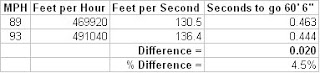 I get two one-hundreths of a second difference. It's certainly possible that is significant. But it seems equally possible that there are factors that matter more, like control or movement or the ability to change speeds.
But we don't obsess about these as much because we can't, and that's because they're not as measurable. But they may be twice as important.
Sunday, April 27, 2008
What's Not Working - The Offense
 Last year we watched the Twins struggle all year because of an anemic offense. The bats finished third to last in the American League in runs scored (718), and they might have been lucky to finish that high considering that they were second to last in OPS (On-base Plus Slugging). New General Manager Bill Smith responded by overhauling the offense, replacing five of the nine lineup spots with new players.
The result? Would you believe it's worse? As of today, the offense ranks second to last in the American League in runs scored. And their OPS is actually 57 points worse than it was last year. Five of the positions in the lineup rank among the worst in the league at their position:
Right Field – 628 OPS ranks 11th in the AL
Michael Cuddyer has been hurt, so 1/3 of these at-bats went to Denard Span, and while Span might develop into a decent option in center field, he can’t provide the production of a bopper that typically mans right field. It’s also worth noting that while Jason Kubel (who got another 1/3 of the at-bats here) flashed some power in a hot start, he limps into this homestand with a discouraging .259 batting average and a gut-wrenching .281 On-base Percentage (OBP). The only guy who walks less than him with that many at-bats is….
Center Field – 639 OPS ranks 12th in the AL
The popular wisdom after Carlos Gomez remarkable first week with the Twins was that he would struggle at times this season, but he was just such a weapon that he had to be on the roster. We were mostly right. He’s struggling. And he’s a weapon. We’re just not sure for which team.
Michael Cuddyer has been hurt, so 1/3 of these at-bats went to Denard Span, and while Span might develop into a decent option in center field, he can’t provide the production of a bopper that typically mans right field. It’s also worth noting that while Jason Kubel (who got another 1/3 of the at-bats here) flashed some power in a hot start, he limps into this homestand with a discouraging .259 batting average and a gut-wrenching .281 On-base Percentage (OBP). The only guy who walks less than him with that many at-bats is….
Center Field – 639 OPS ranks 12th in the AL
The popular wisdom after Carlos Gomez remarkable first week with the Twins was that he would struggle at times this season, but he was just such a weapon that he had to be on the roster. We were mostly right. He’s struggling. And he’s a weapon. We’re just not sure for which team.
In 94 AB this season, Gomez has just 2(!) walks, which is why his OBP is just .271. For some context, the average OBP in the AL is .334. The median team OBP of a lead-off hitter is .351. No team has finished with an OBP lower than .286 from their lead-off hitters in this century. This isn’t just bad. This has a chance to be historically bad.
Shortstop – 523 OPS ranks 12th in the AL
To be fair, the Twins basically punted on this position offensively the minute they signed Adam Everett. He’s never been anywhere close to productive offensively but was supposed to be a defensive whiz. With Everett hurt, the at-bats have basically been split between Matt Tolbert and Nick Punto:
Matt Tolbert - 33 AB - 706 OPS
To be fair, the Twins basically punted on this position offensively the minute they signed Adam Everett. He’s never been anywhere close to productive offensively but was supposed to be a defensive whiz. With Everett hurt, the at-bats have basically been split between Matt Tolbert and Nick Punto:
Matt Tolbert - 33 AB - 706 OPS
Adam Everett - 27 AB - 437 OP
Nick Punto - 24 AB - 367 OPS
April is hardly the time to panic. But when it is time to panic, this looks like a pretty good place to consider a change.
April is hardly the time to panic. But when it is time to panic, this looks like a pretty good place to consider a change.
Third Base – 618 OPS ranks 14th in the AL
Not much is going according to plan for Mike Lamb so far this year. He was wooed by the Twins with promises of getting a chance to bat more versus left-handed pitchers, but so far only had 13 at-bats against them. And he traditionally feasts on right-handed pitchers, but is hitting just .246 against them with very little power. Lamb has had months like this – last May his OPS was just 598 – but it sure would be nice if it didn’t happen in his first month of a multi-year contract with a new team.
Not much is going according to plan for Mike Lamb so far this year. He was wooed by the Twins with promises of getting a chance to bat more versus left-handed pitchers, but so far only had 13 at-bats against them. And he traditionally feasts on right-handed pitchers, but is hitting just .246 against them with very little power. Lamb has had months like this – last May his OPS was just 598 – but it sure would be nice if it didn’t happen in his first month of a multi-year contract with a new team.
Left Field – 600 OPS ranks 14th in the AL
The Twins biggest offseason acquisition has been their biggest disappointment so far. It looks like Delmon Young is trying to work on driving the ball to all fields and control the strike zone, which would be great if it was working. Instead, he’s striking out just as much, walking just as little, hitting 30 points below his career batting average and slugging 100 points worse. And most of that damage has been inflicted immediately following Joe Mauer and Justin Morneau in the lineup.
The Twins biggest offseason acquisition has been their biggest disappointment so far. It looks like Delmon Young is trying to work on driving the ball to all fields and control the strike zone, which would be great if it was working. Instead, he’s striking out just as much, walking just as little, hitting 30 points below his career batting average and slugging 100 points worse. And most of that damage has been inflicted immediately following Joe Mauer and Justin Morneau in the lineup.
The good news is that it sure looks like he’s trying to improve, and at 22 years old, he’s got a good chance of eventually making the adjustment that could lead to stardom. But that sure isn’t happening this month, and recently manager Ron Gardenhire has moved him lower in the lineup.
Sunday, April 13, 2008
On Nick Blackburn and Playing Possum
"For a baseball fan to fail to see that strikeout rates are closely tied to career length, I would argue, is very much like a basketball fan failing to notice that basketball players tend to be tall."
For the first Dugout Splinters of the year, I named ten Twins players I am excited to watch develop this year. And now, two weeks into the season, they almost all rank behind a guy who's pitching tonight. And he wasn't anywhere on the list. And the reason why I'm excited has to do with James' quote above.
The reason Nick Blackburn didn't make that first list was also because of that quote. Blackburn simply didn't show the good in the minors, where "goods" is described as a high strikeout rate. The Twins other young pitchers intrigued me for exactly the opposite reason. But Blackburn wasn't like the others:
- Bill James in The New Bill James Historical Baseball Abstract
For the first Dugout Splinters of the year, I named ten Twins players I am excited to watch develop this year. And now, two weeks into the season, they almost all rank behind a guy who's pitching tonight. And he wasn't anywhere on the list. And the reason why I'm excited has to do with James' quote above.
The reason Nick Blackburn didn't make that first list was also because of that quote. Blackburn simply didn't show the good in the minors, where "goods" is described as a high strikeout rate. The Twins other young pitchers intrigued me for exactly the opposite reason. But Blackburn wasn't like the others:

A K/9IP (strikeout rate) of 6 is about average in the majors, and it's a little higher in the minors. All the other young studs had some very good strikeout rates - some obscenely good. This is why I was so optimistic about the Twins young rotation developing into something special as the year went along. And, obviously, so far, so good.
But Blackburn seemed likely to be the guy who didn't stick around for long. It was certainly possible that he would have a few good starts, and maybe even stick around for a year or so. Old timers like me will remember Twins starter Allen "Little Franky" Anderson, who won the ERA championship in 1988 in his first full year in the majors. He also struck out just 83 batters in 202.1 innings. He had another good year in 1989, lost 18 games in 1990, and played his last major league game in 1991.
So it isn't surprising that Blackburn, who the coaching staff praises as a polished pitcher, is having early success. That happens even with low strikout pitchers. What's surprising is that so far, Blackburn hasn't been a low strikeout pitcher:

By comparison, Blackurns K/9IP last year in AAA-Rochester was 4.64. It's rare to see a pitcher's strikeout rate go up when they jump from AAA to the majors. It's virtually unheard of for a strikeout rate to jump this much.
Small sample size, you say? Well, obviously. But that's the first reason why this is so compelling to watch. Because if you're looking at a pitcher's early results, and you're going to pull one stat that is a decent indicator on whether that success will last, strikeout rate is usually it. For instance, if your closer is scuffling a bit and you notice that he's only struck out just two guys in his first nine innings, odds are it's because he's hiding an injury. Strikeout rate is a hard thing to fake.
But the second reason I'm compelled to watch is because of what I saw in his last start against the White Sox. Blackburn seemed to be striking out the most dangerous White Sox batters, almost as if he was truly pitching to contact for those hitters that were less likely to hurt him. And saving the Ks for the moments it meant the most.
In the first inning, that also meant striking players out exactly when he needed to. Three batters into that inning, the White Sox had one run in, no outs, and runners on first and second base. Blackburn struck out Paul Konerko and Jermaine Dye consecutively before getting a ground ball to shortstop (from AJ Pierzynski) to end the inning.
The heart of the order was back up in the third inning, when Blackburn struck out Jim Thome and Konerko to start that inning. And in the fourth, he struck out Thome again to end another scoring threat.
What struck me about this was that I'm watching a guy who shouldn't be striking people out, and I'm wondering why his strikeout rate is shooting upward. And then he surprises me even more by recording those punchouts in critical moments against some of the opposing team's best hitters. And I can't help but wonder, can a guy really play possum through a six-year minor league career, and then flash the goods when his team, and his career, needs it the most?
I doubt it. But I damn well am going to watch it.
Subscribe to:
Comments (Atom)

 Posts
Posts


